
Lionel O Gauge Train Set Setup: From Box to Bullet-Proof Railroad
Posted by William Jeffries on 31st Dec 2025
Order by phone: 763-231-7847
Free Shipping On Orders Over $100!
If you are already registered, please log in.
Create your account and enjoy a new shopping experience.
Create A New AccountPosted by William Jeffries on 31st Dec 2025
I still remember tearing into my first Lionel set back in 1989. The box promised magic. What I got was a tangle of wires, a locomotive that stalled on every curve, and a growing suspicion that I'd missed something obvious. Thirty-five years later, I've learned that most setup frustrations trace back to a handful of overlooked details. Let me save you the headaches I collected.
Here's where things go wrong before the box even opens. Lionel sells two very different product lines with confusingly similar names, and mixing them up leads to returns, frustration, and wasted afternoons.
Ready-to-Play sets run on batteries and use a wider, proprietary plastic track system scaled at approximately 1:24. They're toys designed for kids eight and up. Nothing wrong with that. But here's the catch: this exclusive track won't connect to anything else Lionel makes. Not O gauge. Not O-27. Not FasTrack. Nothing.
Ready-to-Run sets are the real deal. These are AC-powered, 1:48 scale O gauge trains that form the foundation of an expandable railroad. They use genuine O gauge track with 1.25 inches between the outer rails. They work with all the accessories, all the track systems, all the locomotives you'll eventually buy.
Before you hand over your credit card, check two things: track gauge and power type. If it says battery-powered with that wider plastic track, you're looking at Ready-to-Play. If it mentions a CW-80 transformer or wall-pack power supply with standard O gauge track, you've found Ready-to-Run.
All Lionel O gauge track shares that same 1.25-inch gauge between the outer rails. Your Pennsylvania K4 will physically ride on any of them. But reliable operation depends on curve radius, rail profile, and how these systems connect.
Most contemporary starter sets include FasTrack. I use it on my own layout, and for good reason. The integrated plastic roadbed with molded ballast and ties sits flat on any surface, including carpet. A patented locking mechanism and center half-pin make assembly almost foolproof.
What sold me: power terminals hide under every section. You can tap into power anywhere without hunting for a lock-on. The patented locking system keeps connections secure.
FasTrack curves measure by diameter. O-36 means a 36-inch diameter circle. Most starter sets include O-36 curves, which handle a broad range of locomotives. Larger engines need O-72 or wider.
My grandfather ran Lionel tubular track. His layout still works. That tells you something about durability.
The distinction between O and O-27 trips up newcomers. O-27 track sits 1/8 inch lower with a smaller rail profile and tighter 27-inch diameter curves. Many larger locomotives will derail on O-27 curves. The pins differ too: O gauge uses thicker pins than O-27.
Can you mix them? Yes, with adapter pins and shims to compensate for that height difference. But plan carefully.
Lionel makes a 5-inch FasTrack transition piece that bridges to tubular track. GarGraves track mates to O gauge tubular using their #801 pins. Atlas O track matches O-27 height and connects using their tubular transition joiners.
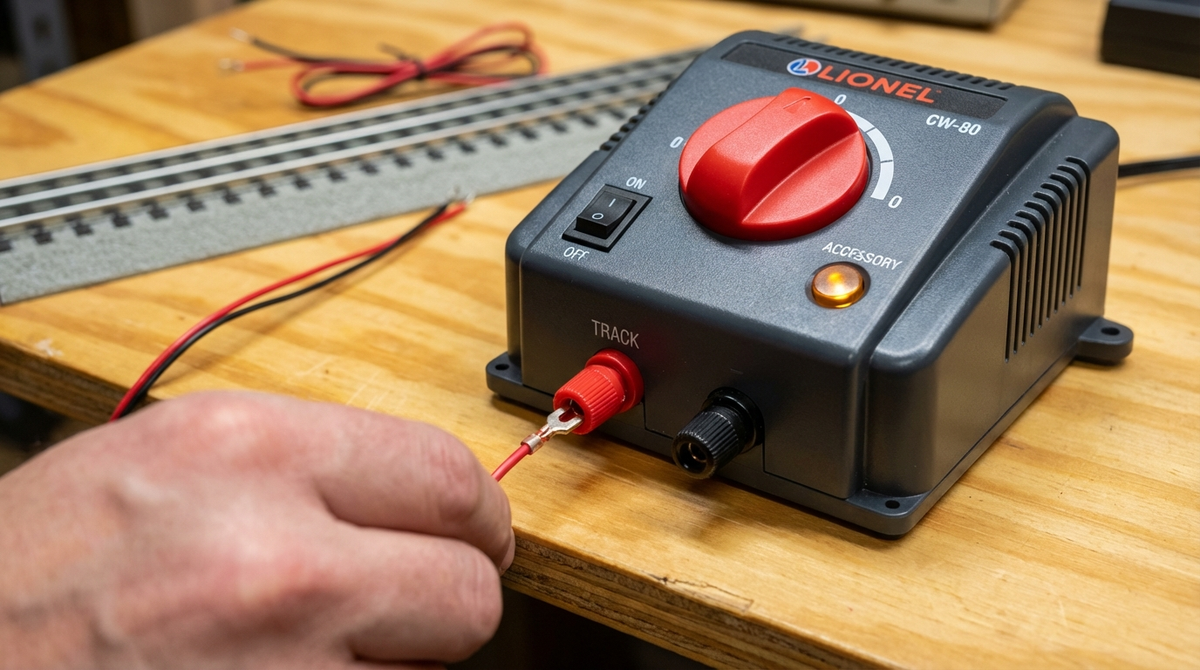
The CW-80 transformer ships with many starter sets. I ran mine for years. It works. But knowing its limits prevents headaches when you expand.
The CW-80 delivers 80 watts and 5 amps of alternating current. That handles a single locomotive and several accessories on a modest layout. The fold-back current limit kicks in above 5 amps, gradually reducing power until a persistent short triggers complete shutdown after 3 seconds.
Here's what they don't tell you: the CW-80 produces a chopped sine wave. Standard multimeters give inaccurate readings. You need a true-RMS meter to measure actual voltage. I learned this after chasing phantom power problems for weeks.
If you're running dual-motor diesels with smoke units, planning a second loop, or adding power-hungry accessories, look at the PowerHouse 180 or GW-180. Both deliver 10 amps and 180 watts with the same fold-back protection.
For serious operators, the Lionel ZW-L offers 620 watts across four channels with dynamic power sharing. The MTH Z-4000 provides pure sine wave output at 400 watts with fast-acting resettable breakers.
Modern Lionel sets offer three tiers of control. Understanding them helps you buy equipment you won't outgrow.
LionChief locomotives respond to a dedicated handheld remote or the free Bluetooth smartphone app. Track runs at fixed voltage. The locomotive handles speed control internally.
The Bluetooth 5.0 pairing works fast. I've seen success rates above 96% within seconds. The LionChief Universal Remote controls any LionChief locomotive, but verify firmware version 1.3 or later using the LionChief U Remote Updater app. Older firmware can brick remotes during updates.
TrainMaster Command Control gives you 32 speed steps and lets you run multiple locomotives on the same track simultaneously. The track carries constant 18-volt power while radio commands control each engine.
Legacy expands to 200 speed steps with advanced sound control, speed graphs, and full layout automation through the Layout Control System. The Base3 bridges all Lionel control types, including Bluetooth LionChief, making it the unifying hub for mixed fleets.
A word about grounding: most Legacy and TMCC signal problems trace to inadequate ground planes, not electronics failures. The 455 kHz command signal uses your household earth ground as a broadcast antenna. Run an 18 AWG ground wire parallel to elevated track sections, about 6-9 inches above, to maintain signal strength.
Here's where most layouts fail. Relying on rail joiners alone for electrical continuity guarantees voltage drops, stalls, and flickering lights. I've seen it dozens of times at club layouts and home railroads alike.
Think of wiring like plumbing. Your main bus wires are the pipes running from the transformer. Use 12-14 AWG stranded copper for most layouts. The CW-80 manual specifies 18-gauge minimum for track connections, 16-gauge for larger layouts.
Feeders are the short drops connecting your bus to the track. Use 18-22 AWG stranded wire and keep feeders under 12 inches. Install feeders every 3-6 feet for best results. On a 12x8 FasTrack loop, adding feeders every 10 feet can raise track voltage at the far end from 15.2V to 17.8V. That improvement beats swapping transformers.
Solder feeders directly to the rail web for permanent layouts. For temporary setups, terminal blocks and insulation displacement connectors work well.
Complex layouts benefit from electrically isolated blocks. These let you control multiple trains independently, prevent one short from killing the whole railroad, and simplify troubleshooting.
Create blocks using insulated track pins for tubular track or FasTrack insulated sections. Insulate only the center rail. Keep the outside rails continuous for TMCC and Legacy ground signals.
Running two transformers with shared common grounds but opposite phases creates voltage spikes exceeding 38 volts. That destroys command control electronics instantly.
Before connecting multiple transformers, perform the 18-volt lamp test. Connect the common terminals together. Wire an 18-volt bulb between the hot terminals. Power on both transformers. Dim or dark bulb means in phase. Bright bulb means out of phase. Reverse one transformer's wall plug and test again.
My layout sits in a finished basement. My wife works upstairs. Noise matters.
L-girder construction uses 1x4s with a 1x2 flange to create lightweight, strong supports. A single 1x4 L-girder spans up to 13 feet, opening space underneath for storage or duckunders.
Open-grid box frames resemble house framing with joists spaced 16-24 inches apart. They provide finished edges and work well for modular layouts that need frequent disassembly.
FasTrack's hollow plastic roadbed acts like a sounding board, amplifying every click and clatter. Some solutions I've tested:
Starter sets sometimes advertise carpet operation. Lionel's own manuals discourage it. Carpet fibers get drawn into locomotive gears and axles, causing binding. Transformers placed on carpet can overheat from blocked ventilation. Use a hard floor or dedicated table.
You've unboxed everything. Now what? Here's the sequence I follow with every new set:
That first oval feels limiting after a week. Here's how to grow.
The FasTrack O-36 remote switches drop right into a starter layout. Power them from your transformer's accessory terminals using the AUX IN connections on the switch base. The non-derailing feature automatically throws the switch when a train approaches from the diverging route.
For automation, Lionel's ASC2 Accessory Switch Controller handles up to four switches or eight accessories. The BPC2 Block Power Controller manages power to eight track blocks. Both integrate with Legacy and the CAB3 app for programmed routes and automated scenes.
Power accessories from a separate transformer independent of track power. This prevents accessories from stealing power from your locomotives. You can simplify wiring by connecting all transformer grounds together, but remember: all transformers must be in phase.
A well-maintained layout runs trouble-free. A neglected one fights you at every session.
Dirty track causes 90% of running problems. Wipe rails monthly with isopropyl alcohol and a lint-free cloth. For stubborn oxidation, use a track cleaning eraser or Brite Boy, then wipe clean. Never use sandpaper. It scratches the tinplating and invites rust.
Every 25 hours of operation, lubricate axles and gears following the manufacturer's guidelines. Clean wheels and pickup rollers with alcohol. Inspect traction tires for wear. The tires slip onto grooves in the drive wheels and replace easily with a small screwdriver.
A true-RMS multimeter reads AC voltage accurately from chopped-wave transformers. A voltmeter car rolling around your layout reveals dead spots and voltage drops in real time. For MTH DCS users, the track signal meter quantifies signal strength on a 1-10 scale.
We work with household electricity and chemical products. Sensible precautions protect equipment and people.
Transformers must plug into properly grounded outlets. Legacy and TMCC require earth ground for signal transmission. Modern electrical code calls for GFCI protection in basements and garages.
Never bypass or increase transformer fuse ratings. The fold-back protection exists to prevent fires and equipment damage.
Safety data sheets classify smoke fluids as potential skin and eye irritants. Some formulations are harmful if swallowed or inhaled. Operate smoke units in well-ventilated areas. Store fluid below 113°F in tightly closed containers. Wipe spills promptly.
Lionel's manuals state electric train sets are not recommended for children under fourteen. Never leave an operating layout unattended. A stalled locomotive or blocked accessory can overheat.
The Lionel community runs deep and moves fast.
The O Gauge Railroading Forum delivers solved answers to complex wiring questions in hours, not days. The Model Train Forum welcomes beginners and provides quick help from experienced modelers.
For video tutorials, Eric's Trains covers product reviews and layout techniques. Classic Toy Trains magazine offers depth on restoration and operations. Official manuals and parts diagrams are free at lionelsupport.com.
One caution: nearly 28% of YouTube how-to videos contradict official manuals. When advice conflicts with manufacturer documentation, trust the manual. Your warranty depends on it.
I've been at this for thirty-five years. My PRR layout has survived three houses, two basement floods, and one suspicious cat. It runs better now than when I started because I learned to respect the fundamentals.
Good wiring matters more than expensive transformers. Track cleanliness beats track quantity. Phasing saves equipment. And when something doesn't work, the answer usually lives in a manual, a forum thread, or a quiet evening tracing wires with a multimeter.
Your Lionel O gauge train set can become a railroad that outlasts you. It starts with doing the setup right.
✨ Complete Your Layout: Explore our wide selection of Photo Real buildings, diorama backdrops, detail parts, and accessories in every popular scale.
✨ Unmatched Realism: From chrome detailing products to neon lighting kits – every piece is designed to make your miniature world come alive.