
Best N Scale Locomotives for Beginners: A Data-Backed Buying Guide for 2025
Posted by William Jeffries on 30th Dec 2025
Order by phone: 763-231-7847
Free Shipping On Orders Over $100!
If you are already registered, please log in.
Create your account and enjoy a new shopping experience.
Create A New AccountPosted by William Jeffries on 30th Dec 2025
I bought my first N scale locomotive in 1989, and I chose poorly. The thing stuttered at slow speeds, stalled on every turnout, and eventually developed that dreaded "clicking" noise that signals a cracked gear. Three months of frustration later, it sat in a box while I questioned whether this hobby was for me.
Thirty-five years and one career at the Railroad Museum of Pennsylvania later, I've learned that your first locomotive purchase is the single most important decision you'll make in N scale. Get it right, and you'll build confidence with every smooth-running session. Get it wrong, and you might abandon the hobby before you ever really start.
The good news? The data on what works has never been clearer. Let me walk you through exactly what to buy, what to avoid, and why the difference matters so much.
If you ask experienced N scalers for a beginner locomotive recommendation, you'll hear one name more than any other: Kato. This isn't brand loyalty talking. It's what happens when a manufacturer consistently delivers locomotives that work right out of the box.
I've tested dozens of Kato models over the years, and the performance data backs up the reputation. According to detailed reviews from Spookshow.net's locomotive encyclopedia, five out of six common Kato diesels earn straight "A" grades for reliability and performance. The EMD NW2 switcher, the SD70M, and the ES44AC all demonstrate exceptional slow-speed control and can pull 12-30 cars without breaking a sweat.
What makes Kato different? Their locomotives feature a powerful five-pole motor with dual brass flywheels. In plain English, that means smooth acceleration from a dead stop and steady running at crawl speeds. When you're switching cars in a yard or pulling a passenger consist through a station, that smoothness transforms the experience from frustrating to genuinely enjoyable.
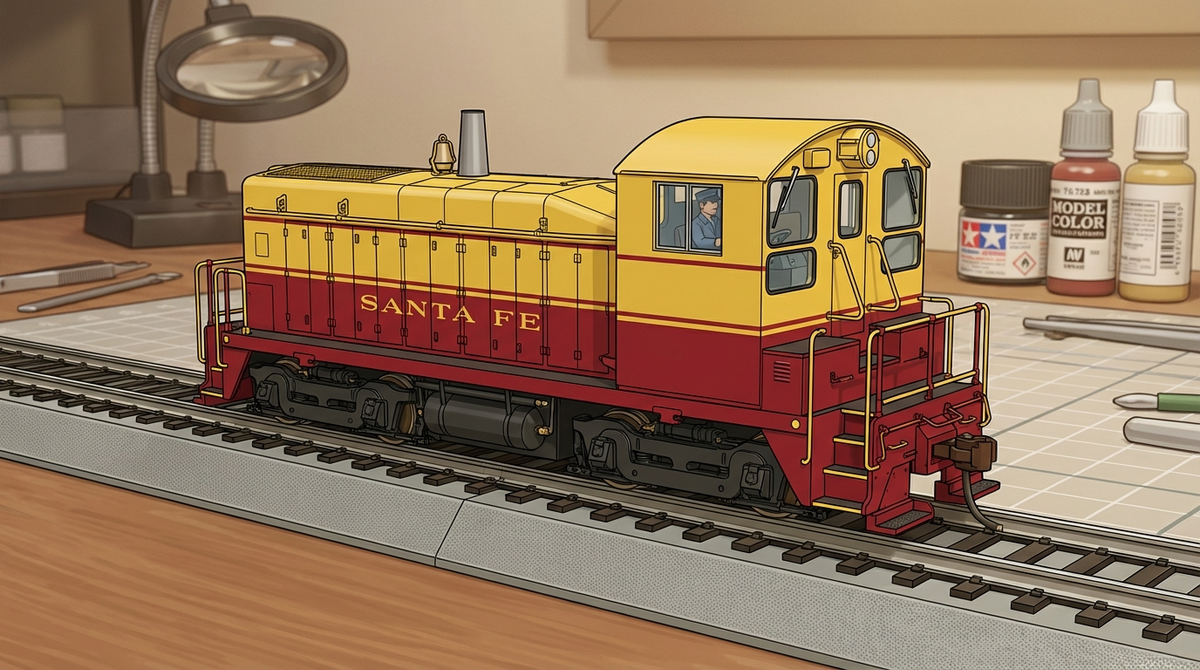
For freight operations, the EMD F7 remains a classic choice. Available in starter sets with Santa Fe Bluebonnet paint, it's powered by a five-pole motor and earns that "A" grade for reliability. Modern diesels like the GE ES44AC and EMD SD70ACe offer impressive pulling power with the same build quality.
The GE P42 Genesis and ALC-42 Charger are exceptional choices for Amtrak fans. Both are DCC-friendly with specific drop-in decoder recommendations, and they'll pull long passenger consists without complaint.
For switching and small layouts, the EMD NW2 is a small powerhouse. Don't let its size fool you. This thing has phenomenal low-speed performance and surprising pulling strength.
Here's where I have to be honest about Kato's weakness: their warranty is only 60 days. That's significantly shorter than competitors like Atlas and Bachmann, who offer a full year. While Kato defects are rare, that short window puts the burden on you to test thoroughly right after purchase. I'll explain how to do that later.
Atlas stands as a strong second choice, but here's where beginners need to be careful. Not all Atlas locomotives are created equal. The brand has gone through multiple tooling generations, and the difference between a 1985 Atlas and a 2024 Atlas is like comparing a flip phone to a smartphone.
Post-2006 "China-era" models from Atlas Master Line are excellent performers. The "Silver" series is DCC-ready with a speaker pre-installed, while the "Gold" series comes with a high-quality ESU or Soundtraxx decoder factory-installed. A 2024 Atlas GP38-2 Gold model I tested demonstrated flawless running on Code 55 track and excellent slow-speed creep.
The GP38-2 and GP40-2 are workhorse models with numerous production runs. Versions made in China (post-1996) earn "A" grades for performance. The latest 2025+ runs feature ditch lights and ESU sound options.
Atlas recently announced the acquisition of Micro-Trains Line, which signals their commitment to the N scale market. The combined resources should mean even better product availability going forward.
Stay away from older Atlas models made in Austria by Roco during the 1970s and 80s. Community consensus calls them "junk" due to poor motors and mechanics. Also watch out for pre-1990 "yellow-box" Atlas locomotives, which have inferior build quality compared to modern runs.
I understand the appeal of a $140 Bachmann Yard Boss set. When you're just starting out, spending less feels smart. But here's what the price tag doesn't tell you: over 40% of users in forum discussions report issues with derailments, poor-quality plastic wheels, or unreliable couplers within the first 60 days of ownership.
Let me break down the real cost of a budget set. You'll likely need to replace the plastic wheelsets with metal ones (about $30-40). The couplers often need upgrading to Micro-Trains knuckle couplers ($20-30). And if the turnouts in your E-Z Track keep causing derailments, you're looking at replacement track too. Add it up, and you've spent as much as you would have on a quality Kato set, except now you've also spent hours troubleshooting problems.
I'm not saying Bachmann makes nothing worthwhile. Their newer models, particularly from the Spectrum line and post-2018 redesigned chassis, have improved significantly. The EMD GP40 and SD40-2 with Econami sound decoders offer decent value if you want factory-installed sound on a budget.
The new Siemens Charger and SC-44 locomotives feature TCS WOWSound decoders with Keep-Alive devices, rivaling premium brands. And the Spectrum 2-8-0 Consolidation steam engine is widely considered a "gold standard" for N scale steam.
The key is knowing which Bachmann to buy. Avoid older models in white boxes and anything with the notorious "split gear" problem that plagues pre-2010 production.
Factory-installed sound typically adds $100 to $150 to a locomotive's price. The immersive experience of realistic engine sounds, horns, and bells is genuinely appealing. But sound comes with trade-offs that matter for beginners.
Here's the physics problem: fitting a sound decoder, speaker, and capacitor pack into an N scale shell requires space. Manufacturers often create that space by using a smaller weight or milling the metal chassis. Less weight means less tractive effort. A Broadway Limited SD40-2 with sound pulls about 24 cars, while a comparable silent Kato pulls around 30. That's a 20% reduction in pulling power.
If your layout has grades over 2%, that difference becomes critical. A locomotive that hauls 20 cars on flat track might struggle with six on a climb.
Start with a silent or DCC-ready locomotive. Learn the basics of operation, track maintenance, and smooth running. Once you're confident, you can add sound to a second locomotive or upgrade your first one if you're feeling ambitious.
If you absolutely must have sound from day one, buy a locomotive with high-quality sound factory-installed rather than attempting a DIY installation. Atlas Master Gold, Broadway Limited Paragon4, or newer Bachmann models with TCS WOWSound are solid choices. The components are optimized for the specific model, and you avoid the complexity of sourcing tiny speakers and enclosures.
The fear of DCC conversion stops a lot of beginners from buying quality locomotives. I get it. The terminology sounds technical, and the idea of opening up a new locomotive feels risky. But here's the reality: most modern N scale locomotives from Kato and Atlas are designed for simple, solder-free decoder installation.
The process takes about 15 minutes. You remove a few screws, pop off the shell, swap out a factory light board for a drop-in decoder board, and reassemble. No soldering. No modifications. If you can change a watch battery, you can install a DCC decoder.
Decoders from Digitrax, TCS, and ESU cost between $33 and $40 for non-sound versions. Here's a quick compatibility guide for popular beginner locomotives:
For Kato SD40-2, SD70ACe, and GG1 models, the Digitrax DN163K1C, TCS K1D4-NC, or ESU 59741 all work. For Kato P42 Genesis and E8/E9, look for the TCS K0D8-A or ESU 59941. The Kato NW2 switcher takes the Digitrax DN123K3 or TCS K3D3.
For Atlas GP40-2 and similar models, the Digitrax DN147A0, TCS AMD4, or ESU 59751 are your options.
Once your decoder is installed, a few simple adjustments make a huge difference. Set CV2 (V-Start) to 1-5 for a gentle start instead of a jackrabbit launch. Set CV3 (Acceleration Momentum) to 10-20 for realistic gradual speed increases. Set CV4 (Deceleration Momentum) to 10-20 so your trains coast to a stop like the real thing.
Free software like JMRI provides a graphical interface for these adjustments if entering numbers manually feels intimidating.
The track system you start with matters more than most beginners realize. I've seen countless new modelers blame their locomotives for problems that were actually caused by poor track connections or unreliable turnouts.
Kato Unitrack uses a patented Unijoiner connection system that's virtually foolproof. The nickel silver rail maintains excellent electrical conductivity, and the turnouts are considered "bulletproof" by community consensus. A typical Kato starter set runs about $290 and includes a quality locomotive, rolling stock, an oval of track, and a smooth DC power pack.
Bachmann E-Z Track costs less upfront, but the snap-fit connections can loosen over time. The turnouts are prone to derailments, and the buried switch motors are difficult to service when they fail. Forum discussions are filled with complaints about under-gauge rails, wide guardrails, and power loss.
If you're buying a starter set and want to build on it, the extra $150 for Kato will save you money and frustration in the long run.
In N scale, where tolerances are measured in thousandths of an inch, a little preventive maintenance goes a long way. Twenty minutes a month can prevent most of the stuttering, stalling, and flickering that frustrate beginners.
Dirty wheels are the number one cause of poor performance. The easiest cleaning method: dampen a paper towel with 91% or higher isopropyl alcohol and lay it over a powered section of track. Hold the locomotive so one truck is on clean rail and the other is on the paper towel. The powered wheels spin on the towel, cleaning themselves. Rotate to clean all wheels.
For the metal pickup wipers inside the trucks, use a soft brush or foam swab to remove built-up grime. Specialized contact cleaner works for stubborn oxidation, but avoid abrasive tools that can scratch the contacts.
Manufacturers often over-lubricate from the factory, and excess oil attracts dirt that clogs gears. The only points that need lubricant are the gear towers and motor bearings. Use plastic-compatible hobby-grade products like LaBelle #108 for bearings and LaBelle #106 with PTFE for worm gears. Apply with a toothpick tip. A single tiny drop is enough.
The used market offers real value, but it's also where broken dreams go to find new victims. That gorgeous vintage locomotive on eBay might run like a charm. Or it might have split gears that will strand you mid-layout.
Before bidding on anything, check Spookshow.net's N Scale Locomotive Encyclopedia. This free resource grades nearly every North American N scale model ever produced. Avoid anything rated "C" or lower.
Most pre-2010 Bachmann steam and diesel locomotives suffer from split or cracked axle gears. You'll hear a clicking noise, or wheels will wobble and fall out. Life-Like Proto 2000 SD45 and SD60 models have the same problem.
The Atlas Samhongsa USRA 2-8-8-2 Mallet from 1994 is a notorious "dud" with running gear that falls off, poor pickup, and constant derailments. Just avoid it entirely.
Any model made before 1990 might have "pizza cutter" wheel flanges that are too deep and thick for modern Code 55 track. They'll bump on the ties and derail constantly.
Turn the locomotive upside down. Try to rotate each wheel with your thumb. If a wheel spins freely on its axle while others don't, the gear is split. That's a deal-breaker. Check for visible dirt or corrosion on the wheels. Look for missing handrails, horns, or detail parts that will be expensive to replace.
Your retailer choice determines your safety net when something goes wrong. A good return policy is worth more than a few dollars saved.
Trainz stands out for offering pre-paid return shipping labels, significantly lowering the risk for beginners. Their standard return window is 30 days, extended to 60 for members. ModelTrainStuff and TrainWorld offer similar 30-day windows but may refer DCC problems directly to the manufacturer, which adds time and hassle.
Speaking of manufacturers: Atlas offers a one-year warranty, Bachmann provides a lifetime limited warranty (with service fees after the first year), and Kato's 60-day policy is the shortest of the major brands.
Given these limited windows, test any new locomotive thoroughly right away. Run it on a simple oval for at least an hour in each direction. Vary speeds from slow to fast. Run it through all your turnouts repeatedly. Attach a short train and test it on any grades. This burn-in reveals most manufacturing defects while your return option is still open.
If you're modeling British prototypes, be aware that UK "N gauge" uses a 1:148 scale rather than the 1:160 standard used in the US. That makes British locomotives about 8% larger than their American counterparts, even though they run on the same 9mm track.
Mixing UK and US models in the same train isn't recommended due to visual and coupler-height discrepancies. The good news: manufacturers like Graham Farish and Dapol are increasingly using NEM 355 coupler pockets and Next18 DCC sockets, making it easier to standardize your fleet if you want operational flexibility.
Your first N scale locomotive sets the tone for everything that follows. A Kato locomotive with an "A" grade from Spookshow.net will run smoothly for decades with basic maintenance. A bargain-bin engine with split gears will teach you nothing except frustration.
Spend a little more upfront. Buy from a retailer with a solid return policy. Test your locomotive thoroughly in the first week. And remember that DCC upgrades are easier than they look.
I wasted three months on that first locomotive in 1989. You don't have to. The data exists. The reliable models are well-documented. All you need to do is make an informed choice, and you'll be running trains instead of troubleshooting problems.
? Complete Your Layout: Explore our wide selection of Photo Real buildings, diorama backdrops, detail parts, and accessories in every popular scale.
✨ Unmatched Realism: From chrome detailing products to neon lighting kits – every piece is designed to make your miniature world come alive.