
Z Scale Trains Pros and Cons: The Honest Guide for Space-Starved Modelers
Posted by Tamara Brooks on 31st Dec 2025
Order by phone: 763-231-7847
Free Shipping On Orders Over $100!
If you are already registered, please log in.
Create your account and enjoy a new shopping experience.
Create A New AccountPosted by Tamara Brooks on 31st Dec 2025
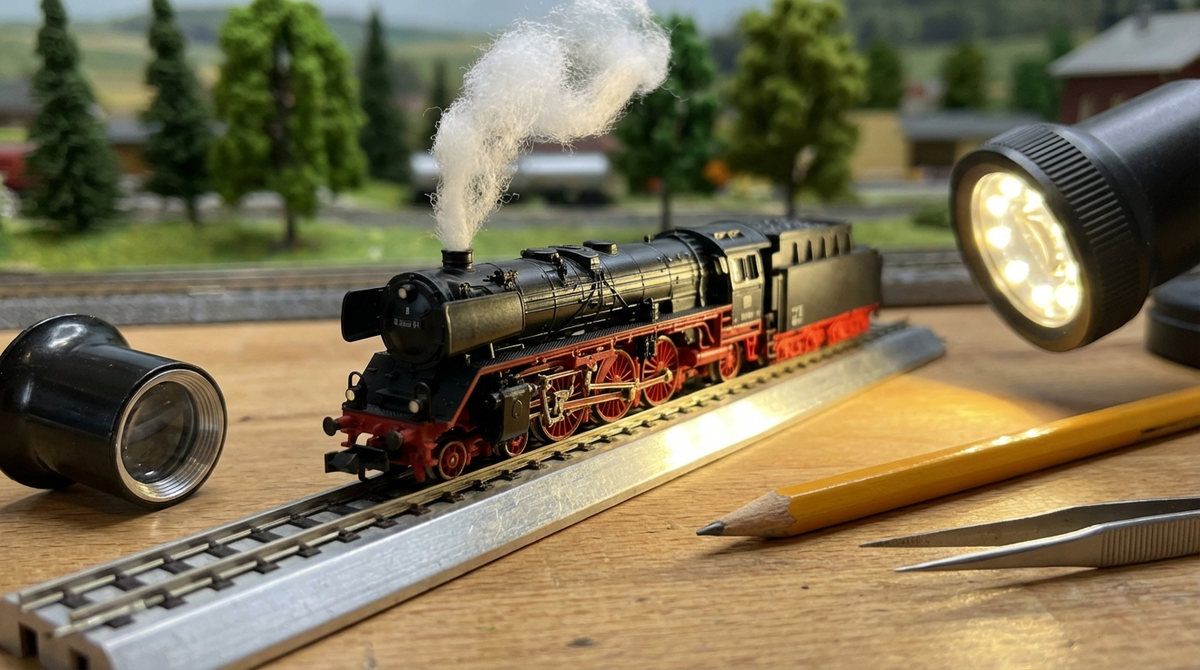
I model in N scale. There, I said it. So why am I writing about Z? Because every time I meet a modeler crammed into a 400-square-foot apartment, staring longingly at photos of sweeping mainlines through mountain scenery, the same question comes up: What about Z scale?
And honestly? It's a fair question. When you're working with a space that barely fits a couch, the idea of running 100-car trains through dramatic scenery on something the size of a coffee table sounds like magic. But Z scale trains pros and cons need to be weighed carefully before you commit to the world's smallest commercially produced model railway scale.
Let me walk you through what I've learned from talking to Z scalers, handling the equipment, and honestly assessing whether the tiny train life is right for you.
Z scale runs at a 1:220 ratio with a 6.5mm track gauge. Märklin introduced it in 1972 and gave it the last letter of the alphabet because they figured nothing smaller could ever be commercially viable. They weren't wrong about that.
The NMRA Standard S-1.2 defines the track gauge tolerance between 6.53mm and 6.86mm, while S-4.2 covers wheel specifications. European modelers follow NEM standards from MOROP, which also specify 1:220 at 6.5mm gauge. These standards mean you can run an American Z Line locomotive on Rokuhan track with Micro-Trains rolling stock. Interoperability matters.
Here's the math that makes people's eyes light up: a layout that needs a 4'x8' board in HO scale fits on a 2'x4' board in Z scale. That's not marketing fluff. That's geometry.
You can model entire railroad districts, Class I mainlines with prototypical curves, and run trains long enough to actually look like trains. My N scale layout is decent, but Z scalers in similar spaces run circles around me when it comes to scenic scope.
The coffee table layout isn't a gimmick in Z scale. A 24"x48" footprint gives you room for a continuous loop with scenery that tells a story. The trick is planning for 3.5 to 4cm of vertical clearance under any glass top, and hiding your controllers in a drawer.
Some modelers take it further with briefcase layouts measuring just 14"x11". Battery-powered, fully scenic, portable enough to take to shows. Try that with HO.
I've seen Z scale layouts mounted at eye level on walls, functioning more like theatrical scenes than traditional layouts. You can build something eight inches deep that creates the illusion of vast distance using forced perspective techniques. Use smaller-scale items in the background, compress building depths, add a photographic backdrop, and suddenly your tiny shelf becomes a mountain panorama.
This is where I hear the most skepticism from fellow modelers. "Z scale is too finicky." "It never runs right." "You spend more time cleaning than operating."
Some of this is outdated. Some of it is true.
Locomotives in Z scale weigh as little as 20 grams. That's roughly the weight of four nickels. The contact patch between wheel and rail is microscopic. This creates real challenges:
Modern Z scale equipment from manufacturers like AZL and Märklin has improved dramatically. Locomotives with 5-pole or coreless motors achieve smooth, crawling slow-speed performance. But you have to earn that reliability.
Track cleaning isn't optional. The consensus among serious Z scalers is to use non-polar solvents like mineral spirits or DeoxIT D5 rather than isopropyl alcohol. The science is that polar solvents can actually encourage micro-arcing that creates new oxide layers. Track cleaning cars and regular maintenance routines are part of the hobby at this scale.
For wiring, run a power bus beneath your layout and install feeder wires every 2-3 feet. Grades should stay below 2% on straight track and 1.5% on curves for reliable operation with longer trains.
The myth that "there are no North American prototypes" belongs in 1985. American Z Line releases new models twice monthly. The November 2025 acquisition of Micro-Trains by Atlas ensures continued production and innovation for North American modelers.
Rokuhan has expanded into North American prototype territory as well. You can find diesels from GP7s to ES44s, plus a solid selection of freight cars.
That said, I won't pretend Z scale matches N scale for selection. Production runs are small. A "big run" might be 500 units. Limited editions can be as few as 20-60 pieces. Items sell out fast.
If you're modeling a specific, less-common era or railroad, you may face frustration. The structure selection is particularly thin compared to larger scales. This is where 3D printing becomes your friend (but that's a topic for another day).
Z scale has a reputation for being expensive. Let me break down what that actually means.
Yes, individual items cost more. An ES44AC locomotive runs around $176 in Z scale versus $80 in N scale. That's a significant premium for the precision manufacturing and smaller production volumes.
Märklin track and turnouts carry similar premiums. A remote turnout might run $51.95 where N scale equivalents cost less.
Here's where the math gets interesting. Building a complete, scenic layout requires:
For a comparable level of operational complexity, the total project cost approaches parity between scales. The space savings compound across every category.
Z scale items, especially from AZL and Märklin, hold their value well. Limited runs create collector interest. An AZL Brass GS-4 sold for $3,000, and a Challenger went for $5,244. If you're worried about resale value, Z scale performs surprisingly well.
"There's no DCC for Z scale" is pure myth at this point. The miniaturization of electronics has caught up.
The ESU LokPilot 5 Micro measures just 8.0mm x 7.0mm x 2.4mm. It delivers 0.75A motor current, 4-6 amplified functions, RailCom+, ABC braking, and coreless motor support.
Want sound? The ESU LokSound 5 Nano at 15mm x 9.5mm x 3.5mm offers 12 sound channels, 128 Mbit memory, and a 3W amp. ZIMO's MS series provides similar capabilities with excellent coreless motor control.
TCS makes drop-in boards for specific AZL locomotives if you want to skip the soldering.
Installation remains challenging. Most Z scale DCC work involves fine-pitch soldering and fitting components into impossibly tight spaces. Sound quality depends heavily on speaker enclosures, which are severely constrained by available space. Heat dissipation is a genuine concern.
The technology works. The installation requires steady hands and patience.
Modern coreless motors require careful power management. They have low inductance, meaning low-frequency PWM signals can cause physical vibration and motor damage. You need high-frequency PWM of 20 kHz or higher for safe operation.
The Rokuhan RC-02 and RC-03 controllers use appropriate high-frequency output. For DCC, most modern decoders from ESU and ZIMO offer adjustable PWM frequencies in the safe range. Keep track voltage between 9-10V DC for analog and 10-12V for DCC.
Your track choice shapes everything else about your layout. Z scale splits into two camps.
Rokuhan's integrated roadbed system has become the go-to for beginners and modular builders. The snap-together connections provide excellent electrical conductivity. Power-routing frogs work reliably. The system includes turnouts in multiple configurations including #6 and #4 equivalents.
The trade-off? Japanese prototype tie spacing. If you're modeling North American railroads and care about that level of detail, it may bother you.
Märklin sectional and flex track remains the standard for European prototype layouts. Atlas offers Code 55 flex track with North American prototype tie spacing. Peco provides Code 60 flex track popular in European circles.
Traditional track offers more flexibility for custom configurations and allows proper ballasting for a realistic appearance. The trade-off is more skill required in track laying and wiring.
It's possible to combine Rokuhan and traditional track, but requires conversion joiners and careful shimming to match different rail heights. Plan this before you build, not after.
Nobody succeeds in Z scale alone. The community matters more here than in any larger scale.
Z Central Station is the primary English-language forum with over 13,000 posts, photo galleries, and live chats. TrainBoard's Z Scale forum provides another active community. The Buy/Sell Z Scale Model Trains Facebook group is essential for secondary market transactions.
If you want to participate in group layouts at shows, build to a standard. Z-Bend Track dominates North American operations-focused layouts, specifying 24" module width at the interface, 9" and 10" track placement from centerline, and DB-25 electrical connectors.
T-TRAK-Z offers a simpler tabletop standard based on Rokuhan track, perfect for smaller events and home use. The NMRA T-TRAK documentation covers the interface dimensions and electrical conventions using Anderson PowerPoles.
Let's address the elephant in the room. Z scale is small. Really small. Can you actually work with it?
An Optivisor or similar head-mounted magnifier isn't optional. It's mandatory. Most Z scalers use magnification between 2.5x and 10x depending on the task.
Good lighting makes everything easier. LED bench lights reduce eye strain when working under magnification.
Rerailing ramps are your friend. Märklin's 8974, Micro-Trains' 988 00 222, and Rokuhan all make versions that turn frustrating re-railing into a trivial operation.
For coupler work, Micro-Trains' Coupler Assembly Fixture and Height Gauge simplify working with their six-part Magne-Matic couplers.
Build at 50 inches height if possible. This brings details closer to eye level without requiring you to hunch over.
Keep scenes shallow. Reaching across 30 inches to retrieve a derailed car gets old fast. Plan access hatches for any hidden trackwork.
Based on everything I've learned, here's my honest assessment:
The Atlas acquisition of Micro-Trains signals major investment in the scale's future. We can expect more reliable production runs, potential new product development, and better integration between track and rolling stock lines.
Electronics continue shrinking. 3D printing fills catalog gaps. The community grows more sophisticated. For the modeler willing to embrace its demands, Z scale offers something no other scale can: a world in miniature that actually fits in your world.
I'll stick with N scale for my own layout. But I understand the appeal. And if you're staring at a 2'x4' space dreaming of mountain mainlines, Z scale might just be your answer.
✨ Complete Your Layout: Explore our wide selection of Photo Real buildings, diorama backdrops, detail parts, and accessories in every popular scale.
✨ Unmatched Realism: From chrome detailing products to neon lighting kits – every piece is designed to make your miniature world come alive.