
Vintage O Gauge Trains Value: A Railroad Veteran's Guide to What They're Really Worth
Posted by Gerald Hoffmann on 31st Dec 2025
Order by phone: 763-231-7847
Free Shipping On Orders Over $100!
If you are already registered, please log in.
Create your account and enjoy a new shopping experience.
Create A New AccountPosted by Gerald Hoffmann on 31st Dec 2025
I spent 35 years working the real iron for Burlington Northern Santa Fe before retiring, and I can tell you that the vintage O gauge trains value question gets asked at every train meet I attend. Guys walk up to tables with shoeboxes full of their dad's old Lionels, hoping they're sitting on a goldmine. Sometimes they are. Most times? Not so much. The difference between a $300 locomotive and a $3,000 one often comes down to details that aren't obvious unless you know where to look.
After decades of collecting alongside my HO modeling, I've watched this market shift dramatically. What sold for premium prices in 2010 might languish on a dealer's table today, while certain rarities keep climbing. Let me walk you through what actually determines value in 2025, because the online guides only tell part of the story.
Before we talk money, let's clear up something that confuses newcomers. The terms "gauge" and "scale" get tossed around interchangeably, but they mean different things. Gauge is the distance between the rails, while scale refers to how the model compares to the real thing. O gauge runs on track that's 1.25 inches between the outer rails, making it roughly 1:48 scale for American manufacturers.
Now here's where it gets interesting. Both O gauge and O-27 track share that same rail spacing, but O-27 track sits shorter with thinner rails and tighter curves. Marx and early Lionel starter sets used O-27 because it cost less and fit in smaller spaces. A 27-inch diameter circle versus 31 inches doesn't sound like much until you're trying to squeeze a layout under the Christmas tree.
The practical implication? Your smaller O-27 trains will run fine on standard O gauge track. But try running a big semi-scale Hudson on those tight O-27 curves, and you'll be picking up derailed cars all afternoon. This matters for value because equipment designed for O gauge operation generally commands higher prices than the O-27 starter set pieces.
After handling thousands of vintage pieces at meets and helping friends evaluate collections, I've boiled it down to five factors that explain over 90% of any item's worth. Miss any one of these, and you'll either overpay as a buyer or leave money on the table as a seller.
The Train Collectors Association grading system runs from C-10 (mint, never touched) down to C-1 (parts value only). Here's the brutal truth: a locomotive in C-8 "Like New" condition can fetch four to six times what the same model brings in C-6 "Very Good" shape. We're not talking small differences here.
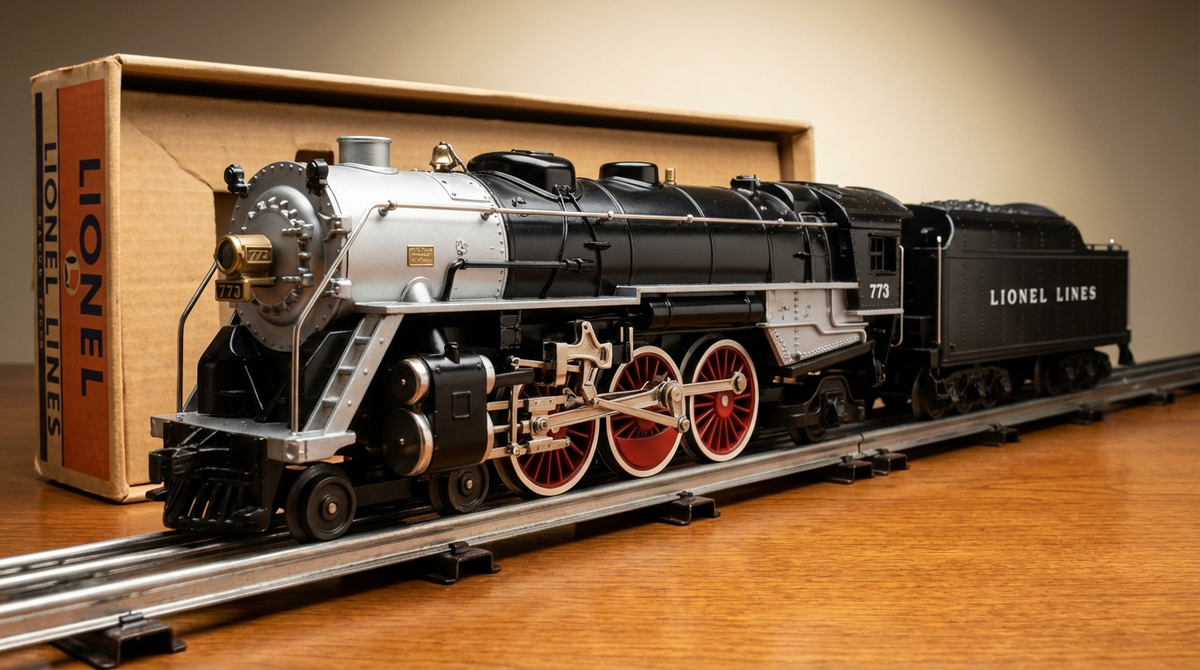
I watched this play out at a recent auction. A 1950 Lionel 773 Hudson in C-8 condition with original boxes sold for $1,450. Meanwhile, comparable C-6 examples without boxes struggled to break $300. That's a five-fold difference for what looks to untrained eyes like the same train.
The grading focuses purely on visual appearance, not whether the thing runs. A pristine shelf queen that's never turned a wheel beats a well-maintained runner with scratches every time in collector circles. Here's the condensed scale:
Below C-4, you're looking at restoration candidates or parts donors. Be ruthlessly honest when grading your own stuff. That engine you remember as "pretty nice" from your childhood probably lands around C-5 or C-6 once you examine it under good light.
This one shocks people who grew up throwing away packaging. Original boxes typically add 40% to an item's value at minimum. For rare pre-war tinplate? The premium becomes astronomical.
I saw a set of original pre-war Blue Comet boxes sell for over $700 while the complete set of cars they once held went for just $1,100. The cardboard was worth nearly as much as the trains themselves. In another case, a box for a Lionel 3854 merchandise car fetched $1,500, exceeding the car's value.
Boxes get their own TCA grading scale from P-10 down to P-3. One rule catches people off guard: any box repaired with household tape like Scotch tape automatically drops to P-5 or lower, regardless of how nice it looks otherwise. Those inserts, instruction sheets, and even the original tissue paper all add value. Save everything.
Scarcity drives premiums, but it's not just about how many were made. Specific production variations, color differences, and lettering changes create collector feeding frenzies. The 6464 boxcar series illustrates this perfectly. Standard versions sell for $10 to $30. But a rare color variation of a 3464 boxcar sold for approximately $1,200.
The most extreme example I know? A Lionel 6464-300 Rutland boxcar with the "solid shield" variation realized $21,150 at auction. Same catalog number as common versions worth maybe $50. The difference came down to a minor printing variation that most people would never notice.
This is why identification guides matter. A 6464-100 Western Pacific in the common silver/blue scheme might bring $75. That same car in the rare orange variation? $300 to $800. If someone had stamped "1954" on the car instead of "W.P.," you'd be looking at five figures because only three or four of those exist.
Where a piece came from and who owned it affects value. Items from documented collections like the Paul Cole or Tom Sage Sr. collections carry premiums because their authenticity isn't questioned. When you're spending thousands on a rare variant, knowing the ownership chain eliminates the nagging worry about counterfeits.
The Paul Cole Collection auction in 2021 demonstrated this beautifully. A hand-painted Märklin O gauge Schlitz Beer Car from around 1906 realized $40,800. The combination of rarity, condition, crossover appeal from beer advertising collectors, and impeccable provenance created a perfect storm.
While TCA grading ignores whether something runs, operational status does affect real-world pricing, especially in lower grades. A C-6 piece is expected to run well after basic maintenance. A C-4 piece? Buyers assume it needs work.
This creates opportunities. Operators looking for trains to actually run can often pick up modified or lower-grade pieces at significant discounts from collector premiums. The guy who wants a 773 Hudson to pull passenger cars around his Christmas tree doesn't need museum-grade perfection.
The pre-war market rewards rarity, craftsmanship, and historical significance above all else. German Märklin pieces, especially those made for American export, command the highest prices. European tinplate craftsmanship from this period remains unmatched.
For American makers, the Lionel 700E Hudson represents the pre-war pinnacle. A 1937 brass prototype sold for $70,000 in 2004. Standard production models in high grade with their original display boards remain the holy grail for serious collectors.
Character-themed sets have enduring crossover appeal. A Lionel pre-war Mickey Mouse Circus Train Set from 1935, complete with original box and accessories, sold for $10,765 at Morphy Auctions in February 2024. Disney collectors competing with train collectors push these prices higher.
This era represents Lionel's peak production years, and the market has split dramatically. Common post-war items have softened in value as older collectors downsize and supply exceeds demand. But blue-chip pieces with boxes keep appreciating.
The 1950 773 Hudson commands premiums over its 1964-66 counterpart because of its die-cast 2426W tender and more detailed valve gear. Knowledgeable buyers look for specific tells like the guide on the steam chest and the font size of the numbers to distinguish the years.
The 6464 boxcar series remains a collector's playground and nightmare simultaneously. Hundreds of variations across dozens of road names create a complex landscape where knowing your production years and body types separates informed buyers from suckers.
One set defies all logic: the 1587S "Girls' Train" from 1957-58. Those pastel-colored cars flopped commercially because parents wanted their daughters playing with dolls, not trains. That failure created rarity. A "Very Good" original set was recently listed at $2,346. Without the box, the set's worth drops to $2,000-3,000 based on component values.
When General Mills bought Lionel's tooling in 1969, the Model Products Corporation era began. Collectors often dismiss these years because of increased plastic construction and simplified details in lower-end sets. That perception creates opportunity.
MPC-era trains offer excellent value for operators and new collectors. Many were purchased by adults who stored them mint-in-box, so high-condition examples are readily available at reasonable prices. You can build a colorful, reliable layout without breaking the bank.
Exceptions exist within this era. The Southern Crescent 4-6-4 (no. 8702) and the Blue Comet 4-6-4 (no. 8801) brought back classic names in colorful liveries. Recent Southern Crescent sets have sold around $400, up from $350 four years ago.
The uncataloged Service Station Special sets sold only through authorized repair centers attract dedicated collectors. The 1988 Dry Gulch Line and the 1999 Bethlehem Steel Set (which included a piece of original post-war tooling as a flatcar load) represent affordable collecting niches with growth potential.
Here's something that surprises people cleaning out Grandpa's basement: the accessories often outvalue the trains. Post-war operating accessories in original boxes are hot commodities that consistently outpace plain rolling stock appreciation.
A Lionel no. 282 Gantry Crane in "Like New Minus" condition with its box sold for $250. The no. 397 Operating Coal Loader, a perennial favorite, brings over $100 in C7+ condition with box. Even a pre-war 164 Log Loader in "as is" condition sold for $60.
Dealer displays represent the rarest category. These factory-built promotional layouts were never sold to consumers. A Lionel OO gauge dealer display from the 1940s sold for $3,200 in 2018. Larger O gauge display layouts like the D-291 or D-40 regularly estimate in the thousands.
Original dealer signage also commands serious money. A Lionel 3-color neon advertising sign sold for $450 in February 2024. These pieces connect directly to the hobby's golden age in ways that trains alone cannot.
I need to be blunt about this because I watch people destroy value with good intentions. Any non-reversible modification, especially repainting, can slash collector value by 50-75%. That's not an exaggeration.
The TCA maintains a separate "R-grade" system for restored items, formally separating them from originals. A repainted train, no matter how expertly done, typically values no higher than an original in C-6 condition. The value defaults to the most common color scheme regardless of what rare color it once wore.
Even minor touch-ups are frowned upon and lower both grade and value. The more original parts, the higher the value. Replacing a major component like a boiler or frame with reproduction parts moves the item into the restored category permanently.
For operators who want to run their trains, this creates buying opportunities. Pieces with TMCC command control upgrades hurt collector value but make wonderful runners available at discounts. The discontinuation of ERR upgrade kits in 2018 was a blow to the operator community, but previously modified engines still circulate.
My advice? Never restore a piece in C-5 or better condition. Preserve the original patina. Mechanical repairs using period-correct parts are acceptable. If you're working with a C-4 or lower piece that you want to run for personal enjoyment, restoration becomes a reasonable option since collector value is already compromised.
The vintage train market follows predictable patterns that smart buyers and sellers exploit. Demand surges every November and December thanks to the tradition of trains around the Christmas tree. Search interest and actual sales climb steadily from October through the holidays.
The massive TCA Eastern Division York Train Meet in April and October creates liquidity events for the entire hobby. Thousands of collectors and dealers converge, and prices adjust to this concentrated supply and demand. Late Friday afternoons at York, when dealers face the prospect of hauling unsold inventory home, often yield the best bargains.
List your premium items 6-8 weeks before the holiday peak for maximum exposure. Sell common items at York or immediately afterward when buyer enthusiasm runs highest. Hunt for deals in January through March when post-holiday selling peaks and buyer fatigue sets in.
Currency fluctuations create cross-border opportunities. A weaker British Pound has allowed US bidders to acquire Hornby and other UK-made trains at effective discounts. The US $800 de minimis threshold for duty-free importation benefits European collectors buying American pieces. With 57% of eBay transactions crossing borders, this matters.
As values climb, so does counterfeiting sophistication. The TCA notes significant increases in "super accurate" reproduction boxes and fake parts. Protecting yourself requires specific knowledge and basic tools.
Build a simple authentication kit: a blacklight for testing paint fluorescence and a small magnet for checking materials. Pre-war lead-based paints often fluoresce under UV light while modern acrylics don't. Fair warning: expert restorers have learned to beat some of these tests.
Examine lettering application methods carefully. Post-war Lionel used heat-stamping that leaves slight impressions or rubber-stamping that appears grainy. Fakes often use silk-screening or dry transfers that look too sharp and perfect. An original Lionel 2331 Virginian has grainy rubber-stamped lettering; repaints feature crisp silk-screens.
Learn part-specific telltales. Original plastic horses for Lionel flatcars carry a 'BB' stamp on their underside; reproductions don't. Reproduction 6464 boxcar doors from the 1990s have different pin marks than originals. Consistency matters too: an old, faded car with a bright, shiny load screams "replacement parts."
For high-value purchases, demand documented provenance or look for official TCA "Ident-Tags" on restored items. When uncertain, consult experts at train meets or through the TCA Standards Committee.
Poor storage destroys value faster than playing with the trains ever did. I've seen collections worth thousands turned into restoration projects because someone kept them in a damp basement or hot attic.
Keep temperature stable between 60-70°F. Avoid locations with wild temperature swings. Higher temps accelerate chemical degradation in paints, plastics, and rubber.
Relative humidity matters just as much. Stay between 40-60%. High humidity promotes mold and metal corrosion. Low humidity makes paper and early plastics brittle. Stability beats any specific number; fluctuations cause expansion and contraction that cracks paint and delaminates decals.
Light damage accumulates permanently. Store trains in darkness when not displayed. For display cases, limit visible light to 50-150 lux and filter 99% of UV radiation. UV-filtering acrylic for display cases pays for itself in preserved value.
Use only archival storage materials. Polyethylene foams, acid-free tissue, and Mylar films are safe choices. Avoid PVC plastics, foam rubber, wood, and newspaper. These off-gas acids that attack metal and paint surfaces over time.
For cleaning, use citric-based cleaners or white vinegar with soft cloths for track. Cotton swabs work for wheels. Mineral spirits or lighter fluid on Q-tips tackle tougher grime carefully. Never use steel wool or sandpaper on anything. And despite what your garage mechanic instincts say, keep WD-40 far away from your trains.
Lubricate sparingly using purpose-made products like the Lionel Lubrication Kit. Over-lubrication attracts dirt and can foul wheel-to-track contact, causing running problems.
A credible valuation triangulates three data sources because no single source tells the complete story.
Price guides like Greenberg's provide excellent baselines for identification and relative value, but printed prices become outdated quickly. Use the most recent edition as a starting point, not a final answer.
Real-world comparables carry the most weight. Search completed eBay listings and auction house "prices realized" databases for your exact model, variant, and condition grade. Ignore asking prices; only track what actually sold within the last 6-12 months.
High-volume dealers like Trainz.com use their extensive sales history to determine value, often ignoring price guides entirely. They typically offer 50-60% of their determined market value when buying collections outright. That percentage sounds low, but factors in their costs for sorting, photographing, listing, storing, and taking return risk on thousands of items.
The bifurcation between top-tier and middle-market pieces will likely accelerate through 2028. Pristine pre-war and early post-war items in C-8 or better condition with excellent original boxes (P-8+) will continue appreciating. Documented provenance adds a multiplier. Iconic European makers like Märklin will lead appreciation.
Dealer displays and rare ephemera represent under-the-radar growth segments. As mint trains become scarcer, collectors increasingly value the context of the hobby: the signs, the promotional materials, the factory displays that brought trains to market.
Mid-grade post-war Lionel faces headwinds. Common, unboxed items in C-5 to C-6 condition will continue softening as supply overwhelms an aging collector base. These are becoming operator-grade items valued for play rather than investment. If you're holding large quantities of common duplicates, consider thinning the herd within the next 24 months.
The MPC/LTI era remains the best entry point for new collectors and operators. You won't get rich collecting these trains, but you'll build an enjoyable layout with reliable, colorful American-made equipment without mortgaging your house. The uncataloged Service Station Sets offer a focused collecting niche with modest appreciation potential for those who enjoy the hunt.
The passion for craftsmanship, for preserving railroad history, for the simple joy of watching trains circle the tree: these endure regardless of market fluctuations. Money comes and goes. The memories of setting up Grandpa's trains with your own grandkids? That's the real value.
✨ Complete Your Layout: Explore our wide selection of Photo Real buildings, diorama backdrops, detail parts, and accessories in every popular scale.
✨ Unmatched Realism: From chrome detailing products to neon lighting kits – every piece is designed to make your miniature world come alive.