Slot Car Replacement Tires: How to Measure, Match and Fit Them Right
Posted by Derek Olson on 20th Nov 2026
Order by phone: 763-231-7847
Free Shipping On Orders Over $100!
If you are already registered, please log in.
Create your account and enjoy a new shopping experience.
Create A New AccountPosted by Derek Olson on 20th Nov 2026

Video: Slot Car Replacement Tires: How to Measure, Match and Fit Them Right
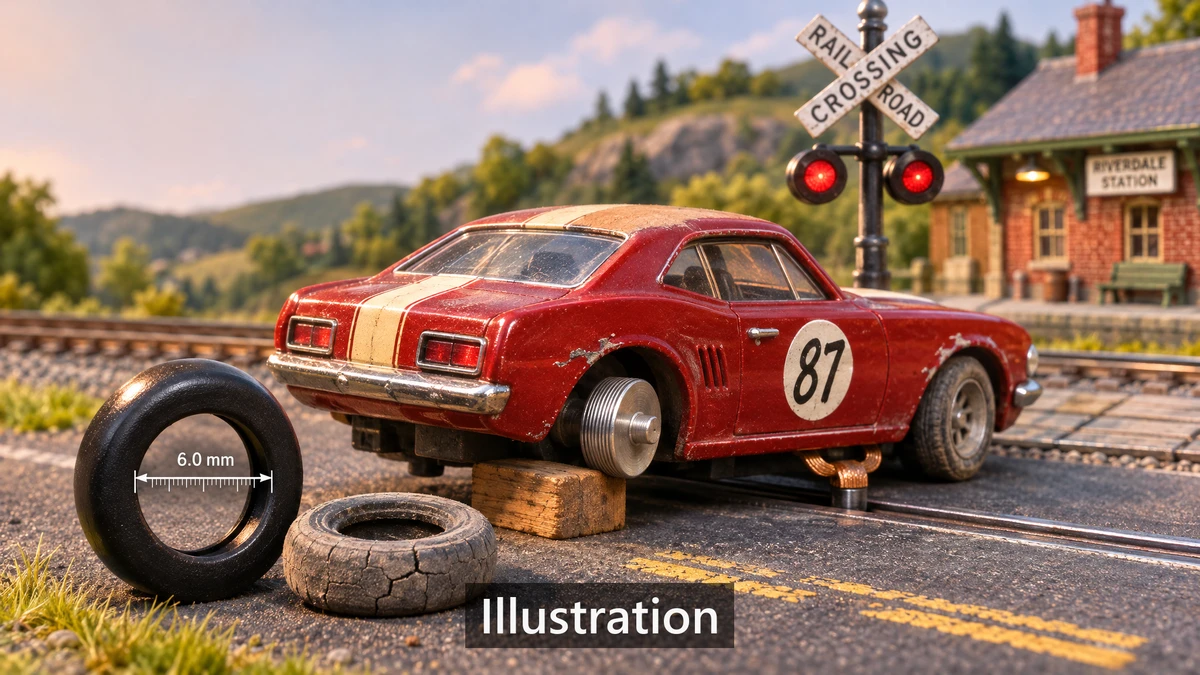
Put a slot car road beside a carefully ballasted mainline and the tires decide whether that car belongs in the scene or ends up in your fresh static grass. Slot car replacement tires usually get sold as speed parts, and sometimes that's what they are. For a model railroader they're closer to running gear. You wouldn't slide an unmeasured wheelset under a detailed locomotive and hope it works out, and tires deserve the same care.
The short version: pick replacement tires by the exact car or chassis, the wheel actually installed on it, and the mounted outside diameter and width. Then choose a compound that suits your track and any rules you run under. Before you buy anything, clean the tires you already have and test again. If the rear tires look gray after a run, clean and retest them before deciding they need replacing.
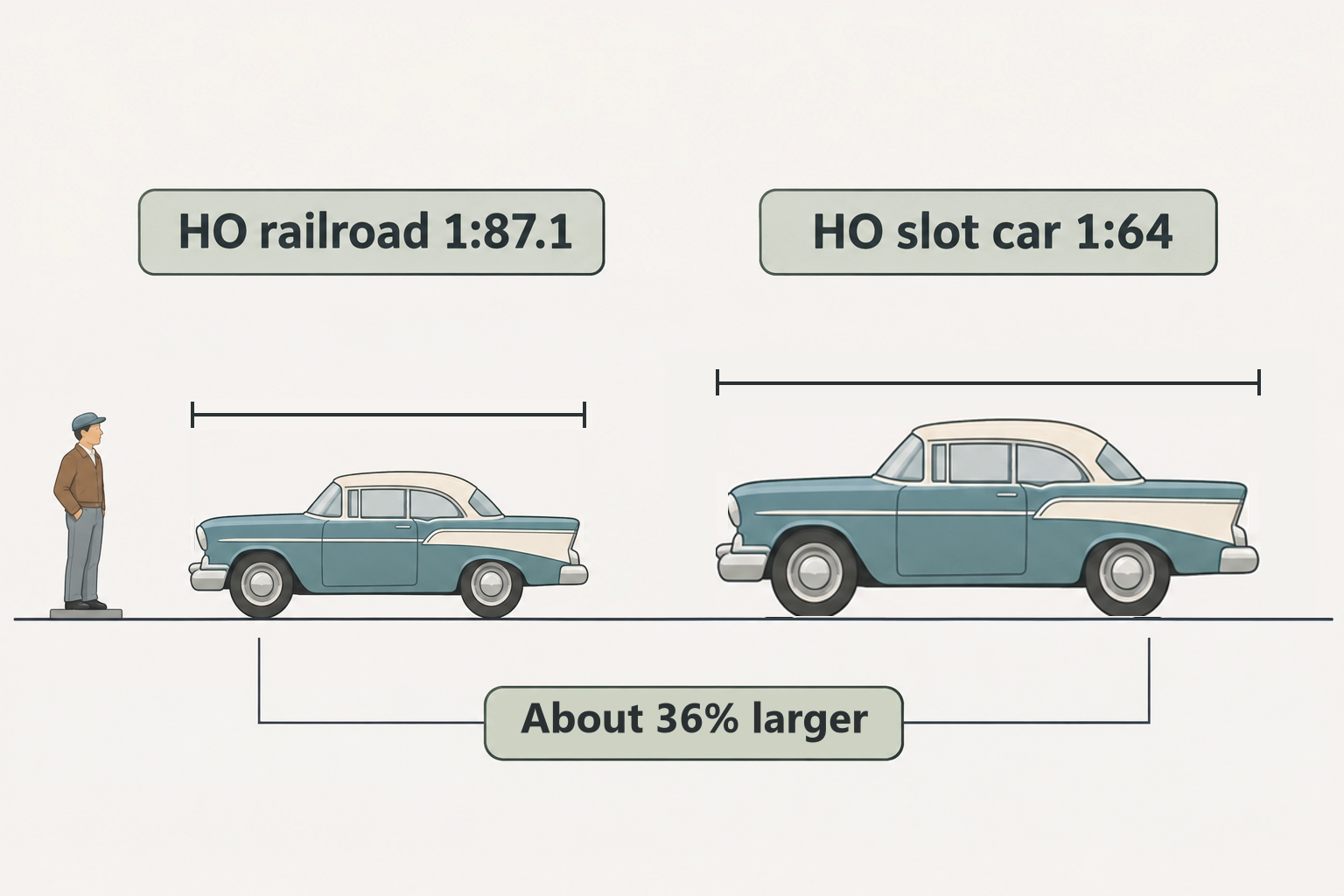
This catches people out constantly. The National Model Railroad Association lists model railroad HO scale at 1:87.1. AFX describes its Mega G+ slot cars as 1/64th scale. Same two letters on the hobby shop shelf, very different proportions. Run the math and a model of the same car is about 36% larger in every dimension at AFX's 1:64 than at railroad HO's 1:87.1, which is why a slot car looks oversized beside HO figures and structures.
That doesn't rule slot cars out of a railroad scene. It means you should decide up front how much compromise you'll accept, because no tire can shrink a car.
In a Trains.com thread on running slot cars and trains together in HO, one contributor describes a layout built in 1963 with integrated slot car roads. The builder isolated the road track into electrical sections and used independently powered blocks to set speeds. Instead of leaving plastic track perched above the ground, the scenery was built up around the roadway.
That's the right instinct. The same thread is honest about the downsides, though:
These are hobbyist reports, not lab tests. They still read like a checklist of design questions you'd want answered before cutting a slot into your layout. Another poster in that thread admits to assuming Faller cars would run on slot car track. They won't, which brings us to an important boundary.
The Faller Car System documentation describes vehicles that carry rechargeable batteries and follow a wire embedded in the road, steered by a magnet on a slider. An energized stop section can halt a vehicle at a railway crossing through its reed sensor. There's no powered slot anywhere.
Faller also treats tires as wear parts and links insufficient tread to traction and steering trouble, especially on curves and hills. Good advice, but it doesn't make Faller tires and slot car tires interchangeable. Shop for them separately.
My take: if strict scale relationships and protecting finished scenery matter most to you, build the slot car road as a separate or removable module. You get the fun of motion without betting your best scene on a car that occasionally decides to fly.
Answer "do I need new tires?" before "which tires should I buy?" Dust, worn-out rubber, out-of-round wheels and electrical pickup problems can all feel the same from the controller, and each one has a different fix.
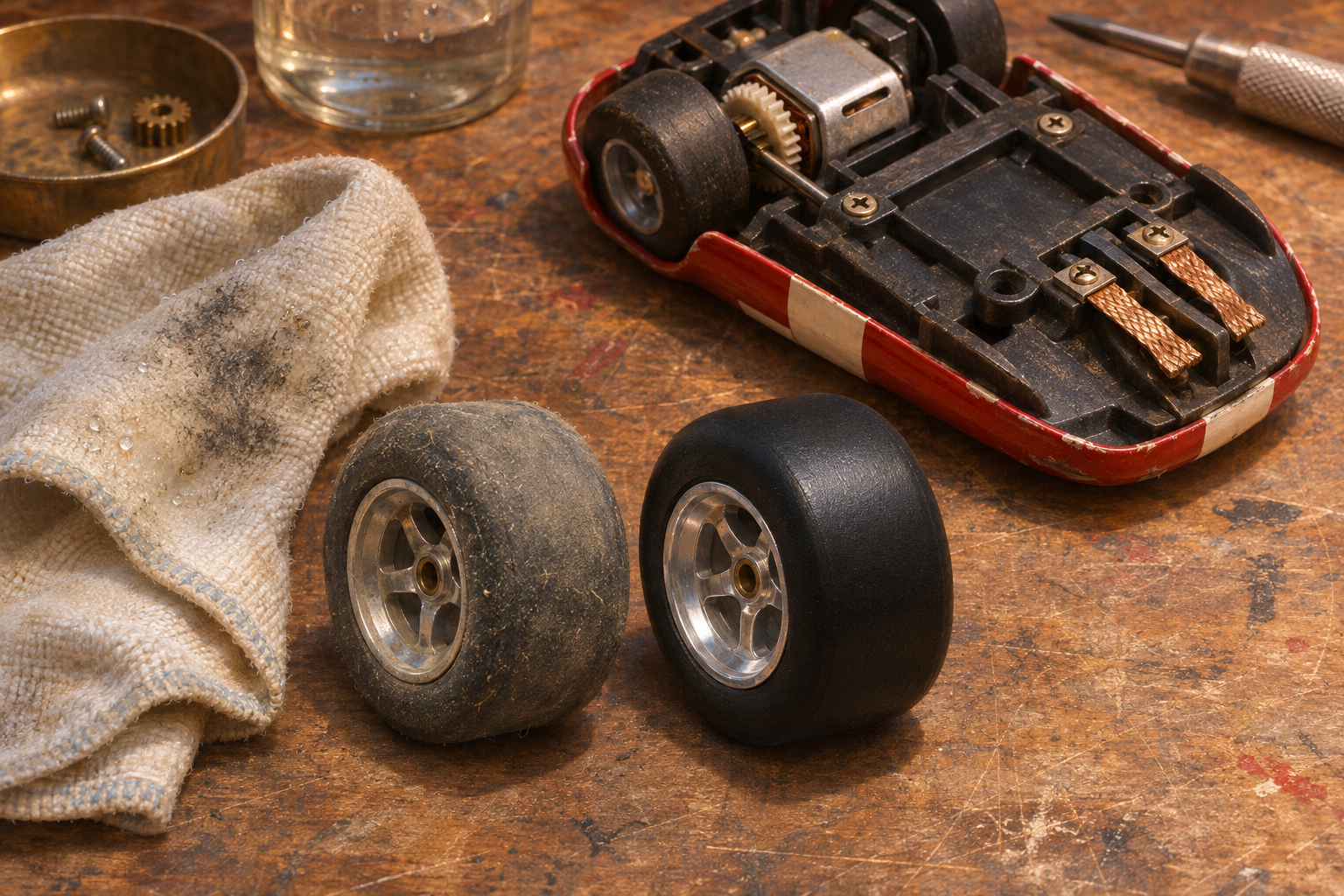
Scalextric's slot car maintenance tips lay out a simple sequence. Start with a clean, dust-free track. Wipe the rear tires with a slightly damp cloth, dry them, then test the car.
The best part is the visual check. If the rear tires look gray, that's dust. Repeat the clean-and-test cycle until the tires stay black after a run. Only then are you judging the tire itself and not the grime sitting on top of it.
That same guide covers the non-tire suspects too: pickup braids that should sit flat against the guide and line up with the track rails, dust inside the chassis, and debris tangled around axles and wheels. If you've ever chased a stalling locomotive only to find dirty wheels, you already understand the logic. Power problems love to impersonate traction problems.
| What you see | What it probably means | What to do next |
|---|---|---|
| Rear tires look gray after a run | Dust contamination | Clean track and tires, dry, retest |
| Deep cracks in the rubber | Surface cleaning can't fix it | Replace the affected tires |
| Older rubber feels hard | Age has changed the material | Assess replacement; don't count on cleaning to revive it |
| Car hops or keeps breaking traction | Wheels or tires may not be round and true | Check seating, concentricity and wheel condition |
| Power cuts in and out | Pickup braid wear or positioning | Inspect the pickup before blaming the tires |
Collectors, this part is for you. Scalextric Australia's tyre maintenance guide notes that original rubber can harden with age and can be damaged by oils and greases. It treats deep cracking as a replacement problem, full stop.
I'd be wary of any forum recipe promising that a chemical soak will bring every vintage tire back to life. Some won't come back, and an improvised treatment on an original part is a gamble with something you can't buy again.
And if the car hops? Worthing HO Racing's tyre and wheel guide puts it plainly: wheels and tires need to be round and sit true. Otherwise the car hops, breaks traction and bounces its traction magnets up and down. A brand-new tire on a bent wheel will hop just as happily as the old one.
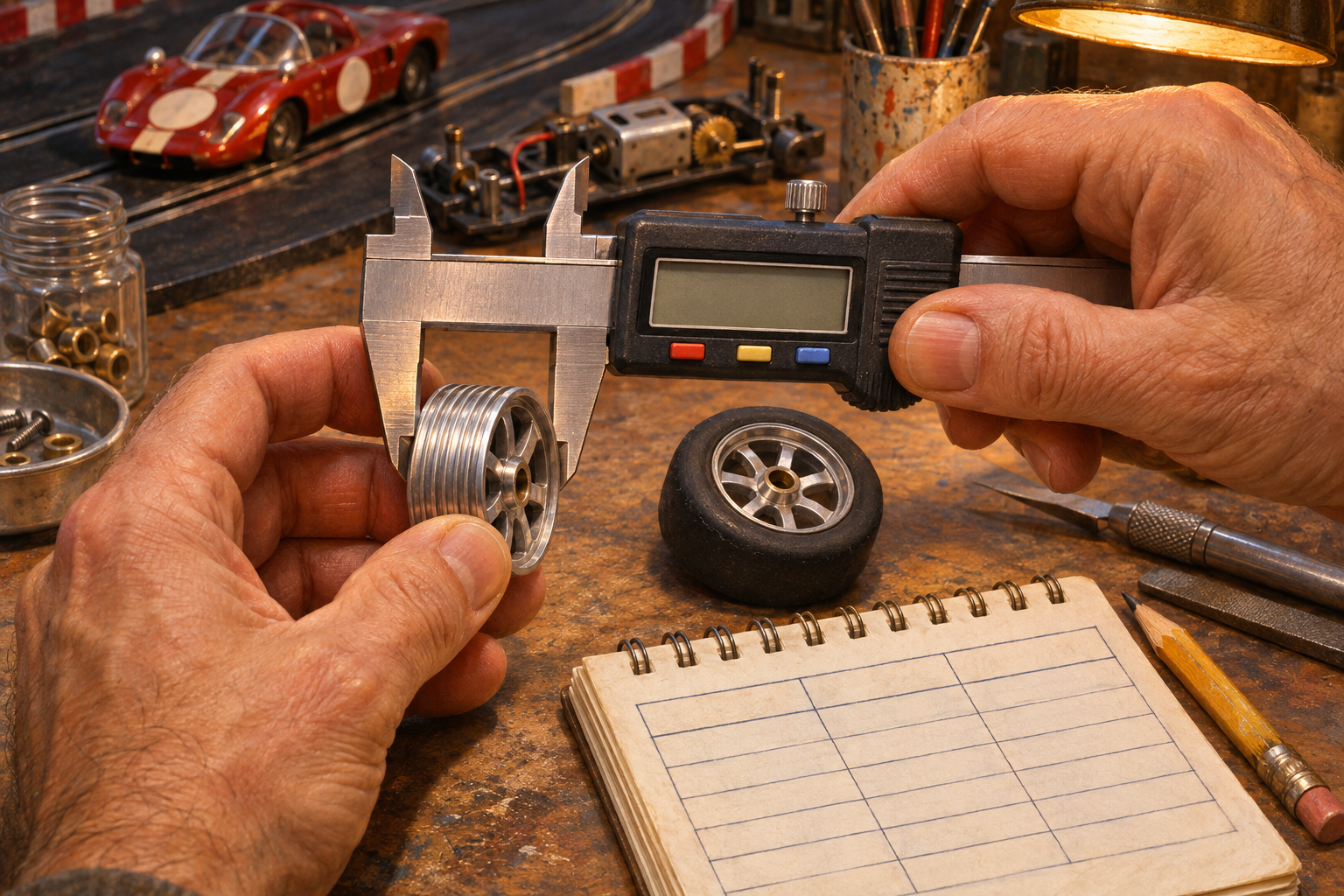
Buying by scale alone is like buying shoes by the label "adult." Slot Car Corner's general tire information explains that there's no industry-wide wheel standard for 1:32 cars, and manufacturers often use one-off wheel designs. That's why its Quick Slicks tire selector asks for the manufacturer and model of your car instead of just the scale.
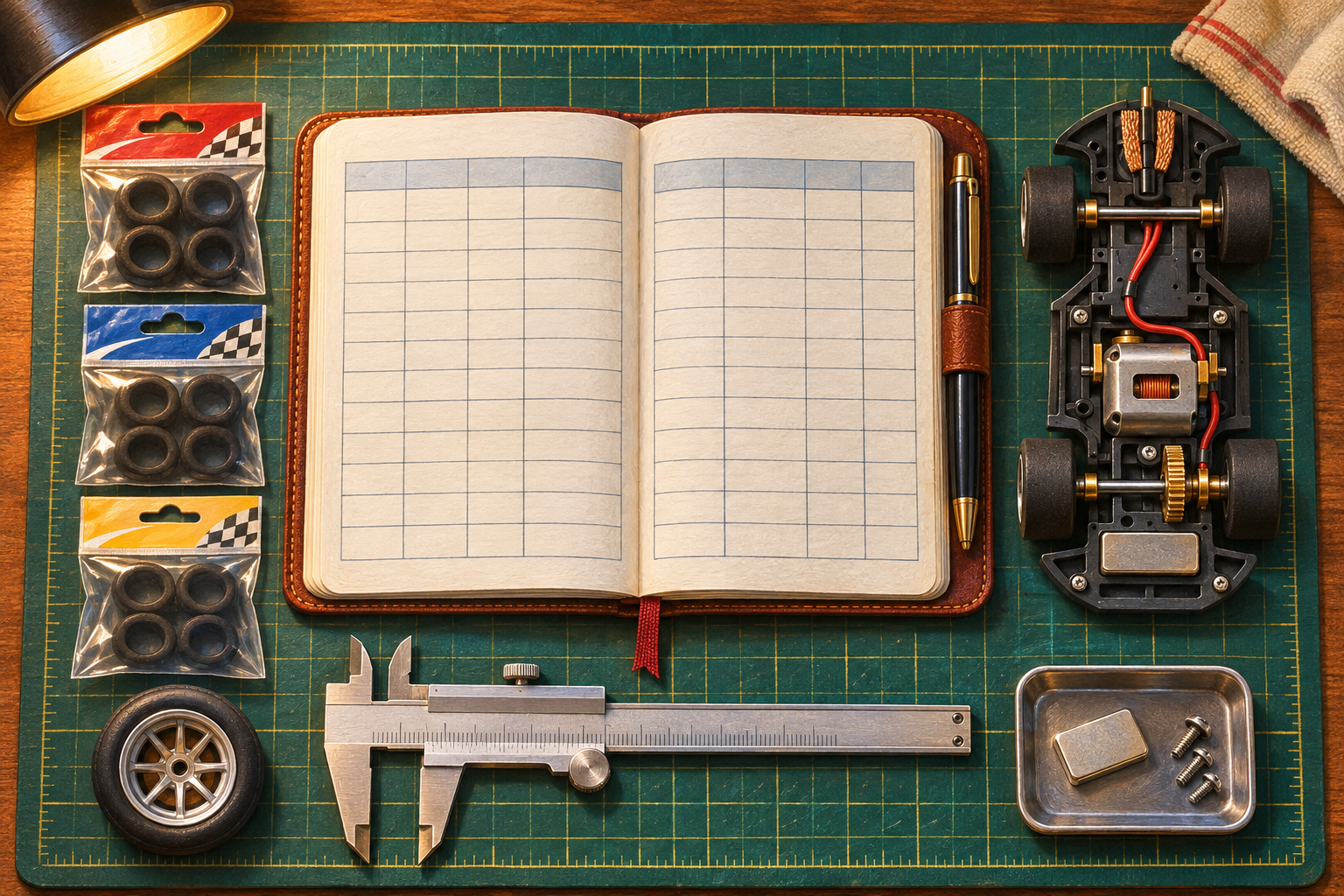
Slot Car Corner's tire and wheel dimensions worksheet splits the job into six numbers, all in millimeters:
| Part | Measurement | Why it matters |
|---|---|---|
| Wheel | Center-rib outside diameter | Captures the raised middle of a ribbed wheel |
| Wheel | Shoulder outside diameter | Separates the shoulder from the rib |
| Wheel | Total width | The wheel's full width |
| Wheel | Center-rib width | Another fit detail beyond diameter |
| Mounted tire | Outside diameter | The running diameter once assembled |
| Mounted tire | Total width | The finished tire width |
Notice the split between the bare wheel and the tire once mounted. Those are different numbers, and mixing them up is how you end up with a tire that rubs the body. If your car doesn't appear in any chart, Slot Car Corner's page on how to measure wheels and tires says there's still a chance one of its tires will fit, and the measurements are how you find out.
Not everyone works in millimeters. The Super Tires HO specification chart uses inches and defines rear tire size as the final outside diameter after mounting on the manufacturer's stock wheel. The Super Tires questions and answers page makes the same point from the other direction: chances are there's a tire designed for the stock wheel already on your car.
Quick Slicks works similarly. Its guide to finding Quick Slicks silicone tires bases published dimensions on a baseline wheel and warns that a different wheel can change the resulting diameter. Write "mm" or "in" next to every number. Future you will be grateful.
Slot.it's wheel and tyre cross-reference list shows why a tire code on its own can mislead you. You cross a wheel family with a tire mold code. Their worked example pairs a PA38 wheel (family F) with a PT19 tire (mold 1096) for an 18.1 mm diameter.
That document was last updated in 2013, so treat it as a lesson in method, not a current fitment promise. The lesson itself is solid: if a previous owner fitted aftermarket wheels, the car's name alone may lead you to the wrong tire. Record the hardware that's actually on the car.
| Car named in the chart | Listed replacement | Details |
|---|---|---|
| AFX Mega G | AFX Mega G 442 | 0.442 in O.D., 0.248 in wide, 0.21875 in I.D. (Super Tires chart) |
| Old original AFX G-Plus | LL446 or LL450 | Remove old sponge tires and clean the hub first (Super Tires chart) |
| Scalextric BMW E30 M3 DTM | Quick Slicks CB33 or CB34 | Listed in the brand fitment summary |
| Slot.it Ferrari F40 | Quick Slicks CB58 | Listed in the brand fitment summary |
The two Quick Slicks entries come from the Quick Slicks fitment summary by brand. One warning: a chart entry for "Mega G" is not automatically a chart entry for "Mega G+." Close isn't the same as confirmed, and that one character can cost you an order.
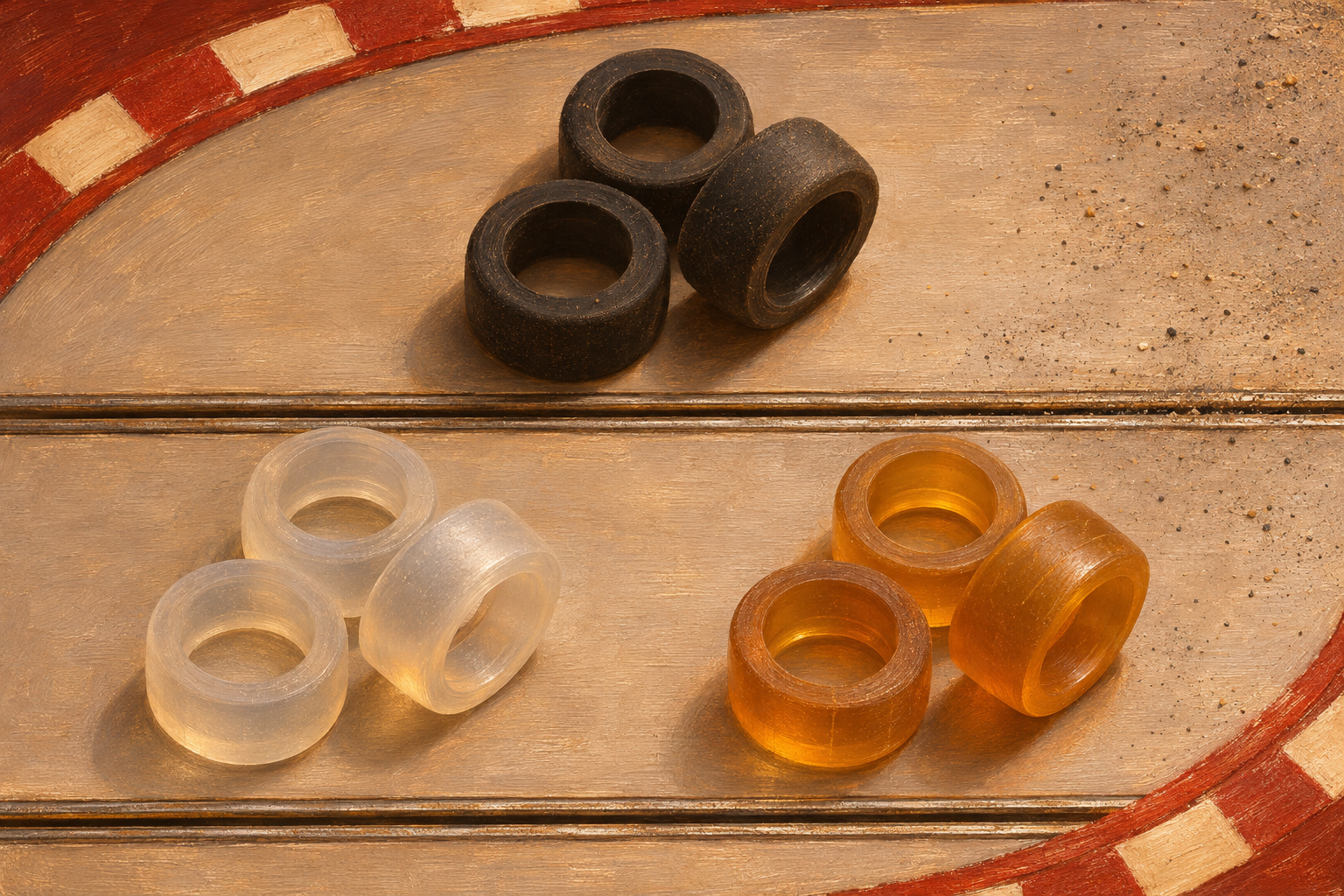
Aftermarket tires come in silicone, urethane and rubber, and Super Tires lists specialized silicone-sponge options for HO too. The material name is a starting point. It isn't a performance spec.
| Tire family | What the sources say | What it means for buying |
|---|---|---|
| Rubber | Original rubber can harden with age; specialist NSR rubber is used in competition prep | Vintage restoration and modern racing rubber are separate decisions |
| Silicone | Super Tires says its Classic silicone is more dust-sensitive than its Yellow Dog urethane | Test the specific product on your track and plan to clean often |
| Urethane | Paul Gage sells multiple hardnesses with different grip, wear and magnet advice | Pick a formulation, not just "urethane" |
| Sponge | Super Tires lists silicone-sponge options in its HO range | Check construction and class eligibility separately |
Slot Car Corner's Paul Gage urethane tire information lists XPG at roughly Shore 20 A and PGT at roughly Shore 40 A. Shore A is a hardness scale; lower numbers are softer. The supplier says XPG generally grips better on most racing surfaces but wears faster, and recommends PGT for cars with stronger aftermarket magnets or multiple magnets.
Then comes the detail I find most useful for collectors. Paul Gage gives XPG a 12 to 18 month shelf life and describes PGT as lasting much longer for cars that run occasionally or sit in storage. That's a statement about those two products, not all urethane. Still, if your slot cars come out twice a year for an open house, shelf life might matter more than peak grip.
A 2007 urethane vs. silicone tire test from Slot Car News ran a Fly Racing Porsche GT1-98 on Slot.it 17 x 10 mm wheels around a 61-foot painted wooden track. Each tire pair got 50 laps, with best laps reported. The magnet setup isn't stated.
The chart shows the clean-track best laps: Super Tires (silicone) led at 4.922 s, ahead of Ortmann (urethane) at 4.935 s, with Jel Claws (rubber) at 5.148 s. On the moderately dusty track, Slot.it S2 (silicone) came out ahead at 4.977 s, just in front of Super Tires at 4.979 s and Ortmann at 4.987 s. Slot.it S1 (silicone) ran 5.048 s there, and Tru Grip (urethane) and Jel Claws both ran 5.176 s. The author also cautions that gaps of 0.003 or 0.010 seconds could come down to chance or uneven driving. I love that honesty. It's one car, one track, one era of products, and it still shows how a ranking flips when the surface changes. The result describes the tires tested in 2007, Jel Claws included, not any tire sold today.
One more caution from Scalextric Australia: silicone residue can affect other compounds, and some clubs restrict silicone. Take that as their guidance for their context, and check before you bring silicone to somebody else's track.
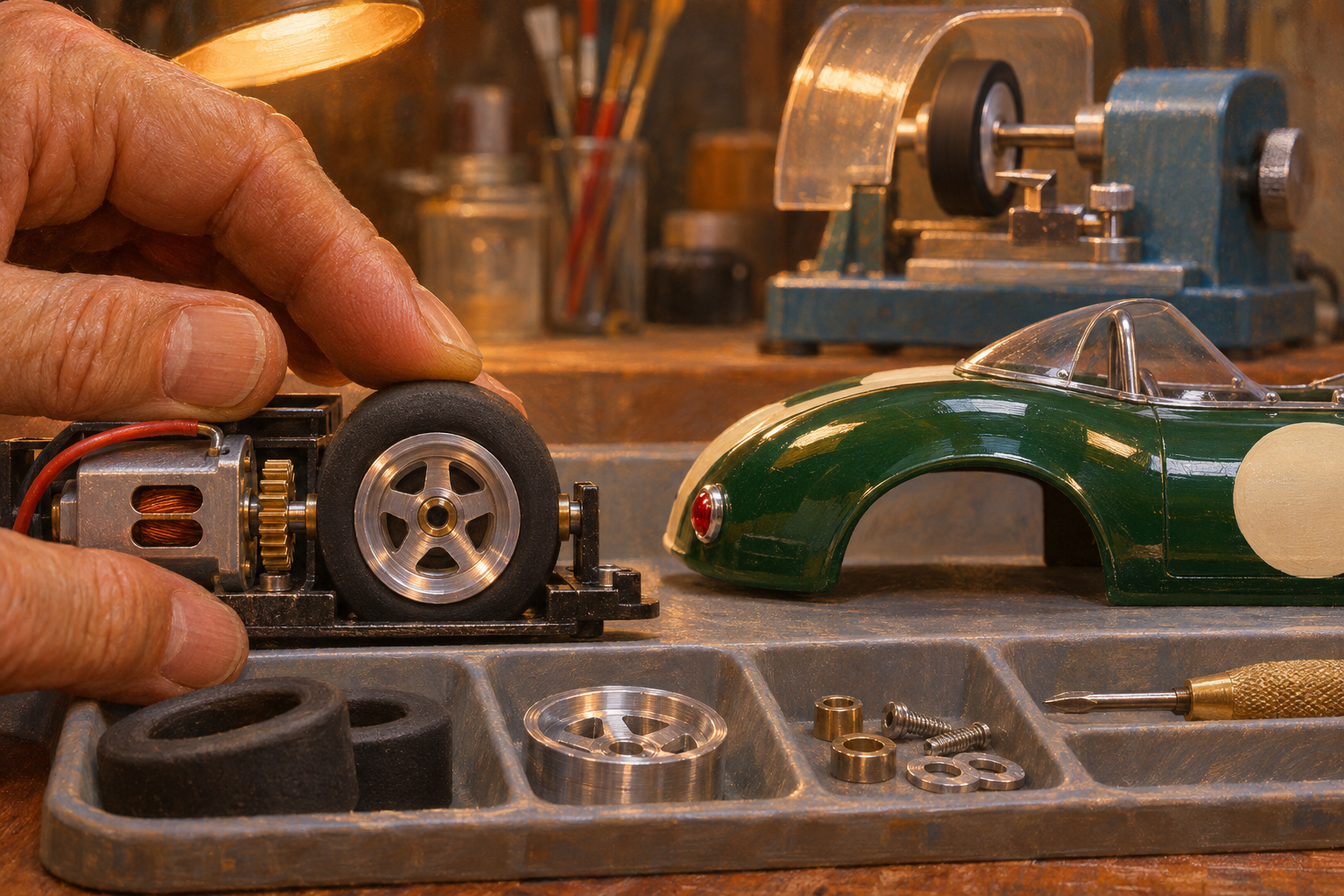
Replacing a tire and tuning a racing tire are two different jobs. A layout modeler usually wants a correctly seated tire and calm, reliable running. A club racer might want bonded tires, tight diameter control and a shaped contact patch.
A safer tire-fitting workflow for layout cars
Our suggested order for layout cars, not a maker's procedure; adapt it to your car, the tire maker's instructions and club rules.
Identify the wheel and replacement
Confirm fitment for the wheel actually installed before you take anything apart or order parts.
Cut power and protect the model
Work away from finished scenery and keep removed parts in a tray.
Inspect and clean the wheel
Follow the maker's instructions for removing old material. The Super Tires chart calls for cleaning hubs after pulling old sponge tires off original AFX G-Plus cars.
Sources: [1]
Seat the new tire evenly
Look for twisting, uneven edges, crowning and body rub before you power up.
Glue only when called for
Use adhesive only when the product and use call for it; "glue every tire" shouldn't be your default.
True only when needed and allowed
Follow the tire maker's or a specialist's method instead of one grit or chemical for every material.
Recheck and run gradually
Judge smoothness, clearance and handling, not just how sticky the tire feels.
Pendle Slot Racing's guide on how to true slot car tyres says up front that the technique is mostly used at club and competition level, where cars usually run without magnets. It walks through NSR rubber tires on NSR aluminum wheels with a professional tire truer: prep and clean the rims, bond the tire edges, reduce the diameter, adjust the width, round the edges.
Oversized tires are the point, since they leave material to work down. Pendle also mentions tire oil for polishing and softening, noting that polishing shrinks the diameter further. And it warns that low-profile front tires can be cut right through during truing. That's specialist advice for a specific setup, not a license to oil every compound you own.
The seven-step workflow at the top of this section is the order to follow for a layout car: confirm fitment for the wheel actually installed, seat the tire evenly, and glue or true it only when the product and your rules call for it.
Worthing HO Racing separates front-end stability from rear traction instead of chasing maximum grip at every corner of the car. Its magnet advice matters most here. Lowering tire height increases magnetic downforce. That can help cornering, but it can also slow the car on the straights and make the motor run hotter.
Worthing adds that some strongly magnetized WHO Mod cars work better on harder tires, because softer ones compress. Put that next to Paul Gage recommending firmer PGT for strong magnets and you get two independent sources pointing the same direction: softer isn't automatically better. The tire works as part of the whole car.
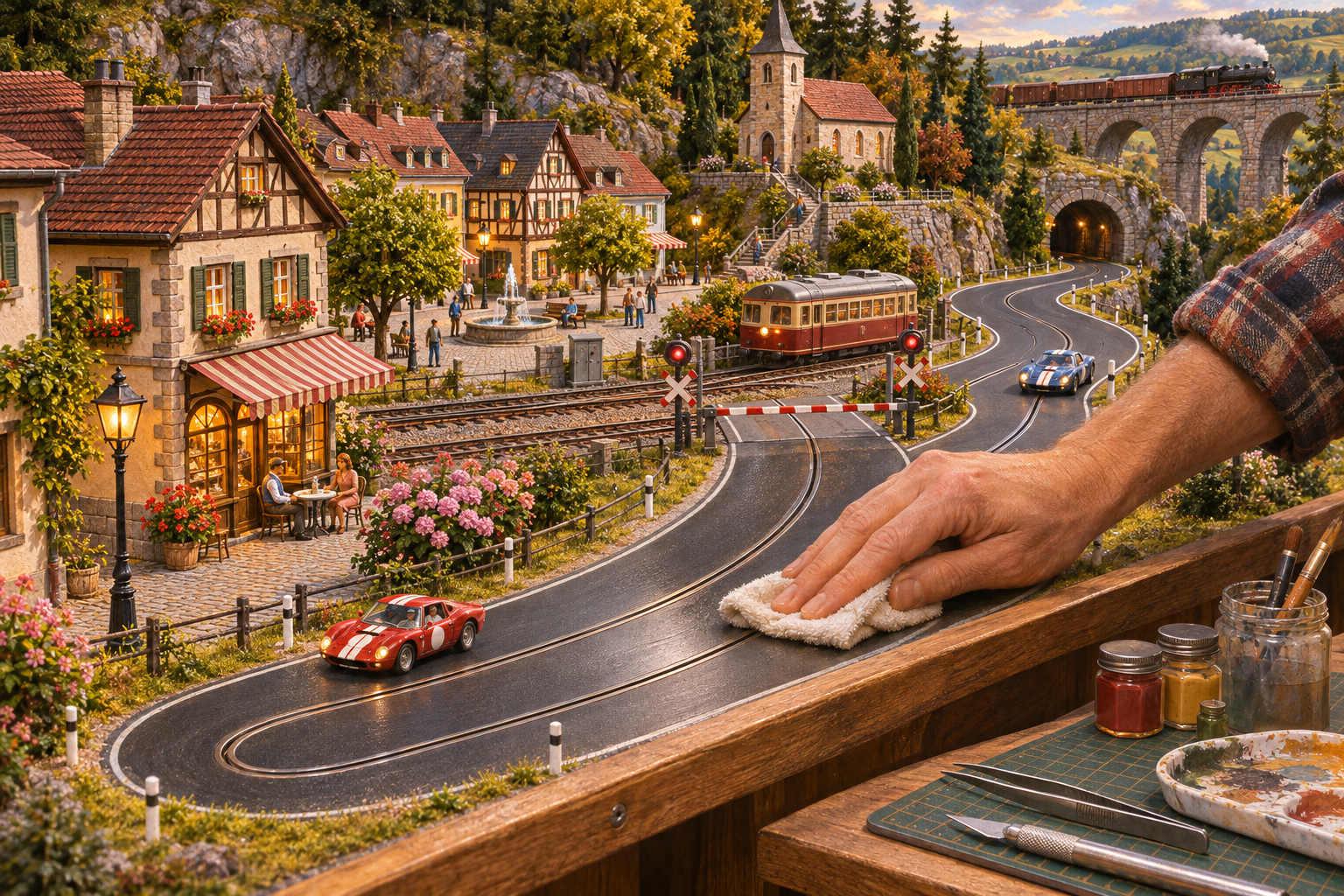
On a scenery-heavy layout, maintenance access stops being an afterthought. Scalextric stresses clean track, and Faller separately recommends keeping model streets free of dust and tire-wear particles. If you can't reach a stretch of road to clean it, that stretch will eventually cost you grip.
Scalextric suggests masking or gaffer tape for experienced racers cleaning tires. Super Tires lists sticky tape too, while noting some tracks and clubs don't allow it. And the HO Slot Car Racing tire and wheel guide discourages tape outright, because its author believes adhesive residue attracts more dirt.
I like that the experts disagree. It tells you to start with your tire maker's instructions and your venue's rules, not a workshop trick someone swore by. For everyday care of the Scalextric tires covered in its guide, damp cloth and dry is a sensible place to begin.
Scalextric advises brushing dust out of the chassis, pulling debris from the axles, adding a drop of light oil to the bearings and wiping away the excess. Scalextric Australia warns that oils and greases can damage original rubber. Put those together and the lesson isn't "never lubricate." It's "keep oil far away from the contact patch." Wipe that excess like you mean it.
The HOPRA 2026 official national rules allow qualifying non-coated, solid silicone, rubber or urethane replacement rear tires in Spec Stock. The same rules prohibit putting tire dressing or "glue" on the track, and allow penalties when a treatment on a car damages the track or gets in other racers' way.
Gluing a tire to its wheel and gluing a racing surface are two completely different things. Don't let a shared word blur them together.
Those are workshop habits for protecting your work, not manufacturer rules. For long-term storage, Scalextric Australia recommends removing and isolating early rubber tires to minimize dye transfer. Apply that advice to the materials it covers, and don't stretch it to everything in the drawer.
No. AFX lists its Mega G+ slot cars at 1/64 scale, chassis vary, and charts tie tires to specific stock wheels. Match the chassis and the wheel, then confirm with a fitment chart.
Not on every track. Silicone tires led both runs of the 2007 test, but which silicone tire led changed with dust, and Super Tires says its Classic silicone is more dust-sensitive than its urethane. Track condition and rules decide.
Record the center-rib diameter and the shoulder diameter separately, then the rib width and total width. The Slot Car Corner worksheet has a slot for each.
Not for a layout car that runs smooth and round. Truing changes dimensions, takes skill and the right equipment, and belongs in deliberate tuning projects.
Worthing HO Racing says lowering tire height increases magnetic downforce. It notes this can help cornering while slowing straight-line speed and heating the motor.
No. Faller vehicles run on batteries and follow a buried wire. Buy their spares from the Faller system, not from slot car charts.
Maximum grip, predictable handling and believable miniature traffic are three different goals, and the best tire for one can work against another. A car that runs a few times a year beside your railroad doesn't need what a club racer needs, even if the wheels match. Clean first, measure the wheel that's actually there, choose a compound with your track and magnets in mind, and seat it so it runs true. That's the order Scalextric, Slot Car Corner and Worthing HO Racing point to before the car goes back on the road you built for it.
Check your slot car tire know-how
Sourced data: each entry cites a numbered source listed below.
How do model railroad HO scale and AFX "HO" slot cars compare?
After a run, your rear tires look gray. What does Scalextric say that usually means?
Which Paul Gage urethane tire is the softer compound?
On a magnet car, what happens when you lower tire height?
What do the HOPRA 2026 national rules prohibit?
Answers
HO railroad is 1:87.1; AFX slot cars are 1:64
The NMRA lists HO scale at 1:87.1, while AFX describes its Mega G+ slot cars as 1/64th scale, so a model of the same car is about 36% larger at AFX's 1:64 than at railroad HO's 1:87.1.
The tires have collected dust
Gray rear tires indicate dust. Clean the track and tires, dry them and retest until the tires stay black after a run.
Sources: [1]
XPG, at roughly Shore 20 A
XPG is about Shore 20 A and PGT about Shore 40 A; lower Shore A numbers are softer. The supplier says XPG generally grips better on most racing surfaces but wears faster, and recommends PGT for stronger or multiple magnets.
Sources: [3]
Magnetic downforce increases
Worthing HO Racing says lowering tire height increases magnetic downforce, which can help cornering but can slow the car on straights and make the motor run hotter.
Sources: [4]
Putting tire dressing or glue on the track
HOPRA allows qualifying non-coated solid silicone, rubber or urethane rear tires in Spec Stock, but prohibits applying tire dressing or "glue" to the track.
Sources: [6]
Innovative Hobby Supply sells its own ST replacement tire line, sold as Jel Claws in its "Jel" compound, with listings such as ST 1115 for Eldon 1/32, ST 2070 for Tyco 440-X2 rears, ST 2060 for AFX Super G+, and ST 2030 and ST 2031 for Aurora T-Jet. Check any listing against the wheel actually on your car, measured as above. Grip or wear claims in those listings are the store's own, not results from the tests in this article.
By Derek Olson

✨ Complete Your Layout: Explore our wide selection of Photo Real buildings, diorama backdrops, detail parts, and accessories in every popular scale.
✨ Unmatched Realism: From chrome detailing products to neon lighting kits – every piece is designed to make your miniature world come alive.