
O Gauge vs O Scale Difference Explained: What Every Modeler Needs to Know
Posted by Derek Olson on 31st Dec 2025
Order by phone: 763-231-7847
Free Shipping On Orders Over $100!
If you are already registered, please log in.
Create your account and enjoy a new shopping experience.
Create A New AccountPosted by Derek Olson on 31st Dec 2025
I've lost count of how many times someone at a train show has used "O gauge" and "O scale" like they mean the same thing. They don't. And if you're about to drop serious money on locomotives, rolling stock, or track, understanding this distinction will save you from expensive compatibility headaches.
My grandpa ran Lionel trains around his Christmas tree for decades. He called everything "O gauge" and never thought twice about it. But when I started getting serious about the hobby and wanted to run more realistic equipment, I discovered a rabbit hole of standards, scales, and systems that nobody had warned me about. Let me walk you through what I learned so you can skip the confusion.
Here's the core concept that trips everyone up:
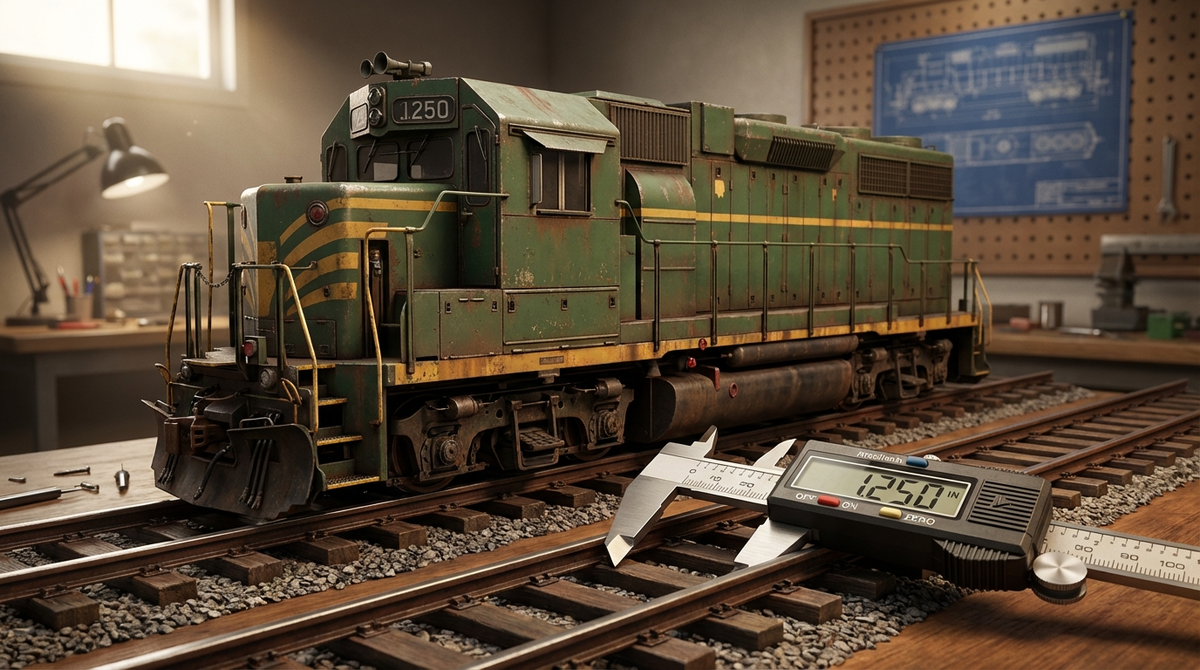
Gauge refers to the distance between the inside edges of the running rails. For O, that measurement is nominally 1.25 inches (31.75 mm) in the U.S. or 32 mm in Europe. It's a physical measurement. You can grab a ruler and check it.
Scale is a proportional ratio describing how much a model has been reduced relative to the real thing. American O scale models are built to 1:48 (quarter-inch equals one foot). British O scale uses 1:43.5. European modelers work in 1:45.
See the problem? Three different scales all running on the same gauge track. That 1:48 American locomotive sitting next to a 1:43.5 British model will look noticeably undersized, even though both are technically "O gauge" compatible.
Blame early toy train manufacturers. The 1.25-inch track gauge was convenient to produce, but it doesn't actually represent correct standard gauge (4 feet 8.5 inches) in 1:48 scale. If you do the math, 1.25 inches at 1:48 scales out to about 5 feet of prototype track. That's wrong, but the industry standardized on it anyway.
European manufacturers got closer to correct. The 32mm gauge combined with a 1:45 scale ratio gives you nearly perfect scale representation of standard gauge track. The Americans and British weren't so lucky.
| Region | Scale Ratio | Track Gauge | Governing Body |
|---|---|---|---|
| U.S. | 1:48 | 1.25 in (31.75 mm) | NMRA |
| U.K. | 1:43.5 (7mm scale) | 32 mm | Gauge O Guild |
| Europe | 1:45 | 32 mm | MOROP (NEM) |
When you're mixing vehicles from different regions or buying die-cast cars for your layout, a 1:43 scale truck next to a 1:48 locomotive creates visual dissonance. Your American switcher will look shrunken next to that British lorry. Some modelers use forced perspective tricks to hide this, but the cleanest solution is sticking to one scale standard.
As an electrician, the 2-rail versus 3-rail question speaks to me on a fundamental level. These aren't just different track styles; they're completely different electrical systems.
Three-rail track runs on AC power. The center rail is hot, and both outer rails serve as common ground. This setup came from the toy train era because it made wiring dead simple. You never have to worry about reverse loops causing short circuits, since both outer rails carry the same polarity.
The locomotives pick up power through roller or sliding shoe pickups that contact that center rail. Direction changes happen through the control system, not by flipping track polarity.
Two-rail systems use DC or DCC power. Each rail carries a different polarity, and in conventional DC operation, you control direction by reversing that polarity. This is identical to how HO and N scale work, which makes it electrically familiar if you're coming from those scales.
The trade-off? Reverse loops will short-circuit your layout without auto-reversing modules. Your wiring gets more complex, but the track looks more realistic without that visible center rail.
The electrical differences force mechanical ones. Three-rail wheels typically have deeper, thicker flanges designed for reliable operation on sectional track. Two-rail wheels use finer profiles that look more prototypical but demand more precise trackwork.
Running 3-rail wheels on finescale 2-rail track causes derailments. The oversized flanges won't fit the tighter flangeways. And traditional 3-rail couplers (those big "lobster claw" knuckles) look toylike next to the body-mounted Kadee-style couplers that 2-rail modelers prefer.
Here's where things get interesting for someone who assumed O gauge meant Christmas-tree trains.
The term "3-Rail Scale" or "Hi-Rail" describes a modern approach combining 3-rail electrical convenience with highly detailed 1:48 scale models. This isn't your grandpa's tinplate.
Manufacturers like Atlas O, MTH (Premier line), and Lionel (VisionLine) produce locomotives and rolling stock that are dimensionally identical to their 2-rail counterparts. The models are true 1:48 scale with proper proportions and fine details. They just happen to run on 3-rail track using AC command control systems.
Track systems from Ross Custom Switches and Atlas O feature realistic ties and a blackened center rail that minimizes visual impact. You can build a highly realistic scene without abandoning the operational simplicity that comes with 3-rail wiring.
Two main organizations publish model railroad standards. The NMRA (National Model Railroad Association) governs North American practices, while MOROP publishes NEM standards for Europe. These documents define wheel profiles, track dimensions, and tolerances that ensure your equipment runs reliably.
The NMRA organizes its O scale standards into categories reflecting different philosophies:
S-1.3 covers "Scales with Deep Flanges" for traditional toy-like operation on very sharp curves. These oversized wheel profiles handle O-27 track (27-inch diameter circles) and less-than-perfect trackwork, but they look chunky and won't work on finescale track.
S-1.2 defines "Standard Scales" representing the mainstream compromise. Most ready-to-run 2-rail and 3-rail "scale" models from major U.S. manufacturers meet these wheel specifications (S-4.2) and track standards (S-3.2).
S-1.1 covers "Proto Models" including the finescale Proto:48 standard for maximum realism.
If you want absolute prototypical accuracy, finescale standards exist for the truly dedicated.
Proto:48 (P48) uses the correct track gauge of 1.177 inches (29.9 mm) for American 1:48 scale. That's narrower than standard O gauge track because it's an exact scale reduction of prototype standard gauge. Wheel profiles replicate AAR prototype specs precisely. The finer flanges and tighter tolerances produce stunning visual accuracy.
ScaleSeven (S7) does the same for British modelers at 1:43.5 scale, using 33mm gauge track and precisely specified wheel standards.
The catch? These finescale standards are incompatible with conventional O gauge track. P48 wheels won't work on standard 1.25-inch gauge track. You're building for a closed system, which means handlaying your own track or using specialized suppliers like Protocraft for wheels and components.
Here's something that tripped me up badly when I started planning my first O scale layout.
Numbers like O-27, O-31, O-36, and O-72 refer to the diameter in inches of a complete circle, not the radius. An O-36 curve creates a 36-inch diameter circle (18-inch radius). O-72 means a 72-inch diameter circle (36-inch radius).
This matters because the minimum curve requirement listed on your locomotive's box determines whether it'll run on your layout. That MTH SD70ACe rated for O-42 will derail or bind on O-31 curves, no matter how much you paid for it.
| Equipment Type | Typical Minimum Curve | Notes |
|---|---|---|
| Small Switchers | O-27 / O-31 | Designed for tight industrial work |
| 4-Axle Diesels (GP9, GP38) | O-31 / O-36 | Versatile but overhang shows on tight curves |
| 6-Axle Diesels (SD40, SD70) | O-42 / O-54 | Some can negotiate O-36 with compromises |
| 21" Passenger Cars | O-54 / O-72 | Lionel's 21" cars need O-54 minimum |
| Large Articulated Steam | O-72 / O-96+ | Big Boy owners often use O-99 or larger |
Plan your mainline curves for the largest locomotive you'll ever want to run. Underestimating curve requirements leads to expensive locomotives sitting unused because they can't navigate your track.
The control system you choose locks you into an ecosystem, so understand your options before buying.
Lionel's Legacy/TMCC system uses wireless RF control with 32 speed steps (TMCC) or 200 speed steps (Legacy). The BASE3 system runs about $590 and adds Wi-Fi for app control.
MTH's DCS (Digital Command System) offers two-way communication between locomotives and the TIU (Track Interface Unit). You get 30 scale MPH speed steps in 1-MPH increments. DCS can actually control TMCC/Legacy engines too, giving you flexibility.
DCC (Digital Command Control) is the open standard for 2-rail. Any NMRA-compliant decoder works with any command station. A basic setup like the NCE Power Cab ($185) gets you started, though O scale's higher current demands often require 5-10 amp boosters for larger layouts.
Sound decoders like the ESU LokSound 5 L/XL or SoundTraxx Tsunami2 run $120-260 per engine. That adds up when you're building a roster.
I see wiring mistakes at train shows constantly. O scale draws more current than smaller scales, so you can't get away with undersized wire.
Run a 12 to 16-gauge bus wire underneath your layout, following the track plan. Then tap off 16 to 22-gauge feeder wires every 10-25 feet and solder them directly to the rails. This prevents voltage drop that makes trains slow down in distant corners.
For MTH DCS systems, a "star" wiring pattern works best, with each track feed running directly back to the TIU. DCC layouts do fine with a linear bus using twisted-pair wires.
Modern locomotives contain sensitive electronics. Old thermal breakers are too slow to protect them during a derailment short.
For 3-rail AC, the Lionel PH-180 PowerHouse trips in under 10 milliseconds. The TMCC Direct Lockon provides instant interruption too.
DCC layouts should be divided into power districts with electronic breakers. The DCC Specialties PSX series reacts in microseconds and can distinguish between dead shorts and inrush current from sound decoders.
Voltage spikes from motor inductance or intermittent wheel contact fry decoders. Bidirectional 1.5KE36CA TVS diodes clamp those spikes. Install them across the track at regular intervals and after your circuit breaker, not before. They fail shorted by design, which trips the breaker safely.
Reverse loops on 2-rail DCC need an auto-reversing module like the PSX-AR or Digitrax AR1 to automatically flip polarity as trains enter and exit.
If you're transitioning from 3-rail to 2-rail, you don't have to sell everything. Some equipment converts easily.
MTH's Proto-Scale 3-2 feature lets you flip a switch and remove center-rail pickups in minutes. Replacement 2-rail wheelsets are available for various MTH trucks.
Atlas O sells drop-in 4-axle diesel wheelsets that include the necessary gears. For rolling stock, swapping trucks is often a bolt-on operation.
Diesel conversions are usually financially viable. Steam locomotives with complex rod assemblies? Sell them and buy dedicated 2-rail versions. The labor and parts cost for converting articulated steamers often exceeds what a factory 2-rail model costs.
Knowing who makes what helps you navigate your options.
Lionel dominates the 3-rail space with product lines from LionChief entry-level sets (under $400) to Legacy and VisionLine premium locomotives. Their BASE3/CAB3 control system and FasTrack sectional track define one major ecosystem.
MTH offers RailKing (semi-scale) and Premier (full-scale) lines. Their RealTrax and ScaleTrax systems give track options at different realism levels.
Atlas O produces highly detailed Trainman and Master lines with their 21st Century Track System. They're transitioning to MTH's Proto-Sound 3.0 for future 3-rail command control.
Williams by Bachmann offers durable, affordable locomotives great for command control upgrades.
Menards has become a player with budget-friendly rolling stock and unique animated features.
Atlas O's 2-rail track system with Code 148 rail dominates this space. Their models are typically DCC-ready or equipped with sound.
Sunset Models/3rd Rail imports limited-run brass locomotives and passenger cars at premium prices. Used brass steam can run from $895 to over $9,000.
British and European modelers have access to Dapol/Lionheart, detailed RTR locomotives, Heljan, and Lenz for Spur 0.
Your choice depends on three factors: fidelity goals, available space, and budget.
Want fun, simple operation with a nostalgic vibe? Traditional 3-rail with tubular track and tinplate aesthetic delivers that. Want realistic trains without complex wiring? 3-Rail Scale/Hi-Rail gives you detailed 1:48 models on easier-to-wire track. Want the most realistic appearance possible? 2-Rail O Scale with DCC is your path. Want absolute prototypical perfection? P48 or S7 finescale awaits, along with handlaid track and a steep learning curve.
A small room limits you to O-31 or O-36 curves, which means traditional 3-rail or a 2-rail switching layout with compact equipment. Medium rooms (12'x20') open up O-54 and O-72 curves for running scale-sized diesels and passenger cars. Large dedicated spaces let you run articulated steam on sweeping mainlines of O-96 or beyond.
Entry level under $1,000 means a 3-rail starter set with CW-80 transformer. Mid-range $1,000-5,000 supports a developed 3-Rail Scale layout or modest 2-Rail switching operation with command control. Premium budgets of $5,000+ are typical for serious 2-Rail Scale collections where a single locomotive can run $500-800 before adding a $150 sound decoder, and brass imports command thousands.
"O gauge" describes the track. "O scale" describes the model's size. Three different scales (1:48, 1:43.5, 1:45) share that 1.25-inch/32mm track gauge, which creates compatibility questions when mixing equipment from different regions.
The 2-rail versus 3-rail choice comes down to electrical preference and aesthetic priorities. Neither is inherently better. Both can produce stunning layouts with realistic operation. Modern 3-rail scale equipment destroys the old "toys versus models" distinction.
Pick your fidelity level, measure your space honestly, and budget for the control system and equipment that matches your goals. Then stop worrying about what other people think and start running trains.
By Derek Olson
✨ Complete Your Layout: Explore our wide selection of Photo Real buildings, diorama backdrops, detail parts, and accessories in every popular scale.
✨ Unmatched Realism: From chrome detailing products to neon lighting kits – every piece is designed to make your miniature world come alive.