
O Gauge Train Transformers Guide: Picking the Right Power for Your Layout
Posted by Derek Olson on 31st Dec 2025
Order by phone: 763-231-7847
Free Shipping On Orders Over $100!
If you are already registered, please log in.
Create your account and enjoy a new shopping experience.
Create A New AccountPosted by Derek Olson on 31st Dec 2025
I've been an electrician for over a decade, and I'll tell you something funny: I probably learned more about AC power from my O gauge layout than from my first year of trade school. There's nothing like watching a $400 locomotive act possessed to make you really, truly understand waveform compatibility.
If you're reading this, you've probably hit that wall. Maybe you just upgraded from a starter set and realized that little wall-wart won't cut it anymore. Maybe you inherited a collection and have no idea what powers what. Or maybe, like me a few years back, you just fried something expensive and want to make sure it never happens again.
This O gauge train transformers guide will walk you through what actually matters when picking a power supply in 2025. I'll skip the marketing fluff and focus on the stuff that keeps your trains running and your wallet intact.
O gauge runs on alternating current (AC), typically between 5 and 20 volts. That's the easy part. The tricky part? Not all AC is created equal, and the type your transformer produces determines whether your $800 steamer purrs like a kitten or screams like a banshee.
Here's what I wish someone had told me years ago: transformers convert household 110-volt power into something your trains can use safely. But they do it differently, and those differences can mean the difference between smooth operation and expensive repairs.
This is the single most misunderstood concept in O gauge power, and it's caused more forum arguments than anything except maybe three-rail vs. two-rail.
Pure sine wave is the smooth, natural waveform you'd see if you graphed clean AC power. Vintage postwar transformers like the Lionel ZW produce it. Modern power bricks like the Lionel PowerHouse 180 produce it. The MTH Z-4000 produces it. Pure sine wave is the universal donor of O gauge power. Everything runs on it.
Chopped sine wave is what happens when modern electronic controllers use solid-state components called triacs to slice off the leading edge of each voltage cycle. The Lionel CW-80 uses this technique, as does the controller portion of the MTH Z-1000.
Why does this matter? Because early MTH Proto-Sound 1 locomotives require pure sine wave power and will run erratically or not at all on chopped wave. And here's the kicker: the Lionel LEGACY PowerMaster explicitly requires pure sine wave input. Try running it with a CW-80 and you'll get unpredictable results at best.
I learned this the hard way when a buddy brought his PS1 Genesis over to run on my layout. We spent two hours troubleshooting before we figured out my Z-1000 controller was the problem. Swapped to a pure sine wave source and it ran perfectly.
The Lionel PowerHouse 180 bricks produce true sine wave output. So does the MTH Z-4000. Postwar transformers like the ZW and KW do too. But the chopped wave from units like the CW-80 can cause motor heating, buzzing, and operational failures with certain electronics.
Here's a quick compatibility rundown:
| Locomotive Type | Pure Sine (PH-180, Z-4000) | Chopped (CW-80, Z-1000 controller) |
|---|---|---|
| Postwar/MPC Lionel | Excellent | Fair (possible buzzing) |
| MTH Proto-Sound 1 | Excellent | Incompatible |
| MTH PS2/PS3 | Excellent | Poor (erratic operation) |
| Lionel TMCC/LEGACY | Excellent | Incompatible with PowerMaster |
| LionChief/Plus | Excellent | Good |
Let me walk you through what's actually on the market and what each one does well. I've used most of these personally, and I'll give you my honest take.
The CW-80 delivers 80 watts and 5 amps of AC power. It's got a throttle lever, buttons for whistle/horn and bell, and a programmable accessory output. The protection system uses a fold-back current limit: push past 5 amps and the green light flashes. Short it out for more than three seconds and it shuts down completely.
It's a solid unit for a 4x8 layout with a couple trains. But that chopped sine wave output means compatibility headaches with MTH engines and older electronics. I keep one around strictly for powering accessories now.
The GW-180 pairs a 180-watt PowerHouse brick with a throttle controller. You get 10 amps of power with variable track voltage and a separate accessory output.
Here's the thing most people miss: the brick itself produces pure sine wave. But when you run through the variable throttle, you're back to chopped wave. For command control, bypass the controller and use the brick directly with your PowerMaster or TIU. That's where the GW-180 really shines.
If you're running TMCC or LEGACY, this is your bread and butter. The PH-180 delivers a constant 18 volts at 10 amps of pure, clean sine wave power. No throttle, no controls. Just rock-solid power for your command system to control.
The real selling point? Its two-stage electronic circuit breaker. For gradual overloads, it uses time-delay to prevent nuisance trips. For dead shorts, it trips in milliseconds. That speed matters when you're protecting a $500 sound board.
I run four of these on my layout, each powering its own district. When something shorts out, only that district goes down. The rest of the railroad keeps moving.
The ZW-L packs 620 watts into a unit that looks like your grandfather's transformer but thinks like a computer. Four handles control four outputs, each capable of 180 watts. Dynamic power limiting shares that 620 watts intelligently across all channels.
The protection system is sophisticated: three tiers including fold-back current limiting and physical breakers. The output is an electronically generated chopped sine wave that approximates pure sine at full throttle. It works with both conventional and command systems, though I'd still use a separate pure sine brick for mixed-brand fleets with PS1 engines.
The Z-4000 delivers 400 watts through two independent 10-amp throttles. Each channel can hit 22 volts, and there are fixed 10V and 14V accessory outputs.
But the Z-4000's killer feature is its pure sine wave output. It runs everything: PS1, PS2, PS3, TMCC, LEGACY, Williams, postwar. If it needs AC power, the Z-4000 handles it.
Bad news: MTH discontinued it in 2021 because they couldn't get the microprocessors anymore. Used units now command $600+ when you can find them. If you spot one in good condition, grab it.
The Z-1000 system pairs a 100-watt brick with a throttle controller. The controller produces chopped wave, which means the same compatibility issues as the CW-80. But here's the workaround: MTH explicitly recommends connecting only the brick to your TIU when running DCS.
That brick produces pure sine wave. Use it that way for command control, and save the controller for conventional running when you're not mixing brands.
I hear this rule of thumb constantly, and it drives me nuts. A modern steam engine with sound and smoke can draw up to 4 amps by itself. Add seven incandescent-lit passenger cars at 0.7 amps each, and you're looking at 9 amps total. On a "one amp per train" budget, you'd be short by 800%.
Here's how I actually size power supplies:
My rule: plan power districts around 10 amps maximum. Larger than that and fault isolation becomes a headache.
Here's a scenario I've seen too many times: someone's running modern command-control locomotives on a refurbished postwar ZW. A car derails, creates a short, and the transformer's thermal breaker takes 10-15 seconds to trip. By then, the voltage spike has already cooked the sound board.
Modern electronics need modern protection. The PowerHouse 180's electronic breaker trips in milliseconds for a dead short. That's fast enough to save your locomotive's electronics.
For the best protection money can buy, look at the DCC Specialties PSX-AC. It's designed specifically for AC systems and offers adjustable trip currents, trip times of 12-15 milliseconds, and something called Adaptive Load Reset.
That last feature is clutch. Sound systems draw heavy inrush current when they power up, which can trip conventional breakers. The PSX-AC learns the difference between that harmless inrush and an actual short. No more nuisance trips when you turn on the layout.
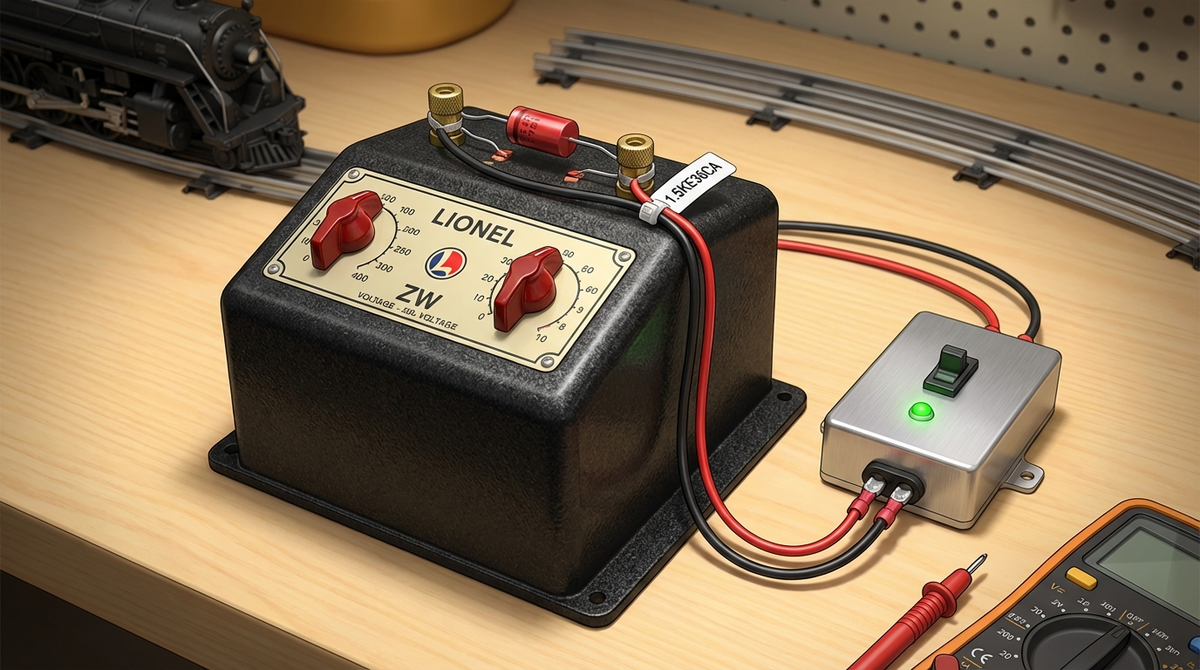
Transient Voltage Suppressor diodes clamp voltage spikes before they reach your locomotives. A bidirectional 1.5KE36CA across each track feed costs maybe $2 and absorbs the transients that derailments and motor inductance create. MTH TIUs have internal TVS diodes, but external ones at track feeds add another layer of defense.
Good wiring is invisible when it works and maddening when it doesn't. The goal is consistent power and clean command signals across your entire layout.
When you use multiple transformers, connect all their common terminals together with heavy wire. This creates a single return path and simplifies troubleshooting. But those transformers must be in phase.
To test phasing: power both transformers to the same voltage. Connect a test light between the hot terminals. If it lights up brightly, they're in phase. If not, flip one plug 180 degrees in the outlet. Running out-of-phase transformers creates a 40-volt hazard when trains cross between districts.
Bus wiring runs heavy 12-14 AWG wire from the transformer under the layout. Smaller 16-18 AWG feeders tap into this bus every 10-20 feet. This minimizes voltage drop on large layouts.
Star wiring runs individual pairs directly from a terminal block to each track feed. MTH strongly recommends this for DCS because it optimizes signal integrity. If you're running both Legacy and DCS, star wiring is your safest bet since Legacy is less sensitive to topology.
Divide your layout into electrically isolated blocks. Each district gets its own power source, limited to about 10 amps. When something shorts in district 3, districts 1, 2, and 4 keep running.
Create blocks by using insulated pins in the center rail. The outer rails typically stay connected unless you're doing detection.
Here's a mistake I made early on: I kept buying bigger track transformers when my trains slowed down near the station. The real problem? Thirty incandescent building lights were stealing power from the track bus.
A single 1445 miniature bulb draws 100-150 milliamps. Put 40 of them on your layout and you're consuming 4-6 amps just in building lights. That's as much as a dual-motor diesel.
Solution: Isolate accessory power on a separate transformer. A dedicated 12-14V AC bus handles lights, crossing gates, and animations without affecting track voltage. A CW-80 repurposed as an accessory supply works great for this.
Better yet: convert incandescent bulbs to LEDs. A string of seven passenger cars with incandescents draws nearly 5 amps. The same cars with LEDs? Maybe 0.2 amps. The conversion pays for itself in freed-up capacity.
Solenoid-type switches like the Lionel O22 have a high but momentary current draw. A capacitor discharge unit prevents coil burnout and provides that satisfying snap.
Stall-motor machines like the Tortoise are different. They draw a constant but tiny 15-20 milliamps while stalled in position. A single 1A DC supply can run over 30 Tortoise machines.
I own a postwar ZW that belonged to my grandfather. It's beautiful, it works, and it produces pure sine wave power. It's also 70 years old and its thermal breaker takes over ten seconds to trip.
Running modern electronics on vintage iron without upgrades is gambling with expensive equipment. The transformer will protect itself just fine. Your $600 Big Boy? Not so much.
A used ZW might cost $50-150. Professional refurbishment runs another $350. Add breakers and TVS diodes and you're pushing the cost of two new PH-180 bricks. Only you can decide if the nostalgia is worth it.
Modern command systems like Lionel LEGACY and MTH DCS keep track voltage constant at 18V while sending digital signals to tell locomotives what to do. The transformer's job shifts from throttling to providing clean, protected power.
The Lionel Base3 is the system brain. A wire from its TRACK U post connects to the common rail. For command-only operation, the PH-180 connects through a TMCC Direct Lockon that provides instantaneous protection.
Want to run conventional locomotives too? Insert a LEGACY PowerMaster between the brick and track. The PowerMaster requires pure sine wave input, so use a PH-180 or postwar ZW, not a CW-80.
The WiFi Track Interface Unit (WTIU) handles both power distribution and signal generation. Power it from a Z-4000 for the cleanest operation, or use Lionel PH-180 bricks.
If you're using a Z-1000, remember: only connect the brick to the TIU. The controller's chopped wave corrupts the DCS signal.
DCS and LEGACY coexist happily on the same track. Their signals don't interfere. To control TMCC engines from a DCS remote, use the TIU/TMCC-Legacy Connector Cable to link the TIU to the Lionel base.
If you're trying to run American O gauge equipment in Europe or other 230V/50Hz regions, a simple step-down transformer won't cut it. The frequency difference matters.
A transformer designed for 60Hz operated on 50Hz sees its magnetic core saturate. Current spikes, heat builds up, and eventually something fails. Even with correct voltage, the lower frequency causes about a 20% increase in flux.
The workaround is derating the input voltage by 17%: feeding 96V to a 115V transformer prevents saturation but reduces output proportionally. The real solution is a frequency converter from a specialist like KCC Scientific, or choosing equipment rated for 50/60Hz operation. The ZW-L, for what it's worth, handles both frequencies natively.
Grab a digital multimeter and a test load (a 12V automotive bulb works great). These two tools solve 90% of power problems.
Disconnect all track feeds. Does it still trip? The problem's in your transformer or main bus. Does it trip only with track connected? Reconnect one district at a time to isolate the fault.
Once you find the problem district, remove all trains. Still tripping? You've got a track short (metal debris, bad wiring, damaged track pin). Not tripping? Put equipment back one piece at a time to find the offender.
This is voltage drop. Put your test load on the track in the slow area. Measure voltage at the transformer terminals, then at the track. More than 0.5-1V difference means resistance somewhere.
Check for hot rail joints (high resistance generates heat). Add feeder wires. Consider soldering track connections or upgrading to heavier bus wire.
On CW-80 systems, check your wiring polarity. The U terminal must connect to the outside rail. On vintage transformers, a failing whistle rectifier causes this. Time for a diode replacement.
After all this, here's my honest recommendation based on layout type:
Small starter layout (4x8): A CW-80 or Z-1000 will get you running. Just be aware of the compatibility limits if you expand later.
Medium layout with command control: Two PH-180 bricks, one for each mainline district, plus a CW-80 for accessories. This setup scales beautifully as you grow.
Large layout or club: Multiple PH-180 bricks, PSX-AC breakers on each district, and TVS diodes at every track feed. This modular approach offers the best fault isolation and is easier to troubleshoot than one massive transformer.
Mixed fleet with MTH PS1: You need pure sine wave. Period. A Z-4000 if you can find one, or multiple PH-180 bricks. Avoid chopped wave controllers for track power.
The days of one transformer running everything are behind us. Modern layouts benefit from distributed power, fast protection, and clean waveforms. Spend the money up front on a proper power architecture, and you'll save yourself in blown electronics and frustration down the line.
By Derek Olson
✨ Complete Your Layout: Explore our wide selection of Photo Real buildings, diorama backdrops, detail parts, and accessories in every popular scale.
✨ Unmatched Realism: From chrome detailing products to neon lighting kits – every piece is designed to make your miniature world come alive.