
O Gauge Track Cleaning Methods That Actually Work: A Practical Guide for Real-World Layouts
Posted by Patricia Nakamura on 31st Dec 2025
Order by phone: 763-231-7847
Free Shipping On Orders Over $100!
If you are already registered, please log in.
Create your account and enjoy a new shopping experience.
Create A New AccountPosted by Patricia Nakamura on 31st Dec 2025
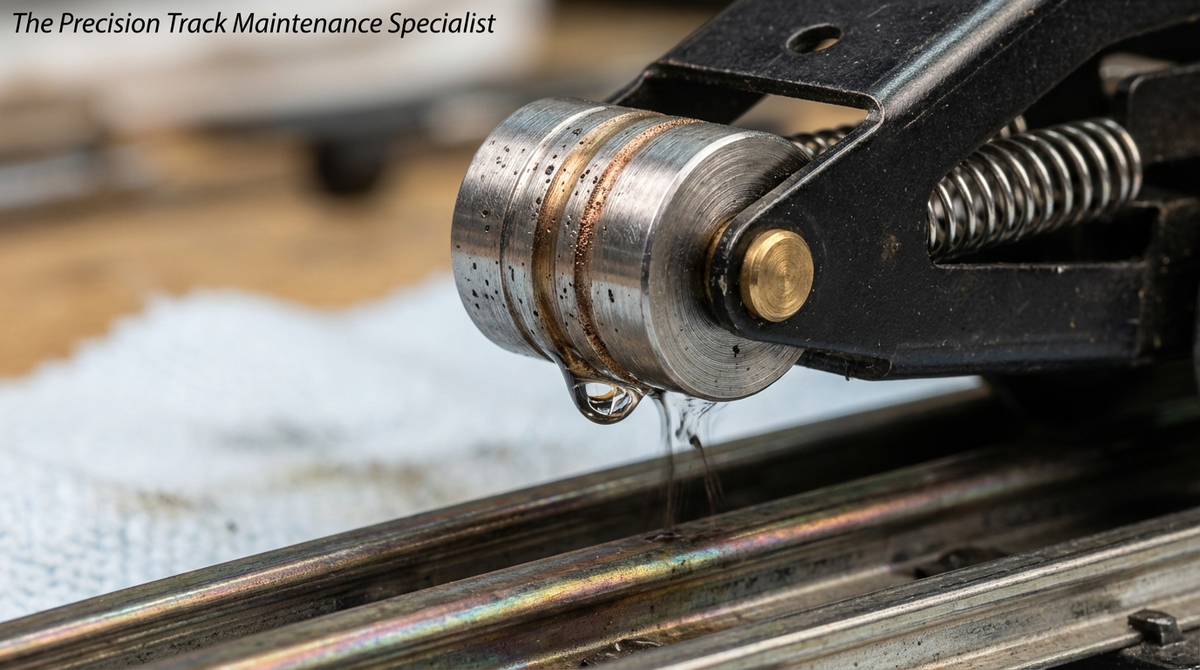
I'll be honest with you: when I first started helping fellow modelers troubleshoot their layouts, I thought dirty track was dirty track. Grab some alcohol on a rag, run it around the rails, call it a day. After years of watching perfectly good locomotives stutter across what looked like clean track, I've learned that O gauge track cleaning methods are about so much more than wiping off visible grime.
The black gunk that accumulates on your rails? It's often not dirt at all. It's the byproduct of microscopic electrical arcing, creating deposits that act like tiny insulators right where your pickup rollers need to make contact. And here's what took me way too long to figure out: the cleaner you choose, the tools you grab, even how you've wired your layout can either solve your problems or make them worse.
This might sound basic, but I've watched experienced modelers use the same cleaning routine on every piece of track they own, then wonder why some sections perform great while others corrode within months. O gauge track comes in several different metal compositions, and each one responds differently to cleaning.
Most modern sectional track from Lionel FasTrack and MTH RealTrax uses nickel-silver rails. Here's the good news: nickel-silver does oxidize, but that oxidation remains electrically conductive. The tarnish you see isn't causing your problems. According to the NMRA's Beginner's Guide, nickel-silver is the only rail material they recommend, and that conductive oxide film is exactly why.
Randy's Layout Blog explains the chemistry: brass tarnish is a non-conductor that creates immediate problems, while nickel-silver tarnish doesn't electrically insulate the metal beneath. The black gunk you're actually fighting? That's usually nickel oxide from micro-arcing at high-resistance points, not the tarnish itself.
Traditional O/O27 tubular track consists of galvanized steel rails with tin plating to prevent rust. The moment you breach that plating with aggressive abrasives, you've started a countdown to corrosion. I've seen beautiful postwar track destroyed by well-meaning modelers who reached for sandpaper.
If you're running vintage tubular track, your cleaning strategy needs to be chemical-first. Never soak track in bleach, and treat abrasives as an absolute last resort.
PIKO's Track Facts series explains that stainless steel doesn't oxidize the way other metals do, but it still accumulates organic grime, smoke residue, and dust. You'll clean less often, but you'll still clean.
Here's where things get interesting. For decades, the standard advice was to grab 91% isopropyl alcohol and a paper towel. I did it myself for years. But recent discussions in the community have challenged that assumption.
Isopropyl alcohol is what chemists call a polar solvent. PubChem's database notes its effectiveness at killing bacteria and removing certain contaminants, but here's the catch: some modelers report that polar solvents can leave microscopic residues that actually encourage the micro-arcing that creates black gunk in the first place.
Non-polar solvents like CRC QD Contact Cleaner work differently. CRC's QD formula evaporates quickly without residue and penetrates hard-to-reach areas while remaining safe for most plastics. Modelers who've switched report extending their cleaning intervals from weeks to months.
One experienced modeler put it bluntly: "Mineral spirits followed by a trace bit of NO-OX will forever be the absolute best way to clean rails. Avoid all alcohols and abrasives."
Odorless mineral spirits offer a middle ground. They're non-polar, effective at cutting grease, and less toxic than many alternatives. The trade-off? Slower evaporation means you'll need to wipe the rails dry rather than letting the solvent flash off.
Sunnyside's odorless formula works well for general grime and as a pre-cleaner before applying protectants. Just test on an inconspicuous spot first, as some plastics and rubbers can react poorly.
Naphtha (lighter fluid) is an excellent organic solvent that evaporates fast with less tendency to damage paint and plastic than acetone. EPA documentation lists it among frequently used industrial cleaning solvents. It's particularly good for heavy grease deposits.
The Trains.com forum has debated Goo Gone extensively. Yes, it dissolves stubborn adhesives and grease. But Goo Gone Pro Power's safety data sheet warns it's not safe for rubber and can damage some plastics. More problematic: it leaves an oily residue that requires a second cleaning step with another solvent. One Redditor noted it works, but only briefly before you need to re-clean.
I cringe every time I see someone recommend sandpaper for track cleaning. Track cleaning methods discussions always seem to circle back to this debate, and the experienced modelers consistently warn against aggressive abrasion.
Garden Railway Guide's maintenance section explains it well: coarse abrasives create micro-scratches that trap dirt and accelerate re-fouling. You're not just cleaning the track; you're creating thousands of tiny pockets where gunk can hide.
The NMRA explicitly warns against steel wool and sandpaper for track cleaning. Steel wool is particularly nasty because it leaves behind conductive metal fibers that can short out your track and get sucked into locomotive motors.
For stubborn oxidation that chemical methods can't budge, here's the hierarchy from gentlest to most aggressive:
Brown kraft paper (like shopping bags) is the gentlest option. It polishes without scratching and shows you exactly what's coming off the rails.
Magic Erasers (melamine foam) work when damp and conform to the rail profile. BASF's Basotect material acts like extremely fine sandpaper. Their technical documentation notes it's as hard as glass but the fine cell structure provides flexibility.
3M's Scotch-Brite 7448 gray pad (ultra-fine) is the go-to for moderate oxidation on nickel-silver. Grit equivalents run around 800-1000, similar to very fine sandpaper. Track Cleaning 101 recommends these flexible, long-lasting pads for general purpose work.
The 3M product selection guide shows the 7447 maroon pad is more aggressive (320-400 grit equivalent). Reserve it for tougher jobs like removing scenery residue or heavy oxidation.
The Bright Boy debate never ends. Walthers' Bright Boy is effective and easy to use, but many experts consider it too coarse for regular use. There's even variation between brands: "There are Bright Boys and then there are bright boys," as one forum member noted.
Walthers' Cratex Extra Fine block is gentler than the standard Bright Boy. One modeler described it as "like using emery cloth vs. sandpaper." Amazon listings confirm it's designed for polishing rail and electrical contacts with minimal damage.
The real game-changer in my track maintenance routine wasn't finding a better cleaner. It was understanding that preventing contamination beats removing it.
The MRH forum consensus is clear: "NO-OX your track and your cleaning chores diminish." This conductive grease creates a protective barrier that prevents oxidation and reduces the electrical arcing that creates black gunk.
But NO-OX-ID requires careful application. It's not a cleaner; you apply it to already-clean track. It needs 24 hours to cure, then you must buff off the excess completely. Leave too much on and you've created a dirt magnet. Worse, it's incompatible with rubber traction tires. Your locomotives will spin helplessly on grades if NO-OX gets on their traction bands.
DeoxIT DN5's technical data shows it's designed for metal surfaces with severe oxidation. The D-Series dissolves contamination while lubricating and protecting the surface. DeoxIT D5 spray fills microscopic gaps and reseals surfaces for better electrical contact.
It's particularly useful for pickup rollers and switch contacts where oxidation creates resistance. A little goes a long way.
Here's the insight that changed everything for me: a lot of "dirty track" problems are actually electrical reliability issues in disguise. Arcing at high-resistance points creates the very carbon and oxide buildup you're trying to clean. Fix the electrical issues, and you clean less often.
The NMRA's Technical Note on wiring explains that bus wire conducts power and signal from your power station to the track. Both run length and current draw determine what gauge wire you need.
MTH's documentation recommends feeders approximately every 25 feet for their DCS system. But experienced modelers often go denser, sometimes adding feeders to every single track section to eliminate rail joiners as electrical variables.
Rail joiners are for mechanical alignment, not reliable long-term electrical connection. Every joint that relies solely on a joiner is a potential arc point, and every arc creates deposits.
Greg Elmassian's comprehensive track cleaning guide breaks down the different types of automated cleaners. The short version: no single car does everything, and knowing which type addresses which problem saves frustration.
Abrasive pad cars drag a weighted pad along the rails. Good for oxidation, but they can smear organic gunk if you don't clean the pad frequently. Solvent-dispensing cars excel at oily residues but can damage plastic ties if left stationary while dispensing. Roller cars mop up liquids beautifully but can't touch oxidation.
The most effective approach combines multiple cars in a cleaning train: solvent car first, followed by a mild abrasive, finished with a dry roller to pick up residue.
Focusing only on the track is fighting half the battle. Your locomotives are constantly depositing material on your rails, and everything that touches the rails picks up whatever's there.
MTH's locomotive manuals recommend cleaning wheels and tires with denatured alcohol applied with a cotton swab. Their RailKing instructions specifically call out denatured (not rubbing) alcohol.
Facebook discussions reveal modelers use everything from Goo-Gone to transmission fluid for wheel cleaning. The key is consistency: clean wheels deposit less gunk on clean track.
Center-rail pickup rollers accumulate grime faster than almost any other component. Dremel's carbon steel brushes work well for removing caked-on deposits. These durable brushes remove rust and corrosion while leaving a matte finish.
Dremel polishing bits at low speeds (10K-15K RPM) can restore heavily contaminated rollers. Their technique guide recommends unplugging the tool first, then unscrewing accessories by pressing the lock button.
Excess smoke fluid is a primary source of the oily film that binds with dust to create performance-killing gunk. MTH's ProtoSmoke fluid comes with precautions on the Material Safety Data Sheet.
The fluids from Lionel, MTH, K-Line, and Williams are all mineral oil-based with varying viscosity. All smoke fluid is mineral oil based with additives for different smells. Overfilling causes that oil to leak onto wheels, chassis, and track.
Bachmann's smoke fluid documentation and their track cleaner MSDS provide handling guidelines. The rule is simple: stick to manufacturer drop counts and use a precision dispenser.
I know, I know. But many effective track cleaning solvents will hurt you if you're careless.
Acetone evaporates very quickly and is hard on the skin. Klean-Strip's acetone SDS classifies it as a highly flammable liquid. Airgas documentation confirms the Category 2 flammability rating. European SDS data advises against private household use.
Lacquer thinner safety data shows it contains toluene and xylene. Chemical compatibility charts show it damages EPDM, rubber, neoprene, polypropylene, and PVC.
Woodworking forums discuss which solvents damage which plastics. Lacquer thinner is incompatible with most materials used in model railroad construction.
Klean-Strip Odorless Mineral Spirits carries a danger warning: flammable liquid and vapor, may be fatal if swallowed and enters airways.
Isopropyl alcohol's flash point is around 54°F (12°C), making it highly flammable. Fisher Scientific's acetone SDS shows similar concerns for common solvents.
Eastman's formulating guide notes that hydrogenated grades work with polar polymers like EVA, acrylic, and ABS. Understanding solvent-plastic compatibility prevents expensive damage.
Tubular track tactics discussions reveal that turnouts concentrate all the maintenance challenges in one spot: moving parts, tight clearances, multiple electrical contact points, and plastic components that don't appreciate aggressive solvents.
Lionel's FasTrack system uses patented center half-pins allowing track orientation in either direction. Straight track sections clean easily, but switches require precision.
MTH RealTrax's nickel-silver rails are durable enough to stand on, but switch point-to-stock-rail contact areas are delicate. Cleaning O scale track with ballast requires mineral spirits on a rag for general gunk and precision applicators for tight spots.
MTH's catalog shows their RealTrax uses flat-top "T"-rail like real railroads. The O-31 Half Curve demonstrates their modular approach. When cleaning these premium switches, work carefully around the plastic switch housing and moving points.
After everything I've learned, here's my actual routine for my own layout:
Weekly: Visual inspection. Run a dry microfiber cloth over the rails during operation. Watch for stalls or flickering lights that indicate developing problems.
Monthly: Run a cleaning car train (when I'm feeling lazy) or wipe all accessible track with a cloth dampened with CRC QD Contact Cleaner. Clean all locomotive wheels with cotton swabs and denatured alcohol.
Quarterly: Deep clean pickup rollers. Inspect switch contacts. Check feeder connections. Apply a fresh micro-thin layer of NO-OX-ID to center rails only (avoiding traction tire contact points).
Annually: Full wheel inspection on all rolling stock. Replace worn traction tires. Test voltage drop across the layout with a multimeter.
The Silicon Underground's FasTrack guide recommends microfiber if you're paranoid about abrasives or liquids. The OGR Forum consensus settles on 91% isopropyl on a paper towel wrapped around a block of wood for those who prefer the traditional approach.
Lionel's HO FasTrack uses nickel-silver rail (code 83), and the same cleaning principles apply across scales. Understanding the electrical resistivity differences between plating types helps you predict which track sections will need more attention.
One forum discussion captured it perfectly: "Nickel silver oxidizes very slowly and the film of oxidation protects against further oxidation. The film isn't conductive but it is so thin it doesn't electrically insulate the metal very effectively."
Stop fighting the wrong battle. Match your cleaning method to your track material. Consider non-polar solvents over alcohol. Invest in your electrical infrastructure. Maintain your wheels and rollers. Respect your smoke fluid limits.
Do all that, and you'll spend a lot more time running trains and a lot less time on your hands and knees with a rag.
✨ Complete Your Layout: Explore our wide selection of Photo Real buildings, diorama backdrops, detail parts, and accessories in every popular scale.
✨ Unmatched Realism: From chrome detailing products to neon lighting kits – every piece is designed to make your miniature world come alive.