
O Gauge Accessories and Buildings: A Practical Guide for Real Modelers
Posted by Tony Marchetti on 31st Dec 2025
Order by phone: 763-231-7847
Free Shipping On Orders Over $100!
If you are already registered, please log in.
Create your account and enjoy a new shopping experience.
Create A New AccountPosted by Tony Marchetti on 31st Dec 2025
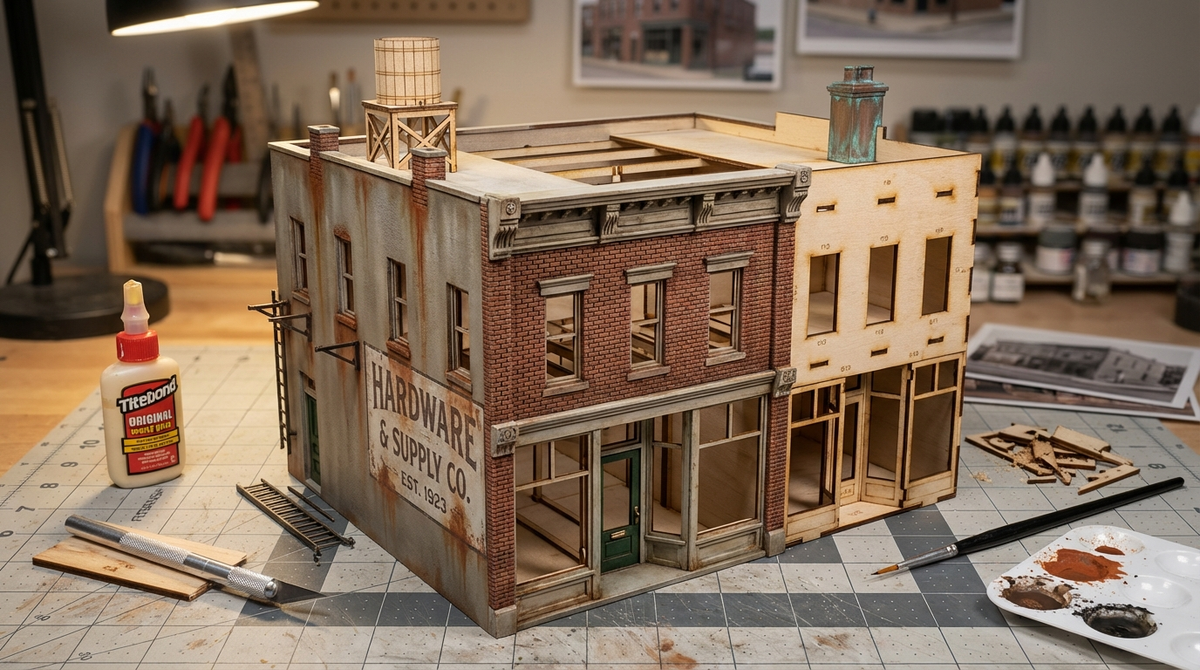
I've been running O gauge trains since my dad first set up that Lionel loop around the Christmas tree in our Cicero living room back in 1972. After 28 years of fixing things at the CTA's Skokie Shops, I've learned that the difference between something that works and something that looks right often comes down to details most people overlook. That's exactly where O gauge accessories and buildings come into play.
Your layout isn't just about the trains. The structures, the operating accessories, the little details that catch your eye when a locomotive rolls past a lit storefront at midnight - that's what separates a track from a railroad. Let me walk you through everything I've learned about making your O gauge world feel real.
Here's where a lot of folks get tripped up, and I don't blame them. The terms get thrown around like they're interchangeable, but they're not. Gauge means the distance between the rails. Scale means how big the model is compared to the real thing. Two different measurements, two different headaches if you mix them up.
In the United States, O scale runs at 1:48 - that's a quarter inch to the foot if you're old school like me. The track gauge sits at 1.25 inches between the rails. Pretty straightforward until you start shopping internationally.
British O gauge uses 7mm to the foot, which works out to 1:43.5. European manufacturers following MOROP NEM standards often build at 1:45. Those differences might sound small on paper, but stick a British 1:43.5 die-cast car next to your American 1:48 buildings and something looks off. The car appears about 10% too large, like it belongs in a different movie.
I made this mistake myself about fifteen years ago. Bought a beautiful set of vehicles from a UK seller on eBay, thinking I'd scored a deal. They looked great in photos. On my layout, next to my American-scaled structures, they stuck out like a transit bus trying to squeeze through an alley. Ended up giving them to my nephew.
The 2-rail versus 3-rail debate has been going on longer than I've been alive. Three-rail is what most of us grew up with - Lionel, Marx, those holiday loops under the tree. That center rail makes wiring reverse loops a breeze, and the selectively compressed proportions let trains handle tighter curves.
Two-rail O scale appeals to modelers chasing maximum realism. No visible center rail, prototypical wheel profiles, scale couplers. The trade-off is more complex wiring and larger curve requirements. Some folks take it even further with Proto:48, which uses a track gauge of 1.177 inches to match the exact proportions of standard gauge prototype.
My basement runs three-rail because I like running my trains, not just looking at them. The O Scale Central community has strong opinions either way, but honestly? Run what makes you happy.
Before you place a single building trackside, know your clearances. NMRA RP-7.1 spells out the minimums: 5.75 inches vertical clearance for tunnels and bridges, 2.25 inches horizontal clearance from track centerline on straight track.
Curves change everything. NMRA RP-7.2 explains why your parallel tracks need wider spacing when they bend. On tight O-36 curves, track centers should expand to around 6 inches. I learned this the hard way when a passenger car sideswipe took out a platform canopy I'd spent two weekends building.
The O gauge market has more options than ever, but knowing who specializes in what saves you time and money. I've bought from most of these outfits over the years, some more successfully than others.
Menards has become a major player with their affordable, often animated buildings. Their structures typically run $75 to $230 and come pre-lit with 4.5V LEDs. Fair warning though: that 4.5V adapter is unregulated. Without a load, it can spike to 9.5 volts DC. I've seen guys burn out Miller signs and LED boards because of this. Either use a regulated power supply or add inline resistors.
Lionel buildings emphasize their Plug-Expand-Play system, which works beautifully with FasTrack layouts. Their structures integrate smoothly with Legacy command control, though you'll pay a premium for that convenience.
MTH RailKing buildings offer solid LED-lit structures at competitive prices. The detailing has improved over the years, and their Operating Coaling Tower remains a favorite operating accessory.
Woodland Scenics Built-and-Ready structures impress me with their weathering. The J. Frank's Grocery and Corner Emporium look like they've actually been standing trackside for decades.
If you enjoy the building process, this is where things get interesting. Bar Mills kits use laser-cut wood and metal castings to create some of the most detailed structures available. Their instructions can be dense, and these aren't beginner projects. But the results speak for themselves.
Better Than Scratch (B.T.S.) produces kits with excellent instructions and tab-and-slot construction that makes assembly logical. Their Cabin Creek Post Office was one of the first craftsman kits I attempted, and the clear documentation helped me avoid most rookie mistakes.
ITLA Scale Models offers a modular approach with their configurable wall systems. Want to build a custom industrial complex? Their interchangeable panels let you design structures that fit your specific space.
Korber Models specializes in industrial structures - roundhouses, power plants, grain facilities. They mix plastic shells with laser-cut detail parts, landing somewhere between RTR convenience and craftsman challenge.
Downtown Deco makes Hydrocal kits that capture masonry textures like nothing else. Their FAQ page explains why the porous material takes paint and weathering washes so well. Just handle these carefully - Hydrocal is brittle and doesn't forgive drops.
Frenchman River Model Works produces cast resin kits, many from original Thomas Yorke designs. Resin requires washing to remove mold release agents before painting, and you'll need CA glue for assembly rather than plastic cement.
When I started wiring accessories decades ago, everything ran through simple push buttons. Press and hold for action. Those days are fading fast. The market has shifted toward centralized relay hubs that work with multiple command systems.
Track power for modern command systems like Lionel Legacy and MTH DCS runs at 18 VAC. Most traditional accessories with solenoid mechanisms expect 14 VAC. Run them at higher voltages and you'll cook the coils.
For LED lighting in buildings, a dedicated DC bus makes sense. Miller Engineering signs and most modern lighting components prefer clean 5V or 12V DC power isolated from your track signals.
The Lionel LCS ASC2 has become the go-to for Legacy users. It handles four switches or eight accessories in momentary or latching modes, all controllable through the LCS App.
MTH's DCS AIU serves the same purpose for DCS operators. You can daisy-chain up to five units for larger layouts.
Running DCC? The Digitrax DS64 handles four turnouts with LocoNet compatibility. NCE's Switch8 Mk2 offers eight outputs for stall motors like the Tortoise, with position memory through power cycles.
Ground loops and voltage spikes cause more grief than most modelers realize. All power supplies need to share a single common ground point. For TMCC and Legacy systems, the command base requires a proper earth ground to function correctly.
TVS diodes are cheap insurance against voltage spikes from derailments and accessory operations. Install them at terminal strips near the track feeds. After watching a friend fry an expensive decoder during a simple derailment, I added these to every power district on my layout.
Let me give you real numbers based on current pricing, because nothing frustrates me more than articles that dance around the money question.
Basic RTR buildings from Menards start around $75 and climb to $230 for larger animated pieces. Woodland Scenics Built-and-Ready structures run $75 to $190 depending on complexity. Lionel's command-compatible buildings often push past $200.
Prices have climbed about 14% since 2022. A small B.T.S. kit might run $34, while complex Banta Modelworks structures reach $500. The O Scale Resource magazine runs regular price comparisons if you want to track market trends.
Simple operating accessory kits start around $60. Command-controlled units like the Lionel Culvert Loader run around $300. The Gantry Crane and similar flagship accessories push well past $500.
A dense, well-detailed scene beats a sprawling empty layout every time. I've watched visitors at club open houses spend twice as long studying a small urban vignette with lit storefronts and ambient sounds as they do watching trains circle a sparse 4x8 oval.
For a convincing town center in about 3.5 square feet:
Total investment around $594, with maybe 20 hours of assembly and detailing for the craftsman kit. That gives you enough variety for realistic local freight operations with reefer spots and boxcar delivery points.
Heavy industry justifies unit train operations and looks impressive:
Budget around $1,250 with 70+ hours of building time. These scenes anchor an entire layout and give you legitimate reasons for coal hoppers and covered gondolas.
Matching your adhesive to your materials prevents heartbreak down the road. I've seen beautiful builds fail at the joints because someone grabbed the wrong glue.
For plastic-to-plastic bonds on styrene or ABS, solvent cements like Tamiya's chemically weld the parts. True fusion, not just surface adhesion.
Resin requires either five-minute epoxy or CA glue with internal reinforcement. Wood-to-wood joints call for aliphatic resin (Titebond II or III) for waterproof strength.
Clear parts like windows? Never use CA near them. The fumes cause fogging. Canopy glue like Formula 560 stays flexible and dries clear.
For foam scenery, use odorless foam-safe CA. Standard CA melts foam on contact.
All resin parts need washing before paint. Mold release agents cause adhesion failure if you skip this step.
Acrylic primers work on everything and allow 12 hours before masking. Lacquer primers give smoother finishes but can damage bare plastic if applied too heavily.
The three-layer weathering approach creates depth no single-step method matches. Start with a pin wash of thinned oil paint to define panel lines and crevices. Apply filters and dry pigments for color variation and grime. Seal everything with matte varnish to protect your work and kill unwanted sheen.
The quality threshold has been crossed. Consumer-grade SLA resin printers now achieve 0.2mm minimum wall thickness, matching the detail of traditional craftsman kits. Over 1,400 new O-scale STL files hit marketplaces last year alone.
Thingiverse offers free community designs. Simple structures and themed buildings populate the library. MyMiniFactory hosts more curated professional work.
When scaling UK designs to American proportions, multiply by 0.906 to convert 1:43.5 files to 1:48. Watch for features that become too thin during scaling - window mullions and railings may need thickening.
A modular building system lets you combine standardized components into unique structures. Premium marketplaces like Gambody cater to those wanting highly detailed files.
After working industrial maintenance for nearly three decades, I take this seriously. Some model railroad materials can genuinely hurt you if handled carelessly.
MDF dust contains formaldehyde. The EPA regulates emission standards for good reason. Cutting and sanding laser-cut MDF kits generates particles you don't want in your lungs.
Epoxy resin systems cause skin sensitization and respiratory issues. The fine dust from sanding cured resin gets deep into lung tissue. NIOSH documents the risks extensively.
Use a NIOSH-approved P100 respirator when cutting or sanding MDF, resin, or wood. Not a dust mask from the hardware store - a proper respirator with particle filters.
OSHA guidelines for wood dust and spray finishing ventilation apply in your hobby space just as they do in commercial shops. A tabletop HEPA extraction fan captures particles at the source.
Airbrushing solvent-based paints requires proper ventilation - 100 linear feet per minute minimum airflow across your work area.
I run my trains. That's my priority. But I also understand why original packaging and condition matter, especially when selling or insuring a collection.
The Train Collectors Association grading scale provides the common language for buying and selling. Condition runs from C-10 (Mint) down to C-1 (Parts Only). METCA standards mirror these conventions.
The paper and box scale (P-scale) grades packaging separately. A piece in C-8 condition with a P-8 box can sell for nearly three times what the same item brings loose. Western Division TCA publishes guides for identifying reproduction boxes and parts.
Stout Auctions data shows the premium original packaging commands. A Lionel #352 Icing Station in a Like New box might hammer at $460 while a loose Excellent example brings $165.
Limited production runs and low manufacturing quantities create scarcity. Club custom runs from organizations like METCA become collectible when production ends.
Licensed items carry mixed results. Coca-Cola themed trains and similar branded products sometimes appreciate, but high survival rates in mint condition can suppress values.
People ask me why I stick with O gauge when HO takes less space and costs less per piece. Fair question.
O scale's larger size means I can see details without squinting. After decades of close work on transit cars, my eyes appreciate the quarter-inch-to-the-foot proportions. HO offers more variety and requires less real estate, but O gauge locomotives have physical presence that smaller scales can't match.
Sound quality matters too. Larger tenders and bodies accommodate bigger speakers with richer bass response. When my Legacy Berkshire fires up, you feel it.
Space requirements are real. A simple loop with O-36 curves needs a table bigger than 3x6 feet. HO fits more railroad in less room. S scale splits the difference but has a smaller ecosystem.
Cost per item runs higher in O gauge. But if you want the experience of driving a locomotive rather than watching tiny trains from across the room, the investment pays off.
Good ergonomics prevent frustration during both building and operating sessions.
Benchwork height depends on how you'll view the layout. I run mine at about 48 inches for comfortable eye-level viewing while standing. Lower heights around 42 inches work better for seated operations or when kids are involved.
Maximum reach to any track should stay under 30 inches. Stretch further and you'll struggle with derailments in back corners. Island layouts accessible from both sides can go 60 inches wide; against-the-wall designs should max at 30.
Aisle width matters during operating sessions. 24 inches minimum for solo operation, 36 inches when multiple people need to pass.
Lift-out sections work for infrequent access points. Keep them light and align them with dowel pins for precision. Hinged gates with piano hinges handle main entry points where you pass through daily.
Pop-up hatches disguised as scenic elements provide emergency access to hard-to-reach areas. A lake or building cluster mounted on removable foam beats crawling under benchwork.
Future you will thank present you for thorough documentation. Color-code all wiring using a consistent scheme. Label both ends of every wire. Map your power districts and accessory addresses.
I keep a spiral notebook under my layout with wiring diagrams, decoder settings, and maintenance notes. Old school? Sure. But it works when the power goes out and I'm troubleshooting by flashlight.
LED lighting uses 75% less energy than incandescent bulbs and lasts dramatically longer. Their directional nature works perfectly for targeted building illumination.
For power supplies, DOE Level VI efficiency standards ensure stable, regulated output. Clean power protects sensitive electronics and reduces waste heat.
O gauge accessories and buildings transform a train layout into something worth sharing. The scale differences trip up newcomers, the wiring intimidates some folks, and the prices make others hesitate. But none of that matters once you see a properly lit urban scene at twilight with your favorite locomotive rumbling past weathered storefronts.
Start with what excites you. Maybe that's a coaling station that actually operates. Maybe it's a Hydrocal kit you paint and weather yourself. The hobby has room for runners and builders, collectors and operators.
I still have that original Lionel transformer my dad used back in Cicero. Doesn't power much anymore, but it sits on a shelf above my workbench as a reminder of why I got into this. The accessories changed, the technology improved, but that feeling of watching trains run through a miniature world? That's stayed exactly the same.
✨ Complete Your Layout: Explore our wide selection of Photo Real buildings, diorama backdrops, detail parts, and accessories in every popular scale.
✨ Unmatched Realism: From chrome detailing products to neon lighting kits – every piece is designed to make your miniature world come alive.