
O Gauge 3 Rail vs 2 Rail Comparison: A Builder's Honest Guide to Choosing Your Track System
Posted by Harold Lindgren on 31st Dec 2025
Order by phone: 763-231-7847
Free Shipping On Orders Over $100!
If you are already registered, please log in.
Create your account and enjoy a new shopping experience.
Create A New AccountPosted by Harold Lindgren on 31st Dec 2025
I've built four O gauge layouts in the past seven years, two for myself and two for friends who got stuck staring at plywood for too long. And here's what I've learned: the choice between 3-rail and 2-rail isn't about which system is "better." It's about which system fits your space, your patience level, and what you actually want out of this hobby.
Some folks want trains running reliably within a weekend. Others want photographic realism and don't mind spending three months on wiring. Neither approach is wrong. But pick the wrong track system for your goals, and you'll end up frustrated, broke, or both.
Let me walk you through what actually matters when making this decision.
At its core, the difference between 2-rail and 3-rail comes down to how electricity gets to your locomotive. Understanding this saves you from headaches down the road.
In a 3-rail setup, that center rail carries the power (typically AC), while both outside rails share a common ground. Think of it like a three-prong outlet where you've got one hot wire and two neutrals. This means your train doesn't care which direction it's facing on the track. Power flows the same way regardless.
Two-rail systems work differently. One rail is positive, one is negative (usually DC or DCC). The locomotive picks up power through wheels on opposite sides. Simple enough on straight track, but here's where things get interesting: turn that train around on a reverse loop, and suddenly your positive rail connects to negative. That's a short circuit waiting to happen.
I helped a friend wire his 2-rail layout last winter. Beautiful design, lots of operational interest, and one reverse loop that nearly drove him to sell the whole thing.
See, in 2-rail, every reverse loop, wye, and turntable creates a polarity conflict. The rails that were positive coming in become negative going out. Without intervention, your train creates a dead short the moment it bridges that gap.
The fix? You need isolated track sections and automatic reversing modules. Devices like frog juicers cost $33-45 per block and detect the momentary short, then flip polarity faster than your circuit breaker trips. The Digitrax AR1 handles this automatically, but you're still cutting gaps, running extra wires, and adding components.
Three-rail? None of that matters. The common-ground outer rails mean your train can loop, wye, and turntable all day without a single polarity conflict. I've watched guys at my local club run continuous operations for hours on 3-rail layouts that would require a PhD in electrical engineering if they were 2-rail.
This isn't a minor convenience. For layouts with complex track arrangements, 3-rail's wiring simplicity represents dozens of hours saved and significant cost reduction. That's time you could spend actually running trains instead of troubleshooting shorts.
The electrical differences cascade into mechanical ones. Your track and wheel standards dictate what equipment runs reliably, what curves you can use, and ultimately how much space you need.
Pick up a 3-rail locomotive and look at its wheels. Those flanges look massive compared to prototype railroad wheels. Modelers call them "pizza cutters," and while the nickname stings, it's earned.
Three-rail equipment uses what's called "hi-rail" wheels with deep flanges, sometimes over 0.118 inches deep. This design is intentional. Deep flanges grab track aggressively, making derailments rare even on sharp curves and through less-than-perfect turnouts.
Two-rail wheels follow NMRA S-4.2 standards, limiting flange depth to just 0.047 inches. They look prototypical but demand precision. Every piece of track must be laid accurately, every turnout tuned carefully, or you'll spend more time rerailing than running.
The practical difference becomes obvious when you watch both systems operate. A 3-rail train blasts through a slightly misaligned turnout without hesitation. A 2-rail train with scale wheels might pick the frog and derail. Neither approach is wrong; they just serve different priorities.
For the truly dedicated, there's Proto:48, which uses the prototypically correct gauge of 1.177 inches instead of standard O gauge's 1.25 inches. The visual improvement is striking, but we're talking about a niche within a niche. Most commercial equipment needs conversion, and you're essentially hand-laying all your track.
If you're reading this article trying to decide between 3-rail and 2-rail, Proto:48 probably isn't your starting point. File it away as something to consider after you've built a layout or two.
Here's where the rubber meets the rail, literally. The space you have available might make your decision for you.
Before we go further, let's clear up something that trips up newcomers. Three-rail curves are named by diameter (O-36 means a 36-inch circle), while 2-rail curves use radius (36" radius creates a 72-inch circle). An O-72 in 3-rail terminology equals a 36-inch radius in 2-rail speak. Keep this straight, or your track planning will become a mess of miscalculations.
Three-rail equipment is designed for tight spaces. Many locomotives handle O-31 or O-36 curves without complaint. That's a circle you can fit on a 4x8 sheet of plywood with room for scenery.
Two-rail equipment demands broader curves. While some gear technically runs on 36-inch radius (O-72 diameter), that's often considered a bare minimum that compromises appearance. Long passenger cars look awkward on tight curves, and couplers bind when cars swing too far. Most 2-rail modelers recommend 48-inch radius or larger for smooth operation and realistic looks.
Let's put this in practical terms. In a 10x12 foot room, you can build a 3-rail layout with multiple loops, sidings, and a small yard. That same room in 2-rail might accommodate a single-track mainline around the walls with minimal industrial switching. The 3-rail layout would let you run a variety of equipment; the 2-rail layout would demand you curate your roster carefully to match your curves.
Turnouts eat space, and their geometry varies between systems. Three-rail switches often use compact curve-substitution designs. Two-rail turnouts typically come in numbered configurations (#5, #6, #7.5), with higher numbers meaning gentler, longer switches.
For yard design, this matters. A 3-rail yard can pack more tracks into less linear footage. A 2-rail yard with proper #5 or #6 turnouts stretches longer. Plan accordingly, or you'll discover your yard doesn't fit where you intended.
Ten years ago, choosing 3-rail meant committing to either Lionel's TMCC/Legacy or MTH's DCS. Two-rail meant DCC. Mixing systems was painful or impossible.
That era is ending.
Lionel's Legacy/TMCC uses radio frequency signals to a command base, offering 200 speed steps and elaborate sound features. MTH's DCS sends signals through the rails with two-way communication, letting the locomotive report back its status. DCC is the open NMRA standard that dominates 2-rail but works just fine on 3-rail track.
What changed? MTH made its Proto-Sound 3.0 system DCC-compatible back in 2016. Suddenly, MTH engines could run on any DCC layout. No conversion needed.
Lionel responded with the Base3, which began shipping in July 2024. This command base controls all Lionel systems and interfaces with DCS and DCC equipment. At $599, it's an investment, but it unifies what were once incompatible ecosystems.
MTH countered with the WTIU, shipped November 2024, which replaced older hardware and integrated with Lionel systems. The September 2025 firmware update v1.3.0 enabled direct connectivity to Legacy and TMCC, letting users run mixed fleets from the MTH app.
The practical upshot? A modeler in 2025 can run Lionel, MTH, and generic DCC-equipped locomotives on the same layout, controlled from a single smartphone. The control system wars are over.
All three systems now offer fine speed control (Legacy's 200 steps, DCC's 128 steps, DCS's scale-miles-per-hour precision). All support consisting multiple locomotives. All deliver synchronized sound and smoke effects.
The Cab3 controls and DCS WiFi interface both offer smartphone operation. Pick based on what equipment you already own or what runs the prototypes you care about.
Maybe you've inherited a 3-rail collection but want 2-rail realism. Or you're curious whether your 3-rail equipment could run on a friend's 2-rail layout. Conversion is possible, but difficulty varies wildly.
Converting freight and passenger cars is straightforward. Swap the deep-flange 3-rail wheelsets for insulated 2-rail wheelsets (the insulated wheels go on the same side for all trucks). Replace those oversized "lobster claw" couplers with body-mounted Kadees. Done.
Parts are readily available. Atlas 2-rail conversion kits run around $33. NWSL offers specialized kits for specific models. Kadee couplers cost $5-10 per pair. Use a Kadee #812 height gauge to set everything at proper NMRA height.
A weekend project. Anyone with basic skills can handle it.
Modern MTH Premier diesels with the Proto-Scale 3-2 feature make conversion almost trivial. Remove the center rollers, flip a switch on the circuit board, and swap in scale wheelsets. MTH sells the appropriate wheelset kits. The whole process takes an evening.
Older diesels without this feature require more work. You're removing the AC-to-DC reversing unit, rewiring pickups from center rollers to insulated wheels, and potentially replacing the motor. Doable, but not for beginners.
Converting 3-rail steam engines pushes into serious machinist territory. Those deep-flange drivers need modification, either turning down flanges on a lathe or pressing new tires onto existing centers. You'll need to insulate wheels on one side of the locomotive and opposite side of the tender, requiring disassembly that intimidates experienced modelers.
For most people, buying a factory 2-rail steam engine makes more sense than attempting conversion. Save your sanity.
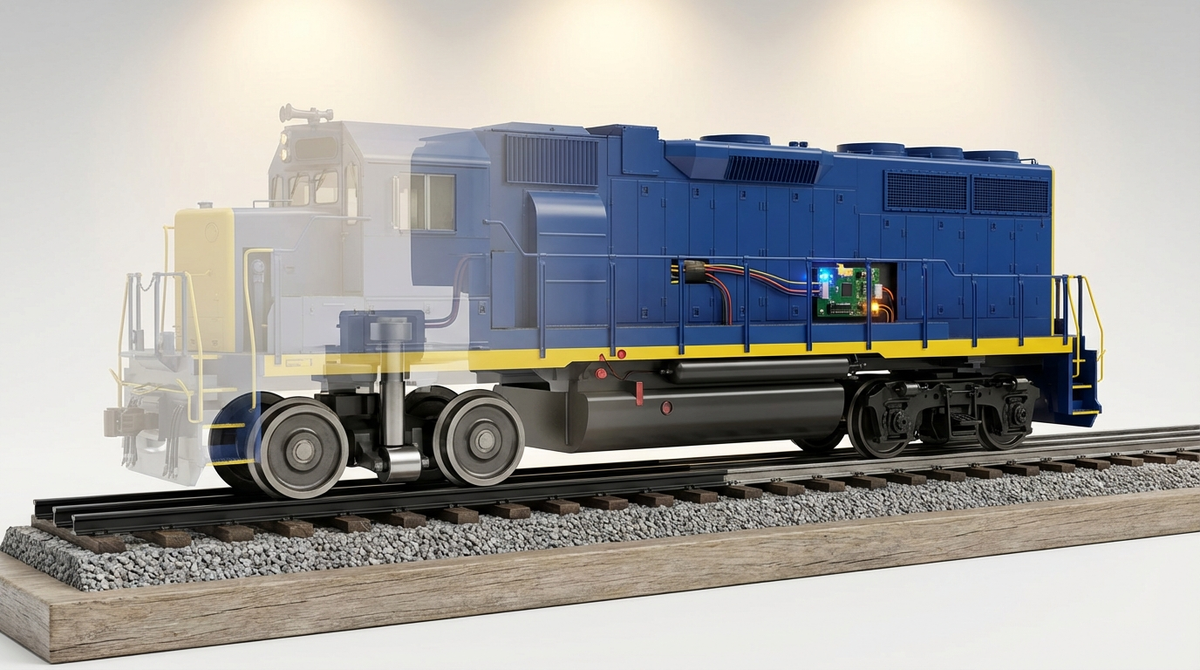
There's a way to sidestep this entire debate. Dead Rail puts batteries and radio receivers inside your locomotives, eliminating track power entirely.
No wiring. No dirty track problems. No polarity conflicts. Your rails become simple guides for the wheels.
A typical conversion involves a 14.8V lithium-ion battery, a radio receiver, and a DCC decoder. The receiver picks up commands from a handheld transmitter or smartphone, generates DCC signals, and the decoder controls the motor and sound. Modern Li-Ion packs provide 2+ hours of runtime in O-scale equipment.
Systems like ProMiniAir integrate with existing DCC infrastructure, forming what users call an "island of compatibility" with AirWire and Tam Valley systems. Other options include proprietary systems like RailPro and SoundTraxx Blunami.
A basic Dead Rail conversion runs around $180-300 in parts depending on your decoder choice. That sounds expensive until you calculate what 2-rail wiring costs across an entire layout with multiple reverse loops and power districts.
The conversion process involves removing track pickup components, fitting batteries and electronics, and installing charging ports. Complex steam locomotives require creative battery placement, but O-scale tenders usually have room.
For club members running on varied layouts, Dead Rail makes particular sense. Your locomotive works everywhere, regardless of what track system the host uses.
Let's talk numbers, because budgets matter.
Three-rail has the lower barrier. Grab a Lionel LionChief starter set for $300-960 and you're running trains that evening. Track, transformer, locomotive, and cars in one box.
Two-rail doesn't package this way. You're buying separately: a DCC-ready locomotive from Atlas O ($500-800), track and turnouts (more on that below), and a DCC system like the NCE Power Cab (~$200). Budget $1,000-1,500 minimum to get running.
This is where 2-rail expenses compound. A Lionel FasTrack O-36 remote turnout costs around $75. An Atlas O 2-rail #5 turnout runs $92, but you'll also need a separate switch machine and frog wiring components. That adds up across a yard with a dozen turnouts.
The flex track itself is competitively priced between systems, but 2-rail demands more careful installation. Sloppy trackwork that a 3-rail train ignores will derail 2-rail equipment constantly.
At the high end, both systems offer serious models. Lionel's VisionLine Hudson set runs $2,160. Sunset/3rd Rail brass models command similar premiums in both 2-rail and 3-rail versions. The quality gap has narrowed substantially; modern 3-rail Premier models rival 2-rail detail.
Production schedules differ, though. Atlas O operates on pre-order cycles with 9-24 month lead times. MTH shifted to monthly built-to-order releases after reorganization. Plan accordingly if you want specific prototypes.
If 3-rail's simplicity appeals but you cringe at visible center rails, take heart. You can dramatically improve appearances without abandoning the system.
Paint transforms 3-rail track. Spray all three rails with a flat brown or grimy black, then immediately wipe the railheads clean while paint is wet. Rust-Oleum Camouflage Earth Brown (#1918) is a popular choice among modelers I know.
Some folks prefer GarGraves Phantom line with pre-blackened center rails, but results vary. Many find painting yields better integration with surrounding scenery.
Generous ballasting that buries tie bases further reduces center-rail prominence. Brennan's Better Ballast provides realistic texture without overwhelming detail.
Installing Kadee couplers on 3-rail rolling stock does more for realism than almost any other single modification. Those truck-mounted lobster claws look terrible in photographs. Body-mounted Kadees couple closer, look prototypical, and produce authentic slack-action sounds.
Many modern cars from Weaver and Atlas come with pre-drilled mounting pads. The conversion takes maybe 15 minutes per car once you get the hang of it.
MTH's scale wheel option on Premier equipment splits the difference between pizza cutters and true scale flanges. These "hi-rail" wheels still handle 3-rail track but look substantially better from normal viewing distances.
After building multiple layouts in both systems (and helping friends through their decisions), patterns emerge in who chooses what.
Your space is limited. That spare bedroom or basement corner can't accommodate 48-inch radius curves? Three-rail gets you running trains where 2-rail physically won't fit.
You value operation over appearance. Club members running timetable-and-train-order sessions for hours straight appreciate equipment that doesn't derail on marginal trackwork.
You want broad equipment compatibility. More ready-to-run choices exist in 3-rail, particularly for modern diesels and postwar-era equipment.
You prefer simple wiring. If electrical work frustrates you, 3-rail's polarity-free design eliminates the most complex aspects of layout construction.
Photographic realism is your goal. That visible third rail ruins close-up shots. Two-rail track photographs like the prototype.
You have space for broad curves. Forty-eight inch radius minimum, sixty or more preferred. Your room needs to accommodate these without cramped aisles.
You appreciate the DCC ecosystem. Native DCC compatibility means access to decoders, systems, and support from the broader model railroad community, not just O gauge specialists.
You enjoy precision work. Two-rail demands careful track laying and attention to clearances. If you find that satisfying rather than tedious, you'll thrive.
You run at clubs with varied standards. Battery power works everywhere, regardless of what track system you encounter.
You hate troubleshooting electrical issues. Dead Rail eliminates dirty track, loose feeders, and power district problems.
You want 2-rail realism without 2-rail wiring complexity. Your track becomes purely mechanical, with all electrical sophistication contained in the locomotive.
If a friend asked me today what system to choose, I'd start with questions rather than recommendations.
How much space do you actually have? Measure twice. A 10x12 room changes the calculus compared to a 15x25 basement.
What era and railroad interest you? Some prototypes have better representation in one system than the other.
How much time will you spend operating versus building? Modelers who run trains constantly should prioritize reliability. Those who enjoy construction can accept more maintenance-intensive choices.
What's your wiring comfort level? Be honest. If you've never soldered or used a multimeter, 3-rail's simplicity offers a gentler learning curve.
The good news? Both systems produce excellent results in the right hands. I've seen stunning layouts in 3-rail that put lazy 2-rail efforts to shame, and vice versa. The track system enables your modeling; it doesn't define it.
Pick the one that matches how you want to spend your time. Then build something you're proud of.
✨ Complete Your Layout: Explore our wide selection of Photo Real buildings, diorama backdrops, detail parts, and accessories in every popular scale.
✨ Unmatched Realism: From chrome detailing products to neon lighting kits – every piece is designed to make your miniature world come alive.