
N Scale vs HO Scale Detail Comparison: A Builder's Honest Look at What Really Matters in 2025
Posted by Harold Lindgren on 30th Dec 2025
Order by phone: 763-231-7847
Free Shipping On Orders Over $100!
If you are already registered, please log in.
Create your account and enjoy a new shopping experience.
Create A New AccountPosted by Harold Lindgren on 30th Dec 2025
I've built four model railroad layouts since retiring from construction in 2018, and if there's one question I hear more than any other at club meetings, it's this: should I stick with HO or switch to N scale for better detail in a smaller space?
After 40 years of measuring twice and cutting once, I've learned that the answer depends on what you're actually trying to build. And the old assumptions about N scale being too small for serious detail work? They're mostly outdated.
Let me be direct with you: if someone told you five years ago that N scale couldn't match HO for fine details, they were right. Today? That argument holds about as much water as a screen door on a submarine.
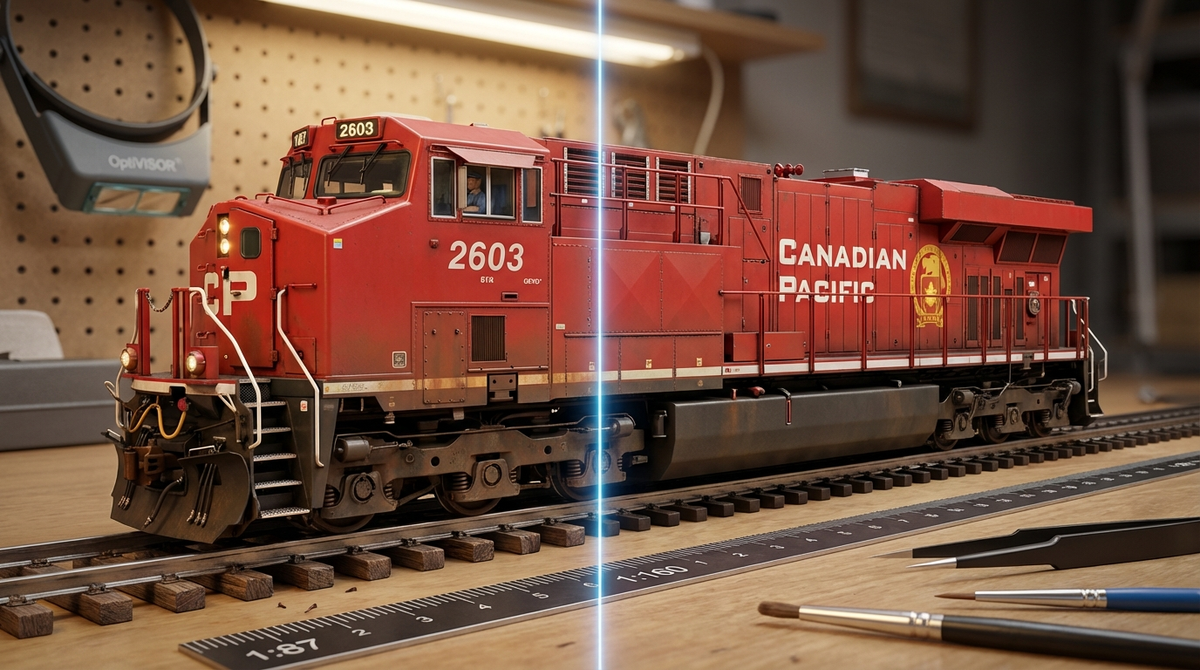
The manufacturing revolution that started around 2018 has armed N scale modelers with tools that would have seemed impossible a decade ago. Look at what ScaleTrains is doing with their Rivet Counter N scale GE AC4400CW locomotives. These models come with factory-applied wire grab irons, trainline hoses, MU clusters, and etched-metal radiator grilles. The Canadian Pacific version runs about $319 with DCC and sound, and the level of road-number-specific detail would have been unthinkable in N scale just a few years back.
I still model in HO myself, the Soo Line through Minnesota and Wisconsin, but I can admit when the competition has caught up. The Atlas Master Line now includes N scale boxcars with separately applied wire grab irons and etched-metal brake wheel platforms that rival anything in my HO fleet.
Broadway Limited Imports even released the first factory-installed operating smoke unit in N scale on their Paragon4 2-8-0 Consolidation. Die-cast metal body, numerous separate parts, and actual smoke coming from the stack. In N scale. My younger self would have called that science fiction.
Here's where my building background comes in handy. When I framed houses, I knew that tolerances mattered differently depending on whether you were looking at rough carpentry or finish work. The same principle applies to model railroading.
The human eye can resolve details down to about one arcminute of angle. That's not a made-up number; it's the angular diameter threshold for 20/20 vision. At a typical viewing distance of 36 inches from your layout, that translates to being able to see details as small as 0.0109 inches.
Do the math with me. An HO scale grab iron made from 0.012-inch wire measures about 0.30 mm thick. You can see it clearly at three feet. An N scale grab iron made from 0.007-inch wire comes in at 0.18 mm, and at that same distance, it starts to blur into the surface of the model.
This matters if you're building a contest diorama or shooting macro photography. The typical EMD locomotive uses 1-inch diameter solid wire handrails on the prototype, and reproducing that faithfully requires different wire gauges in each scale. In HO, those handrails pop. In N, they're visible but not quite as crisp without magnification.
For layouts designed to be viewed from a normal standing position? The difference barely registers. I've stood in front of modern N scale layouts at conventions and honestly couldn't tell the scale until I looked at the people for reference.
This is where HO still holds a genuine advantage, and it's not something manufacturers can engineer around easily. Physics is physics.
Modern sound decoders in both scales use identical audio technology. The ESU LokSound 5 produces 16-bit sound at 31.25 kHz whether it's installed in an HO diesel or an N scale switcher. The difference is what happens after that signal leaves the decoder.
An HO diesel shell can accommodate 28mm mega-bass speakers capable of reproducing low frequencies down to around 250-350 Hz. That's the deep rumble you feel in your chest when a real SD40-2 idles nearby. SoundTraxx makes excellent speakers in various sizes that take full advantage of that available space.
N scale locomotives are typically limited to 11x15mm sugar cube speakers that roll off near 500 Hz. The sound is clear, it's loud enough, but that gut-punch low end just isn't there. Zimo makes some impressive MS series sound decoders for small scales with real 16-bit resolution, but even they can't change the fact that tiny speakers can't move enough air to produce bass.
If chest-thumping sound matters to you, HO wins. If you're okay with higher-frequency audio that still captures the character of the prototype, N scale sound has become genuinely good.
Here's a practical concern that doesn't get enough attention: electrical pickup and what happens when your locomotive hits a dirty stretch of track or an unpowered turnout frog.
The internal volume of an HO locomotive shell is roughly eight times that of its N scale counterpart. That extra space allows for serious keep-alive capacitor installations. An ESU PowerPack Mini at 15.7 x 9.7 x 13 mm can provide up to four seconds of power through interruptions. The SoundTraxx CurrentKeeper at 40 x 6 x 11 mm can manage up to ten seconds.
In N scale, you're working with the TCS KA-N1 at just 6.6 x 9.2 x 3.5 mm, which provides about 1000µF of capacitance. That's enough for maybe one to two seconds of power, which might not bridge a long dead frog or a particularly grimy section of track.
The Broadway Limited Paragon4 decoders address this by integrating extra capacitance directly onto the board, but HO still has a meaningful advantage for layouts with complex trackwork or modelers who aren't obsessive about track cleaning.
Now let me give N scale its due, because this is where the smaller scale absolutely dominates.
One scale mile in N scale measures 33 feet. In HO, that same scale mile stretches to 60.7 feet. You can read more about these scale calculations at the NMRA's beginner page.
What does that mean practically? The Free-moN standard specifies a 22-inch minimum radius for N scale mainlines, which accommodates even modern 89-foot autoracks without unrealistic overhang. To achieve equivalent operational realism in HO, you'd need 40-inch curves or larger.
I built my current Soo Line layout in a 12 x 14 foot spare room. In HO, I can run convincing local freight trains of maybe 8-10 cars through fairly generous curves. If I'd gone with N scale, I could have modeled a full mainline with passing sidings, a yard, and multiple industries, running 25-car trains that actually look like the prototypes I remember seeing as a kid.
For modelers working in apartments or spare bedrooms, N scale offers four times the layout potential in the same footprint. That's not marketing fluff; it's geometry. The possibilities for N scale layouts in modest spaces are genuinely impressive.
Choosing track is a bigger deal in N scale than HO, and there are some pitfalls worth knowing about.
The NMRA's S-4.2 wheel standard establishes dimensions for both scales, but N scale has a particular compatibility issue with older equipment.
True fine-scale track like Atlas Code 55 looks fantastic, but it's incompatible with the deep-flange pizza cutter wheels found on pre-2000 N scale rolling stock. Those old flanges hit the molded spike heads and cause rattling and poor tracking.
You have two solutions: replace wheelsets on your older equipment with modern low-profile versions, or use Peco Code 55 track, which ingeniously uses buried Code 80 rail to achieve a fine-scale appearance while remaining compatible with all wheel types.
In HO, Peco Code 83 has become the go-to choice for realistic American prototype modeling. The track is based on actual A.R.E.A. drawings with authentic tie sizes, spacing, and spike detail. Most modern HO equipment uses RP-25 wheel profiles that run well on Code 100, 83, or even 70 track, so compatibility is less of a concern.
The notion that N scale is universally cheaper needs some scrutiny.
On a per-item basis, yes, N scale costs less. A high-detail N scale diesel with DCC and sound typically runs 10-15% cheaper than its HO equivalent. A ScaleTrains Rivet Counter N scale ET44AC might retail for $250-325, while the HO version goes for $319-357.
But here's what the marketing doesn't tell you: a visually impressive train in N scale requires more cars to achieve the same visual mass as HO. If you're running 15-car trains instead of 8-car trains because your layout can accommodate them, you've just spent nearly twice as much on rolling stock.
Track and scenery costs scale with physical layout area, not modeling scale. Since N scale layouts often feature more track and more structures to fill the same room, the total expenditure can match or exceed an HO layout of simpler design.
The Atlas Master Line FMC 5077 boxcar runs about $38.95 in HO, with wire grabs and etched parts out of the box. The N scale version comes in around $25-35. But if your N scale layout can fit twice as many cars on screen at once, you might end up buying twice as many.
My honest assessment: for a layout of equivalent operational complexity and visual impact, total ownership costs for N and HO converge to within about 10%.
This is where I'll share something personal. I'm 68 years old, and my eyes aren't what they were when I was framing houses in my thirties.
The smaller components of N scale present genuine challenges for modelers with age-related vision changes. But the difficulty isn't insurmountable, and it's mostly a function of equipment rather than willpower.
For fine work in any scale, lighting standards recommend illuminance levels of 1000-1500 lux or more. That's significantly brighter than typical room lighting. A high Color Rendering Index (CRI above 90) ensures accurate color perception.
The OptiVISOR headband magnifier has become my constant companion at the workbench. The DA-5 lens with 2.5x magnification at 8 inches works well for most HO detailing and standard N scale work. For N scale super-detailing or soldering micro-LEDs, the DA-7 at 2.75x and 6 inches brings everything into focus.
Good tweezers matter more than you'd think. Cheap tweezers are useless for handling tiny N scale parts. Swiss-made Dumont tweezers in styles 3C or 5 are worth every penny for precision placement.
The American Optometric Association recommends the 20-20-20 rule for any close work: every 20 minutes, take a 20-second break to look at something 20 feet away. Your eyes will thank you.
The available volume inside a locomotive shell determines what electronics you can install and how many features you can activate.
HO locomotives typically use PluX22 interfaces (NEM 658) with decoder dimensions up to 30.0 x 16.0 x 6.0 mm. This format supports up to 12 amplified function outputs, enough for complex lighting schemes, servos, and sound.
N scale relies primarily on the Next18 interface (NEM 662), with decoder dimensions limited to about 15.0 x 9.5 x 2.9 mm for non-sound versions. The ESU LokSound 5 micro packs impressive capability into that tiny footprint, but you're working with 4 amplified and 4 logic function outputs rather than the dozen available in HO.
For basic DCC operation with sound, both scales perform excellently. When you start adding specialized lighting effects, synchronized ditch lights, cab lighting, and multiple speakers, HO's larger form factors provide meaningful breathing room.
If you attend club operating sessions or exhibitions, the physical handling of your models matters.
An HO scale model occupies roughly eight times the volume of its N scale counterpart. The A-Line Hobby Tote system holds 16 HO 40-foot boxcars per case. The same case holds 98 N scale 40-foot boxcars. That's a massive storage density advantage for N scale.
The Axian Technology boxes offer another option, holding cars on their sides with foam retainer strips. The side-lying position works but poses some risk to delicate handrails, especially on the finer N scale models.
For maximum protection, Kato's bookcase-style cases store cars upright in pre-cut foam inserts, often shaped to specific train sets. They're excellent for Japanese prototype trains and anything you absolutely cannot afford to damage.
The N vs HO comparison gets complicated when you consider that N scale isn't actually one standard worldwide.
North American and continental European N scale uses 1:160 ratio. British N scale uses 1:148 to match their standard gauge on 9mm track, making UK models about 8% larger than their American counterparts. Japanese conventional N scale uses 1:150 for their narrow-gauge Cape Gauge trains, while Japanese Shinkansen (bullet trains) use 1:160.
Mix these scales on the same layout and you'll notice the differences. A 1:150 Japanese building placed next to a 1:160 American locomotive will look subtly oversized. For purists, this matters.
Coupler systems also diverge by region. North American modelers standardized on Kadee magnetic knuckle couplers for HO and Micro-Trains for N scale. European manufacturers follow NEM (Normal European Modelling) standards set by MOROP, using standardized pockets that allow easy coupler swapping and close-coupling mechanisms.
If you're mixing American and European equipment, Kadee makes couplers with NEM-compatible shanks for HO. The N scale situation is trickier since Micro-Trains hasn't produced a Magne-Matic for the NEM 355 pocket.
Let me walk through a specific example to show how these differences play out in practice.
ScaleTrains produces their Rivet Counter GE ET44AC GEVO in both scales, allowing direct comparison of manufacturer-supplied detail.
The HO version features see-through steps, operating ground lights, separate plumbing and cabling, etched metal grilles, and a full cab interior. The Canadian National anniversary edition includes road-number-specific details throughout.
The N scale version includes factory-applied wire grabs, trainline hoses, MU clusters, uncoupling levers, wipers, mirrors, and sunshades with etched metal grilles and a detailed cab interior. The Norfolk Southern Thoroughbred version demonstrates the same attention to prototype accuracy.
The primary HO advantages are the see-through steps and more extensive underframe cabling. From a normal viewing distance of 2-3 feet, I'd challenge most modelers to identify which scale they're looking at without size reference.
After building four layouts and spending more hours than I should admit thinking about this stuff, here's my honest framework.
Choose N scale if you want long trains snaking through sweeping mountain scenery, mainline operations with realistic curve geometry, or if your available space is limited to a spare room or apartment. The detail is there. The sound is good enough. The space efficiency is unbeatable.
Choose HO scale if deep, chest-thumping sound matters to you, if macro photography is part of your hobby, if you prefer larger parts that are easier to handle and modify, or if you're building a detailed switching layout where you'll be viewing models up close. The mature market means more variety, especially for steam and transition-era prototypes.
The old argument that N scale can't hold a candle to HO for detail? Dead and buried. Modern ScaleTrains Rivet Counter N scale locomotives would embarrass HO models from a decade ago.
The real deciding factors now are speaker physics, available space, and whether you've invested in good magnification. Everything else is negotiable.
I still model in HO because I started with the Soo Line and I'm too stubborn to switch. But if I were starting fresh in 2025 with my current spare room? I'd think long and hard about N scale. The numbers make sense, and the detail debate is over.
✨ Complete Your Layout: Explore our wide selection of Photo Real buildings, diorama backdrops, detail parts, and accessories in every popular scale.
✨ Unmatched Realism: From chrome detailing products to neon lighting kits – every piece is designed to make your miniature world come alive.