
N Scale Trains for Small Spaces: A Railroader's Guide to Compact Layouts
Posted by Gerald Hoffmann on 30th Dec 2025
Order by phone: 763-231-7847
Free Shipping On Orders Over $100!
If you are already registered, please log in.
Create your account and enjoy a new shopping experience.
Create A New AccountPosted by Gerald Hoffmann on 30th Dec 2025
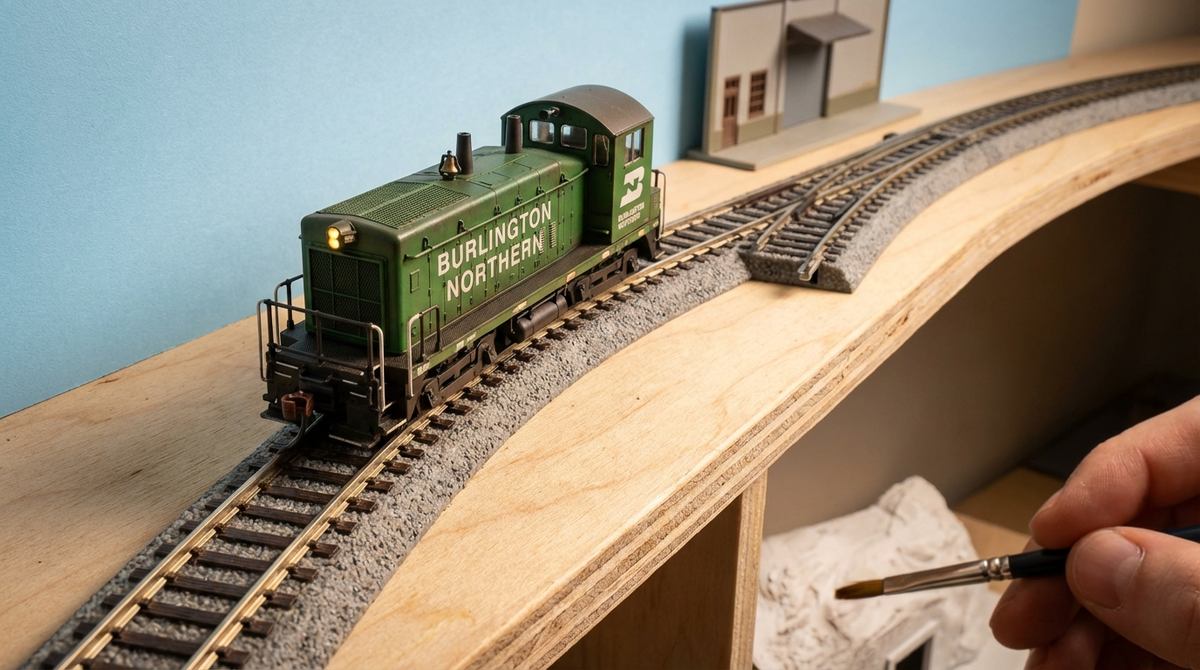
I spent 35 years working the real iron for Burlington Northern Santa Fe before hanging up my lantern in 2019. My basement workshop in Duluth is dedicated to HO scale recreations of Great Northern and Northern Pacific operations from the transition era. But here's the thing: if I were starting fresh today in a small apartment instead of a house with a full basement, I'd be running N scale without a second thought.
Why? Because the math doesn't lie. N scale gives you roughly three times the track density of HO in the same footprint. That's not marketing fluff. That's geometry working in your favor.
I've watched countless newcomers at the Lake Superior Railroad Museum where I volunteer struggle with the same question: how do I fit a meaningful railroad into my spare bedroom or apartment corner? This guide is my answer. We're going deep on everything from curve radii to wiring to the latest nano-sized sound decoders. Pull up a chair.
At 1:160 ratio, N scale models run on 9mm gauge track and occupy roughly one-eighth the volume of their HO counterparts. That simple fact changes everything when you're working with limited real estate.
Consider this practical example. A basic loop of Kato Unitrack using their standard 12.4-inch radius curves creates a layout just over two feet wide. Try that in HO with an 18-inch radius and you're looking at a layout over three feet wide. The difference adds up fast when you're trying to squeeze past your layout to reach the refrigerator.
What does this mean in real terms? You can run longer, more prototypical-looking trains. You can include passing sidings, small yards, and interesting switching moves. You can build scenes that actually tell a story instead of just watching a train chase its tail around a Christmas tree oval.
Here's where newcomers often get confused. The term "N gauge" refers to that consistent 9mm distance between the rails. The "N" comes from "neun," German for nine. That part is universal worldwide.
But "scale" varies by region:
The good news? Models from all regions run on the same 9mm track, making them largely interoperable. The 7.7% size difference between 1:160 and 1:148 is barely noticeable unless you park identical prototypes side by side. Some clever modelers even use the smaller 1:160 buildings in their background to create forced perspective depth on a 1:148 layout.
This is where I've seen more frustration and wasted money than anywhere else in the hobby. Picking the right minimum curve radius determines what equipment you can run reliably and how good it looks doing it.
The unofficial N scale minimum has long been 9.75 inches, which is what you'll find in most starter sets. Kato designs their locomotives around this 249mm baseline curve.
But after watching trains run at dozens of club meetings and open houses, I can tell you that 9.75 inches is a bare minimum that limits your options. The practical sweet spot starts at 11 to 12 inches. That extra inch or two opens up your equipment choices dramatically and makes everything run smoother.
| Equipment Category | Absolute Minimum Radius | Recommended Minimum | Notes |
|---|---|---|---|
| Small Switchers (NW2, MP15DC) | 7.5" - 9.75" | 11" or greater | Generally reliable, but body-mounted couplers may struggle below 10" |
| 4-Axle Road Switchers (GP38-2) | 9.75" | 11" - 12" | Works on tight curves but looks better with broader radii |
| 6-Axle Diesels (SD70, ES44AC) | 9.75" - 11" | 12" - 15" or greater | Iffy on 9.75" curves; significant overhang |
| Small Steam (0-6-0, 2-8-0) | 9" - 9.75" | 11" or greater | Most handle tight curves but look unrealistic |
| Large Steam (4-8-4, Big Boy) | 11" - 12" | 15" - 18" or greater | Will navigate 11" but with extreme overhang |
| Short Freight Cars (33' - 40') | 7.5" | 9.75" or greater | Rule of thumb: 2.5x car length minimum |
| Medium Freight Cars (50' - 60') | 9.75" - 11" | 12" or greater | Body-mounted couplers on 60' cars can cause issues on 12" curves |
| Long Passenger & Autoracks (70' - 89') | 13" - 17" | 19" or greater | Will bind and look ridiculous on anything tighter |
| Kato Pocket Line/Trams | 4.6" (R117mm) | 6" (R150mm) | Specifically designed for Compact track; not compatible with standard equipment |
Keep your mainline grades at 2% or less for reliable operation. That's a 2-inch rise over 100 inches of track. Push to 4% and you'll watch your train length shrink along with your locomotive's enthusiasm.
For vertical clearance under bridges, the NMRA standard is 1-21/32 inches, but build for 2 inches if you want to run modern double-stack containers without holding your breath.
Turnouts are labeled by their frog number. A #4 turnout has a sharper angle than a #6, which is sharper than a #8.
The track you choose shapes everything from setup time to long-term reliability. Here's how the major systems stack up for small-space builders.
If you want plug-and-play reliability, Kato is hard to beat. The Unijoiners snap together solidly, electrical conductivity stays consistent, and turnout motors come built-in. Their Compact geometry options with R117mm and R150mm curves open up possibilities for briefcase-sized layouts.
The Code 80 rail looks a bit chunky to finescale eyes, and the price runs higher than flex track, but you can tear down and rebuild configurations endlessly. I've watched members at our local club rebuild entire layouts in an afternoon using Unitrack they've owned for decades.
The Japanese alternative offers the widest geometric variety including curved turnouts, 3-way switches, and mini-curves down to R103mm. The roadbed profile looks more realistic than Unitrack. The catch? You're importing from Japan, which affects cost and availability. The connectors also aren't as robust as Kato's system.
For my money, Peco Code 55 Streamline represents the best balance of appearance and compatibility for permanent layouts. Their clever "buried rail" design looks prototypically low while still working with older deep-flange wheelsets. The turnouts are spring-loaded, mechanically precise, and DCC-friendly out of the box.
The trade-off is skill requirement. You're cutting and shaping flex track, filing rail ends, and doing more involved turnout wiring. It's not a weekend project for someone who's never soldered before.
Atlas Code 55 wins the beauty contest with fine nickel silver rail and realistic brown tie detail. It's gorgeous. It's also unforgiving. Those molded spike heads will catch on older "pizza-cutter" wheelsets, causing derailments and frustration. If your collection includes vintage equipment, budget for wheel replacements or look elsewhere.
The time-tested standard that works with everything. Less visually refined than Code 55 options, but affordable, durable, and compatible with any N scale wheelset ever made. The Snap-Switches are entry-level at best, so plan to upgrade those if you're serious about operations.
You don't need a dedicated train room to build something meaningful. Here's what works for renters and small-space dwellers.
A 36" x 80" hollow-core door from the home improvement store gives you a lightweight, rigid, and inexpensive base for a substantial N scale layout. Support it on sawhorses or detachable legs, and you can lean it against a wall when company comes over.
The internal cardboard honeycomb structure creates a drum effect with noise and vibration, so top the door with 1-2 inches of extruded foam insulation. This dampens sound, provides a carveable base for scenery, and makes the whole package more pleasant to operate.
The LACK series uses lightweight honeycomb construction that supports up to 55 pounds while weighing almost nothing itself. A single 21-5/8" square side table can host a complete micro-layout. Link multiple units together for something larger. The hollow structure actually helps with creative wiring solutions if you're careful not to compromise the frame.
| Factor | Recommendation | Why It Matters |
|---|---|---|
| Maximum Reach | 18-24 inches | Beyond 30 inches becomes unreachable for maintenance and rerailing |
| Shelf Depth | 12-18 inches for N scale | Narrower shelves preserve aisle space in tight rooms |
| Layout Height | 50-56 inches standing; 40-42 inches seated | Eye-level viewing creates more realistic scenes |
| Aisle Width | 30 inches minimum; 36 inches comfortable | 24 inches works solo but feels cramped |
Before cutting any lumber, tape out your planned footprint on the floor. Live with it for a week. You'll discover conflicts with traffic patterns, door swings, and furniture placement that look fine on paper but fail in practice.
Wiring scares people away from the hobby more than anything else. I've heard the anxiety expressed at nearly every clinic I've attended. The good news: for small N scale layouts, it doesn't have to be complicated.
Never rely on rail joiners for electrical conductivity. Nickel-silver rail has significant resistance compared to copper wire, causing voltage drops that make trains slow down mysteriously in certain spots.
The fix is a power bus with frequent feeders:
The simplest setup for a starter layout:
This controls one train at a time. Speed comes from voltage; direction from polarity reversal at the pack.
DCC allows independent control of multiple trains but requires special handling for reverse loops where a train re-enters the main facing the opposite direction.
The module automatically detects polarity conflicts and flips the loop's power instantaneously, preventing shorts.
Modern wireless DCC eliminates the tethered throttle, which makes a huge difference on a small shelf layout where you're constantly moving around:
The open-source DCC-EX system with its EX-CSB1 ready-to-run unit offers built-in Wi-Fi supporting up to 10 simultaneous throttles for around $100. That's hard to beat for getting into wireless operation.
Not every locomotive handles small-layout geometry equally. Here's what actually performs when the track gets tight.
| Locomotive | Minimum Radius Performance | Notes |
|---|---|---|
| Kato NW2 | Excellent on 9.75" | Smooth, quiet, slow-speed champion. Top choice for micro-layouts. |
| Atlas MP15DC | Excellent on 9.75"; handles 5" radius | Swiss-watch-like performance and slow-speed creep |
| Atlas VO-1000 | Excellent on 9" radius | Older model with excellent slow-speed control |
| Bachmann 44-Tonner | Excellent on 8" curves | Nimble choice for industrial or pizza box layouts |
| Kato GP38-2 | Good on 9.75" | Generally reliable on standard tight curves |
| Kato Pocket Line | Excellent on 4.6" (R117mm) | Designed specifically for Compact track; ideal for desktop layouts |
Coupler compatibility causes more headaches than it should. Micro-Trains Line couplers have become the de-facto standard for reliable magnetic uncoupling, and many serious operators convert their entire fleet.
Here's my decision process:
Curves tighter than 12 inches? Stick with truck-mounted couplers. They swing more freely and handle tight geometry better. Converting to body-mounts on tight curves often causes the truck to bind against the coupler box, creating derailments that'll drive you crazy.
Curves 12 inches or wider? Consider body-mounted couplers for more prototypical appearance and better tracking when backing long cuts of cars.
Running older Rapido couplers? Plan to convert them using MTL conversion kits. Those horn-hooks belong in a museum.
The old argument that N scale locomotives are too small for sound is dead. A new generation of nano-sized decoders packs high-fidelity audio into packages that fit switchers.
| Decoder | Dimensions | Audio Power | Key Feature |
|---|---|---|---|
| Zimo MS500 | 14 x 10 x 2.6 mm | 1W @ 8 ohm | Smallest Zimo sound decoder; fits narrow-hood diesels |
| ESU LokSound 5 Nano | 19.6 x 8.5 x 3.2 mm | Up to 3W | ESU's smallest with excellent Autotune motor control |
| ESU LokSound 5 Micro | 21 x 10 x 3.8 mm | Up to 3W | Often includes 11x15mm sugar cube speaker |
| SoundTraxx TSU-1100 | 27 x 10.5 x 5 mm | 1W @ 8 ohm | Universal format fitting many N scale shells |
The Zimo MS500 and ESU LokSound 5 Nano represent the current state of the art. Both support stay-alive capacitors directly, which eliminates those annoying sound cut-outs over dirty track or complex turnout frogs. On a compact layout where every turnout matters, that feature alone justifies the investment.
Small layouts demand smart visual techniques. Two approaches consistently deliver results: forced perspective and layered backdrops.
Forced perspective tricks your eye into seeing greater distance by placing smaller-scale objects in the background.
Your backdrop should stand 18 to 24 inches above the scenery. Use thin, flexible material like 2mm MDF to create seamless curved corners. Sharp 90-degree corners instantly destroy the illusion.
For urban scenes, layer your elements:
This technique creates convincing urban density without consuming precious layout depth.
You can enter N scale at various price points. Here's what each budget realistically buys.
A Kato N Scale Starter Set gets trains running quickly. The BNSF GE ES44AC Freight Set, for example, includes a locomotive, six freight cars, a complete Unitrack oval, and a DC power pack. The track is durable enough to reuse in a permanent layout later.
The limitations: DC control means one train at a time, and the included rolling stock may not match your preferred prototype.
This budget allows real customization on a 2'x4' board:
For sound and wireless control on a door-sized layout:
Start with a Kato M1 or M2 set ($120-$240) and expand with V-series track sets over time. The used market on eBay and hobby forums offers 40-50% discounts on rolling stock if you're willing to replace wheels or couplers. Building your own benchwork from dimensional lumber and foam saves substantially over pre-made solutions.
Reliable operation depends on clean track and wheels. Here's what actually works.
| Method | Best For | Caution |
|---|---|---|
| Isopropyl Alcohol (70-91%) | Routine cleaning before sessions | Temporary fix; doesn't prevent oxidation |
| Abrasive Track Erasers | Heavy oxidation removal | Overuse creates micro-scratches that accelerate future dirt buildup |
| NO-OX-ID A-Special | Long-term prevention on permanent layouts | Must apply as extremely thin film; over-application attracts dirt |
| Track Cleaning Cars | Automated maintenance during operation | Supplement to manual cleaning, not replacement |
For small-space modelers, modular standards solve a fundamental problem: how do you experience a large-scale operating railroad when your home layout fits on a bookshelf?
The answer is T-TRAK, arguably the most accessible modular standard for N scale enthusiasts. The philosophy centers on simplicity, portability, and setup on standard banquet tables.
A single straight T-TRAK module measures just 308mm (about 12-1/8 inches) wide. The standard specifies Kato Unitrack for the two mainline tracks at module interfaces, ensuring plug-and-play connectivity.
What this means in practice: you can build a corner module and a straight module at home, creating a small L-shaped diorama that's a manageable project. Take it to a club meet and your little section instantly becomes part of a room-filling layout running dozens of trains.
The T-TRAK community includes over 160 known clubs worldwide and active Facebook groups with thousands of members. Resources like the official NRail standards page provide everything needed to get started.
Other modular options exist. NTRAK predates T-TRAK and focuses on large exhibition displays with three mainlines. Free-moN prioritizes finescale appearance and point-to-point operations with stricter standards. But for apartment dwellers looking to build small while connecting big, T-TRAK remains the smartest entry point.
The N scale community is welcoming and deep. Here's where to plug in.
Reddit's r/NScale and r/nscalemodeltrains communities offer quick advice and photo sharing. Multiple Discord servers cater to model railroaders, including The Model Railroader, which provides real-time chat organized by topic.
Steve's Trains deserves special mention for small layout builders. His channel features complete start-to-finish build series including 2'x4' layouts, 3'x5' layouts, and 1'x6' switching layouts. The compilations are required viewing for anyone starting a compact project.
N scale in small spaces isn't a compromise. It's a strategic choice that puts more railroad into less room while keeping your options open for equipment, operations, and community participation. The geometry matters, but it's not magic. An 11-inch minimum radius handles most equipment reliably. Kato Unitrack or Peco Code 55 will serve most builders well. Wiring follows simple principles if you commit to proper bus and feeder discipline.
Build your first module to T-TRAK standards. You'll have something satisfying to operate at home and a ticket to much larger adventures with the club community. That's a combination the bigger scales can't match when you're counting square feet.
My three grandkids still prefer the real trains at the Lake Superior Railroad Museum, and I can't blame them. But when they're old enough to appreciate the craft behind miniature railroading, I'll be showing them that you don't need a basement to build something worth operating.
? Complete Your Layout: Explore our wide selection of Photo Real buildings, diorama backdrops, detail parts, and accessories in every popular scale.
✨ Unmatched Realism: From chrome detailing products to neon lighting kits – every piece is designed to make your miniature world come alive.