
N Scale Train Set with DCC: A Working Man's Guide to Getting It Right
Posted by Tony Marchetti on 31st Dec 2025
Order by phone: 763-231-7847
Free Shipping On Orders Over $100!
If you are already registered, please log in.
Create your account and enjoy a new shopping experience.
Create A New AccountPosted by Tony Marchetti on 31st Dec 2025
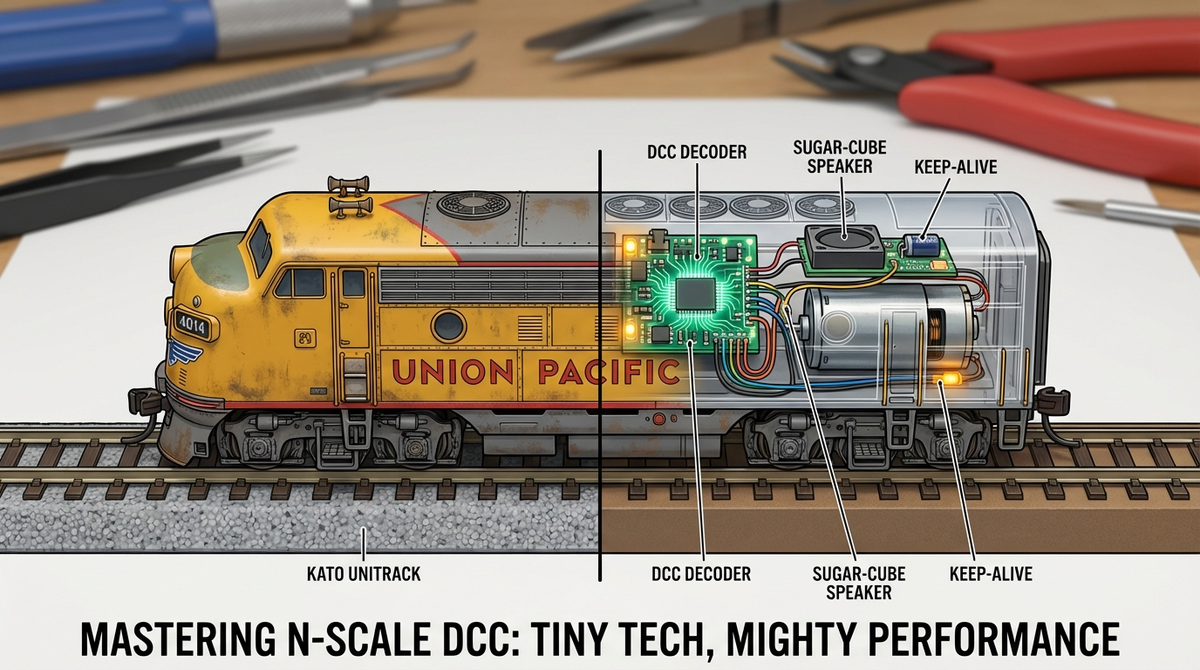
I spent 28 years fixing things for a living, and one lesson stuck with me: the right tool makes the job easier. An N scale train set with DCC is exactly that-the right tool for running realistic model railroad operations when you don't have a spare barn to work with. My basement is full of O gauge, but I've helped enough friends set up their N scale layouts to know this combination makes sense for a lot of people.
Here's the deal. N scale takes up about a quarter of the space of an equivalent HO layout. And DCC lets you run multiple trains on the same track independently-no complicated block wiring, no isolation switches, just trains doing what trains do. Put those two things together and you've got a hobby that fits in an apartment spare room.
I'm going to walk you through everything: the standards, the gear, the wiring, and the gotchas. No sales pitch. Just what works.
Before you buy anything, you need to know what you're working with. N scale runs on 9mm track gauge. In North America and Europe, the ratio is 1:160-meaning your model locomotive is 1/160th the size of the real thing.
Now here's where it gets a little confusing. The Brits use 1:148 scale for their N gauge stuff. Japanese models are typically 1:150 for their narrow-gauge trains and 1:160 for the Shinkansen bullet trains. But here's the good news: everything runs on the same 9mm track. So that Kato locomotive you picked up in Tokyo will work just fine on your American layout.
DCC stands for Digital Command Control. The NMRA standardized it back in the '90s, which means gear from different manufacturers actually plays nice together.
Think of it like this: in the old DC days, you controlled train speed by adjusting the voltage going to the track. More juice, faster train. The problem? Every locomotive on that track section moved at the same speed. Want to run two trains independently? You needed separate power districts with their own controllers. It was a wiring nightmare.
DCC flips that on its head. The track carries constant voltage plus a digital signal. Each locomotive has a decoder that listens for its specific address. When the decoder hears "Address 1591, speed step 45," only that engine responds. The command station generates the signal, the booster amplifies it, and the decoder executes it.
For N scale, the NMRA recommends 12 volts on the track. Most quality systems let you dial in the output for N scale specifically.
This trips up a lot of beginners. "DCC Ready" means the locomotive has the wiring and connector for a decoder, but there's no decoder installed. You're buying a plug. "DCC Equipped" or "DCC Fitted" means the decoder is already in there, ready to go.
The market has shifted hard toward factory-installed decoders. Bachmann's DCC Sound Value sets come with everything wired up, including sound. Kato's newer offerings are increasingly shipping DCC-equipped too.
My advice? If you're just starting out, buy DCC-equipped. Install your first decoder after you've run trains for six months and understand how the system works.
The good news about the 2025 market is you've got real choices. The bad news is there's a lot of junk out there too. Let me break down what works.
Bachmann's approach is simple: give you everything in one box. Their Roaring Rails set includes a DCC sound-equipped locomotive, rolling stock, track, and controller. Street price runs around $309-$499 depending on where you shop.
The Whistle-Stop Special is similar but with a steam locomotive. Figure $336-$380 for that one. Both come with E-Z Track and an E-Z Command Plus controller.
Here's where I have to be honest. That E-Z Command controller is limited. It'll run trains and that's about it. You can't program most CVs, and it won't handle four-digit addresses. For a beginner who just wants to see trains run, it's fine. But you'll outgrow it fast if you stick with the hobby.
Kato takes a different approach. Their F7 Freight Train set gives you a locomotive with DCC pre-installed, cars, and their bulletproof Unitrack system-but the power pack is DC. You're expected to supply your own DCC system.
The Metra F40PH Starter Set is DCC-friendly, meaning the decoder drops right in. Their upcoming Super Chief set for 2025 follows the same pattern-excellent train, DC power pack included.
Why would you want this? Because Kato's Unitrack is rock-solid reliable, and you're going to want a better DCC system anyway. This way you're not paying twice.
If you model European prototypes, the Fleischmann z21 Digital Start Set is worth a look. Around $473, it comes with a DCC-fitted locomotive and the z21 start controller, which has native smartphone app support.
British modelers should check out Graham Farish's Moving Mountains set. Around $395, it includes a Zimo sound decoder and high-detail UK prototype rolling stock. Just remember British N gauge is 1:148 scale, so mixing with American equipment looks a bit off.
Here's where I'll save you some grief. The controller you pick now determines how far you can go later. Buy cheap, buy twice.
Two systems dominate the entry-level market for good reason.
The Digitrax Zephyr Express (DCS52) gives you 3 amps of power-plenty for N scale-and can address up to 20 locomotives. The integrated USB port connects directly to a computer for JMRI, and the LocoNet expandability means you can add wireless throttles and more boosters as your layout grows. Street price is around $185-$198.
The NCE Power Cab is a 2-amp handheld system that puts all controls in your hand. It'll run 4-8 N scale locomotives comfortably. Users praise its intuitive interface-you're running trains within minutes of opening the box. Around $195-$200 gets you the complete starter set.
A Facebook group discussion I came across had modelers comparing notes, and the consensus was clear: both systems are reliable, both have active support communities, and both will last you years.
Looking to spend less? The DCC-EX CommandStation is an open-source Arduino-based system that costs under $100 in parts. It's got native WiFi and solid documentation, but you're building it yourself. Perfect for the technically minded.
Got deeper pockets? The ESU CabControl is a premium wireless system with 7-amp output and built-in WiFi. Around $425, it's overkill for most beginners but works beautifully with ESU LokSound decoders.
The folks on the HO Scale Model Trains Facebook group put it well: Digitrax is flexible but has a learning curve, NCE is user-friendly and powerful, and both beat the pants off basic controllers like the E-Z Command.
I've watched grown men nearly cry over wiring problems. Here's how to avoid joining them.
Your bus wire is the layout's backbone. For N scale, run 16 AWG wire under your benchwork, paralleling the track. For layouts over 20 feet, step up to 14 AWG.
Feeder wires connect the bus to the rails. Use 22-24 AWG, keep them under 12 inches long, and-here's the part most people skip-install feeders on every piece of track. Not every six feet. Every piece. N scale rail has high resistance, and rail joiners are for alignment, not electrical continuity.
A trick from DCC Concepts: twist your bus wires together, about one twist per foot. It reduces electrical interference and keeps things tidy.
More beginners throw in the towel over turnout wiring than anything else. Power-routing turnouts designed for DC can cause short circuits in DCC if you don't understand what's happening.
Kato's #6 turnouts and Peco's Electrofrog designs route power only to the selected route. On DCC, when a locomotive's metal wheels bridge the frog, you can create a short between conflicting polarities.
The fix? Frog juicers from Tam Valley Depot. These little devices automatically sense the locomotive and flip the frog polarity before a short happens. Install one on each live-frog turnout and your headaches disappear.
Peco's newer Unifrog turnouts are designed to be DCC-friendly out of the package, eliminating the need for insulated rail joiners on frog rails.
For reverse loops, you need an auto-reverser like the DCC Specialties PSX-AR. It detects the short circuit as your train enters the loop and flips the polarity of the entire section before the booster shuts down.
The miniaturization of electronics has been stunning. Ten years ago, getting sound into an N scale locomotive was nearly impossible. Now it's almost routine.
The ESU LokSound 5 Nano is about as good as it gets. At 19.6 x 8.5 x 5.3 mm, it crams 16-bit audio, excellent motor control, and a connection for external keep-alive capacitors into a package smaller than my thumbnail. ESU's auto-tune feature adjusts motor control to each specific locomotive.
Zimo's MS500N pushes the envelope with 32-bit audio at 44.1 kHz-CD quality sound in an N scale locomotive. The motor control is equally impressive, handling modern coreless motors without a hiccup.
For non-sound applications, the TCS Z2 at 13 x 6.9 x 2.8 mm fits almost anywhere and delivers 1 amp continuous. Digitrax's DZ126T is another solid, affordable option.
SoundTraxx's Tsunami2 TSU-1100 brings their Dynamic Digital Exhaust technology to N scale, syncing exhaust sounds to motor load. It's a bit bigger than the ESU and Zimo options, but the sound quality justifies the extra space.
N scale uses primarily two interfaces. The NEM 651 is a 6-pin connector that's become standard on European models and some American ones. The newer interfaces like Next18 pack more functionality into a similar footprint.
Kato's drop-in decoders are designed specifically for their mechanisms-buy the EM13 for most applications and it slides right in.
Here's something that took me years to appreciate. N scale locomotives are light, which means they lose electrical contact easily. Dirty track, turnout frogs, dead spots-any interruption causes the locomotive to stall or the sound to reset.
Keep-alive capacitors store a few seconds of power. When the wheels lose contact, the capacitor keeps the decoder running. The TCS KA-N1 is specifically designed for N scale and costs about $20. For the reliability improvement you get, that's a bargain.
Most modern decoders have dedicated solder pads for keep-alive connections. ESU calls theirs PowerPack, and they publish clear installation guides. For decoders without direct connections, the capacitor wires across the bridge rectifier, but that requires more skill.
This is where the hobby has really changed. You don't need to buy a $150 handheld throttle anymore. Your phone does it better.
Engine Driver for Android and WiThrottle for iOS are free apps that turn your phone into a full-featured wireless throttle. Hook your DCC system to a computer running JMRI, connect via WiFi, and you're walking around your layout controlling trains with your thumb.
Engine Driver's documentation walks you through setup in about 15 minutes. The interface is more intuitive than most hardware throttles, with graphical function buttons and speed sliders.
The Digitrax Zephyr Express connects to JMRI through its integrated USB port. NCE requires their USB interface board. The z21 systems from Fleischmann have WiFi built in.
Multiple people can connect simultaneously. So when your grandkids visit, everyone gets a throttle. Try doing that with hardware controllers without spending hundreds.
Programming CVs by punching numbers into a handheld throttle is tedious. CV29 bit 5... wait, is that speed step mode or analog conversion?
JMRI's DecoderPro fixes this. It's free software that provides a graphical interface for your specific decoder model. Instead of CV numbers, you see "Acceleration Rate" and "Horn Type" with sliders and dropdown menus.
The Small Model Railroads blog walks through setting up a low-cost JMRI installation. DecoderPro's roster feature lets you save configurations for each locomotive, copy settings between similar engines, and back up everything to your computer.
For consisting-running multiple locomotives together as one unit-DecoderPro's speed-matching tools can generate custom speed tables so your Kato F7 and your Atlas GP38-2 run at exactly the same speed. Without that, one will pull while the other drags.
The JMRI Users Group on Groups.io is an incredible resource. Search the archives and you'll find answers to almost any question.
Clean track and clean wheels. That's 90% of DCC troubleshooting right there.
The CMX Clean Machine is a heavy brass tank car with a solvent-dispensing pad underneath. Run it around your layout once a week and your track stays clean. The manual explains the chemical options-most folks use 90%+ isopropyl alcohol.
For stubborn oxidation, avoid coarse abrasives like the Brite Boy. They create micro-scratches that attract more dirt. A fine-grit sanding mesh or graphite block works better as a one-time treatment.
Woodland Scenics makes a Roto Wheel Cleaner for rolling stock. Dirty wheels will re-contaminate clean track faster than you can blink.
Use plastic-compatible lubricants like Labelle #108. Apply sparingly with a needle-point applicator-only to gear towers and axle ends.
Midwest Model Railroad's maintenance guide puts it clearly: never use WD-40 or 3-in-1 oil. They damage plastics and turn gummy. Over-lubrication attracts dirt and impairs electrical pickup.
Locomotive won't respond? First, check the obvious-is the system powered, is track power on, are you using the right address? Try address 3, the factory default for most decoders.
If it still won't move, put it on the programming track and try to read CV8 (manufacturer ID). If the system can read the decoder, the problem is a bad connection or wrong address. If it can't read anything, the decoder may be dead.
Stuttering and stalling is almost always dirty track or wheels. Clean both and test again. If it stalls in the same spot-usually a turnout frog-that's a power-routing issue. Install a frog juicer.
Random stalls? That's the classic case for a keep-alive capacitor.
Rapido Trains has carved out a niche for modelers who want museum-quality sound and detail. Their Budd RDC and F59PH diesels ship with ESU LokSound decoders and their own "MoPower" keep-alive system.
Trains Magazine's review called the Budd RDC one of the finest N scale models ever produced. The sound captures the distinctive whine of those self-propelled coaches perfectly.
Their newsletter announced a new Amtrak Turboliner for 2025. Pre-orders are already listed on eBay around $613 for the 5-car set with DCC and sound.
Is it expensive? Yes. Is it worth it? If you want the best, absolutely. Fusion Scale Hobbies' brand guide consistently ranks Rapido at the top for N scale sound models.
Let me give you three concrete plans based on who you are and what you're working with.
You've got a 2x4 folding table and dreams. Here's your shopping list:
In six months, add a Kato V1 passing siding set for more interesting operations. Add a second locomotive and you're running two trains independently on a folding table.
You had trains as a kid. Now you've got more money than time and want sound.
Your first upgrade should be a TCS KA-N1 keep-alive in that sound locomotive. The improvement in operation over turnouts is night and day.
Budget isn't the constraint. You want the best.
Set up a dedicated computer running JMRI 24/7. In six months, start adding occupancy detection and signaling through LogixNG.
You're not alone in this. The community resources are exceptional.
nScale.net is the most active N scale-specific forum. The TrainBoard DCC section draws modelers from all scales with experience across every system.
Reddit's r/modeltrains is great for quick questions and seeing what others are building. The Model Railroad Forums skew toward experienced modelers.
For video learning, the HO Scale Facebook group recommends "The DCC Guy" (Larry Puckett) and "Ron's Trains N Things" on YouTube. Both explain DCC concepts in plain English without assuming you already know everything.
The NMRA standards documents are the definitive technical references. Their T-TRAK module standards are perfect if you want to build something portable that works at club events.
Regional NMRA conventions offer clinics on everything from basic wiring to advanced automation. Check past convention schedules for the types of topics covered.
N scale DCC isn't plug-and-play simple. You'll need to learn some wiring, understand decoder programming, and probably buy a second piece of equipment after you realize the first one doesn't do what you need.
But here's what you get in return: a layout that fits in your spare room, running multiple trains independently, with sound that makes your visitors ask "is that real?" The technology has matured to the point where reliable operation is achievable, not aspirational.
Start with good equipment-a Digitrax Zephyr Express or NCE Power Cab, not a toy-grade controller. Wire it right the first time with a proper bus and feeders. Install keep-alive capacitors in your locomotives. And join the online communities, because the collective knowledge there will save you hundreds of hours of frustration.
I've watched this hobby transform over 50 years. What we can do now in N scale would have seemed like science fiction when I was a kid watching my dad's Lionel circle the Christmas tree. The tools are better. The information is more accessible. The used market is strong if budget is tight.
The only thing stopping you is getting started.
✨ Complete Your Layout: Explore our wide selection of Photo Real buildings, diorama backdrops, detail parts, and accessories in every popular scale.
✨ Unmatched Realism: From chrome detailing products to neon lighting kits – every piece is designed to make your miniature world come alive.