
N Scale Track Radius Recommendations: A Modern Modeler's Complete Guide
Posted by Derek Olson on 30th Dec 2025
Order by phone: 763-231-7847
Free Shipping On Orders Over $100!
If you are already registered, please log in.
Create your account and enjoy a new shopping experience.
Create A New AccountPosted by Derek Olson on 30th Dec 2025
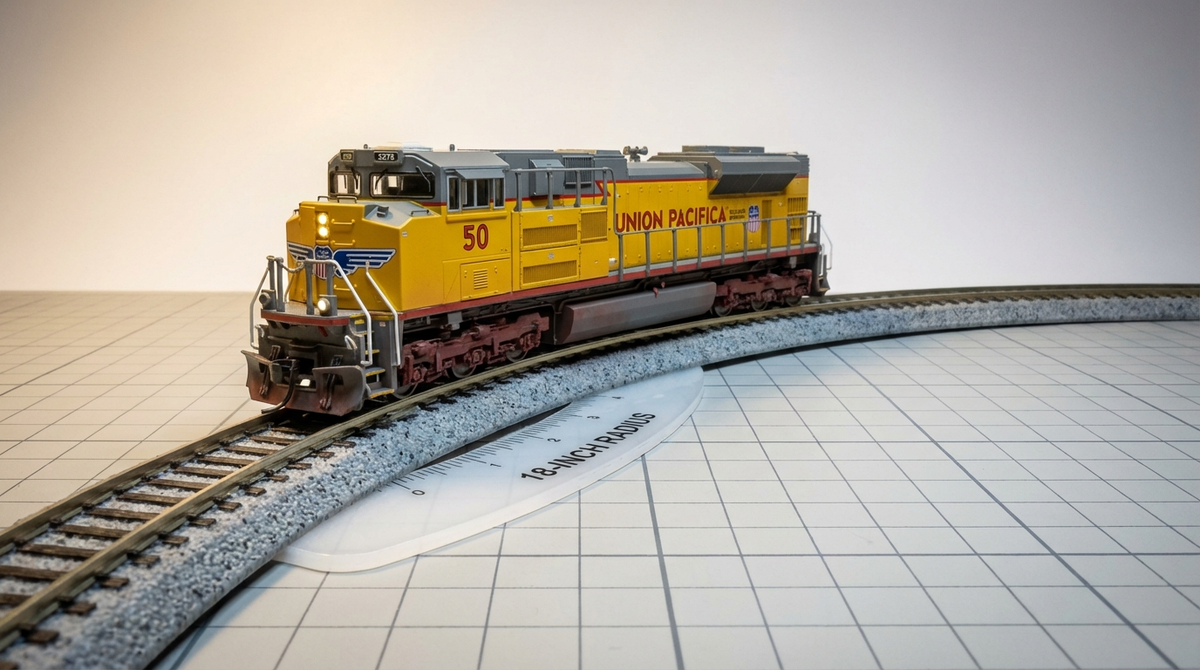
I made every mistake you can make with N scale curves. My first layout used 9¾-inch radius track because that's what came in the box. My brand-new six-axle diesels derailed constantly. My 85-foot passenger cars looked ridiculous, lurching around corners like drunk elephants on roller skates. It took me way too long to realize the problem wasn't my locomotives or my track-laying skills. The problem was geometry I'd locked myself into before laying a single piece of rail.
If you're planning an N scale layout in 2025, the radius decisions you make right now will determine whether you spend your hobby time enjoying trains or fishing derailed cars out from behind scenery. Let me save you the frustration I went through.
That 9¾-inch radius curve worked great when most N scale freight cars were 40-foot boxcars and locomotives topped out at four axles. The hobby has changed. Manufacturers like Kato, ScaleTrains, and Rapido now release incredibly detailed 89-foot autoracks, double-stack container cars, and full-length passenger equipment as their bread and butter.
I pulled up catalogs from major manufacturers and counted: over 70% of new freight car releases exceed 60 feet in prototype length. That 1970s-era geometry simply cannot handle 2025 equipment without significant compromises.
Those starter-set curves now belong exclusively on industrial spurs serving small switchers and shorty cars. Your visible mainline needs to start at 15 to 18 inches minimum if you want modern equipment to both run reliably and look like something other than a carnival ride.
The NMRA's Recommended Practice RP-11 classifies equipment and track into lettered categories from A through Q. Each class specifies minimum radii and turnout frog numbers for different car lengths.
Here's what the NMRA actually recommends for N scale locomotive-hauled equipment:
| Class | Car Length | Min. Radius | Min. Turnout |
|---|---|---|---|
| F | 40' Cars | 8.875" | #4 |
| I | 60' Cars | 12.0" | #6 |
| L | 70' Cars | 14.5" | #6 |
| N | 80' Cars | 17.375" | #8 |
| O | 85' Cars | 19.625" | #8 |
| Q | All Cars | 24.0" | #8 |
Notice something? If you want to run modern 85-foot equipment per NMRA standards, you need nearly 20-inch radius curves. The NMRA's beginner guide states these are minimums for restricted speed operation. For mainline speeds, bump up one or two classes.
This catches a lot of modelers off guard. Walk into any hobby shop and over 85% of premium N scale locomotives now come with body-mounted couplers instead of the old truck-mounted style.
Body-mounts look better and push cars without that annoying "slinky effect" where cars accordion during backing moves. But they transfer lateral forces directly to the car body on curves. This creates a phenomenon called stringlining where cars get pulled toward the inside of a curve and derail.
The Layout Design Special Interest Group did extensive testing and found stringlining risk doubles when body-mounted equipment enters curves with radius less than 2.5 times the car's length. For an 89-foot autorack (about 6.7 inches in N scale), that means 16+ inch minimum radius.
If you want to run tight curves under 13 inches, you'll need to either stick with truck-mounted couplers or invest in long-shank coupler conversion kits.
Manufacturer specs tell an interesting story. That "minimum radius" printed on the box? It's the tightest curve the model can physically negotiate at slow speed. It's not where the model runs well or looks good.
Here's what I've learned testing equipment on my bench:
Kato states 9¾-inch minimum, but they also explicitly warn that this radius is too tight for six-axle locomotives in their own documentation. I run mine on 15-inch curves minimum. The improvement in tracking and appearance is night and day.
The Big Boy lists 11-inch minimum. At that radius it works, but those massive articulated drivers look tortured grinding around such tight curves. Budget for 18 inches if you want the visual payoff these expensive models deserve.
Superliners can technically handle 11-inch curves, but the overhang is excessive. A forum member reported derailments on 12⅜-inch curves due to skirting interference. I wouldn't go under 18 inches for passenger operations.
ScaleTrains publishes both minimum (11 inches) and recommended (19 inches) radii. That eight-inch gap tells you everything about the difference between "it runs" and "it runs well."
The Rapido documentation flat-out states 28-inch radius with standard couplers. With their special long-shank couplers? Still 18 inches minimum. Rapido designed these cars for broad, realistic curves from day one.
Community testing shows these physically cannot run on curves under 24 inches because the wheels contact the car frame. No amount of coupler modifications helps.
Kato uses R-codes. Tomix uses C-codes. Atlas uses inches. Peco uses radii numbers. It's confusing until you see them side by side.
Here's my cross-reference based on the Kato Unitrack catalog and Atlas track specifications:
| Radius | Kato | Atlas | Peco Setrack | Suitability |
|---|---|---|---|---|
| 9¾" / 249mm | R249 | 9¾" | - | Industrial spurs only |
| 11" / 282mm | R282 | 11" | - | Practical minimum for 6-axle locos |
| 12⅜" / 315mm | R315 | 12½" | - | Mixed freight operations |
| 13⅛" / 333mm | - | 13¾" | R4 | Good general use |
| 15" / 381mm | R381 | 15½" | Flex only | Recommended modern equipment |
| 18-19" / 457mm | R481 | 19" | Flex only | Optimal visible mainline |
| 22" / 559mm | - | 21¼" | Flex only | Prototypical/modular standard |
The Peco Setrack system tops out at their R4 curve around 13 inches. For broader curves, you'll need Streamline flex track.
Let me make this simple with specific scenarios:
Standard T-TRAK corners use 11-inch inner and 12⅜-inch outer curves. Many clubs now build wider-radius corners for North American passenger equipment.
Helixes terrify me. Not because they're hard to build, but because they're impossible to reach when something goes wrong. And something will go wrong if you cut corners on radius.
Here's the math that trips people up. A curve adds friction that makes grades "feel" steeper to your locomotive. The formula for N scale:
Effective Grade = Actual Grade + (17.4 ÷ Radius in inches)
That 2% grade on a 12-inch radius helix? Your locomotive experiences it as 3.45% effective grade. On an 18-inch radius, it's only 2.97%. On 22 inches, it drops to 2.79%.
The vertical clearance calculation adds another constraint. An 18-inch radius helix at 2% grade gives you only about 2.26 inches between deck levels. The NMRA recommends 1.75 inches minimum for modern high-cube equipment, but you also need room for your hands to retrieve derailed cars.
My recommendation for helix radius: 20-24 inches minimum. Accept more turns to achieve your elevation change rather than steeper grades on tighter curves.
I used #4 turnouts in my first yard because they saved space. What a mistake. The diverging route on an Atlas #4 turnout equals roughly 9¾-inch radius. Pushing cars through that geometry, especially through crossovers with opposing curves, caused constant derailments.
The Kato #6 turnouts have a diverging route equivalent to about 19 inches. That single upgrade cut my yard derailments by at least a third.
The NMRA recommends inserting a straight track section between opposing turnouts (in crossovers or S-curves) equal to the length of your longest car. This allows couplers to realign before entering the second curve.
| Turnout | Equivalent Radius | Best Use |
|---|---|---|
| #4 | ~9¾-11" | Industrial spurs with short cars only |
| #6 | ~18-28" | Yard ladders, mainline crossovers, passing sidings |
| #8+ | 30"+ | High-speed mainlines, large classification yards |
The Free-moN standard mandates #6 turnouts minimum for all mainline applications. If modular clubs building for interoperability require it, that tells you something about reliability.
Here's a myth I believed for too long: that a small layout means accepting 9¾-inch curves. Not true.
A standard 80x30-inch hollow-core door can accommodate 11-inch and 12¼-inch nested loops. The Carolina Central 2.0 track plan from Kato proves this works beautifully with Unitrack on exactly that footprint.
That extra 2-3 inches of radius opens your roster from "1970s branchline only" to "most modern 4- and 6-axle diesels plus 60-foot cars." The trade-off? Maybe one fewer industrial spur. Worth it.
Code 55 track looks fantastic. Those fine rails scream "prototype" compared to the chunky Code 80 rail.
But there's a catch. Atlas acknowledges that older rolling stock with deep "pizza-cutter" wheel flanges (up to 0.033 inches) can bottom out on Code 55's molded spike detail. The NMRA S-4.2 standard specifies maximum 0.022-inch flange depth.
Before committing to Code 55, pull out your NMRA standards gauge and check your vintage equipment. Non-compliant wheelsets need replacement (Atlas #22134 works well).
My compromise: Code 55 on visible trackage, Code 80 in hidden staging where appearance doesn't matter but reliability is paramount.
The market has voted. Equipment keeps getting longer, more detailed, and more demanding of realistic geometry.
The Free-moN standard established 22-inch minimum mainline radius back in 2002, anticipating this trend. NTRAK has always used 24 inches. The T-TRAK community increased track spacing from 25mm to 33mm in 2003 specifically because larger models kept sideswiping on standard corner modules.
When manufacturers like Rapido design new passenger cars requiring 28-inch radius with standard couplers, they're telling you where the hobby is heading.
Planning a layout today with mainline curves under 15 inches actively works against where N scale is going. You'll find yourself unable to run exciting new releases or forced into expensive retrofit projects.
Before you spike any track, spend an afternoon with a sheet of plywood and some loose track:
A few hours of testing now prevents hundreds of hours of frustration later.
N scale track radius isn't just a technical specification buried in catalogs. It's the foundation that determines whether your railroad becomes a source of pride or a constant battle against physics.
For modern equipment, 18 inches is the new 9¾. If you want to run today's long autoracks, passenger cars, and detailed freight equipment without compromise, design your mainlines for 22-24 inch curves and use #6 or larger turnouts.
Yes, that takes more space. Yes, it might mean a simpler track plan. The trade-off? Trains that run smoothly, look realistic sweeping through curves, and don't dump you into crawl spaces fishing for derailed cars behind your carefully built scenery.
Your future self will thank you for building the railroad right the first time.
By Derek Olson
✨ Complete Your Layout: Explore our wide selection of Photo Real buildings, diorama backdrops, detail parts, and accessories in every popular scale.
✨ Unmatched Realism: From chrome detailing products to neon lighting kits – every piece is designed to make your miniature world come alive.