
N Scale Track Radius Recommendations: A Practical Guide for Reliable Operations
Posted by Benjamin Park on 30th Dec 2025
Order by phone: 763-231-7847
Free Shipping On Orders Over $100!
If you are already registered, please log in.
Create your account and enjoy a new shopping experience.
Create A New AccountPosted by Benjamin Park on 30th Dec 2025
I got into model railroading for relaxation. Three years later, I'm hosting operating sessions that feel more stressful than my actual logistics job. But here's the thing: most of that stress disappeared once I stopped fighting my track geometry.
The radius you choose for your N scale curves isn't just some number you pick from a catalog. It determines whether your trains run smoothly or spend half the session on their sides. It controls how long your trains can be, how steep your grades can get, and whether your layout looks like a miniature railroad or a toy train set.
After rebuilding curves on my Milwaukee Road layout twice, I've learned the hard way that getting radius right the first time saves you hundreds of hours and thousands of dollars. So let me share what I've figured out.
For decades, 9.75 inches was the sacred minimum radius for N scale. Kato's popular 9.75-inch radius curves became the default for starter sets and small layouts. And for old-time equipment, short 40-foot boxcars, and small switchers, that radius still works.
But modern N scale has changed. Manufacturers now produce incredibly detailed steam locomotives and long freight cars that simply cannot negotiate those tight curves without problems. Six-axle diesels, 85-foot passenger cars, and 89-foot autoracks have become standard equipment for anyone modeling post-1960 railroading.
The practical minimum for any serious layout built today is 12 inches. Not because some authority declared it so, but because that's what the equipment demands. Every modern N scale catalog lists recommended minimum radii, and 11 to 13 inches has become the baseline for new releases.
If you want your layout to remain compatible with equipment you'll buy five or ten years from now, build with 12-inch minimum curves on your visible trackage. Your future self will thank you.
The right radius depends entirely on what you're running. A layout built for 1890s narrow-gauge equipment has completely different requirements than one designed for modern unit trains.
If you're modeling a mining operation, logging railroad, or tram line, you can use tighter radii. Kato's UNITRACK Compact system supports curves down to 4.6 inches for specialized equipment like Pocket Line trains and trams. Just understand that only specific locomotives designed for these tight curves will run reliably.
Small steam locomotives (0-4-0, 0-6-0) and short switchers handle 11-inch radius curves without complaint. If your layout focuses on industrial switching with older, shorter cars, you have more flexibility.
Once your cars exceed 70 scale feet in length, everything changes. The NMRA's Recommended Practice RP-11 exists specifically to coordinate modeler expectations with what manufacturers can deliver. It classifies equipment and specifies minimum radii for each class.
According to the technical documentation, equipment should operate satisfactorily at restricted speeds (20 scale mph) through the specified minimum curves. For higher speeds, you need larger radii.
The real problem comes with coupler swing. Longer cars have their trucks mounted further from their ends. On tight curves, those ends swing way out, pulling couplers to extreme angles. Add body-mounted couplers into the mix, and you've got a recipe for constant uncoupling.
Here's the uncomfortable truth for anyone modeling contemporary railroading: 85-foot passenger cars and 89-foot autoracks need 18-inch curves or larger for reliable operation with body-mounted couplers. You can squeeze by with less using truck-mounted couplers, but appearance suffers.
The rule of thumb in the community is that minimum radius should equal three times the car length. For an 89-foot autorack (about 6.7 inches in N scale), that works out to roughly 20 inches.
I've seen modelers run 19-car intermodal trains on 15-inch hidden curves, but stringlining becomes a real risk. If you push the limits, expect to spend time fixing derailments.
Want to know where the hobby is heading? Look at what modular groups require. They've tested these standards with hundreds of different locomotives and thousands of operating hours.
T-TRAK modules use Kato Unitrack with 11.1-inch (282mm) and 12.4-inch (315mm) radii. The standard prioritizes portability and accessibility. You can transport modules in your car and set up layouts on folding tables.
The trade-off is operational. T-TRAK works well for train watching and basic running, but long modern equipment struggles on those curves.
NTRAK clubs, which organize massive public displays, mandate 24-inch minimum radius for their two main tracks. Their branchline allows 18 inches. This standard developed over decades of public exhibition experience.
When you're running trains for eight hours straight in front of crowds, reliability becomes everything. Those broad curves prevent derailments that would embarrass the club.
Free-moN takes a different philosophy. The standard exists for modelers who want their layouts to look and operate like real railroads. The minimum mainline radius is 22 inches with #6 turnouts and Code 55 track.
Why 22 inches? Because that's where curves start looking credible. Contest judges and model railroad photographers consistently report that curves below this threshold look "toy-like" in photographs.
If you're building a home layout and want it to match Free-moN quality, treat 22 inches as your visible mainline minimum. You'll be designing to the same standard as exhibition-quality modules.
Every layout makes compromises somewhere. For most of us, that somewhere is hidden trackage: staging yards, return loops, and areas behind backdrops where nobody sees the trains.
My Milwaukee Road layout uses 18-inch curves in scenic areas but drops to 15 inches in the hidden return loops. That lets me fit more visible scenery while maintaining decent reliability.
The formula I use: hidden curves can be one "class" tighter than visible curves, but never go below 15 inches for modern equipment. Below that, stringlining and derailment risks climb steeply.
On tight hidden curves, limit train length to about three-quarters of the loop's circumference. This prevents your locomotive from catching its own caboose on S-curves and eliminates the weird accordion effect that happens when long trains compress through 180-degree turns.
I also strongly recommend installing easements (more on those shortly) at every transition into hidden curves. You won't see them, but your trains will run better for having them.
Here's something that caught me completely off-guard when I started operating my layout: curves add effective grade. Your locomotive doesn't just fight the physical slope. It also fights the friction from those curved rails.
The formula is simple: Effective Grade = Actual Grade + (17.5 / Radius in inches)
So a 15-inch radius curve adds 1.2% to whatever physical grade you're climbing. Put a 2% actual grade on a 15-inch curve, and your locomotive experiences 3.2% effective grade. That's brutal.
Helixes combine the worst of both worlds: continuous grade on continuous curves. An 18-inch radius helix with 2% physical grade has an effective grade of nearly 3%. Train length drops dramatically.
For my layout, I abandoned the helix concept entirely and went with a longer, hidden grade on broader curves. It took more space but lets me run longer trains.
If you absolutely need a helix, use the largest radius you can fit and keep physical grade at 2% or less. Test with your heaviest, longest consist before committing to permanent construction.
For any curve under 18 inches, I recommend limiting actual grade to 2%. This keeps effective grade under 3% even on relatively tight curves.
On straight track, you can push grades higher. The NMRA's beginner resources note that long trains look bad and derail on overly tight curves. Adding steep grades makes everything worse.
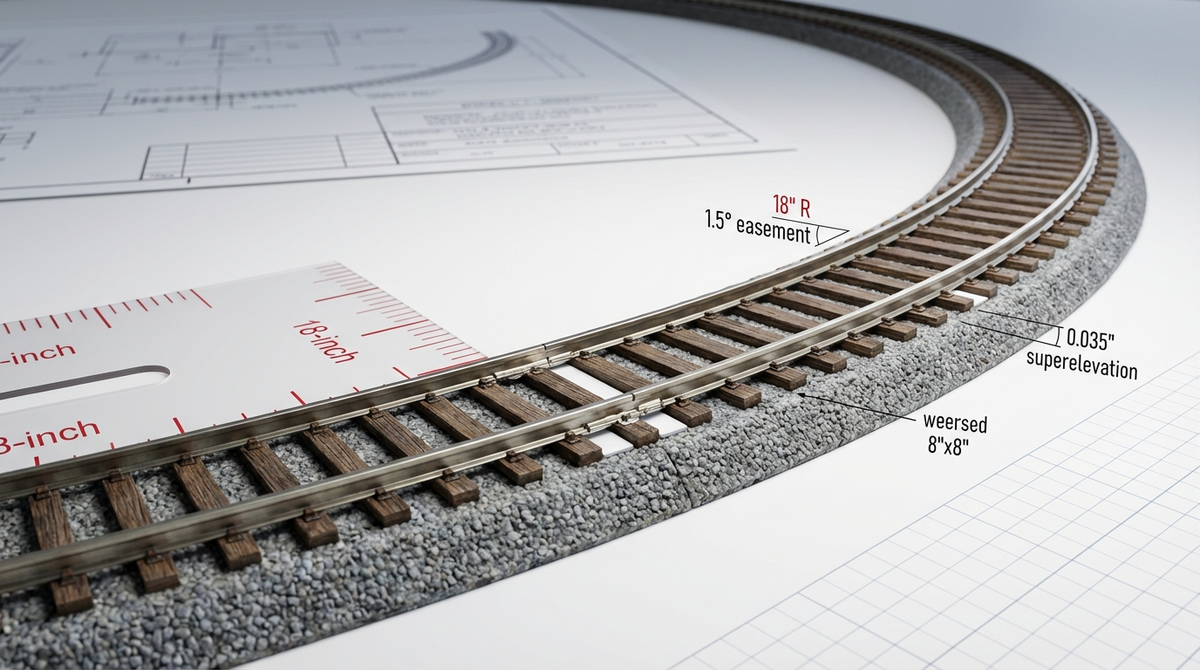
An easement (also called a spiral) gradually introduces a curve instead of hitting it all at once. Real railroads use them universally. Model railroads mostly ignore them. This is a mistake.
When a truck hits a fixed-radius curve cold, it lurches sideways. That sudden force can pop wheels off rail, stress couplers, and looks awful. An easement spreads that lateral force over several inches of track, dramatically reducing problems.
With flex track, easements are easy. Start your curve earlier than needed and gradually tighten it to the final radius. The "bent stick" method works well: hold a flexible straightedge at the starting and ending points, and it naturally forms an easement curve.
With sectional track, you can approximate easements by placing a piece of larger-radius curve before your main curve. For example, insert one 22-inch radius section before entering an 18-inch curve.
Minimum easement length equals your longest car. Better easement length equals 1.5 times your longest car. For an 89-foot autorack (6.7 inches in N scale), aim for 10-inch easements.
Even short 6-inch easements provide noticeable improvement. Some improvement beats none.
Superelevation means banking curves by raising the outer rail. Real railroads do this so trains can take curves at higher speeds without derailing.
In N scale, the operational benefit is negligible. Our oversized wheel flanges provide plenty of lateral support regardless of banking. But superelevation looks fantastic, especially in photographs and videos.
Limit superelevation to 0.030 to 0.040 inches (the height of a business card or so). More than that creates problems: top-heavy cars like double-stacks can tip over, and stringlining risk increases as cars want to slide down the banked curve.
Never apply superelevation through turnouts. The complex frog geometry makes it impossible to do correctly, and derailments will result.
Use thin styrene strips or layers of masking tape under the outer rail's ties. Build up the height gradually over your easement length (minimum 8-10 inches of transition).
Superelevation creates the best visual impact on your signature curves. Pick one or two prominent mainline curves and bank them properly rather than trying to superelevate everything.
Your track choice has real cost implications, especially for larger radii.
Every rail joint is a potential failure point. Dirt accumulates, rail expands and contracts, joints work loose. Sectional track has joints every few inches. Atlas Code 80 sectional curves use multiple pieces per circle, meaning dozens of joints.
Flex track dramatically reduces joints. A 22-inch radius semicircle built from 30-inch flex track pieces needs only two joints versus twelve or more with sectional.
For tight radii, sectional track is competitive. Kato Unitrack 11-inch curves cost about $2.25 per piece, four pieces make a circle, roughly $9 total.
But for 22-inch radius curves, sectional track either doesn't exist or costs substantially more than flex track. That same 22-inch semicircle built from Atlas Code 55 flex track costs around $15-18 and has far fewer failure points.
Use sectional track for radii that manufacturers produce in abundance: Kato's 11-inch and Atlas's 19-inch curves are good examples. The convenience of pre-formed curves outweighs the joint count for standard radii.
Use flex track for any custom radius, any radius larger than what's commonly available in sectional, and any hidden trackage where reliability matters more than ease of construction.
Several track systems serve N scale modelers:
Kato Unitrack: The most complete integrated-roadbed system. Ground-level single track, elevated sections, and accessories all snap together. Radii range from 4.6 inches to 28.25 inches. The complete track list shows every available piece.
Atlas Code 55: Praised for its realistic appearance with simulated wood brown ties and fine nickel silver rail. Available in both sectional and flex formats. Their Code 55 turnout selection includes wye turnouts and curved turnouts.
Atlas Code 80: The classic Code 80 system with black ties offers good performance at lower cost. Snap-Track products remain popular for beginners. Available in bulk packs for large projects.
Atlas True-Track: Features Code 65 rail with integrated roadbed. The gray roadbed version and tan roadbed version suit different scenic preferences. Layout packages offer convenient starter options.
PECO: British manufacturer producing Code 80 and Code 55 track with excellent turnouts. Their Setrack system provides first radius (228mm), second radius, and larger options. Hattons carries the full range of PECO N gauge track. Jackson's Models notes the compatibility between Code 80 and Code 55 PECO Streamline products.
The Atlas All-Scales Catalog and their complete track reference help with planning. For ordering, the consumer order form lists current availability.
On straight track, N scale double-track spacing is straightforward: about 1-1/16 inches center to center for modern equipment. On curves, everything changes.
Long cars swing outward on curves. Their corners extend beyond the track centerline. If two trains pass on adjacent curves, those swinging corners can collide.
The NMRA's RP-7.2 provides exact specifications. For a 10-inch radius curve with modern equipment, you need 1-9/16 inches between track centers. That's significantly wider than tangent spacing.
Kato Unitrack uses 33mm (about 1-5/16 inches) default spacing. This works on straight track but fails the NMRA standards for curves tighter than about 22 inches when running modern long equipment.
Kato does offer wider track spacing options including 49.5mm pieces. Use these on curves of 13 inches or less to prevent sideswipes.
The NMRA Clearance Assistant helps calculate exact requirements. Their online calculator makes the math easy.
Real railroads also have obstacle clearances to consider. The tangent track standards define minimums for bridges, tunnels, and trackside objects. Curved track obstacle clearances add to these requirements.
For interurban modeling, different standards apply since that equipment has different characteristics.
Community forums discuss practical track spacing and clearance issues regularly. Real-world experience often provides better guidance than specifications alone.
Here's the uncomfortable aesthetic truth: an 18-inch radius in N scale represents a very tight 290-foot prototype curve. That's about a 20-degree curve in railroad terminology. Real railroads rarely use curves that sharp except in mountains and switching districts.
Experienced model railroad photographers report that curves start looking convincingly realistic around 22 inches. Below that, something looks "off" even to casual observers.
N scale uses 1:160 ratio. Multiply any N scale radius by 160 to get the equivalent prototype dimension, then divide by 12 to convert to feet.
Using this formula:
For signature scenes where you want credible mainline appearance, use 22 inches or more. Relegate anything under 15 inches to hidden trackage or industrial spurs where tight geometry makes sense.
If you photograph your layout or shoot videos, curve radius matters even more. Camera angles that work on tight curves are limited. Broad curves let you position the camera where real railroad photographers would stand.
Your chosen radius directly determines how much room your layout needs. Understanding these spatial requirements prevents painful redesigns later.
The 180-degree turnback curve (what layout designers call a "blob") often consumes the most space on any layout. A simple double-track turnback with 18-inch inner radius requires approximately 43 inches of benchwork width.
Here's the formula: take your inner radius, add track spacing (about 1.5 inches for NMRA-compliant spacing on curves), add the outer radius, then add 4 inches for safety margins (2 inches on each side to catch derailed equipment).
For planning purposes:
An 18-inch radius turnback curve requires nearly four feet of benchwork depth. This surprises many modelers planning their first layout.
You can comfortably reach about 30 inches across a scenicked layout without damaging your work. Any benchwork deeper than this needs access from multiple sides or pop-up hatches.
For aisles, 24 inches minimum allows one person to work comfortably. For operating sessions with multiple people, 36-48 inches allows operators to pass without colliding.
On my Milwaukee Road layout, I planned 36-inch aisles specifically because I host operating sessions. The extra space pays dividends when four people are trying to keep trains moving.
After years of trial and error (heavy on the error), here's my practical radius framework:
For visible mainlines: 18 inches minimum, 22 inches preferred. Use #6 turnouts or larger. Install easements at every transition.
For visible branchlines: 15 inches minimum. #5 or #6 turnouts work well. Easements still matter.
For industrial spurs and yard tracks: 12-13 inches is acceptable since trains move slowly and tight geometry looks prototypical in industrial areas. #4 or #5 turnouts are appropriate.
For hidden trackage: 15 inches minimum for modern equipment. Never go below this regardless of space constraints. The derailments aren't worth it.
Before you commit to permanent track installation, lay temporary flex track at your chosen minimum radius. Run your longest, heaviest trains through it. Check for overhang, coupler swing, and derailment tendency. Spend an afternoon testing before you spend weeks building.
The community consensus has shifted toward broader curves over the past thirty years. The NMRA standards reflect this evolution. Equipment keeps getting longer and more detailed. Design your layout for the equipment you'll want to run five years from now, not just what's in your drawer today.
When I rebuilt my layout's curves from 12 inches to 18 inches on the visible mainline, operating sessions went from stressful to enjoyable. Trains run longer. Derailments dropped to near zero. The scenery looks better because I'm not fighting the "toy train" appearance of tight curves.
Model railroading was supposed to be relaxing. Getting the track geometry right is how you make it that way.
? Complete Your Layout: Explore our wide selection of Photo Real buildings, diorama backdrops, detail parts, and accessories in every popular scale.
✨ Unmatched Realism: From chrome detailing products to neon lighting kits – every piece is designed to make your miniature world come alive.