
N Scale Layout Ideas for 4x6 Table: Building a Reliable Miniature Railroad
Posted by Tamara Brooks on 30th Dec 2025
Order by phone: 763-231-7847
Free Shipping On Orders Over $100!
If you are already registered, please log in.
Create your account and enjoy a new shopping experience.
Create A New AccountPosted by Tamara Brooks on 30th Dec 2025
I'll be honest with you: a 4x6 table sounds like a lot of space until you actually start laying track on it. Then you realize every millimeter counts, every curve radius decision haunts you, and that turnout you crammed into the corner is going to derail trains until the end of time.
I've been there. My first N scale attempt was a disaster of tight curves and wishful thinking. Now I run a modern intermodal layout that actually works, and I've learned that the difference between a frustrating layout and a satisfying one comes down to a handful of geometry rules and some wiring discipline that nobody taught me upfront.
So let's fix that. Here's what I wish someone had told me before I burned through two months and a few hundred dollars on my first 4x6 attempt.
Here's the brutal truth about N scale curves: most of your derailments will happen because your radius is too tight. Community forums are filled with frustrated modelers reporting issues on curves under 11 inches, and the pattern is consistent enough to call it a rule.
Yes, Kato lists 9.75 inches as a design minimum, but that's a survival threshold, not a recommendation. My GP38-2s will technically crawl around a 9.75-inch curve. They look ridiculous doing it, and anything longer than a 50-foot boxcar becomes an uncoupling nightmare.
The NMRA's recommended practice suggests curves should be three times the length of your longest car. For a 50-foot car at N scale (about 3.75 inches), that works out to roughly 11.25 inches. For 85-foot passenger cars, you're looking at 19 inches or more if you want them to look anything other than absurd.
Slamming straight track directly into a curve is a recipe for coupler swing and derailments. An easement is a transition curve that lets your train ease into the bend gradually. With flex track, you can let the track naturally curve over a distance at least as long as your longest car. With Kato Unitrack sectional pieces, use a larger radius piece (like 28.25 inches) to transition into a tighter curve.
I learned this the hard way when my SD40-2 kept uncoupling on the same curve. Added an easement section, problem vanished.
A 2% grade (2-inch rise over 100 inches) is the practical maximum for reliable operation. Go steeper and your locomotive pulling power drops off a cliff. Hit 4% and you're basically building a helper district, which is cool if that's intentional, but frustrating if you just wanted your train to climb a hill.
Here's what catches people: grades on curves are effectively steeper than their measured slope. A 2% grade on a tight 12-inch radius curve can perform like a 3.25% grade. Plan accordingly.
If geometry is king, turnout choice is the crown prince. I've watched modelers sabotage perfectly good layouts by cramming in #4 turnouts to save a couple inches of space.
The data is stark: layouts using #4 turnouts experience nearly double the uncoupling incidents compared to #6 turnouts. That sharp diverging angle creates an implicit S-curve that longer cars and six-axle locomotives hate.
Use #4 turnouts only for tight industrial spurs where you'll be running 40-foot cars and small switchers. For everything else, #6 is your minimum. If you can fit #7 or #8 turnouts on your mainline, even better.
Peco Code 55 turnouts are gorgeous and offer options like curved turnouts and double crossovers that nobody else makes. But they require powered frogs and careful wiring.
Atlas Code 55 turnouts are a solid middle ground: realistic appearance, reasonable price, and good availability.
Kato Unitrack turnouts cost more (~$27 for a #6) but offer foolproof geometry and electrical connections. For a first layout, I'd lean toward Kato for the mainline and use Atlas or Peco in yards where custom geometry matters more.
This is where opinions get heated. Let me give you the practical breakdown.
Kato Unitrack is the plug-and-play champion. The integrated roadbed locks together with UniJoiners that provide solid mechanical and electrical connections. You can have a working oval running trains in an hour.
The downsides? Fixed geometry limits your creativity, and the Code 80 rail is oversized compared to prototype. But for beginners or portable layouts, the time saved is worth the trade-off.
Atlas Code 55 flex track runs around $2.17 per foot and gives you complete geometric freedom. Code 55's finer rail profile looks far more realistic than Code 80, though you might need to swap out wheelsets on older rolling stock.
Peco Code 55 offers the best appearance and complex trackwork options, but commands premium prices and requires more wiring knowledge.
My recommendation for a 4x6? Run Kato Unitrack for your main oval and passing siding, then use flex track for industrial spurs where you want custom curves. Best of both worlds.
Here's where I watch people shoot themselves in the foot repeatedly. A small layout doesn't mean simple wiring. In fact, N scale's higher rail resistance makes robust wiring more critical than in larger scales.
I know, DC seems simpler. But on a 4x6 table, DCC transforms your operational possibilities. You can run a local switcher and a mainline freight simultaneously without flipping toggle switches or wiring complex blocks.
A Digitrax Zephyr Express will set you back around $185 compared to $50-70 for a quality DC power pack. The investment pays off in operational enjoyment.
NCE recommends 14-16 AWG wire for your power bus and 22-24 AWG for feeders. Run the bus down the center of your layout's underside, twisted 3-5 times per foot to reduce interference.
Here's the part everyone underestimates: you need feeders every 3 feet at minimum. Many successful builders solder feeders to every single piece of track. Don't rely on rail joiners for electrical conductivity; they're for mechanical alignment only.
Once your wiring is complete, perform the quarter test: power up the system and drop a coin across the rails at various points. Your circuit breaker should trip instantly everywhere. If it hesitates or hums, you need more feeders or heavier bus wire.
For turnout frogs, especially Peco Electrofrogs, you'll need to power them. A Tam Valley Frog Juicer automatically handles polarity switching. And consider a DCC Specialties PSXX-AR circuit breaker to isolate shorts without killing your whole railroad.
Here's something nobody tells beginners: a hollow-core door will amplify every wheel click and motor hum into a drum solo. They're cheap and rigid, sure, but acoustically terrible.
Lab tests published in Model Railroad Hobbyist measured bare plywood at 65 dB, cork-on-plywood at 60 dB, and a foam-over-plywood assembly at just 55 dB. That 10 dB drop is clearly audible.
Start with 1/2-inch or 3/4-inch plywood as your base. Glue a layer of 1-2 inch XPS foam (pink or blue board) on top using latex caulk, not white glue. The caulk stays flexible and breaks the vibration path.
Add cork or foam roadbed on top of the XPS, again bonded with latex caulk. Then secure your track with a thin bead of caulk, not nails or screws. Every rigid fastener creates a direct path for vibration to travel into the benchwork.
Some of the quietest layouts add rubberized camper tape beneath the cork. It's an extra step, but if you want your DCC sound decoder to be the star rather than competing with track noise, it's worth it.
Here's where 4x6 layouts get tricky. Your table is 48 inches deep. Military and NASA ergonomic standards peg comfortable forward reach at about 24 inches. That means if you push your layout against a wall, half of it becomes a dead zone you can barely reach.
The ideal approach is island placement: position your 4x6 in the middle of the room with access from all four sides. Suddenly nothing is more than 24 inches from an edge.
If that's not possible, put the whole thing on casters so you can roll it away from the wall for maintenance. Or design lift-out sections and access hatches disguised as fields or lakes.
Any tunnel you design should be short, straight, and have a removable top. Never build a tunnel deeper than your arm can reach. Trust me on this.
A theme transforms a generic loop into a plausible world. The Murphy Branch of the Western North Carolina Railroad makes an excellent template for a 4x6 layout: dramatic mountain scenery, steep grades (historically over 4%), signature trestles, and diverse industries.
The branch supported paper mills, chemical plants, quarries, and timber operations, all generating distinct car types:
The Blue Ridge Southern Railroad currently operates this line with GP38-2 and GP39-2 locomotives, interchanging with the Great Smoky Mountains Railroad tourist train. Model either era, or blend them.
River trestles crossing the Tuckasegee make dramatic focal points. The Cowee Tunnel can be represented by a portal disappearing behind a scenic divider. The Bryson City bridge offers excellent prototype photo reference.
Don't eyeball this. On a 4x6 table, a misplaced turnout by half an inch can cascade into a plan that doesn't fit.
AnyRail ($59) is the beginner's best friend. The interface is intuitive, the track libraries are extensive, and it generates accurate shopping lists. If you value your time, this is the pick.
SCARM ($40, or free with limitations) includes a 3D preview and a large library of user-submitted plans. Solid for budget-conscious builders.
XTrackCAD is free and powerful, with automatic spiral easement generation. But the learning curve is steep. I'd recommend it for engineers and CAD veterans; everyone else will be happier with AnyRail.
Let's talk real numbers. A 4x6 N scale layout falls into roughly three tiers:
The jump from Budget to Mid-Range delivers the biggest reliability improvement. If you can swing it, start there.
Before you commit track to roadbed, run through this sequence:
Lay your track plan on the floor using actual pieces. Run your longest and most finicky equipment through every curve and turnout. Build a test ramp to determine what grade your locomotives can actually handle.
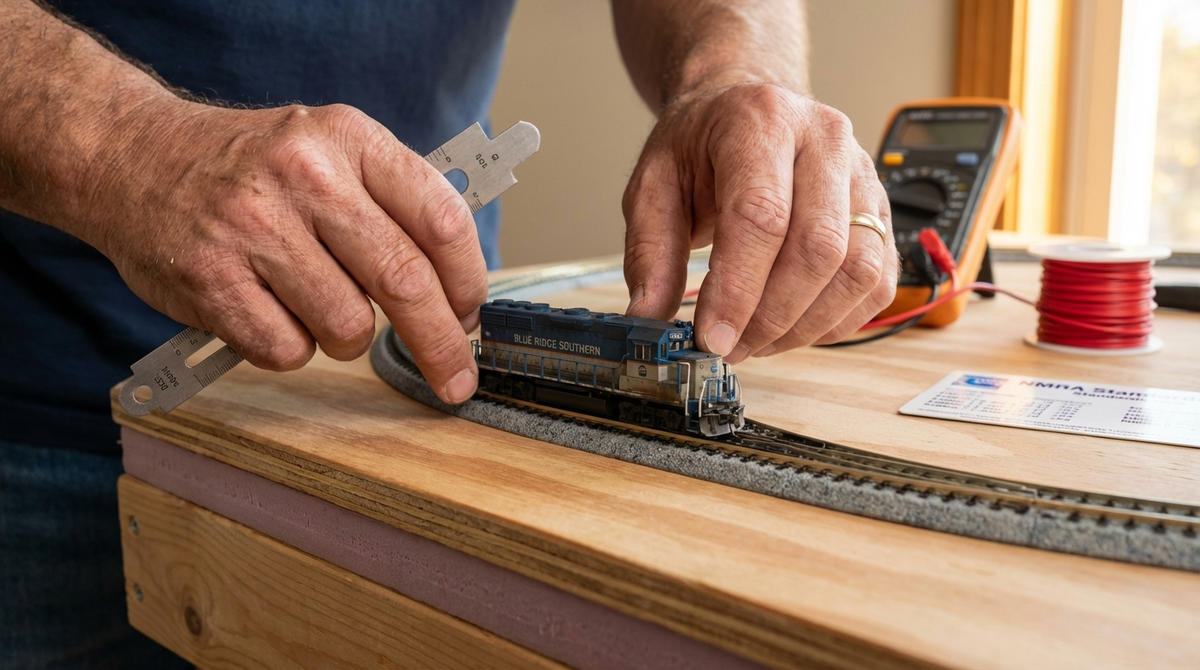
Solder all rail joiners for permanent electrical conductivity. Use an NMRA Standards Gauge to check track gauge, turnout points, and flangeway clearances at every joint.
Use a level across the rails in curves. Run a straightedge over grade transitions to catch vertical kinks. Any bump you feel will cause problems.
Power up your DCC system and systematically short the rails at various points. Instant breaker trip everywhere means you're good. Hesitation means more feeders.
Don't assume equipment is perfect out of the box. Check wheelsets with an NMRA gauge. Verify coupler heights. Weigh your cars and add weight if needed.
Even a standalone 4x6 can be prepared for expansion. Build your outer frame with Free-moN end-plate specifications: 3/4-inch birch plywood, 6 inches high, with track perpendicular and level approaching the edge.
Use Anderson Powerpole connectors for your track bus. If you ever want to connect to a club layout or add a bolt-on staging yard, you'll be ready in 10 minutes instead of fighting with adapters.
The T-TRAK standards offer another modular option if you're using Kato Unitrack, with standardized corner and straight modules that connect together.
I've spent way too many hours reading build logs on TrainBoard, ModelRailroadForums, and nScale.net. The patterns are consistent.
Modelers who define their purpose first, whether they want to railfan long trains or perform complex switching, build more satisfying layouts. Those who maximize radius beyond the minimum express fewer regrets later. And everyone who plans for reach avoids the most frustrating failure mode: a beautiful layout you can't maintain.
Mike's Small Trackplans Page and Steve's Trains offer excellent starting points with downloadable files. The Kato website has Unitrack-specific plans with parts lists.
If you want publication-quality photos, lighting matters more than your camera. Use LED strips with CRI 95 or higher and a color temperature between 4000K and 5000K.
COB LED strips provide continuous, dot-free light that's easier to diffuse. Mount them inside an aluminum channel with a frosted cover to eliminate glare on glossy surfaces.
For backdrops, 1/8-inch tempered hardboard takes paint well and can bend into coved corners. A painted gradient sky often looks better than photo prints, which require extremely high resolution (300 DPI minimum) to avoid pixelation.
N scale's shallow depth of field makes models look like toys in photos. Focus stacking, taking multiple shots at different focus distances and combining them in software, is the solution professionals use to get that perfectly sharp front-to-back look.
A 4x6 table is enough space for a satisfying N scale railroad if you respect its constraints. Use 11-inch minimum radius curves on mainlines. Install #6 turnouts everywhere that matters. Wire like you're building something bigger. Build quiet benchwork from the start. And most critically: keep everything within arm's reach.
The modelers who struggle with 4x6 layouts almost always made the same mistakes: curves too tight, turnouts too small, wiring too thin, or track too far away to fix when things go wrong. Skip those errors, and you'll have a layout that runs reliably and brings you back to the workbench night after night.
Now stop reading and start building. Your first layout won't be perfect, but it'll teach you more than any article can.
✨ Complete Your Layout: Explore our wide selection of Photo Real buildings, diorama backdrops, detail parts, and accessories in every popular scale.
✨ Unmatched Realism: From chrome detailing products to neon lighting kits – every piece is designed to make your miniature world come alive.