
N Scale Layout Ideas for 4x6 Table: Building a Reliable, Operable Railroad in 24 Square Feet
Posted by Benjamin Park on 30th Dec 2025
Order by phone: 763-231-7847
Free Shipping On Orders Over $100!
If you are already registered, please log in.
Create your account and enjoy a new shopping experience.
Create A New AccountPosted by Benjamin Park on 30th Dec 2025
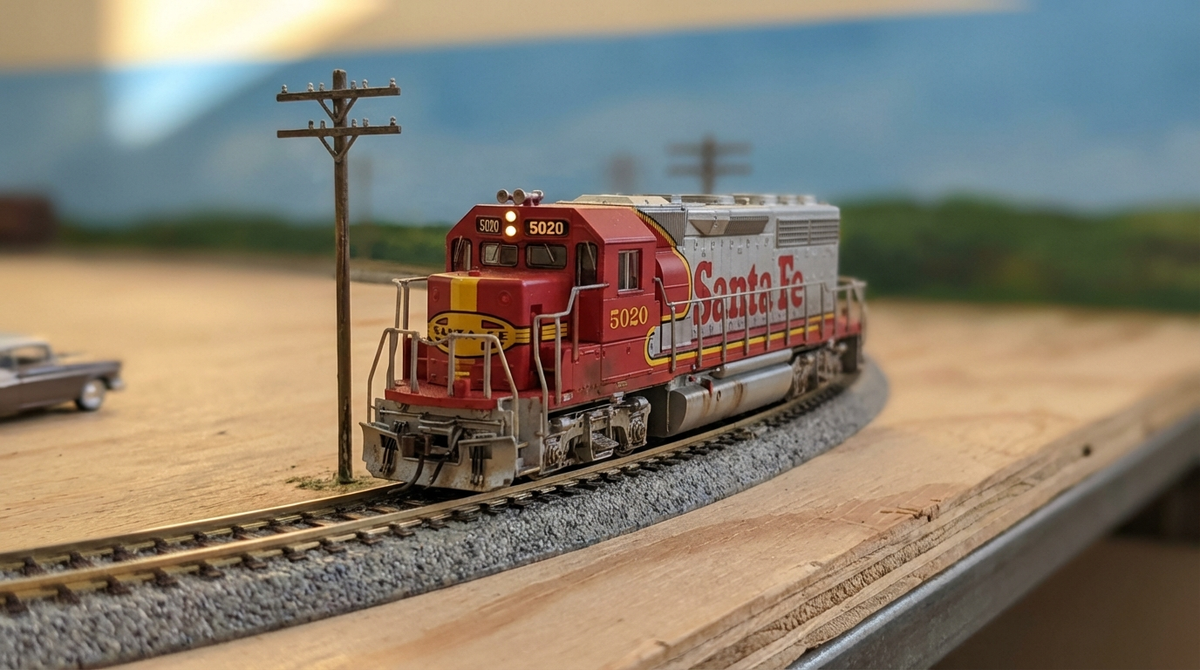
I got into model railroading thinking it would be relaxing. Then I discovered operations, and now I host timetable-and-train-order sessions in my basement that are probably more stressful than my actual job managing logistics for a trucking company. But here's what that background taught me: a model railroad is a system. And like any system, the 4x6 N scale layout lives or dies based on decisions you make before you lay a single piece of track.
If you're eyeing that spare corner or thinking about converting a table into your first serious layout, the 4x6 footprint hits a genuine sweet spot. It's big enough for real operational interest, small enough to finish, and perfectly sized for N scale's strengths. I've spent years watching modelers succeed and fail on layouts this size, and the difference almost always comes down to geometry, access, and realistic expectations.
Let me walk you through what actually works.
The 24 square feet of a 4x6 table gives you something rare in model railroading: enough space to tell a story without drowning in it. In N scale, you can fit curves broad enough to look convincing, run trains long enough to feel like trains, and still have room for industries that do real work.
The N scale layout design advantages become obvious when you compare this to HO. A 4x6 N scale layout offers roughly the same operational potential as a classic 4x8 HO layout, but you're not stuck with the toy-train curves that HO demands in that space. Where an HO modeler might be forced into 18-inch radius curves that look awkward with six-axle diesels, you can run 13-inch or even 15-inch curves in N and still have room for a yard.
And unlike a narrower shelf layout, you've got depth. Foreground, midground, background. Room to create actual scenes rather than just a strip of track.
Here's where I watch people go wrong, over and over. They grab a starter set, start snapping track together, and six months later they're tearing it all out because nothing runs reliably. The geometry decisions you make now will determine whether you're running trains or chasing derailments.
The 9.75-inch curves that come in most starter sets? They work for small switchers and 40-foot freight cars. That's about it. Community experience from modelers discussing minimum curve radius overwhelmingly shows that tight radius rails are the primary source of operational frustration.
For modern equipment, especially longer passenger cars and six-axle diesels, you want 11 to 12 inches minimum on your mainline. That's the threshold where most modern N scale equipment stops complaining. The minimum radius for reliable N scale operation really does make that big a difference.
For a 4x6 table, here's what's achievable:
The recommended minimum radius curves in N scale actually allow for 85-foot passenger cars when you get up to 15 inches or more. At 9.75 inches, the unwritten rule from N scale's early days, most modern equipment looks ridiculous with extreme overhang, and mixed-length trains become derailment machines.
I run a small Milwaukee Road layout with a modest grade between my staging yard and the main level. Even at 2%, I learned quickly that train length matters more than you'd think.
The NMRA beginner's guide puts 2% as the practical maximum for mainline operation with reasonably long trains. What forums discussing maximum practical grade in N scale don't always mention is the curve penalty. When you put a grade on a curve, you're effectively making it steeper.
The adapted John Allen formula works out to about 17.5 divided by your radius in inches. So a 2% grade on an 11-inch curve? That's effectively a 3.6% grade. Your locomotive that happily pulls 20 cars on level track might manage five or six going uphill around that curve.
As one modeler working on a small N scale layout grade discovered, grades up to 3.5% are possible, but you're committing to very short trains. The percentage of grade N scale trains can climb depends heavily on locomotive weight, wheel cleanliness, and how many cars you're willing to sacrifice.
My advice: if you can avoid grades entirely on a 4x6, do it. If you need an overpass, keep the grade on straight track and stay at 2% or less.
Turnouts are where trains derail. Period. The number (#4, #6, etc.) indicates how sharp the diverging route is. Higher numbers are gentler and longer.
For mainlines, the NMRA layout planning guide recommends #6 or higher. The difference between #4 and #6 turnouts might not look like much on paper, but it translates directly to reliable operation at realistic speeds.
The N scale turnout roundup breaks it down:
The debate over #6 versus #8 on mainlines comes down to space. On a 4x6, #6 is usually the practical choice. For #4 versus #6 in yards, the answer depends on what you're willing to give up.
An S-curve happens when a left curve immediately becomes a right curve, or vice versa. Crossovers are inherent S-curves. And laying track properly means understanding that S-curves are derailment factories.
The fix is simple: insert a straight section between opposing curves that's at least as long as your longest car. Better yet, 1.5 to 2 times the car length. The physics of coupler forces in an S-curve will yank shorter cars right off the rails if you don't give them room to transition.
The track you choose shapes your entire building experience. I've seen modelers agonize over this decision for months, so let me save you some time.
If you want to run trains reliably with minimal frustration, Kato Unitrack is the answer. The snap-together system with integrated roadbed has earned its "bulletproof" reputation for good reason.
The electrical connectivity is nearly perfect right out of the box. For portable layouts or situations where you might disassemble and reassemble, nothing beats it. One modeler's Scenic Ridge kit experience highlighted how much easier troubleshooting becomes when track connections aren't a variable.
The Unitrack system offers curves from 8.5 to 28.25 inches, #4 and #6 turnouts, and double crossovers that maintain their standard 33mm track spacing. The Kato catalog shows the full range.
The downside? Cost runs roughly $11 per foot, about double what you'd pay for flex track. And the Code 80 rail looks oversized for N scale unless you weather it heavily.
For modelers chasing visual realism, Atlas Code 55 track is the gold standard. The smaller rail profile with brown ties looks dramatically more prototypical than the chunky Code 80 alternatives.
The Atlas flex track allows custom curves, proper easements, and complex yard arrangements that sectional track can't match. Atlas offers both Code 80 and Code 55 options, with the #5 turnouts in Code 55 being particularly popular for yards.
Peco Code 55 turnouts offer an alternative with their curved diverging legs and excellent frog geometry. The Peco Streamline turnouts come in small, medium, and large radius options, with the turnout dimensions documented clearly.
The track and turnout selection ultimately depends on your priorities. Atlas and Peco require more skill to install correctly, and you absolutely must solder feeders rather than relying on rail joiners.
The Bachmann E-Z Track with its remote turnouts works fine for simple ovals and beginners. The 12.50-inch radius curves and 14-inch radius options give you geometry choices. Just don't expect the electrical reliability of Unitrack or the aesthetics of Code 55 flex.
Every 4x6 layout falls into one of three operational philosophies. Choose the one that matches how you actually want to spend your time with trains.
Two independent ovals with crossovers. This is for watching trains run. The track plans from Steve's Trains include several double-loop designs that fit a 4x6 with room to spare.
A well-designed double loop can fit a 12.4-inch inner radius and 13.7-inch outer radius on a 3.5 by 5.5-foot table, as demonstrated in the 3.5 by 5.5-foot layout build. Scale that up to 4x6 and you've got even more generous curves.
The Mike's Small Trackplans collection shows multiple double-loop configurations, including options with staging. Add a few industrial spurs and you've got a layout that satisfies both running and occasional switching.
If you want the journey to feel long, fold your mainline back on itself. An up-and-over design with a grade and bridge dramatically increases the feeling of distance traveled.
One 78x30006 plan fits a folded dogbone with passing sidings and a small yard on a door-sized layout. The 11-inch minimum radius works, and scenic dividers between the folded sections create the illusion of traveling through multiple towns.
Just remember the grade rules. Keep it at 2% or less, and try to put the grade on straight track. A 6x4 N scale layout plan shows how to handle the elevation changes without sacrificing reliability.
This is my territory. Pack industries into every available inch and spend your sessions spotting cars, building trains, and solving switching puzzles.
The 2x4 switching layout with Inglenook demonstrates how much operational interest you can cram into a small space. Scale it up to 4x6 and add a continuous running loop around the perimeter for variety.
The key to a switching layout is the runaround track. Without one, you're circling the entire layout just to get the engine on the correct end of your cars. The small industry discussion covers this trap.
I've watched dozens of 4x6 builds unfold on forums over the years. The patterns are clear.
One builder's 3x5 layout experience taught hard lessons about overpacking. Too many industries, steep grades forced by tight constraints, and crowded switching moves that made operations frustrating rather than fun. The 3.5% grade and 11-inch radius limited train length to four to six cars.
The Copper Canyon build log showed that automated features like auto-throw turnouts are achievable even on small layouts. The builder used a Wabbit decoder with trigger rails for hands-free operation.
A modeler seeking 4x6 advice made a smart choice: adding a detachable 2x4 staging extension. That extra staging transforms a loop from "roundy-round" into a purposeful layout where trains come from somewhere and go somewhere.
The build log from one 4x6 project reinforces the importance of testing as you go. Don't bury track under scenery until you've run every piece of equipment through every route multiple times.
One builder working on the Atlas track plan modification added an over-and-under section to the basic plan. Don't be afraid to modify published plans. They're starting points, not gospel.
Here's a lesson that cost me hours of frustration: anything beyond 28 to 30 inches from the edge is out of comfortable reach. On a 48-inch wide table, that means the center line is your practical limit.
The forward reach standards and ADA reach definitions confirm what modelers discover the hard way. The ADA standards specify maximum obstructed forward reach of 44 inches over a 25-inch obstruction, but comfortable, repeated reach is much less.
The ergonomic reach zones research shows that frequent, comfortable reach for most adults tops out around 19 to 25 inches before posture becomes compromised.
Design your layout so all track is within reach. Or, if track must go deeper, build access hatches into your benchwork. The lift-out section alignment requires robust dowel pins and careful track joint engineering. A removable bridge approach works well for some layouts.
The lift-out section discussion on forums shows that many builders prefer lift-outs to hinged gates because wood movement doesn't throw off alignment. And for DCC layouts with stay-alive capacitors, you need electrical interlocks to cut power when sections are removed.
The NMRA benchwork guide covers the fundamentals. For N scale, the benchwork height discussion consistently lands on higher being better. Those tiny trains need to be closer to eye level.
The N scale benchwork conversation points to 50 to 56 inches as the target for rail height. That's significantly higher than HO layouts. The layout height survey shows experienced N scalers gravitating toward chest height or higher.
For a 4x6 table, I recommend building on heavy-duty locking casters. That mobility means 360-degree access during construction. You can push the layout away from the wall to work the back side, then roll it back when you're running trains.
The DC versus DCC comparison is a common beginner question. Here's my take: wire for DCC from day one, even if you start with a DC power pack.
The getting started with DCC guidance makes the case that basic DCC wiring is actually simpler than the block-and-toggle complexity of multi-train DC operation. The DC versus DCC decision framework shows that DCC shines when you want to run multiple trains independently.
The wiring comparison confirms that straight DCC is no harder than DC, and for reversing loops or multiple blocks, it's easier. The N scale wiring best practices apply to both systems.
The NMRA guide on adding power walks through the basics. Install a 14 or 16 AWG power bus under the entire layout. The recommended wire sizes by scale confirm this is appropriate for N scale.
From the bus, run 20 or 22 AWG feeder wires to the track. Solder one feeder to each rail every three to six feet. Preparing for DCC this way means you can plug in a DCC command station later without rewiring.
For reversing loops and wyes, you'll need to isolate both rails at both ends of the reversing section. The model railroad wiring guide covers this clearly. Under DCC, an automatic reversing module like the Digitrax AR1 handles polarity flipping automatically. The DCC for beginners resource explains the process step by step.
The equipment you choose needs to match your geometry. For an 11 to 12-inch minimum radius mainline, focus on:
Locomotives: Four-axle diesels like GP7s, GP38s, and RS-3s handle tight curves beautifully. The NMRA curvature and rolling stock recommendations show these as appropriate for curves well under 11 inches. Bachmann's 2-8-0 is rated for 9.75-inch curves, and reviews confirm excellent performance on 11-inch and broader curves.
Freight cars: Stick to 40 and 50-foot cars for reliable operation. The average N scale car size discussion shows these lengths navigate tight curves without issue. Longer cars work but may cause problems when coupled to shorter equipment.
Passenger cars: For curves under 15 inches, look at shorter cars. The 60-foot Harriman coaches from Wheels of Time are a good choice, with N Scale Supply stocking them. Full 85-foot passenger cars need 15-inch or broader curves to look and run right.
The N scale coupler guide explains the critical difference between truck-mounted and body-mounted couplers on tight curves. Truck-mounted couplers swivel with the trucks, giving more swing and reducing the lateral forces that cause derailments.
Micro-Trains couplers offer multiple shank lengths. The 1016-1 medium shank body-mount works well for most applications. Their coupler diagrams and conversion kit listings help identify the right solution for your equipment.
The NMRA wheel standards matter for reliable operation. An NMRA gauge checks both track and wheels against the published standards. The wheelset discussion on nScale.net shows the value of upgrading to quality metal wheelsets like Fox Valley Models offerings or the low-profile steel wheels discussed in forums.
Weight cars according to the NMRA weight recommendations: 0.5 ounces initial plus 0.15 ounces per inch of length. The RP-20.1 car weight specification explains the physics. The motive power and rolling stock guide covers proper weighting technique.
A 4x6 layout gives you room for three-dimensional scene design. The goal is making 24 square feet feel like a much larger world.
The backdrop height discussion suggests 16 to 20 inches for N scale. The backdrop heights conversation and guidance on backdrop placement recommend keeping the horizon line relatively low to enhance the sense of distance.
For painting, a gradient from darker blue at the top to very light blue or white at the horizon creates atmospheric depth. The sky color discussion and real-world examples show effective techniques. Keep clouds subtle and wispy rather than hard-edged.
The forced perspective technique uses smaller scales in the background to create depth. On an N scale layout, incorporating Z scale buildings in the distance can be dramatically effective. The Z scale perspective discussion shows how a ridge line or row of trees separating the scales prevents direct comparison.
Paint distant elements in softer, grayer colors to simulate atmospheric haze.
For the back edge against the backdrop, use shallow structures. The low-relief warehouse building approach works well. Scalescenes printable low-relief structures and Metcalfe N scale low-relief kits offer ready options. Building flats printed on paper and mounted on foam core work for the furthest elements.
The paper structures discussion covers mounting techniques.
Don't build flat. The dimensional techniques guide shows how even slight elevation changes create distinct visual zones. Hills, cuts, and overpasses break sightlines and make the layout feel larger.
The shelf layout design principles apply to 4x6 tables too: use view blocks like tall buildings or tree lines to separate scenes.
Let me give you realistic numbers based on current pricing.
Value Tier (DC Starter): Around $900. Basic DC power pack, sectional track, manual turnouts, enough to get trains running.
Mid-Tier (DCC): Around $2,200. An entry-level DCC system like the Digitrax Zephyr or Zephyr Express, flex track, powered turnouts, a small roster.
Premium Tier (DCC with Sound and Signals): Can exceed $5,900. Higher-end DCC systems, sound decoders, block detection, and signaling. ESU LokSound decoders run $200 to $300 each.
A phased approach spreads costs over time. Benchwork and basic track first. Power and wiring second. Scenery third. Details forever.
Modern software prevents expensive mistakes. The two leading options for N scale are AnyRail and SCARM.
AnyRail reviews praise its intuitive interface. The software discussion consistently recommends it for beginners. Download AnyRail and try the free version, which allows up to 50 track pieces.
SCARM offers powerful 3D visualization and detailed parts list management. The 1:1 scale printing feature in the licensed version saves days of template work. The track library includes all major brands including Atlas.
The SCARM layout database includes downloadable plans. The track plan discussion points to multiple sources for design inspiration.
Even on a small layout, basic signaling adds operational realism. The RR-CirKits detection modules and Digitrax detection and signaling products make this achievable.
A minimal system uses a block detector like the TCS BOD-8-SM or Digitrax BXP88, a signal driver like the Digitrax SE74, and free JMRI PanelPro software.
The JMRI WiThrottle server allows wireless throttle control from your phone. Engine Driver for Android or similar apps connect to JMRI and provide full locomotive control from your pocket.
JMRI's Signal Mast Logic automatically generates correct signal aspects based on block occupancy and turnout position. The Entry/Exit interlocking and NX routing documentation cover advanced automation.
Total hardware cost for a minimal system: under $300.
The track and wheel standards exist because turnouts are the number one source of derailments. Use an NMRA gauge to check both track and wheelsets against the published trackwork standards.
The S-curve discussion and easement techniques show how to prevent coupler-related derailments. The easement forum thread covers practical implementation.
For reversing loop wiring, auto-reversers like the DCC Specialties PSX-AR handle polarity flipping automatically. The PSX-AR diagram shows proper installation.
The Morgan Valley RR plan and Simplicity & Great Plains plan are designed for HO scale with geometry that doesn't translate directly to N scale.
The Atlas track catalog shows the available options. To modernize these plans for N scale:
The Kato track plan examples offer N-native designs that avoid these translation problems. The SCARM N scale layout database and Peco-specific plans provide ready-to-use alternatives.
The Steve's Trains build series and 2x4 project layout videos show construction techniques step by step. The scenery and lighting installment covers finishing details.
For track and wiring, the 3.5x5.5 layout track and wiring video walks through the process clearly.
The NMRA standards index is your reference for everything from track centers and clearances to tangent track centers and curved track centers.
Manufacturer resources from Kato on minimum turning radii, Atlas track specifications, and Peco track plan sheets help with specific product questions.
For JMRI, the Layout Editor documentation, blocks documentation, and signaling setup guide cover the software side of operations.
A 4x6 N scale layout isn't a compromise. Built with the right geometry, proper access planning, and a clear operational purpose, it's a complete railroad. My Milwaukee Road sessions prove that operational satisfaction comes from smart design, not raw square footage.
Start with curves of 11 inches or larger on your mainline. Keep grades under 2% and on straight track. Use #6 turnouts where trains need to move, and #5 in your yard. Wire for DCC from day one. And for the love of all things prototype, design so you can reach everything.
Then run trains. That's the whole point.
? Complete Your Layout: Explore our wide selection of Photo Real buildings, diorama backdrops, detail parts, and accessories in every popular scale.
✨ Unmatched Realism: From chrome detailing products to neon lighting kits – every piece is designed to make your miniature world come alive.