
N Scale Coupler Conversion Guide: Practical Methods for Reliable Operations
Posted by Harold Lindgren on 31st Dec 2025
Order by phone: 763-231-7847
Free Shipping On Orders Over $100!
If you are already registered, please log in.
Create your account and enjoy a new shopping experience.
Create A New AccountPosted by Harold Lindgren on 31st Dec 2025
After building houses for four decades, I learned that foundations matter. A crooked foundation means a crooked house, no matter how fancy the trim work. The same principle applies to model railroading, and in N scale, your couplers are the foundation of every operation you'll ever run.
I've converted hundreds of cars since retiring to this hobby, and I can tell you this: the humble coupler is where most operational failures happen. Get it right, and your trains run like clockwork. Get it wrong, and you'll spend more time on your knees picking up derailed cars than actually enjoying your railroad.
This guide covers everything you need to know about converting your N scale fleet to reliable knuckle couplers. We'll talk standards, brands, tools, and step-by-step procedures that actually work. No theory for theory's sake-just practical methods I use in my workshop here in Hudson.
The N scale landscape has shifted dramatically. When Arnold introduced N scale back in the early 1960s, they gave us the Rapido coupler-a simple hook design that worked well enough for running trains in circles. But we're not running circles anymore. Modern operators want prototypical switching, realistic yard work, and trains that don't uncouple every time they go around a curve.
The Magne-Matic knuckle coupler developed by Kadee changed everything. Keith and Dale Edwards created a magnetically-actuated coupler that actually looks like what you see on real trains, and it became the standard by which everything else is measured. Their N scale version debuted in the late 1960s, and serious modelers have been using it ever since.
Today, body-mounted knuckle couplers are the default standard for new N scale rolling stock. If you're sitting on a fleet of older cars with truck-mounted Rapidos, you're working with equipment that's increasingly incompatible with modern expectations. The good news? Converting them isn't difficult once you understand the process.
Before you order a single coupler, you need to understand what you're working with. Two standards govern the N scale world, and they don't always play nice together.
Here in North America, the NMRA sets the rules. Their S-2 standard specifies a coupler height of 0.216 inches from the rail top to the knuckle centerline, with a tolerance of plus or minus 0.010 inches. That's tight, but it needs to be. The physics of reliable coupling demand precision.
This height specification is the single most important number you'll work with. Get it wrong, and your couplers will uncouple on grades, refuse to couple on level track, or bind up in ways that make you want to throw the whole car in the trash.
European modelers follow NEM standards from MOROP. The NEM 355 standard defines a standardized pocket for interchangeable coupler heads, which is why you can pop different couplers in and out of European equipment so easily. NEM 356 and 357 define the coupler heads themselves.
If you're running European equipment alongside North American stock, you'll need to account for these differences. The original Arnold Rapido coupler was designed for this European system, which is why it's still common on imports.
I've heard people argue about body-mounted versus truck-mounted couplers for years. Let me save you some time: body-mounting wins for any serious operation.
Real railroads mount their couplers to the car body, not the trucks. There's a reason for that-the forces involved in moving freight trains are tremendous, and you want those forces transmitted through the strongest part of the car.
The same principle applies to models. When you push a train, a truck-mounted coupler creates sideways pressure on the truck bolster. Push hard enough, and the truck skews, and suddenly you're watching your car derail in slow motion. I've seen it happen hundreds of times at operating sessions.
Body-mounted couplers transmit forces through the car's frame, leaving the trucks free to track correctly through curves and turnouts. The improvement in switching reliability is dramatic-especially when you're pushing cars through complex trackwork.
There's one scenario where truck mounting is acceptable: tight curves. If your minimum radius is under 13 inches and you're running long cars, body-mounted couplers might not swing far enough to clear. The practical minimum for body-mounts on standard freight cars is about 13 inches, and 85-foot passenger cars need 18 inches or more.
But here's my view: if your layout has curves that tight, consider redesigning before you commit to truck-mounted couplers. You'll be fighting operational problems forever otherwise.
The coupler market has diversified since Kadee's patents expired in 1997. Today you've got multiple options, each with strengths and weaknesses worth understanding.
This is the benchmark. The Magne-Matic design features a vertical split-knuckle with scissors action and a coil spring for centering. It's made from acetal plastic that holds up well over time, and the magnetic uncoupling works reliably when heights are correct.
The Micro-Trains product line includes body-mount kits (1015 short shank, 1016 medium shank) and T-shank adapters for locomotives. If you want hands-free magnetic uncoupling, standardizing on Micro-Trains is your best path.
For display models or dedicated unit trains, the True-Scale coupler offers the most prototypical appearance. No springs means no "slinky effect" when you stop a train, but it also means manual uncoupling only. These are body-mount only and won't couple with other N scale couplers-so commit fully or don't use them at all.
The Accumate coupler comes factory-installed on Atlas rolling stock. It's a decent coupler, but the magnetic uncoupling is inconsistent. Current Atlas releases use trip pins that aren't magnetic, which defeats the purpose for many operators.
The molded plastic centering springs also have limited swing compared to Micro-Trains. If your Atlas cars came with Accumates that work smoothly, keep them. If they're giving you trouble, convert to Micro-Trains.
Kato's proprietary couplers are a decent upgrade from Rapidos and work well within an all-Kato fleet. They require modeler-installed trip pins and can be finicky when mixed with other brands. The 11-702 version is popular for basic conversions.
The E-Z Mate Mark II offers an economical path to knuckle couplers. They feature an integrated metal coil spring and work with all magnetic uncoupling systems. The installation is straightforward, making them a good choice for upgrading older Bachmann equipment or converting Rapido-equipped cars on a budget.
The McHenry coupler from Athearn is the largest N scale knuckle coupler available-closer to HO size, frankly. The spring mechanism is often too stiff for magnetic operation. These come standard on Athearn N scale equipment, but I rarely see them used for conversions. The standard shank version works if you need a spare for an Athearn car, but don't standardize your fleet on these.
ScaleTrains offers their own coupler design on their equipment. According to their FAQ, the coupler boxes accept Micro-Trains 1015 or 1016 couplers, so you can standardize easily.
Rapido Trains equipment (not to be confused with the old Rapido coupler) comes with proprietary couplers designed for Micro-Trains compatibility. Their replacement parts are available if needed.
Before ordering parts, answer three questions. Your answers will determine over 90% of your conversion choices.
I spent 40 years building houses with quality tools, and I can tell you that cheap tools cost you money in the long run. The same applies here. A proper toolkit costs about $125 and will serve you through hundreds of conversions.
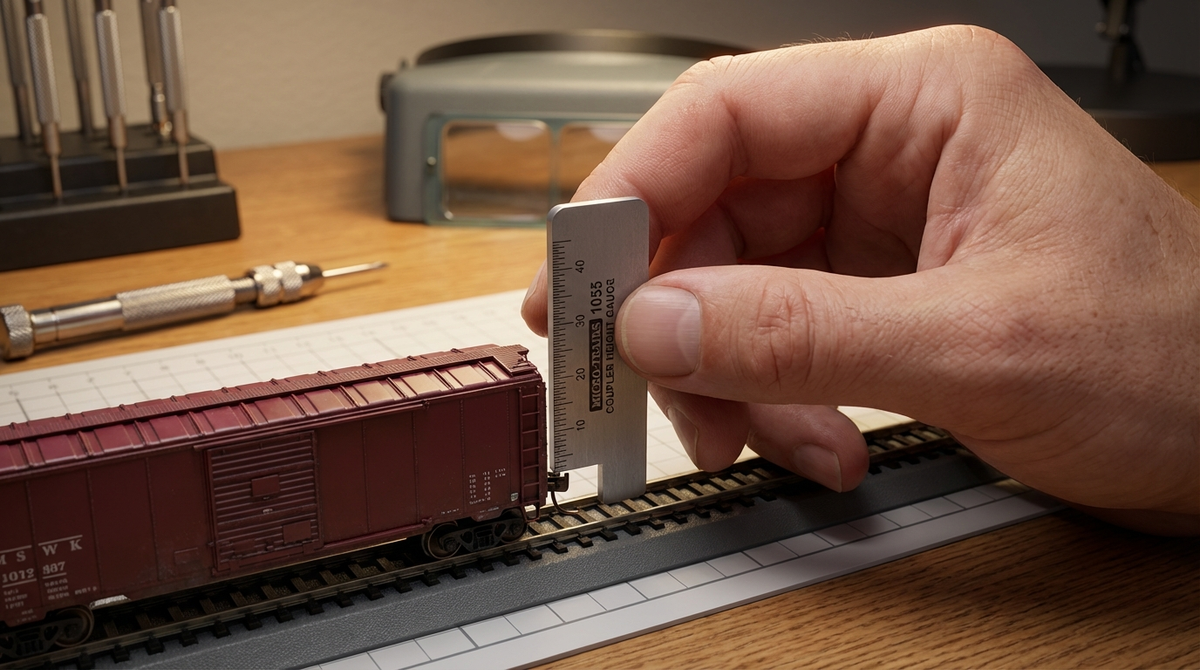
The Micro-Trains #1055 coupler height gauge is the single most important tool you'll buy. It verifies that your knuckle sits at the correct 0.216-inch height. At around $14, it's the highest-return investment in this hobby. One warning: it's metal, so don't use it on powered track.
The trip pin height gauge checks that the pin clears the railhead by 0.010 inches-high enough to avoid snagging on turnout frogs, low enough to engage uncoupling magnets.
For body-mounting, you need a 00-90 tap and corresponding drill bits. The Kadee tap and drill set works well, as do the Micro-Trains equivalents. A pin vise gives you the control you need for drilling into plastic without cracking it.
Trip pin pliers are designed specifically for bending those tiny pins without kinking them. A good hobby knife with fresh blades handles trimming and cleanup. And if you're working in N scale without magnification, you're punishing your eyes unnecessarily-get an OptiVisor or similar headset.
Stock up on 00-90 screws in various lengths. Keep strips of 0.020-inch styrene for shimming. You'll need CA glue (both thin and gel formulas) for securing shims and mounting pads.
For lubrication, use dry graphite only. Wet lubricants attract dirt and gum up the works. A little graphite keeps the mechanism smooth without the mess.
Here's where we get practical. These procedures work-I've used them on everything from vintage Atlas cars to modern imports.
This is the most common conversion you'll do. Those old Rapido couplers need to go.
The Atlas parts diagram shows how their equipment is assembled. You have two options:
Quick swap: Replace the entire truck assembly with Micro-Trains trucks with couplers. Takes seconds, but retains truck-mount limitations.
Full conversion: Remove the stock coupler mechanism and install body-mount draft gear. This requires more work but delivers better performance. The Atlas catalogs list compatible replacement parts if needed.
Kato locos often need coupler conversions for compatibility with a Micro-Trains fleet. The Micro-Trains website lists specific conversion part numbers for different Kato models.
For newer Kato units with higher coupler pockets, the standard 2004 underslung coupler may sit too high. Try a 1015 standard-shank coupler instead-its geometry often corrects the height issue.
Older Bachmann equipment with truck-mounted Rapidos converts easily with T-shank couplers. The 1129 medium T-shank and 1130 long T-shank handle most applications. Pop open the truck's coupler box, remove the old Rapido, and drop in the T-shank replacement.
Newer Bachmann cars come with E-Z Mate couplers standard, which are compatible with Micro-Trains and generally work fine out of the box.
Modern European models use the NEM 355 pocket system. Converting these is simple because you can just swap the coupler head without modifying the car.
Dapol makes knuckle couplers with NEM-compatible shanks that push right into the existing pocket. For 100% Micro-Trains standardization, you'd need to cut away the NEM housing and create a new mounting surface-possible, but usually unnecessary unless you're running a dedicated North American prototype layout.
A perfectly installed coupler can still fail if your locomotive jerks around like it's having a seizure. DCC decoder tuning matters more than most people realize.
CV3 (acceleration) and CV4 (deceleration) control how your locomotive responds to throttle changes. For yard work, set these low-values of 2-5 give you responsive, controllable moves. For road power, higher values (15-30) simulate the inertia of a real train and keep couplers taught.
Most decoders offer a switching or shunting mode that cuts top speed and reduces momentum. On ESU LokSound decoders, F3 typically activates this. On TCS decoders, it's F7. Program this function on every yard switcher-the improved controllability during coupling moves is worth it.
Nothing stresses couplers like locomotives fighting each other in a consist. If one unit wants to go faster than another, the couplers absorb that constant push-pull. Use JMRI's speed matching tools to create matched throttle curves for all your power. The modern sound-equipped locomotives from ScaleTrains and others deserve this calibration work.
Even with careful installation, problems happen. Here's how I diagnose them.
Height mismatch: Add styrene shims to raise the coupler; file the mounting surface to lower it. Apply plastic-safe threadlocker if screws keep loosening.
Trip pin snagging: Bend the pin upward with proper pliers until it clears a 0.010-inch gauge. If you don't use magnetic uncoupling, just clip the pin off entirely.
Centering problems: Disassemble the draft gear box and check for plastic flash or a misseated spring. Make sure the mounting screw isn't pinching the box.
Random uncoupling: This "slinky effect" usually means your cars are too light. Weight them to NMRA RP-20.1 standards. A short piece of round stock inside the centering spring can also dampen unwanted movement.
Let's talk money. A 50-car fleet conversion runs about $320 in parts and tools-roughly $6.40 per car when you factor in the one-time tooling cost. That assumes you're buying couplers in bulk packs, which you should be doing.
The Micro-Trains 10-pair bulk packs run about $2.05 per pair versus over $7.50 for individual 2-pair packs. Buying singles is throwing money away.
The operational return is immediate. Derailments drop by 70% or more when you standardize on body-mounted knuckle couplers and maintain proper height. That's not marketing-that's what I've seen on my layouts and at club operating sessions.
The financial return shows up at resale. Cars converted to body-mounted Micro-Trains command a $5-7 premium over Rapido-equipped equivalents. Buyers factor in the conversion work they'd have to do otherwise. A converted fleet essentially pays for its own upgrade when you sell.
Two trends are worth watching: 3D-printed couplers and DCC-actuated uncoupling.
Jacksonville Terminal Company's Very Real Knuckle coupler represents the bleeding edge-scale-sized with molded air hoses and serious detail. The problem? They're 3D-printed resin, and resin is brittle. Early reports suggest a breakage rate around 15% under normal handling versus under 1% for Micro-Trains. Beautiful for display, risky for operations.
PreciModels offers DCC uncoupler conversion kits that use tiny actuators to operate the coupler via decoder function outputs. No magnets needed, no trip pins to snag. The cost and complexity limit this to specific applications-cabooses, dedicated switching locos, or key cars-but the technology points toward a future where we can uncouple anywhere on the layout.
The Micro-Trains conversion charts map hundreds of models to specific coupler part numbers. This is your primary reference-print it and keep it at your workbench.
The N Scale Railroading Magazine coupler comparison article provides good visual references for the differences between brands.
For vintage equipment identification, collector guides help you figure out what you're working with before you start cutting.
A coupler conversion project is like any other construction job: measure twice, cut once, and use the right tools for the task. The $125 you spend on a proper toolkit pays for itself in the first dozen cars you convert without frustration. The $320 you spend upgrading a 50-car fleet pays for itself in operating sessions where trains actually run the way they should.
I've built four layouts since retiring, and every one runs better because I took the time to standardize couplers before I started operating. Do the work up front. Your future self will thank you-probably during an operating session where nothing derails and every coupling happens on the first try.
✨ Complete Your Layout: Explore our wide selection of Photo Real buildings, diorama backdrops, detail parts, and accessories in every popular scale.
✨ Unmatched Realism: From chrome detailing products to neon lighting kits – every piece is designed to make your miniature world come alive.