
N Scale Buildings and Structures: A Practical Guide to Getting Them Right
Posted by Tamara Brooks on 31st Dec 2025
Order by phone: 763-231-7847
Free Shipping On Orders Over $100!
If you are already registered, please log in.
Create your account and enjoy a new shopping experience.
Create A New AccountPosted by Tamara Brooks on 31st Dec 2025
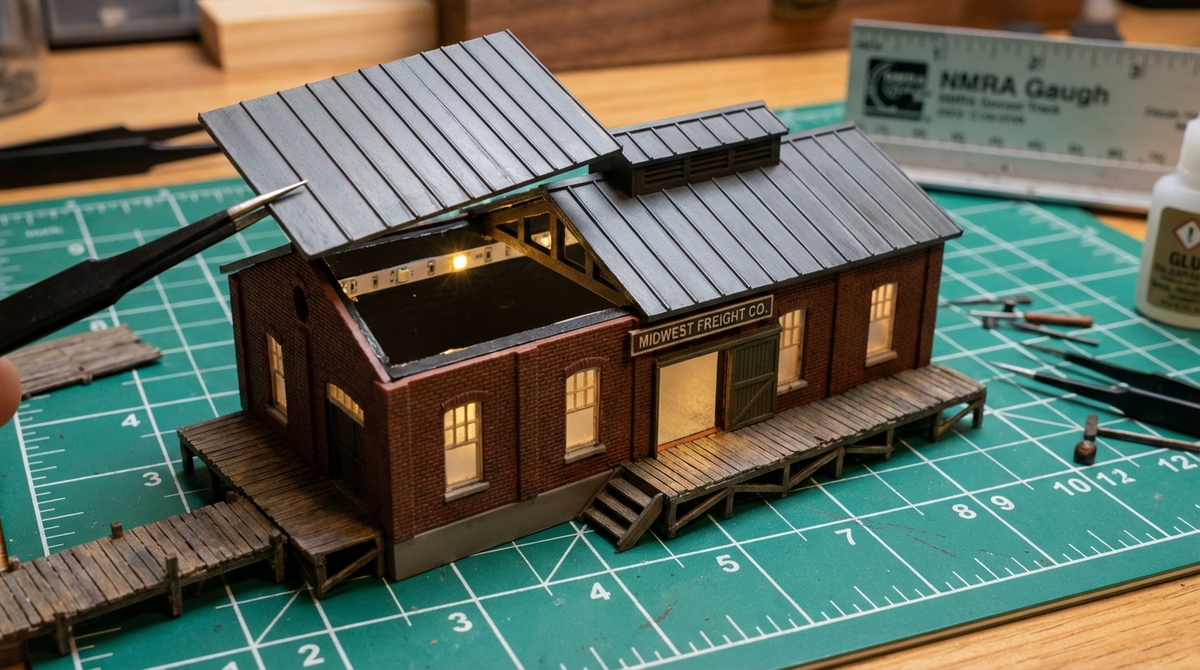
I bought my first structure kit about three years ago because I needed something to put next to my intermodal yard. Grabbed a Walthers Cornerstone warehouse, slapped it together in an evening, and thought I was done. Spoiler: I wasn't. The roof was too tall for my overpass, the walls glowed like a haunted house when I added lighting, and the whole thing looked like it belonged in a different decade than my modern BNSF consists.
That experience taught me something you probably already suspect: N scale buildings and structures aren't just about picking something that looks cool. They're about understanding the numbers, matching your era, and knowing which construction method actually fits your skill level and patience threshold.
Let's get the basics out of the way. N scale runs at 1:160, which means one real-world foot shrinks down to about 0.075 inches on your layout. That's tiny. A 50-foot boxcar becomes less than four inches long. This compression is exactly why N scale lets you model things that would eat an entire basement in HO.
The track gauge is 9mm between the rails, and that's standardized across manufacturers. You can mix Kato, Atlas, and Peco track without drama. But here's where it gets a little weird: British N gauge uses 1:148 scale, and Japanese models often run at 1:150. They all use the same 9mm track, but a British building will look about 8% larger than an American one when placed side by side.
I use this to my advantage. Smaller 1:160 structures in the background of a scene with slightly larger foreground buildings creates a subtle forced perspective effect. Your brain reads it as depth, and you save precious layout real estate.
Here's where most people get burned. You spend hours detailing a beautiful depot, cement it in place, and then watch your double-stack well cars slam into the eaves on the first test run.
The NMRA publishes RP-7.1, which lays out minimum clearances for different eras. For modern operations (post-1983), you need at least 1.73 inches of vertical clearance and 0.45 inches from the track centerline to any structure. That's on straight track. Curves eat more space.
I keep an NMRA standards gauge on my workbench. Before any structure gets glued down, it gets checked. This ten-dollar tool has saved me from expensive mistakes more times than I can count.
The market for N scale structures has exploded over the past few years. You've got options ranging from cheap and fast to expensive and time-consuming, and none of them are inherently better than the others. It depends on what you're trying to accomplish.
Walthers Cornerstone dominates this category, and for good reason. Their kits go together quickly, parts are molded in realistic colors, and the finished product looks good from typical viewing distances. A Golden Valley Depot kit runs about 4 x 2-1/8 inches and assembles in an afternoon.
The Cornerstone catalog covers everything from small-town depots to massive industrial complexes. For modern layouts, their Modern Steel Warehouse and Modern Concrete Warehouse kits nail that contemporary tilt-up construction look.
Woodland Scenics Built-&-Ready structures offer another path: pre-assembled, pre-weathered, and ready to place. They're pricier, but if you need to populate a scene quickly, they work.
Blair Line and Bar Mills produce some of the most detailed N scale structures available. The laser cutting produces crisp edges and realistic wood grain textures that plastic can't match. A Blair Line gas station or general store will look right at home on a transition-era layout.
But these kits demand patience. The assembly process involves painting before construction, careful handling of tiny parts, and internal bracing to prevent warping. Warping is a real problem if you don't seal both sides of the wood equally before painting. The moisture from paint or glue gets absorbed unevenly, and you end up with banana-shaped walls.
I prime everything with automotive gray primer before any other work. Stripwood bracing on the interior keeps the walls straight over time.
This is my territory. Resin kits capture extremely fine detail that injection molding can't reproduce. Small-run producers create prototypes that the major manufacturers will never touch.
The trade-off is fragility. Resin parts snap if you look at them wrong, and SLA 3D prints can be even worse unless you're using engineering-grade resins designed for durability. Prep work is also significant. Washing off mold release agents, removing support structures, and curing UV resins all add hours to the build process.
For N scale, SLA printing beats FDM hands down. The layer lines on FDM prints are too visible at 1:160 scale. An SLA printer with 0.05mm layers produces parts that look like they came from a professional mold.
ModelBuildings.org and Scalescenes offer downloadable PDF kits that you print on cardstock and assemble. The photorealistic textures look good, and the cost per building is minimal.
These work best as background flats or budget town fillers. Without internal bracing from foamcore or card, they're prone to warping over time. But for quickly populating a distant city block, you can't beat the price.
Wrong glue equals weak joints, damaged parts, or fogged windows. I keep several types on hand because no single adhesive does everything well.
For plastic kits, solvent cement like Tamiya Extra Thin creates the strongest bonds. It actually melts the styrene slightly, fusing the parts together. The catch: it will fog clear window parts if you're not careful, and it requires decent ventilation.
Cyanoacrylate (CA glue) bonds almost anything to almost anything, and it sets in seconds. Great for attaching small detail parts or joining dissimilar materials. But the bond is brittle, and the fumes can irritate your eyes and lungs.
For wood kits, PVA glue works well. It's slower to cure, which gives you repositioning time, but it can warp thin wood if applied too heavily.
For windows, use canopy glue or Micro Kristal Klear. These dry crystal clear and won't fog the plastic. The bond isn't structural, but windows don't need to bear loads.
A modern distribution center doesn't belong on a 1950s branch line, and a wooden freight house looks absurd next to a container crane. Getting the era right separates layouts that tell a story from those that look like random buildings dumped next to track.
The transition era captures steam and diesel coexisting, which makes it popular for its operational variety. Buildings from this period tend toward wood frame construction with brick commercial structures in towns.
American Model Builders produces laser-cut kits based on actual railroad prototypes. Their UP depot kits run about 6 x 2.5 inches. Walthers' Golden Valley Freight House pairs well with their matching depot.
For industries, grain elevators and team tracks dominated rural areas. Railroads brought farmers access to markets that had never existed before, and the infrastructure reflected that agricultural focus.
My layout models the modern era, so I spend a lot of time thinking about contemporary structures. The dominant building type is the tilt-up concrete warehouse, the kind you see in every industrial park in America.
Walthers' Modern Concrete Warehouse measures about 12 x 6.75 inches in N scale. Combine multiple kits for larger facilities. The Industrial Office kit works as a yard office or adjacent business.
Intermodal facilities need container handling equipment. N Gauge Models offers reach stackers in resin, and there are various 3D printed options if you're willing to source files.
Nothing ruins a lighted structure faster than "the glow." You add a warm LED inside, expecting a cozy lit window, and instead the entire building looks radioactive. The plastic walls themselves transmit light.
The fix is simple but requires discipline: paint the interior flat black before assembly. This blocks light from bleeding through the walls. Then paint a lighter color (white or silver) over the black to reflect light back toward the windows, making the interior brighter.
After assembly, test with a flashlight in a dark room. Check every seam and corner. Seal leaks with black electrical tape or a bead of caulk on the inside.
SMD LEDs in sizes like 0603 (1.6mm x 0.8mm) and 0402 (1.0mm x 0.5mm) fit inside most N scale structures without showing. Evan Designs sells pre-wired LEDs with hair-thin magnet wire that's easy to hide.
The common mistake is running LEDs too bright. A 1kΩ resistor on 12V gives you stadium lighting. Bump that up to 4.7kΩ or 10kΩ for a softer, more realistic glow. Prototype buildings aren't lit like operating rooms.
I'm going to sound like your safety officer here, but this stuff matters. Many modeling materials are legitimately hazardous if you don't handle them properly.
Tamiya Extra Thin Cement contains MEK and acetone with flash points below room temperature. These are flammable and produce VOCs that you shouldn't breathe. A spray booth with at least 100 fpm face velocity is the OSHA recommendation for spray finishing.
For CA glues and resin work, nitrile gloves and a NIOSH-approved respirator with organic vapor cartridges are appropriate. Uncured photopolymer resin is toxic to aquatic life and shouldn't go down the drain. Cure it under UV light first, then dispose of the solid.
Here's where my 3D printing background forces a reality check. A huge percentage of models on sites like Thingiverse carry Non-Commercial licenses. That means you can print them for yourself, but selling prints is legally sketchy.
The Etsy sellers offering prints from Thingiverse files are often operating in a gray area (or an outright red one). If you want to sell prints commercially, use platforms like Cults3D with their Commercial Use licenses or MyMiniFactory Merchant Tiers.
For personal use, Creative Commons BY licenses let you do almost anything as long as you credit the creator. But always check before printing.
If you build modules for T-TRAK or NTRAK, structure placement matters even more than on a home layout. Other people's trains need to pass your scenery without collisions.
T-TRAK specifies the front track at 1.5 inches from the fascia, with minimum vertical clearance of 45mm (about 1.75 inches). Side clearance increases on corner modules to account for overhang on curves.
NTRAK uses three mainlines positioned at specific distances from the module's rear edge. Free-moN emphasizes prototypical appearance with minimum 22-inch radius curves and #6 turnouts.
For transport, magnets work well for removable roofs and delicate details. Pack modules face-to-face with spacer arms to protect the scenery, or use foam cradles for shock absorption.
NMRA judging weighs construction quality heavily. Squareness, clean joints, and proper finishing can make or break your score.
Magnetic gluing jigs or even Lego blocks help maintain perfect 90-degree corners during assembly. A machinist's square lets you check alignment throughout the build.
The painting sequence matters too. Prime first, then base colors, then a gloss coat before decals to prevent silvering, then weathering, and finally a matte varnish to protect everything. Just don't spray the varnish over windows.
For weathering, less is more in N scale. Colors appear darker on smaller models due to scale color effect. Add up to 23% white to your weathering mixes, and use diluted washes rather than heavy applications.
Walthers Cornerstone and Woodland Scenics remain the dominant U.S. manufacturers for plastic kits and ready-built structures. But Japanese and European brands have become much more accessible through online retailers.
Kato and Tomytec produce excellent modern Japanese buildings and platforms. Kato's Local Line Small Station Building even supports lighting installation. Auhagen and Faller cover European prototypes.
The N Scale Architect offers laser-cut and 3D-printed craftsman kits for modelers who want something beyond the mass-market offerings. YankeeDabbler stocks a wide range of manufacturers in one place.
Before any structure goes on my layout, I run through a mental checklist. Are the walls square? Are joints tight and glue-free on visible surfaces? Does the roof sit flat? Will it pass a clearance gauge?
For lit structures: does anything glow that shouldn't? Is the light level realistic? Are the windows clean and unfrosted by overspray?
For era-appropriate scenes: does the signage match the period? Are the colors muted appropriately for the scale? Is the weathering subtle enough to look right at arm's length?
This self-audit catches problems before they become permanent. It's the same process contest judges use, just applied earlier in the workflow.
N scale buildings reward attention to detail. The small size means every mistake shows, but it also means every well-executed element adds to the illusion. Get the numbers right, choose appropriate construction methods, and finish with discipline. Your structures will look like they belong in the scene, not like they were dropped in from a different railroad, era, or scale entirely.
✨ Complete Your Layout: Explore our wide selection of Photo Real buildings, diorama backdrops, detail parts, and accessories in every popular scale.
✨ Unmatched Realism: From chrome detailing products to neon lighting kits – every piece is designed to make your miniature world come alive.