
Most Realistic HO Scale Locomotives: A 2025 Buyer's Guide for the Detail-Obsessed
Posted by Tamara Brooks on 29th Dec 2025
Order by phone: 763-231-7847
Free Shipping On Orders Over $100!
If you are already registered, please log in.
Create your account and enjoy a new shopping experience.
Create A New AccountPosted by Tamara Brooks on 29th Dec 2025
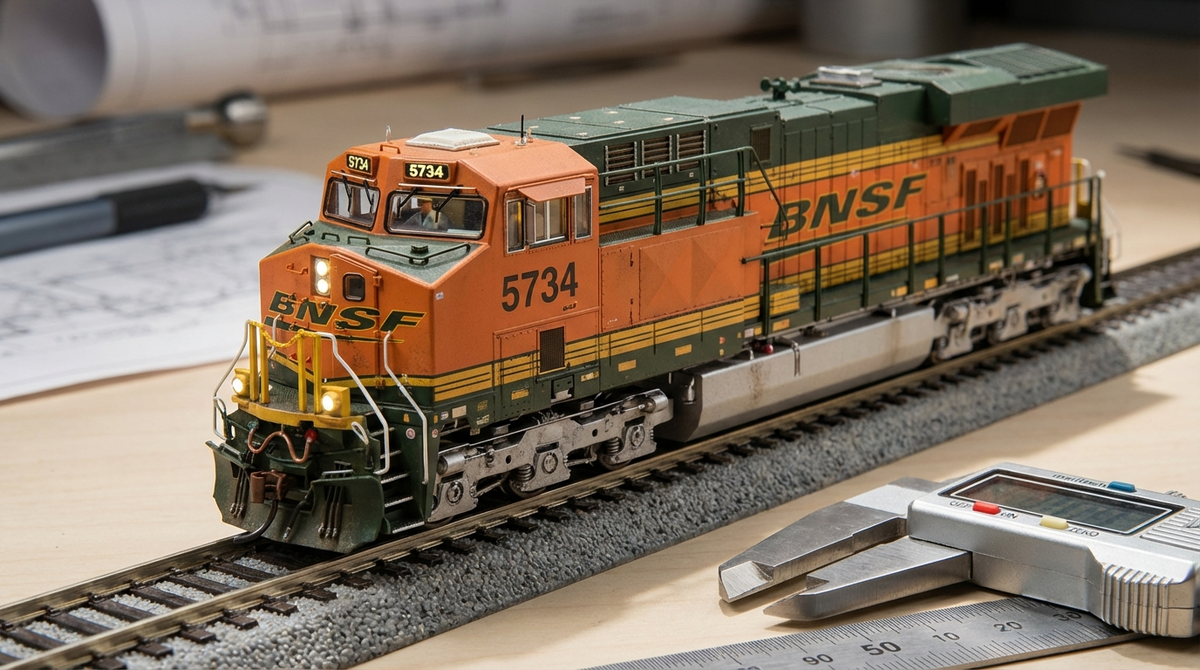
I spend most of my modeling time in N scale, which means I watch the HO world with a mix of envy and bewilderment. You folks get everything. Every road number. Every phase variation. Sound decoders that could pass for recordings from the cab. And yet, with all those choices, the question I hear most from HO modelers is still the same: which locomotives are actually the most realistic?
After digging through performance data, owner reports, and enough product specs to fill a boxcar, I've got answers. They might not be what you expect.
Here's the thing that took me a while to accept: a locomotive can have 90 separately applied parts and still feel fake on the layout. That's because realism isn't just about rivet counts anymore. It's a combination of three factors, and if any one of them fails, the whole illusion collapses.
Fidelity is the obvious one-prototype accuracy, sharp paint, road-number-specific details. This is what you see when the model sits on your desk.
Functionality is what happens when you put it on the rails. Can it crawl at 1 scale mph through your yard without stuttering? Do the ditch lights flash correctly? Does the sound actually respond to load?
Fitness for Service is the one nobody wants to talk about. If your locomotive develops cracked gears or a fried motor after 20 hours of operation, it doesn't matter how pretty it was. A shelf queen isn't realistic-it's furniture.
When I evaluate locomotives now, I weight these roughly 35% fidelity, 50% functionality (split between operations and electronics), and 15% reliability. Your math may vary, but ignoring any of these will cost you eventually.
Three brands dominate the high-end plastic market: ScaleTrains, Athearn, and Rapido. Each has a distinct philosophy, and understanding those differences will save you money and frustration.
ScaleTrains has built their reputation on what I'd call vertical integration. They don't just make detailed shells-they engineer complete systems where the body, decoder, and power delivery all work together.
Their Rivet Counter SD40-2 and Burlington Northern variants showcase this approach. You get dimensionally accurate truck centers, see-through dynamic brake intakes, and paint colors matched to Tru-Color Paint standards. The micro-printing is legible under magnification, which still amazes me.
But the real magic is under the hood. ScaleTrains standardized on ESU LokSound 5 decoders with "Full Throttle" features, and most Rivet Counter models include a factory-installed ESU PowerPack providing up to 4 seconds of keep-alive. That means smooth crawls through turnouts without stalling.
Their DASH 9-44CW models feature operating LED front, rear, and side walkway lights-all configurable through the decoder. The Kansas City Southern patched units even replicate specific weathering like faded HVAC covers and exhaust burn marks.
Street price for sound-equipped models runs $300 to $340, which is steep. But you're buying a complete package that works out of the box.
If ScaleTrains wins on electronics integration, Athearn Genesis wins on visual presentation. Their paint and weathering work is genuinely stunning.
The Genesis 2.0 line features bodies scaled from prototype drawings and field measurements, with fine-scale Celcon handrails and etched metal grilles. Their SD70ACe includes see-through steps, illuminated ground lights, and full cab interiors.
What really sets them apart is the "Primed for Grime" (P4G) factory weathering. These aren't just dirty models-they replicate the specific way paint fades and wears on real locomotives. The base colors are matched to prototype, with simulated patches, rust, and UV degradation. If you've ever struggled to make a factory-fresh model look like it's actually done some work, P4G cuts your finishing time by roughly 60%.
Athearn uses SoundTraxx Tsunami2 decoders, which offer excellent sound and Dynamic Digital Exhaust. The catch? No factory keep-alive. You'll need to add a stay-alive capacitor yourself if you want reliable operation on dirty track.
One gotcha: about 19% of units reportedly arrive with excess factory lubrication that can mar the finish. Check yours before weathering, and clean if necessary.
Street prices land around $265 to $285 for sound-equipped units-the best value in the premium tier if paint quality is your priority.
Rapido occupies a unique space. They chase prototypes nobody else will touch, with a level of detail that borders on pathological.
Their approach starts with 3D scanning actual locomotives to ensure 100% accurate shapes. The B36-7 model features full underbody piping, multi-color class lights, and step lights that illuminate when the engine stops. Their F40PH-2D review showed exceptional slow-speed performance-under 1 scale mph at speed step 1.
Like ScaleTrains, Rapido uses custom ESU LokSound V5 projects with sounds recorded from prototype locomotives. Their Dash 8-40CM includes a "Mo-Power" capacitor for keep-alive, and the lighting packages rival anyone's-track lights, step lights, class lights, the works.
The F40PH line demonstrates their obsession beautifully. The Phase I models correctly feature smaller 1,500-gallon rear-mounted fuel tanks, three vertical ribs, and recessed Nathan P5A horns. Later phases get the larger front-mounted tanks, four ribs, and quieter Q-fans. Even the strobe lights are era-specific.
Here's the catch: Rapido's QC is inconsistent. Owner reports indicate roughly 6% of units arrive with issues ranging from paint blemishes to non-functional motors. Their warranty support is responsive but slow-parts sometimes have to come from Canada-and some models need CV tuning to run smoothly at low speeds.
If you model Canadian prototypes or want specific details nobody else offers, Rapido is worth the gamble. Just buy from a dealer who bench-tests before shipping.
Not everyone needs museum-grade detail. Some of us just want locomotives that run well, look good, and won't break after a year on the layout. That's where the mid-tier brands shine.
Ask veteran operators which brand they trust most, and you'll hear Atlas and Kato mentioned in the same breath. There's a reason for that.
Atlas's Master Line has been described as "built like a rock with the precision of a Swiss watch." The U23B features their signature five-pole skew-wound motor with dual brass flywheels-a combination that delivers smooth, quiet, reliable operation year after year.
Their lineup comes in two flavors: Silver (DCC-ready with 21-pin plug) and Gold (factory ESU LokSound 5). Silver models at $199 MSRP give you that legendary drive quality while leaving room to install your preferred decoder. Gold at $325-$345 delivers ready-to-run sound.
The C-420 review showed Atlas models hitting under 1 scale mph at speed step 1, with prototypical top speeds around 65 mph. The GP40-2 lineup includes etched metal fans and detailed cab interiors at price points well below the premium brands.
Community-reported failure rates hover under 2%. When you're building a fleet for operations, that kind of reliability matters more than the last gram of detail.
WalthersProto carries baggage from the Life-Like Proto 2000 era-specifically, the infamous cracked axle gears that plagued pre-2005 models. That plastic became brittle over time, affecting GP7s, GP9s, and F-units.
The good news: Walthers fixed it. Modern WalthersProto production uses helical-cut gears with 21-pin DCC plugs and factory ESU LokSound 5 options. If you're buying new, you're fine.
If you inherit or buy used Proto 2000 models, the fix is straightforward. Walthers provided replacement wheelsets, and Athearn #60024 gears work as a common swap. Budget 30 minutes and $15 in parts, and you've got a solid runner.
The USRA 2-10-2 showed WalthersProto steam starting smoothly at 1 scale mph, running quietly up to 40 mph-right where drag freight belongs.
InterMountain's earlier GEVO models had rough reputations-loud gears, poor pulling power, wrong sound files. Their newer Tier 4 GEVO features a completely retooled drive and ESU sound. Post-2020 releases deserve a fresh look.
Bowser dominates the ALCo and MLW niche. Their C-630M correctly captures details like Dofasco trucks for Canadian roads. Early C-636 runs had ride height issues, but later production corrected them. If you model roads that ran ALCo power, Bowser might be your only realistic option in plastic.
I'll be blunt: the decoder determines how your locomotive behaves, and the differences between platforms are measurable. This matters most for slow-speed operations-yard switching, coupling moves, anything under 5 scale mph.
The LokSound 5 leads on motor control. Its 50 kHz PWM frequency produces nearly silent operation with coreless motors. The "Auto Tune" function calibrates to your specific motor, and minimum sustained speeds below 1 scale mph are achievable with tuning.
Advanced features include "Drive Hold" (independent control of speed and prime mover RPM) and an independent brake function. Sound projects run 16-bit at 31.25 kHz with 10 simultaneous channels-genuine hi-fi territory.
The catch: full customization requires the ESU LokProgrammer hardware. CV-only tuning gets you partway there, but the proprietary software unlocks everything.
Tsunami2's strength is Dynamic Digital Exhaust (DDE)-automatic load-responsive sound that makes your locomotive grunt under strain without you touching anything. The 16 polyphonic channels and 7-band equalizer give excellent audio flexibility.
Motor control uses "Hyperdrive2," which is very good but typically yields minimum speeds in the 1-3 scale mph range on default settings. "Flex-Map" technology allows function remapping via CVs without proprietary hardware-a real advantage for users who don't want to buy a separate programmer.
Keep-alive requires an external CurrentKeeper add-on.
BLI's Paragon 4 includes an integrated "GoPack" capacitor-keep-alive out of the box. The "Rolling Thunder" feature transmits low-frequency sounds to an external subwoofer for physical bass you can feel.
The downside: default motor start-up delay and higher starting voltage make ultra-slow control less intuitive. Minimum speeds typically land around 2-3 scale mph. There's no dedicated independent brake function-only dynamic brake via F4.
BLI decoders work fine for mainline running and passenger operations. For serious switching work, I'd lean toward ESU or Tsunami2.
Prototypical lighting separates good models from great ones, especially during operating sessions with dimmed room lights.
Rule 17 dimming reduces headlight brightness when meeting trains or sitting in sidings-a real railroad practice your model should replicate. Ditch lights flash alternately when the horn sounds at grade crossings (US practice; Canadian roads typically don't flash). Class lights indicate train status: white for extras, green for following sections, red for the rear.
ScaleTrains and Rapido deliver the most complete lighting packages out of the box. The ScaleTrains GP30 manual shows Rule 17 on F12, tri-color class lights on F5, and independent numberboards on F14. Rapido's condensed operating manual lists Rule 17 on F7, flashing ditch lights on F6, and class lights on F9/F11.
BLI's Paragon 4 offers similar features through "Pro Mode"-Rule 17 on F7, ditch lights on F8/F104-but you need to activate it. Atlas Gold series diesels with LokSound include Rule 17 on F12 and ditch lights on F6.
Athearn Genesis has the hardware-illuminated numberboards and ground lights-but full prototypical behavior may require CV programming. The Tsunami2 decoder is capable, but Athearn doesn't always pre-configure advanced lighting logic.
Two philosophies dominate here: factory weathering vs. pristine canvas.
Athearn's Primed for Grime delivers an in-service appearance that most modelers can't achieve themselves. The technique replicates sun-bleached paint, worn lettering, and the subtle patina of years in revenue service. Athearn recommends applying matte clear coat before adding your own weathering layers.
ScaleTrains takes the opposite approach-perfect factory finish as a starting point. Their online weathering tutorials demonstrate professional techniques on their models. Some releases feature subtle weathering like faded nose logos, but full grime is left to you.
Rapido's pad printing process produces exceptionally sharp lettering and micro-stenciling. Their ProtoPaint line dries to a glossy, decal-ready surface for those who want to customize. Like ScaleTrains, they encourage modelers to add their own weathering.
The premium brands have pushed prototype accuracy to remarkable levels. Let me show you what I mean with two examples.
The Milwaukee Road owned 10 SDL39s, built in two orders (1969 and 1972) with notable differences. ScaleTrains didn't just make "an SDL39"-they made both orders separately.
First order units get four jacking pads per side, roof-mounted snow shields, and Prime PM-516 electronic bells. Second order units get two jacking pads, winterization hatches, Stratolite beacons, and Prime PM-733 bells.
It gets crazier. Run 2 models of #581 depict its post-1974 appearance with modifications visible in 1973 prototype photos. Model #582 includes its unique "T" sideways exhaust vent, confirmed by 1975 photographs.
This is what "railroad, road number, and era specific" actually means.
Rapido's F40PH models capture phase variations with similar obsession. Phase I units (nos. 200-229) feature smaller rear-mounted fuel tanks, three rear ribs, and Nathan "Old Cast" P5a horns. Later phases get front-mounted tanks, four ribs, recessed Q-fans, and K5LA horns.
The lighting replicates era-specific strobes-twin xenon on Phase 1, larger "Star" strobes (flashing independently) on later versions.
Nobody wants to talk about this, but it matters. Here's what the data shows.
Kato and Atlas remain the reliability leaders. Community surveys report return rates under 2%. Kato's mechanisms are "whisper quiet" and built for decades of service. Atlas models with Kato-heritage drives inherit that reputation.
ScaleTrains hit a rough patch in 2022-2023 with motor failures-high current draw, erratic operation, sometimes damaging decoders. They appear to have changed suppliers in mid-2024. Their 2-year warranty requires shipping the model for service.
Rapido's QC variance runs higher than competitors-roughly 6% issue rate based on owner reports. Problems range from minor (loose parts) to major (non-functional electronics). They offer a Lifetime Limited Warranty, but parts availability can be limited.
Broadway Limited maintains excellent customer service with US-based repair facilities. Some users suggest this is necessary given higher-than-average QC issues with Paragon electronics.
Athearn acknowledged a significant tooling error on a recent GP38-2 and offered customers full refunds or $50 credits. That's responsive customer service in action.
Here's the simplified math:
| Budget | Best Option | Reasoning |
|---|---|---|
| Under $200 | Atlas Silver + aftermarket decoder | Legendary drive quality; choose your own electronics |
| $260-$300 | Athearn Genesis 2.0 (sound) | Best paint/value ratio; excellent lighting |
| $300-$350 | ScaleTrains Rivet Counter | Best integrated electronics; factory keep-alive |
| $300-$400 | Rapido (niche prototypes) | Unmatched detail on specific prototypes; Canadian roads |
| $400+ | BLI sound/smoke or brass-hybrid | Integrated smoke and keep-alive; brass-level detail |
The $260-$300 range consistently delivers the best balance of features. Below $200, you sacrifice lighting logic and sound quality. Above $400, you're paying for niche prototypes or brass materials-diminishing returns for general operations.
If I were building an HO fleet today (and believe me, I've thought about jumping scales), I'd split my budget between Athearn Genesis for road power and Atlas Master for switching duties. The Athearn units would give me excellent out-of-box appearance with reliable drives. The Atlas switchers would deliver bulletproof performance for the yard work where slow-speed control matters most.
For statement pieces-the locomotives that anchor an era or prototype-I'd wait for ScaleTrains releases in my preferred road numbers. The premium is worth it for models you'll run thousands of hours.
And Rapido? I'd buy their Canadian steam or weird-prototype diesels the moment they announced something I needed. Just through a dealer who tests first.
The "most realistic" locomotive is the one that runs like it belongs on your layout, looks right for your era, and keeps working year after year. Everything else is marketing.
By Tamara BrooksBuild Your Dream Railroad with Innovative Hobby Supply!
?️ Complete Your Layout: Explore our wide selection of Photo Real buildings, diorama backdrops, detail parts, and accessories in every popular scale.
✨ Unmatched Realism: From chrome detailing products to neon lighting kits – every piece is designed to make your miniature world come alive.