
Model Train Starter Set Recommendations 2024: Your Scale-By-Scale Buying Guide
Posted by Patricia Nakamura on 31st Dec 2025
Order by phone: 763-231-7847
Free Shipping On Orders Over $100!
If you are already registered, please log in.
Create your account and enjoy a new shopping experience.
Create A New AccountPosted by Patricia Nakamura on 31st Dec 2025
When I inherited my father's incomplete N scale layout back in 2011, I remember staring at boxes of track, half-finished scenery, and a locomotive that hadn't run in years. I had no idea where to start. The hobby felt like it had a thousand unwritten rules, and every forum post I read seemed to contradict the last one.
If you're feeling that same overwhelm right now, I want you to know: picking a starter set in 2024 is actually easier than it's ever been. The technology has caught up to our impatience. You can go from sealed box to running trains in under thirty minutes with most modern sets. That's not marketing fluff. I've timed it.
But here's what nobody tells you upfront: the locomotive in your starter set matters far less than the track underneath it. Get the track wrong, and you'll spend more time troubleshooting than modeling. Get it right, and you'll wonder what all the fuss was about.
Let me walk you through what's actually worth your money this year.
I've watched too many beginners fall in love with a beautiful O gauge locomotive, buy it, and then realize it needs a room they don't have. Mismatching your space to your scale is the most expensive mistake you can make in this hobby.
Here's my honest breakdown:
N Scale at 1:160 is your friend. My dad chose it for exactly this reason. You can run sweeping curves and create genuinely interesting operations in a footprint that would barely fit a basic HO oval. I've seen stunning N scale empires built on old doors and repurposed bookshelves.
Z Scale goes even smaller at 1:220. These tiny trains can fit on a coffee table. But be warned: the selection is more limited, and the detail work will test your eyesight.
This is HO Scale territory at 1:87. It's the world's most popular scale for good reason. The balance of detail, equipment availability, and operational potential hits a sweet spot that's hard to argue with. A standard 4x8 plywood sheet has been the proving ground for generations of model railroaders.
O Gauge at 1:48 was practically designed for this. The larger, heavier models survive accidental kicks from kids and pets. They're easier to handle, and there's something magical about the heft of a Lionel steam locomotive that smaller scales can't replicate.
If you've got outdoor space and want to combine gardening with railroading, G Scale is purpose-built for weather exposure. These rugged trains use UV-resistant materials and can handle year-round outdoor operation.
I'll admit my bias here. N scale is my home turf. After years of working on my father's layout, I've developed strong opinions about what works.
If you buy one thing from this article, let it be this: Kato's N Scale starter sets are the safest investment in the hobby. Their UNITRACK system uses a special nickel-silver alloy that resists tarnishing. I've never had to clean my Kato track the way I've scrubbed other systems.
The Mixed Freight starter set with a BNSF GE ES44AC runs about $204 street price. The included Power Pack SX is smooth and reliable. The basic oval measures under 4.5 x 2.5 feet. Perfect for a desk or small table.
What I love most: every Kato starter set includes detailed instructions for expanding with their Variation Series track packs. You're not buying a dead end.
At around $239 retail ($125 street), the Thunder Valley costs significantly less than Kato. The GP40 diesel is a solid runner, and the nickel-silver E-Z Track works reasonably well.
But here's my concern: the 11.25-inch radius curves are tight. Really tight. Many larger steam locomotives and modern diesels simply can't handle curves that sharp without derailing or looking ridiculous. You're limiting your future locomotive purchases before you've even started.
If budget is your primary constraint, the Thunder Valley will get you running. Just know that you may outgrow that track geometry faster than you expect.
HO commands the largest share of the market, which means you'll find more locomotives, rolling stock, and accessories than any other scale. It also means the starter set competition is fierce.
This is Bachmann's flagship HO starter, and it's loaded. The DCC sound-equipped F7-A diesel includes a prime mover sound, three air horns, and a bell. You're getting multi-train control capability and realistic audio in one box.
The Thunder Chief runs about $365 street price against a $469 MSRP. The 56" x 38" oval of nickel-silver E-Z Track fits comfortably on a standard 4x8 table.
My one caution: the included E-Z Command controller is just 1 Amp. Sound decoders are power hungry. Running more than one sound locomotive will overload it. Budget for a controller upgrade if you plan to expand.
For modelers who know they want DCC from day one, the Digital Commander includes two decoder-equipped locomotives and the E-Z Command Plus system. You're running independent train control immediately.
The $654 price tag is steep, but you're getting two complete trains. Think of it as two starter sets with shared track.
The Rail Chief takes a different approach. Instead of digital control, it piles on accessories: miniature people, a signal bridge, and a 47" x 38" oval of track. The GP40 diesel is reliable if unspectacular.
At $365 retail, you're paying for scenic potential rather than electronic sophistication.
If you want a bulletproof locomotive and couldn't care less about sound, WalthersTrainline's offerings deserve attention. Their Flyer Express around $215 focuses on reliability over features.
The EMD GP15-1 locomotive just works. No bells, no whistles, no headaches.
Here's something that surprised me when researching 2024: MTH hasn't released new complete starter sets in years. They're focused on individual locomotives and rolling stock. If you want a complete O gauge starter set with track and power in 2024, Lionel is essentially your only option.
Fortunately, Lionel has stepped up.
Every current Lionel starter set uses LionChief Bluetooth 5.0. You get a physical remote in the box, plus app control from your phone or tablet. Voice commands through the app let you control your trains hands-free.
This is the closest thing to "plug and play" I've seen in model railroading. No programming. No wiring diagrams. Download the app, pair the locomotive, and run.
The Pennsylvania Flyer at $399 is Lionel's entry-level freight set. The 0-8-0 steam locomotive includes puffing smoke and RailSounds. The FasTrack is durable and snaps together easily on carpet.
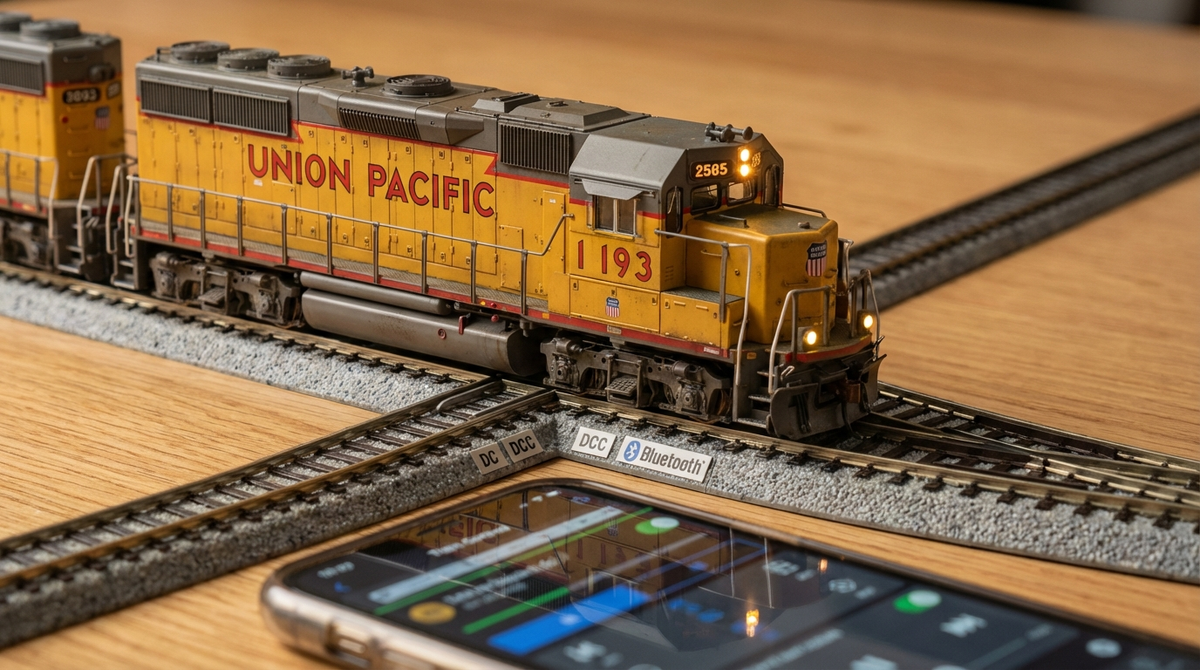
The Union Pacific Flyer at $413 street uses identical technology to the Pennsylvania Flyer. You're paying a slight premium for the iconic UP yellow and gray scheme.
For $399 street ($499 MSRP), the Super Chief delivers the famous red and silver "Warbonnet" scheme on FT diesels. This is a passenger set, which means streamlined coaches instead of freight cars.
I'll be honest: The Polar Express isn't the most prototypically accurate set Lionel makes. But at $450 street, it might be the most emotionally resonant. The 2-8-4 Berkshire steam locomotive pulls coaches from the movie. Kids lose their minds over it.
If your goal is family memories around the Christmas tree rather than historical accuracy, this is the set.
Outdoor railroading is its own world. Weather resistance and track durability matter more than electronic sophistication.
The PIKO Santa Fe R/C Starter Set at around $448 combines German engineering with a wireless radio-control throttle. The solid brass track won't rust outdoors. The set is fully compatible with LGB equipment, so you're not locked into a proprietary ecosystem.
For most garden railway beginners, PIKO represents the smartest entry point in 2024.
LGB's Christmas Train Starter Set costs more at around $450 EUR, and you get analog DC control instead of wireless. What you're paying for is decades of proven outdoor durability. LGB locomotives use legendary Bühler motors that run forever.
The brass track uses R1 600mm curves, matching PIKO's geometry. If you want peace of mind and don't mind the premium, LGB is worth the investment.
I've read too many forum complaints about Bachmann's G scale sets to recommend them for outdoor use. The steel track rusts. The gears have reliability issues. If you're planning a permanent garden railway, spend the extra money on PIKO or LGB brass.
For completeness, I should mention the smallest common scale. Märklin invented Z scale and their "Modern Freight Service" starter set at €339 provides the classic entry point. The Class 285 diesel is beautifully detailed for something that fits on your fingernail.
Rokuhan has become a serious competitor with their excellent track system and affordable battery-powered starter sets around $90. Their curves go down to R45mm. We're talking layouts that fit inside a briefcase.
Märklin's track system is somewhat proprietary, while Rokuhan offers more flexibility. If you're seriously considering Z scale, research both ecosystems before committing.
When I started in this hobby, the advice was simple: begin with DC, upgrade to DCC later. That advice is now obsolete.
A Digitrax Zephyr Express command station now sells for $185-$200. An NCE PowerCab starter kit runs $199.
That's cheaper than many track expansion packs. Basic sound decoders start under $30. If you're serious about this hobby, starting with DCC makes financial sense.
The NMRA's beginner guide to DCC is worth reading. The technology sounds intimidating, but modern systems are far more user-friendly than their reputation suggests.
For absolute beginners or families, Bluetooth control removes the intimidation factor entirely. Hornby's HM7000 system runs through an intuitive smartphone app. You can control multiple trains on simple DC track power.
The HM7000 decoders work in OO, TT, and N scales. App-based control on DC track power means you don't need a complex command station.
Lionel's LionChief accomplishes the same thing for O gauge. Bachmann's E-Z App sets like the Blue Star offer wireless control via smart device.
The trade-off? These are proprietary systems. A Lionel LionChief locomotive won't respond to a Hornby app. DCC is an open standard that works across manufacturers.
If you're modeling European prototypes, Märklin's mfx system deserves mention. Their digital starter sets use three-rail AC track with automatic locomotive registration. It's wonderfully "plug and play" but locks you into the Märklin ecosystem.
I've saved this section because it's the one thing I wish someone had told me clearly when I started: track quality determines whether beginners stay in the hobby.
The most common reason people abandon model railroading? Frustration with derailments and electrical problems. Both trace back to track.
UNITRACK's nickel-silver rails resist tarnishing. The UniJoiner connection system provides reliable electrical contact without soldering. Forum after forum praises this track for "zero-derailment" performance.
Yes, Kato UNITRACK costs more than alternatives. The M2 Basic Oval with Passing Siding runs $240. But you're buying insurance against the frustration that drives people away.
If you have the budget, the M1 plus V1 combination (basic oval plus passing siding) is my recommendation for serious beginners. The passing siding immediately makes operations more interesting.
For HO scale European modelers, Märklin C-Track offers similar reliability to Kato. The click-system connections are robust. But remember: C-Track is designed for Märklin's three-rail AC system.
Bachmann E-Z Track is widely available and affordable. The nickel-silver versions perform reasonably well. But some base-level sets include steel alloy track that tarnishes quickly and requires constant cleaning.
Check what's in your starter set box. If it says "steel alloy," budget for a track upgrade.
FasTrack is the default for modern Lionel sets. It's durable enough to survive carpet use and family room abuse. The nickel-plated steel rails require more cleaning than pure nickel-silver, but for the intended use case, it works.
You'll eventually hear about PECO and Hornby flexible track. These systems offer more realistic curves and greater layout flexibility. But they require cutting, soldering, and a flat baseboard.
Save flex track for your second or third layout. Integrated roadbed track like UNITRACK or E-Z Track is far more forgiving for beginners.
The most common LionChief complaint involves remote pairing failures. Fresh batteries solve most cases. If that fails, use the Bluetooth app instead. Lionel support is responsive if you need deeper troubleshooting.
Older Bachmann locomotives have a reputation for split plastic gears. Newer models use metal gears. Regular light lubrication with Bachmann's E-Z Lube extends gear life significantly.
Basic 1-Amp controllers struggle with sound decoders. Running multiple sound locomotives on a starter set controller causes resets and erratic behavior. Budget for a 3-Amp system like the Digitrax Zephyr Express if you want sound.
This one bites almost everyone. You buy a gorgeous articulated steam locomotive, bring it home, and watch it derail on every curve.
Most HO starter sets use 18-inch radius curves. Many larger locomotives and full-length passenger cars require 22 or 24-inch radius. Check the manufacturer specifications before buying any locomotive.
Kato publishes minimum radius requirements for all their equipment. Use it.
Steel track rusts. Period. If you're building anything intended for outdoor use, brass track is mandatory.
Resist the urge to buy more equipment immediately. Run your starter set. Practice coupling and uncoupling cars. Get comfortable with smooth starts and stops. Learn what clean track feels like.
Your one purchase: a track expansion pack that adds a passing siding. The Kato V1 or V2 elevation set transforms operations. Hornby track bundles and Bachmann expander packs offer similar improvements for their respective systems.
If you started analog, now's the time. A quality DCC system opens up sound decoders, independent train control, and realistic lighting. The learning curve is real but manageable.
Buy one "DCC Ready" locomotive or install a plug-in decoder in your existing engine. Sound decoders are addictive. Fair warning.
Upgrade your rolling stock wheelsets from plastic to metal. The improvement in tracking and sound is noticeable. Then try your first scenery project. A small diorama or a single corner of your layout.
With my landscape architecture background, this is where the hobby really grabbed me. Watching bare plywood transform into a miniature world is genuinely magical. Don't rush it. Scenery teaches patience.
Train World and Bachmann's website are good starting points for purchases. The NMRA beginner's guide covers topics I couldn't fit here. Model Railroader forums and Facebook groups are where you'll find answers to specific questions.
Reddit's model trains community is surprisingly helpful for beginners. Don't be afraid to ask questions that feel basic. We all started somewhere.
My dad's layout is still incomplete. I've added to it over the years, made it my own, filled in the gaps he left behind. But I've kept his original locomotive, that aging Kato GP38, running on the same track he laid down decades ago.
A good starter set is the beginning of a story. Yours is waiting to be written.
✨ Complete Your Layout: Explore our wide selection of Photo Real buildings, diorama backdrops, detail parts, and accessories in every popular scale.
✨ Unmatched Realism: From chrome detailing products to neon lighting kits – every piece is designed to make your miniature world come alive.