
Model Train Gauge vs Scale Explained: What Every Hobbyist Needs to Know
Posted by Tony Marchetti on 31st Dec 2025
Order by phone: 763-231-7847
Free Shipping On Orders Over $100!
If you are already registered, please log in.
Create your account and enjoy a new shopping experience.
Create A New AccountPosted by Tony Marchetti on 31st Dec 2025
My dad ran Lionel trains around our Christmas tree in Cicero, Illinois, back when I was knee-high to a boxcar. I never once heard him use the word "scale." It was always "O gauge this" and "O gauge that." Took me years to figure out he was technically wrong. And here's the thing: he wasn't alone. Most hobbyists mix up these two terms constantly, and it leads to some expensive mistakes.
So let's settle this once and for all. I've spent over 40 years running trains and 28 years fixing CTA equipment at the Skokie Shops. I know the difference between something that matters and something that's just trivia. The scale versus gauge distinction? It matters.
Here's the simplest way I can put it. Scale is the model's measurement as a proportion to the original, while gauge is the measurement between the rails. That's it. Two different numbers measuring two different things.
Scale means the ratio of your model to its real-world counterpart. HO scale is 1:87.1. That means every dimension on the model is 87.1 times smaller than the real locomotive or boxcar. N scale is 1:160. O scale (my personal favorite) runs 1:48 in the U.S.
Gauge refers to the distance between the rails. For HO scale, that's 16.5 millimeters. For O scale, it's 1.25 inches (31.75mm). These measurements determine which trains can physically run on which track.
The confusion happens because we often use these terms interchangeably. Someone says "HO gauge" when they mean "HO scale," and nobody corrects them because we all know what they're talking about. But here's where it gets interesting: a single track gauge can be used across multiple scales to represent different types of railways.
"So what?" you might be thinking. "I just want to run trains." Fair enough. But understanding this difference prevents you from buying stuff that won't work together.
A quick vocabulary lesson: the "prototype" is the real-world train you're modeling. When someone says their model is "prototypically accurate," they mean it matches the dimensions and details of the actual railroad equipment.
Before the 1930s, there were no common standards for model railroad equipment. Imagine buying a locomotive from one manufacturer and finding out it won't run on track from another company. That chaos led to the founding of the National Model Railroad Association in 1935. The NMRA created the standards that let equipment from different brands work together.
In Europe, MOROP publishes the NEM standards, which serve the same purpose for European modelers. NEM standards are defined and maintained in collaboration with model railroad manufacturers across the continent.
Let me give you the quick rundown on what's out there. I've included the official NMRA scale ratios and their corresponding track gauges.
| Scale | Ratio | Track Gauge | Notes |
|---|---|---|---|
| Z | 1:220 | 6.5mm | Tiny. Good for extremely limited spaces. |
| N | 1:160 | 9mm | Second most popular worldwide. |
| TT | 1:120 | 12mm | Popular in Central/Eastern Europe. |
| HO | 1:87.1 | 16.5mm | Most popular scale globally. |
| OO | 1:76.2 | 16.5mm | Dominant in the UK. Uses HO track. |
| S | 1:64 | 22.4mm | Niche scale between HO and O. |
| O | 1:48 (US) | 31.75mm | Classic scale. Think Lionel. |
| G | Various | 45mm | Large scale, often for outdoor layouts. |
HO scale remains the most popular because it offers the widest variety of products at every price point. N scale comes second and lets you pack more railroad into less space. O scale is where I live, and there's nothing like watching a big locomotive rumble through your layout.
This is where things get genuinely confusing. If you wander into G scale territory, you'll encounter four different scales all running on the same 45mm track.
So a manufacturer selling "G scale" equipment might mean any of these ratios. Gauge 1 purists will tell you there's a real difference in visual accuracy. They're right. But most garden railroaders just want something robust that runs well outdoors, and mixing scales doesn't keep them up at night.
Here's a quirk that still baffles newcomers. British OO scale is 1:76.2, but it runs on the same 16.5mm track as HO scale (1:87.1). The models are bigger, but the track is the same width.
Why? Back in the 1930s, electric motors were too bulky to fit inside correctly scaled British locomotive bodies on true HO gauge track. Manufacturers made the bodies larger to accommodate the motors but kept the existing HO track gauge because it was already available.
This creates what's called a scale/gauge mismatch. The track looks slightly too narrow for the trains. Most people don't notice or don't care, but it's spawned an entire movement of British modelers who've adopted finescale standards like P4 that use a corrected, wider track gauge.
Don't assume OO and HO equipment will look right together. The trains will run on the same track, but place an OO locomotive next to an HO one, and the size difference jumps out at you.
If you want to verify dimensions yourself, here's the basic formula: Model Dimension equals Prototype Dimension divided by Scale Ratio.
Let's say you want to know the correct model track gauge for standard gauge (1,435mm prototype) in HO scale:
1,435mm ÷ 87.1 = 16.47mm
That's why HO standard gauge uses 16.5mm track. The math checks out.
For quick estimates, British modelers use a "mm per foot" shortcut:
Online calculators like the Garden State Central tool eliminate manual math. Punch in a prototype dimension, select your scale, and get the model measurement instantly. ExactRail's calculator handles dozens of scales including narrow-gauge variants.
Most beginners blame tight curves for their derailments. The real culprit is usually the relationship between wheel flanges and rail height.
"Code" refers to rail height in thousandths of an inch. Code 100 rail is 0.100 inches tall. Code 83 is 0.083 inches tall.
Code 100 was the long-time HO standard. It's forgiving and works with older equipment that has deep wheel flanges. Code 83 looks more realistic because it better represents prototype mainline rail, but it demands wheels with shallower flanges.
Here's where trouble starts. European wheels built to NEM standards often have deeper flanges than American NMRA-compliant wheels. Run those European locomotives on Code 83 track, and the flanges can hit the molded spike heads, causing rough riding or derailments at turnouts.
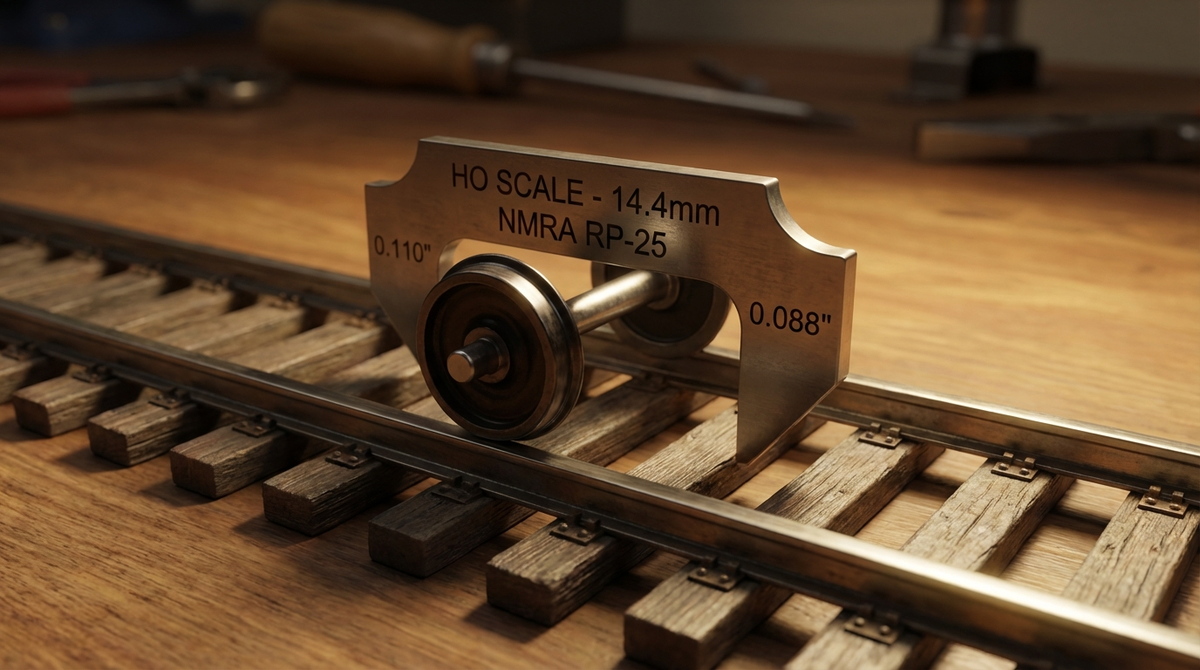
The NMRA RP-25 wheel contour specification defines a shallower flange designed specifically for finer track. If you're buying used equipment or importing models from Europe, check those wheel profiles before assuming everything will run smoothly on your Atlas Code 83 track.
Turnouts cause more derailments than anything else. The geometry at the frog, where the rails cross, demands precise wheel dimensions.
Key measurements include:
Pick up an NMRA Standards Gauge for your scale. It's the fastest way to diagnose why a locomotive keeps jumping the tracks at a particular switch.
One of the cleverest tricks in the hobby is using track from a smaller scale to model narrow gauge in a larger scale. On30 is the most popular example. It uses O scale models (1:48) on HO gauge track (16.5mm) to represent 30-inch gauge prototypes.
Why would anyone do this? Three reasons:
HOn30 (also called HOn2½) does the same thing in HO scale, using N gauge 9mm track. British modelers call their version OO9, running 4mm scale models on 9mm track. The 009 Society has thousands of members who model charming British narrow-gauge railways this way.
The visual compromise? Track ties look oversized because they're from the smaller scale. Skillful ballasting and scenery can hide this, and manufacturers like Peco make track specifically designed for these mixed-gauge combinations with correctly proportioned ties.
Here's a mistake I've seen cost people real money. Some folks assume DCC track voltage is the same across all scales. It's not.
NMRA Standard S-9.1 specifies different voltage ranges:
Use the wrong voltage, and you can permanently damage decoders. Never connect a large scale power pack to an N scale layout thinking "more power is better." Those tiny decoders aren't designed to handle 18 volts.
Model railroading is global, but standards vary by region.
| Region | Standards Body | Key Characteristics |
|---|---|---|
| North America | NMRA | 2-rail DC standard. Kadee-style knuckle couplers. Comprehensive wheel and track specs. |
| Europe | MOROP (NEM) | Metric measurements. Märklin's 3-rail AC coexists with 2-rail DC. NEM 362 coupler pockets. |
| UK | De facto British | OO scale dominates. Tension-lock couplers standard. |
| Japan | De facto Japanese | N scale dominant at 1:150 for narrow-gauge prototypes, 1:160 for Shinkansen. |
If you're importing equipment, watch for coupler compatibility issues. North American knuckle couplers don't mate with European loop-style couplers without modification. The NEM 362 coupler pocket standard does make swapping couplers easier on European models.
They don't. We've covered this. Scale is the ratio; gauge is the track width. Using them interchangeably leads to purchasing errors.
OO models are visibly larger than HO. They'll run together, but mixing buildings and figures from both scales looks wrong.
Flange depth matters. Older N scale equipment with deep "pizza cutter" flanges will struggle on modern Code 55 track.
It's scale-dependent. Check your system's documentation and match voltage to scale.
They're scale/gauge combinations, not separate scales. On30 is O scale (1:48) running on HO gauge track. The "n30" indicates the narrow-gauge prototype.
True, but #6 or higher turnouts run smoother and cause fewer derailments. Use the largest number your space permits for mainlines.
O27 trains have shortened dimensions designed for tight curves. True O scale equipment needs much broader radius curves.
They corrode and loosen. Solder feeder wires from your main power bus to every piece of rail for reliable operation.
Space drives this decision more than anything else.
Got a desktop or small shelf? Z scale or T gauge lets you run trains in tiny spaces.
Got a spare room or 4x8 table? HO offers the widest product selection. N scale packs more railroad into the same footprint.
Got a basement or garden? O scale delivers heft and presence. G scale handles outdoor conditions and kids' hands.
Consider your eyesight and hands too. N scale details can challenge older eyes. O scale locomotives are easier to detail and repair.
Use this before spending money on any rolling stock or track:
My dad never knew the difference between scale and gauge, and he ran those Lionel trains for decades without a problem. You can get by without understanding the technical details. But when something goes wrong, when locomotives derail at the same turnout every time, when European imports won't run right, when a decoder burns out for no apparent reason, this knowledge saves you money and frustration.
Scale is how big the model is compared to the real thing. Gauge is how far apart the rails sit. The NMRA spent 90 years sorting out standards so your equipment works together. Understanding what they standardized and why puts you ahead of hobbyists who just guess and hope for the best.
Now go run some trains. That's the whole point of this hobby.
✨ Complete Your Layout: Explore our wide selection of Photo Real buildings, diorama backdrops, detail parts, and accessories in every popular scale.
✨ Unmatched Realism: From chrome detailing products to neon lighting kits – every piece is designed to make your miniature world come alive.