
Model Railroad Planning for Beginners: A No-Nonsense Guide to Your First Layout
Posted by Tony Marchetti on 31st Dec 2025
Order by phone: 763-231-7847
Free Shipping On Orders Over $100!
If you are already registered, please log in.
Create your account and enjoy a new shopping experience.
Create A New AccountPosted by Tony Marchetti on 31st Dec 2025
I've been watching trains run since I was a kid in Cicero, watching my dad set up Lionel around the Christmas tree. After 28 years turning wrenches at the CTA's Skokie Shops, I've learned something about building things that actually work: you measure twice, you follow the specs, and you don't skip steps just because you're excited.
Model railroading is no different. The guys who end up with beautiful, reliable layouts aren't luckier or richer than the rest of us. They just planned better at the start.
I've seen too many beginners grab a starter set, slap down track on a piece of plywood, and then wonder why their trains derail every third lap. The problem almost always traces back to decisions made before the first piece of track was laid. So let's walk through this the right way.
Here's the single biggest mistake I see: guys fall in love with HO scale locomotives at the hobby shop, then try to squeeze an HO layout into a room that can barely handle N scale curves. About 75% of beginners make this exact error, and it leads to long cars derailing on tight curves and projects getting abandoned out of frustration.
The fix is simple but requires discipline: measure your room first, then pick your scale. Not the other way around.
Every scale has minimum curve requirements that physics demands you respect. A locomotive doesn't care how much you paid for it; if the curve's too tight, it's coming off the rails.
HO scale (1:87) is the most popular for good reason. The selection of locomotives, rolling stock, and accessories is unmatched. But those HO trains need at least an 18-inch radius curve to run reliably, and 22 inches or more is what you want for modern six-axle diesels.
N scale (1:160) can work with 9.75-inch to 11-inch curves, which means you can fit a much more complex layout into the same footprint. The trade-off? Smaller models that require steady hands and good eyesight.
O scale, my personal favorite, needs 35 inches minimum for turns. That's a big footprint. G scale for garden railways? You're looking at 48 inches or more.
The 4x8-foot sheet of plywood has been the default beginner layout for generations. There's a reason: it's an achievable goal, it fits through most doors, and you can fit a decent HO oval with some switching opportunities.
But experienced modelers will tell you the 4x8 island has real problems. That 4-foot depth means you can't reach the center without climbing onto the layout. And Tony Koester has called the 4x8 a poor choice because it uses room space inefficiently. You need an 8x10-foot room just to have 2-foot aisles around it.
If space is tight, consider N scale on a hollow-core door. An 80x30-inch door is lightweight, rigid, and gives you enough room for a complete layout with staging, passing sidings, and industries. Hollow-core doors are perfect bases because they're flat and won't warp.
A model railroad is a workspace. You'll spend hours reaching across it, crawling underneath it, and standing beside it. Get the ergonomics wrong and you'll hate operating your own layout.
You need room to move. A 24-inch aisle is the absolute minimum for one person, but you'll feel cramped. If you ever want a friend to operate with you, 36 inches is the realistic target. Club layouts with multiple operators run 48-inch aisles so people can pass without bumping.
I've seen guys plan beautiful track schemes that leave 18-inch aisles. Those layouts become storage shelves within two years.
Here's a number that should guide every layout decision: 30 inches. That's the maximum comfortable reach over a layout. Anything beyond that becomes a chore to maintain. For detailed work like uncoupling cars, your effective reach drops to 20-24 inches.
This is why experienced modelers favor around-the-walls shelf layouts over islands. Shelf layouts keep everything accessible while maximizing track in your room.
An around-the-walls layout needs a way in. Duckunders are generally discouraged because they're a barrier for older operators and anyone with back problems. Even a 56-inch clearance duckunder can be a hazard.
Better options include lift-out sections or swing gates. The key is robust construction with piano hinges and mechanical alignment systems like dowel pins. For DCC layouts, add an interlock switch that cuts power when the bridge is open.
Layout height is personal, but here are the trade-offs:
52-57 inches gives you eye-level viewing, which looks fantastic and opens up under-layout storage. But you sacrifice reach depth at the back.
42-48 inches is the sweet spot for most people. Comfortable for standing operation, decent viewing angle, and you can still reach most of the layout.
36-38 inches maximizes your reach and makes under-layout wiring easier, but you're looking down at your trains like a bird.
For N scale, build 2-4 inches higher than you would for HO to bring those small details closer to eye level.
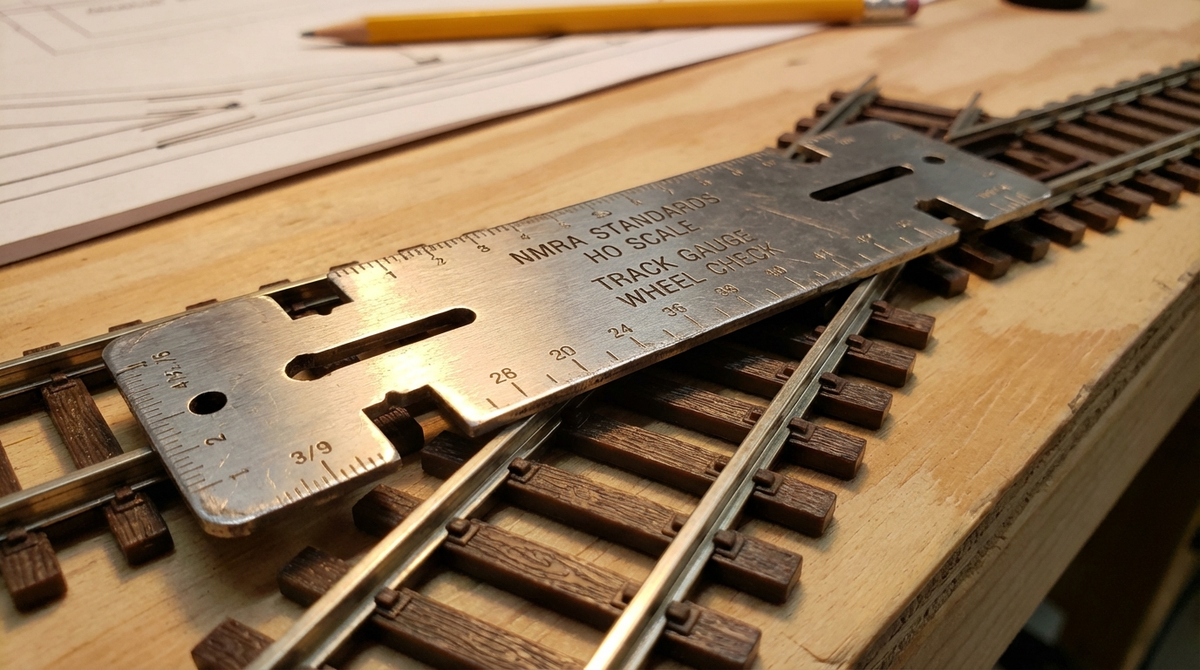
I spent 28 years fixing things at CTA. You know what causes most equipment failures? People ignoring the specs. Model railroads work the same way. About 80% of derailments on new layouts trace back to out-of-spec wheels or turnouts, issues you can prevent with a $15 NMRA standards gauge.
The NMRA's RP-11 document is your bible here. It classifies equipment by the minimum curve it can handle. The physics don't care about your feelings.
For HO scale:
Use the largest radius your space allows. Tight curves look bad and cause problems.
A turnout's frog number tells you how sharp the diverging route is. #4 turnouts are tight, good for slow-speed yards. #6 turnouts work for branch lines and some mainline use. #8 turnouts are what you want for high-speed mainlines running large modern equipment.
This choice has to happen during planning. Retrofitting turnouts costs three times as much once scenery is in place.
An S-curve happens when a curve in one direction immediately follows a curve the other way. This whips couplers in opposite directions and pulls lighter cars off the track. The fix is a straight section between opposing curves that's at least 1.5 times the length of your longest car.
Watch for hidden S-curves where crossovers lead into parallel sidings. They sneak into track plans all the time.
Keep grades under 2% (2 inches of rise per 100 inches of run). Anything steeper cuts your locomotive's pulling power dramatically.
If you're building a helix to connect levels, understand that curves add to the effective grade. A 24-inch radius curve adds about 1.33% effective grade in HO. So a 2.5% physical grade on a 24-inch helix feels like nearly 4% to your train.
Minimum helix radius in HO is 30 inches for reliable operation. Anything tighter causes string-lining derailments. And leave 3.5 to 4 inches of vertical clearance between loops so you can reach in when something derails.
Beginners consistently overbuild their benchwork. I've seen guys use 2x4 construction that could support a car lift. 1x3 or 1x4 boards are plenty for a model railroad. You're building a table, not a loading dock.
Open-grid benchwork is like building a wall frame with 1x4 boards spaced 16-24 inches apart. Sturdy, provides a finished edge for fascia, and works great for yards and modular sections. You can cut out sections for below-track scenery like rivers.
L-girder benchwork uses main beams made from a 1x2 attached to a 1x4. Joists lay across the girders with risers supporting the roadbed. It's extremely flexible because you can move joists around to accommodate scenery. Linn Westcott developed this system in the 1960s specifically because it forgives imprecise cuts.
Shelf brackets work for narrow around-the-walls layouts mounted directly to wall studs. Simple, keeps the floor clear, and sturdy if anchored properly.
A basic 4x8 open-grid table runs about $40-60 for lumber plus around $50 for 2-inch XPS foam or $40 for 1/2-inch plywood. Add $15 for screws and glue. Total: roughly $3-4 per square foot.
Use drywall screws, not nails. Drill pilot holes in pine to prevent splitting. And for the love of all that's holy, use a level. An unlevel layout means trains roll away when you don't want them to.
Twenty years ago, this was a real debate. In 2025, it's pretty much settled: DCC wins for most beginners.
With traditional DC, the track is divided into electrical blocks, and you need toggle switches and multiple power packs to run two trains. It's complex wiring that gets complicated fast.
DCC sends digital commands through the rails to decoders in each locomotive. You run a simple two-wire bus around the layout, drop feeders to the track, and control everything from one system. Independent control of multiple trains. Full control of lights, sound, and up to 28 functions.
Use 14 AWG wire for your main track bus. This is not optional. Undersized wire causes voltage drop, which makes DCC systems malfunction and trains slow down far from the command station.
Drop 20-24 AWG feeder wires from the bus to the track. And here's what most beginners miss: solder a feeder to every single piece of rail. Rail joiners are for mechanical alignment, not electrical continuity. They corrode and fail.
The "quarter test" tells you if your wiring is adequate. Power up a section and drop a quarter across the rails. Your DCC system's short-circuit protection should trip instantly. If it doesn't, your wiring can't carry enough current to clear a fault, which is both a fire hazard and a decoder-killer.
The Digitrax Zephyr Express runs $197-245, puts out 3 amps, and expands easily through LocoNet. Built-in USB and support for 20 throttles.
The NCE Power Cab costs around $195-200 and puts everything in an all-in-one handheld. It expands into a full 5-amp system when you outgrow it.
The ESU CabControl is pricier at $390-500 but comes with 7 amps, built-in WiFi, and 32+ throttle support.
The budget Bachmann E-Z Command around $150 works for very small layouts but limits you to 10 addresses and 1 amp.
As your layout grows, divide it into electrically isolated power districts. Each district gets its own electronic circuit breaker like the DCC Specialties PSX series or Digitrax PM42. This way, a short in the yard doesn't kill the mainline.
Any track where a train can reverse direction without turning around (reverse loops, wyes, turntables) needs an automatic reversing module. Isolate both rails at both ends and use something like the PSX-AR to handle the polarity flip automatically.
Turnout control ranges from $3 manual ground throws to $25+ motorized systems. Your choice depends on layout size and whether you want automation.
Manual ground throws from Caboose Industries or Micro Engineering cost $3-10 each. Dead simple, silent, and reliable. Great for small layouts and yards where hands-on operation feels right.
Twin-coil solenoid motors make a satisfying snap but burn out if you hold the button too long. They need a capacitor discharge unit for reliable operation.
Slow-motion stall motors like the Tortoise cost $15-25 each and throw slowly and quietly. The prototypical motion looks great, and they include auxiliary contacts for frog powering. Installation requires mounting under the layout and careful linkage alignment. DCC Concepts Cobalt motors are similar.
Servo-based systems run $10-20 per turnout if you're comfortable with assembly. Very precise and adjustable.
The frog is where rails cross in a turnout. Many commercial turnouts have unpowered plastic frogs that create dead spots. Short-wheelbase locomotives can stall when their wheels lose contact.
Powering the frog means its polarity switches based on turnout position. With Tortoise motors, you can use the built-in auxiliary contacts to handle this automatically.
For DCC layouts, an electronic Frog Juicer is the simplest solution. It detects shorts and flips polarity instantly, so fast the DCC system doesn't even notice.
Accessory decoders like the Digitrax DS64 or DCC Concepts accessories let you throw turnouts from your throttle or set up routes that align multiple turnouts with one command. They also support local pushbuttons for panel control.
Scenery transforms a test track into a believable world. But don't rush it. The base materials you choose affect weight, carving ease, and durability.
XPS foam (the pink or blue boards) has become the standard. It's lightweight, easy to carve, moisture-resistant, and deadens sound. Stack layers with foam-safe adhesive and carve to shape. Don't use a hot wire cutter without ventilation because it releases toxic fumes.
Plaster cloth drapes easily over cardboard formers to create terrain shells. Hydrocal is harder and more durable but messy to work with.
Sculptamold combines clay, plaster, and paper mache into a lightweight material that clings to anything. It can be carved after setting but takes days to dry fully, especially in humid conditions.
Ballasting looks simple but gets messed up constantly. Here's the proper sequence:
Woodland Scenics Scenic Cement is a convenient pre-mixed option.
Creating realistic water requires a sealed, painted base below track level.
Woodland Scenics Realistic Water is self-leveling and good for still ponds. Pour no more than 1/8 inch per layer. Deep Pour Water handles thicker applications up to 1/2 inch but requires 24 hours to cure.
Epoxy resins like EnviroTex Lite give a durable high-gloss finish but require precise mixing and bubble removal with a heat gun.
Acrylic mediums like Vallejo Still Water work well for shallow effects and top coats.
A layout becomes truly engaging when trains have somewhere to go and something to do. Plan for operations from the start, even on a small layout.
Staging represents the outside world. Trains originate and terminate here. Design staging first because it's hard to retrofit. Staging tracks must be as long as your longest planned train.
Passing sidings let two trains on a single track main line meet and pass. They must be longer than your longest train with room to clear both turnouts.
A yard lead is a dedicated switching track separate from the mainline. It should be as long as the longest track in your classification yard.
A runaround lets a locomotive get around its cars to switch from the other end.
Once your layout operates, you need logic for moving cars. Car cards and waybills are a classic paper system where each car gets a permanent card and routing slips tell you where it goes.
JMRI OperationsPro automates this process. You input your rolling stock and layout locations, define routes, and the software generates realistic switch lists for each train crew.
The Inglenook Sidings puzzle is a brilliant skill-builder: a lead track and three sidings of specific lengths, with the goal of assembling a specific five-car train from eight cars. Simple track, challenging logic.
The Timesaver is John Allen's famous switching game designed for speed and efficiency in tight quarters.
Here's where most beginners sabotage themselves: they get excited and start scenery before verifying the track works. Then they discover problems and have to tear up finished scenery to fix them.
Test progressively at each phase:
Benchwork phase: Use a level to ensure everything is flat. Check for square corners and wobble.
Track laying: Run an NMRA gauge over every piece of track and turnout before installation. Factory-new track can be out of spec.
Wiring: Use a multimeter to check continuity from rail top to bus wire for every feeder. Check for shorts between rails before powering up. Run the quarter test on every power district.
Run your best-performing locomotive and freight car over every inch of new track before adding scenery. If they derail, the problem is the track.
Factory-new rolling stock often needs attention:
Building a model railroad costs real money. Plan for it or you'll end up with a half-finished project.
A well-planned 4x8-foot HO layout with DCC, flex track, and basic scenery runs around $1,700-2,100. An N scale layout on a hollow-core door costs less, maybe $1,200-1,500.
Benchwork: $100-150 for lumber, foam, and hardware
Track and roadbed: $200-350. HO flex track runs around $7 for 3 feet. Turnouts cost $15-32 depending on type.
Control system: $250-450. That's an entry-level DCC system plus decoders at $25-100+ per locomotive.
Rolling stock: $150-350 for a starter locomotive and 6-10 cars
Scenery and structures: $150-300 for ground cover, ballast, and basic kits
Spread costs over time:
This spreads a $1,750 build over a year at $150-220 per month.
Save money: Buy used track and structures at swap meets. Build kits instead of buying ready-to-run. DIY your benchwork.
Don't skimp: Invest in a reputable DCC system from Digitrax, NCE, or ESU. Use quality flex track. Wire with the proper gauge. The cost of tearing out failed cheap stuff vastly exceeds buying right the first time.
Using software prevents expensive geometry mistakes. You can verify curves are smooth, clearances work, and turnouts fit before buying anything.
SCARM is free for up to 150 track pieces, Windows only. Full version costs $59.90. Very intuitive with instant 3D preview and a model train simulator extension.
AnyRail runs on Windows and has the shallowest learning curve. Free version limited to 50 track pieces; full version around $65. Imports from other programs and generates parts lists.
XTrackCAD is free, open-source, and runs on Windows, Mac, and Linux. Steeper learning curve but powerful, with automatic spiral easements.
Mac users should look at RailModeller Pro, a polished native app for $44.99 on the App Store.
For complex multi-level layouts, 3rd PlanIt at $124.95 offers professional tools including CNC export for custom roadbed.
CadRail at $99.95 provides a full CAD toolset plus train simulation.
SCARM's layout database has hundreds of free plans in all scales.
Model Railroader's track plan database offers decades of published plans searchable by size, scale, and type.
You don't have to figure this out alone. NMRA conventions feature over 200 clinics covering every topic. The Golden Spike Award program guides beginners through foundational skills with feedback from experienced modelers.
Local NMRA divisions host hands-on clinics and layout tours. The Achievement Program provides structured goals.
Modular groups like T-TRAK and Free-moN let you build small, standardized sections that join together at shows. It's a manageable first project with the reward of participating in large operating layouts.
Online, the Trains.com beginner section is packed with tutorials. Model Railroad Academy offers structured video courses.
YouTube has excellent creators. Luke Towan and Kathy Millatt teach detailed scenery techniques. Jason Jensen's channel covers kit building. Ken Patterson's "What's Neat This Week" delivers weekly product reviews and expert interviews.
The NMRA's Discord server provides real-time Q&A.
Free-mo and Free-moN groups on Facebook share setup planning and standards discussions. The Free-mo standard emphasizes prototypical operations on a single-track mainline, and Free-moN raises the bar for N scale.
I've watched too many beginners make the same errors:
Starting too big. A basement empire as your first project leads to budget overruns and abandonment. Start with something you can finish in under a year.
Ignoring track geometry. Tight curves with long equipment guarantee derailments. Use NMRA RP-11 and track planning software to verify geometry.
Bad wiring. Solder feeders to every rail. Don't rely on rail joiners for power.
Inaccessible track. Turnouts in tunnels or track 3 feet from any edge will haunt you.
Underweight cars. Light rolling stock derails constantly. Weight everything to NMRA spec.
Model railroad planning for beginners really comes down to this: measure before you buy, follow the standards, test before you scenery, and don't try to build everything at once.
The guys at my local NMRA division who have gorgeous, reliable layouts aren't smarter than you. They just did the boring stuff right. They measured their rooms. They checked their wheel gauge. They soldered feeders to every rail.
After 28 years fixing transit equipment, I can tell you: the difference between stuff that works and stuff that breaks usually comes down to whether somebody followed the specs or tried to shortcut them.
There are no shortcuts here. But there's also nothing mysterious. Get an NMRA standards gauge. Use the track center and clearance recommendations. Follow the curve radius guidelines for your equipment. Wire it properly.
Your trains will run smooth. And that's the whole point.
✨ Complete Your Layout: Explore our wide selection of Photo Real buildings, diorama backdrops, detail parts, and accessories in every popular scale.
✨ Unmatched Realism: From chrome detailing products to neon lighting kits – every piece is designed to make your miniature world come alive.