
Model Railroad Beginner Mistakes to Avoid: A Practical Guide from the Benchwork Up
Posted by Benjamin Park on 31st Dec 2025
Order by phone: 763-231-7847
Free Shipping On Orders Over $100!
If you are already registered, please log in.
Create your account and enjoy a new shopping experience.
Create A New AccountPosted by Benjamin Park on 31st Dec 2025
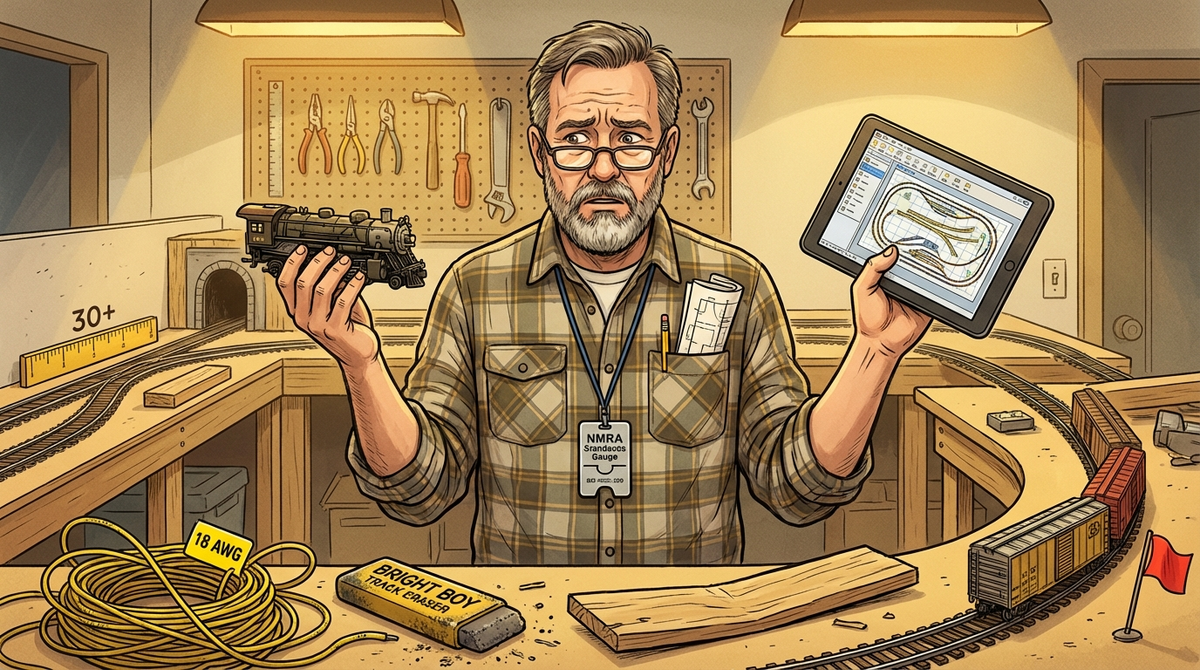
My first layout was a disaster. I know that now. At the time, I thought I was building my dream railroad in my basement. What I actually built was a 12x14-foot monument to every rookie error in the hobby. The track buckled in summer. Half my turnouts sat in unreachable corners. My wiring was so undersized that locomotives would crawl to a stop at the far end of the mainline. Three years later, I tore the whole thing out and started over.
I'm telling you this because I want you to skip that phase. I work in logistics for a trucking company during the day, and if there's one thing my job has taught me, it's that problems upstream cascade downstream. A loading dock mistake at 6 AM becomes a driver delay at noon and an angry customer by dinner. Model railroading works the same way. A benchwork shortcut today becomes a derailment nightmare next year.
So let's talk about the model railroad beginner mistakes to avoid if you want a layout that actually runs trains instead of collecting dust.
Here's the pattern I've watched play out dozens of times. A new hobbyist sees a gorgeous layout in a magazine or on YouTube. They buy a bunch of track, clear out the basement, and start building their own miniature empire. Six months later, they've got half-finished benchwork, a tangle of wire, and a growing sense of dread every time they walk downstairs.
The number one mistake beginners make is over-scoping their first project. Eagerness kills more layouts than bad track ever will. You want to model the entire Milwaukee Road from Chicago to Seattle? That's beautiful. But building it all at once is a recipe for burnout.
The solution isn't to abandon your vision. It's to build it one piece at a time. The One Module Approach (TOMA) developed by Joe Fugate changed how I think about layout construction. You build and completely finish one module before starting the next. Scenery, wiring, testing, everything. The result? You always have something that works.
The Domino method from David Barrow takes a similar approach with standardized rectangular sections. These can be built individually, scenicked completely, and even rearranged later if you change your mind. No more wrestling with full sheets of plywood or committing to a track plan before you really understand what you want.
My advice? Start with something like a 4x8 layout and actually finish it. Run trains on it. Host an operating session or two. You'll learn more from completing a small project than from abandoning three large ones.
I once spent an entire Saturday troubleshooting a section of track that derailed everything I ran over it. I checked wheel gauges, cleaned rails, adjusted coupler heights. Nothing helped. The problem? I had created what modelers call an S-curve, and I didn't even realize it.
An S-curve happens when you have a curve in one direction immediately followed by a curve in the opposite direction. The physics are brutal. Your couplers swing one way, then immediately the other, and cars get yanked right off the rails.
The fix is simple in theory: insert a straight section between opposing curves. But here's the catch. That straight section needs to be at least as long as your longest car. Running 89-foot auto racks? You need about 12 inches of straight track in HO scale between reverse curves. Running 40-foot boxcars? You can get away with about 5.5 inches. The rule is simple: one full car length minimum, and more is better.
Hidden S-curves are sneaky. They show up at crossovers, at the start of sidings, anywhere you're not paying attention. Watch for them in your track planning phase and eliminate them before you lay a single piece of rail.
I wanted a double-deck layout on my first build. Made sense, right? More railroad in the same space. What I didn't understand was grade compensation.
A grade of 2% is the practical maximum for reliable operation. That means a 2-inch rise over 100 inches of run. Go steeper, and your locomotives will struggle. Your trains will stall. Operations become a nightmare.
But here's what really got me. Curves add to your effective grade. A 2% climb on a 24-inch radius curve in HO isn't really 2%. It's closer to 3.3%. The formula is 32 divided by your radius, and you add that number to your nominal grade percentage. For N scale, use 17.5 divided by the radius.
I've seen beginners try to fit a helix into a 4x4 space with 18-inch curves and wonder why their trains can barely climb it. The math doesn't lie. Compensate your grades on curves, or accept that your trains will struggle.
Prototype railroads don't slam trains from straight track into a constant-radius curve. They use transition curves, called easements, that gradually tighten. Easements aren't just about looks. They reduce the stress on couplers and make trains roll through curves instead of jerking through them.
If you're using flextrack, easements are easy to add. Just bend the track gradually tighter as you enter the curve, then gradually looser as you exit. The NMRA recommends planning easements rather than abrupt transitions from straight to your minimum radius.
This is where my logistics brain screams at beginners. Your wiring is infrastructure. It's the highway system that everything depends on. Cheap out here, and every mile of track you add amplifies the problem.
A starter set power pack puts out maybe half an amp. A serious DCC system runs 5 amps or more. This is not a small upgrade. It's a completely different electrical environment.
The power bus, those main wires running under your layout, needs to handle that current without significant voltage drop. NMRA Technical Note TN-9 recommends keeping voltage loss below 5% at your farthest track. For a 5-amp system, that means 14 AWG wire minimum for your main bus, with 12 AWG being even better for longer runs.
I've seen guys use 22 AWG telephone wire for their bus. That's asking for trouble. Voltage sags at the far end of the layout. Locomotives stall. Decoders act erratically. Worse, inadequate wiring can prevent your short-circuit protection from working correctly.
Rail joiners are not reliable conductors. They corrode. They loosen. Over time, they create high-resistance connections that starve your locomotives. You need feeders soldered directly to the rails, and you need them often.
The rule I follow: a feeder to every piece of track, or at minimum, every three to six feet. Some modelers go tighter, adding feeders at even shorter intervals. More feeders means less resistance, which means better performance everywhere.
Feeder wire can be smaller gauge since these runs are short. 20 to 22 AWG works fine for HO feeders kept under 12 inches. Soldering them takes practice, but it's a skill worth developing. Good wiring practices separate layouts that run reliably from layouts that drive you crazy.
Here's your non-negotiable quality check. Once your wiring is done, drop a quarter across the rails at various points around your layout. Your booster should trip immediately. If it doesn't, you have too much resistance in your wiring, and a real short circuit might not trip the breaker at all. That means melted equipment or worse.
Test every section. Test your sidings. Test your staging. If the quarter test fails anywhere, fix your wiring before you move on.
I used to think NMRA standards were for club modelers and the type-A personalities who measure everything to three decimal places. Then I tried to run a friend's cars on my layout and watched them derail at every turnout.
Your wheels need to be set to specific dimensions, or they'll pick points, climb rails, or wedge into frogs. The NMRA Standards Gauge is an inexpensive tool that should be in every modeler's toolbox. It checks track gauge, wheel spacing, flange depth, and turnout clearances.
When a car derails repeatedly, the first thing I do is check it with the standards gauge. Nine times out of ten, the wheel gauge is off. A quick adjustment with a wheel puller, and the problem vanishes.
Mismatched coupler heights cause more uncoupling grief than anything else. Cars separate on curves, in tunnels, at the worst possible moments. The Kadee Coupler Height Gauge gives you an instant visual reference. In HO, the coupler centerline should be 25/64 inch above the railhead.
Every piece of rolling stock should get checked before it touches your main layout. I keep a test track on my workbench specifically for this. New cars get gauged, weighed, and test-run before they earn a spot on the roster.
If you're buying equipment from UK sources, beware. British OO scale (1:76) is physically larger than HO scale (1:87), but both run on the same 16.5mm gauge track. The clearance and wheel profile differences can cause problems when you mix equipment. Know what you're buying and what standards it conforms to.
My first layout had a beautiful mountain scene in the back corner. Took me weeks to build. Looked fantastic. And it sat directly over a turnout that I could not reach without crawling across the layout surface.
Guess which turnout failed first?
A comfortable reach for most people is about 24 inches from the layout edge. You can stretch to 30 inches if you're tall and don't mind some awkwardness. Beyond that, you need an alternative access method.
Layout height matters too. The higher your benchwork, the shorter your reach. At 36 inches off the floor, you might manage 36 inches of reach. At 54 inches (a nice viewing height for HO), your comfortable reach drops to 18-24 inches.
Corners are the worst. Two 36-inch deep benchwork sections meeting at 90 degrees create a diagonal distance of over 50 inches to the back corner. That corner might as well be on the moon.
If you ever want to run operating sessions with friends, 24-inch aisles are too narrow. Two people cannot pass comfortably. The NMRA recommends 30 inches minimum for two operators, with 36 inches being the sweet spot for comfortable operation.
I've hosted sessions in aisles that were too tight. Operators bump into each other. Someone backs into a control panel. A drink gets knocked over. Wider aisles reduce stress and make the whole experience more enjoyable.
Sometimes you need track to cross an aisle. Lift-out sections or swing gates solve this, but they require careful engineering.
Alignment is the critical factor. Dowel pins, dovetail sockets, or stereo jacks can provide precise, repeatable positioning. Hinges develop slop over time, so overbuilding the alignment mechanism pays dividends.
You also need a safety interlock. A microswitch that cuts power to approach tracks when the section is open prevents trains from running off the edge. This isn't optional. It's insurance against your own forgetfulness.
For reaching into deep scenes, pop-up access hatches work well. The opening should be at least 14x18 inches, large enough to get your hands and tools through comfortably.
When I rebuilt my layout, I spent three times as long on benchwork as I had the first time. It felt like I was wasting time. I could have been laying track! But that solid foundation made everything afterward easier.
L-girder benchwork has been the standard for decades, and for good reason. You create L-shaped supports from dimensional lumber, run them on legs, then attach joists perpendicular to the girders. The joists can be moved easily, which is huge when you realize that turnout motor needs to go exactly where you placed a cross-member.
Open grid construction is simpler but less flexible. You build a series of interconnected boxes, strong but fixed. Once those cross-members are in place, moving them means rebuilding.
For a first layout, either works. L-girder gives you more options as your plans change. And your plans will change.
Wood moves with humidity. A 12-inch pine board can change width by a quarter inch between summer and winter. Plywood resists this movement because its cross-laminated layers counteract each other.
For framing, ripping strips from plywood sheets gives you straighter, more stable material than dimensional lumber. Yes, you need to drill pilot holes when screwing into plywood edges. The extra stability is worth the effort.
MDF is dimensionally stable but susceptible to moisture damage and sagging. If you use it, keep it dry and support it well.
Extruded foam insulation has become popular for layout tops, and I understand why. It's light, easy to carve for scenery, and provides natural sound deadening. Two inches of foam over half-inch plywood creates a stable, quiet surface.
Some modelers skip the plywood entirely, laying foam directly on their framework. This works, but you lose the option of mounting things underneath without the foam. For portable modules or light layouts, foam-over-framework can be remarkably strong.
A layout built on hollow plywood surfaces can sound like a drum when trains run. The vibration transfers to the scenery shell and amplifies into an annoying rumble.
Solutions include using Homasote or foam sub-roadbed to absorb vibration. Bonding foam to plywood helps. Some modelers apply 3M camper tape between cork roadbed and plywood to decouple vibrations.
I lost three months of work to humidity. The track I laid in air-conditioned comfort buckled when the weather changed. Rails kinked. Turnouts bound up. The wood benchwork, which looked perfectly straight in January, developed a visible bow by July.
Wood movement from humidity changes is a far bigger threat to your track than thermal expansion of the rails themselves. Nickel-silver rails barely move with temperature. The wood underneath moves a lot.
The solution is climate control. Keep your layout space between 35% and 55% relative humidity year-round. For basements, this often means running a dehumidifier in summer. Insulating foundation walls helps prevent condensation that can spike local humidity.
Sealing your benchwork lumber with paint slows moisture absorption and helps equalize dimensional changes between seasons. Paint all sides, not just the visible ones.
If you can't control your layout room's climate, leave expansion gaps in your benchwork and accept some seasonal maintenance.
I used to attack my track with a Bright Boy every week. The rails would gleam. Then, within days, the black gunk would return, worse than before. I thought I wasn't cleaning often enough. I was actually creating the problem.
Abrasive cleaners create micro-scratches on the rail surface. Those scratches trap dirt and promote micro-arcing between wheel and rail. The arcing oxidizes the metal, creating more of that black residue. You scrub harder, scratch deeper, and make the cycle worse.
The better approach uses solvents, not abrasion. A lint-free cloth dampened with mineral spirits or a plastic-safe contact cleaner like CRC 2-26 removes gunk without scratching. Skip the abrasives entirely.
Some modelers swear that isopropyl alcohol makes things worse. It's a polar solvent that can leave residue encouraging more micro-arcing. Non-polar solvents like naptha or mineral spirits work better.
After cleaning, apply a thin layer of graphite to the railhead. A soft pencil run along the inside top of the rail leaves enough. Graphite improves conductivity, fills microscopic pits, and inhibits oxidation. Trains run better and stay cleaner longer.
A reliable layout needs reliable rolling stock. That means regular attention to your locomotives and cars, using the right materials and techniques.
Over-lubrication attracts dust and gums up mechanisms. A tiny amount of plastic-compatible synthetic oil on motor bearings and axle points is all you need. Use plastic-safe grease on gears, not oil.
Never lubricate wheel treads or rails. This causes wheel slip and destroys traction. Avoid household oils like 3-in-1 or WD-40, which aren't plastic-safe and leave sticky residues.
Dust is a primary contributor to dirty track and clogged mechanisms. A portable HEPA filter or box fan with a furnace filter can dramatically reduce airborne particles in your layout room. Covering the layout when not in use helps too.
When vacuuming scenery, stretch old pantyhose over the nozzle to catch small parts before they disappear into the bag.
Turnouts cause more derailments than any other track feature. Choosing the right type and setting them up correctly is worth your attention.
Insulfrog turnouts have a plastic frog that's electrically dead. Simple to wire, but they create a power gap that stalls short-wheelbase locomotives. Fine for a basic layout, frustrating for serious operations.
Electrofrog and Unifrog turnouts have powered frogs, eliminating stalls and providing better electrical reliability. They require slightly more wiring to switch frog polarity with the points, but devices like Frog Juicers automate this.
For DCC layouts, powered frogs are worth the extra effort.
I learned the hard way that hidden track is the most likely to fail and the hardest to fix. If you're planning hidden staging or tunnels, design for reliability and access.
Keep hidden staging simple. Avoid turnouts if possible. Use generous clearances. Wire everything with extra feeders. Install inexpensive webcams so you can see what's happening without crawling underneath.
A common regret among experienced modelers is not building enough staging capacity. Plan for at least twice as many tracks as you think you need.
We deal with sharp tools, flammable chemicals, small parts, and electrical equipment. A few safety precautions prevent serious problems.
If your layout is in a basement or garage, GFCI protection is required by electrical code for good reason. Install GFCI outlets or breakers if you don't already have them.
Never daisy-chain power strips. Use UL-listed strips with built-in overcurrent protection, plugged directly into wall outlets. Power strips are for low-power devices, not space heaters.
Solder fumes contain hazardous compounds including formaldehyde. Soldering can cause respiratory irritation and long-term health issues. Work in a well-ventilated area with fume extraction if possible.
Flammable solvents like isopropyl alcohol and mineral spirits require care. Store them in approved containers away from heat. Ensure adequate ventilation during use.
Rags soaked in oil-based finishes can spontaneously combust. Lay them flat to dry on concrete, or store them in a water-filled, sealed metal container.
CA glue (super glue) reacts with cotton and can generate enough heat to burn skin or ignite fabric. Use polyethylene gloves, not cotton, when working with it.
Small detail parts are choking hazards for young children. Keep them secured and out of reach.
Button batteries are extremely dangerous if swallowed, capable of causing severe internal burns. Keep all button battery products away from children.
High-powered magnets can cause serious injury if multiple magnets are swallowed. Store them securely.
Every experienced modeler has a pile of lessons learned the hard way. You don't have to repeat our mistakes. Start small. Wire heavy. Adhere to standards. Design for access. Control your environment. Clean with solvents, not sandpaper.
The goal isn't perfection. It's a layout that runs trains reliably while you figure out everything else. My Milwaukee Road doesn't look like a magazine cover yet, and it probably never will. But trains run on time, meets happen without drama, and my operating buddies keep coming back. That's success in my book.
Now go build something you can actually finish.
✨ Complete Your Layout: Explore our wide selection of Photo Real buildings, diorama backdrops, detail parts, and accessories in every popular scale.
✨ Unmatched Realism: From chrome detailing products to neon lighting kits – every piece is designed to make your miniature world come alive.