
Large Scale Garden Railroad Setup: What Actually Works After 30 Years of Watching People Get It Wrong
Posted by Tony Marchetti on 31st Dec 2025
Order by phone: 763-231-7847
Free Shipping On Orders Over $100!
If you are already registered, please log in.
Create your account and enjoy a new shopping experience.
Create A New AccountPosted by Tony Marchetti on 31st Dec 2025
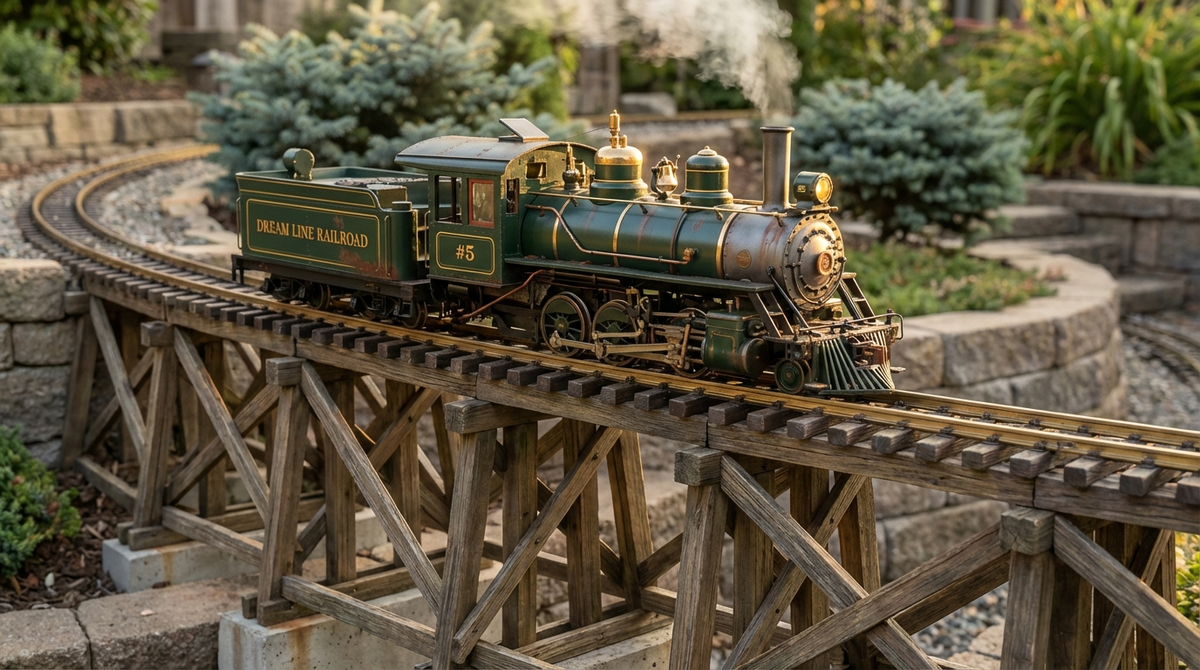
I've watched guys pour thousands into garden railroads only to rip them out three years later. Bad drainage. Wrong track material. Frost heave that turned their mainline into a roller coaster. After spending 28 years fixing things at the CTA Skokie Shops, I can spot a doomed project from across the yard.
Your large scale garden railroad setup doesn't have to become another cautionary tale. The hobby has changed dramatically since the early days of ground-level loops in crushed stone. New materials, battery power systems, and hard-won lessons from builders across every climate zone have given us a roadmap. You just need someone willing to tell you the truth about what works and what doesn't.
Before you buy a single piece of track, answer one question: Do you want to watch trains run, or do you want to operate them?
Sounds simple, but this shapes everything. A continuous-run layout built for relaxing on the patio needs broad curves and minimal switching. You're designing for visual appeal, not operational complexity. Wide radius turns look better anyway, and your trains will run smoother with fewer derailments.
But if you're drawn to prototypical operations with yards, sidings, and industries, that's a different animal entirely. You'll need functional yard ladders, headshunts, and appropriate turnouts. Some builders use car card and waybill systems to generate traffic patterns for operating sessions. Even on a continuous-run layout, the itch to do simple set-outs and pick-ups usually shows up eventually.
Here's where I see guys from sunny Arizona give advice to folks in Minnesota, and vice versa. Stop. Your local climate dictates everything from foundation depth to material selection.
Rain and storm runoff destroy more garden railroads than anything else. Before you turn a shovel of dirt, understand your local rainfall intensity using NOAA Atlas 14. This isn't paranoia. Standing water causes soil erosion, hydrostatic pressure against walls, shorted circuits, and plant loss. Design for the 25-year storm, not the average Tuesday afternoon shower.
In cold climates, frost heave will destroy your roadbed. The ground freezes, expands, and pushes everything upward. Come spring, your perfectly level track looks like a sine wave. You need to know your local frost line depth before setting a single post.
Some builders use frost-protected shallow foundations with XPS insulation placed below the roadbed. This prevents the ground from freezing underneath, eliminating heave entirely. A builder in Buffalo documented zero frost heave after adding just one inch of XPS over a compacted gravel base.
Desert builders face the opposite problem. UV radiation destroys untreated plastics within 2-3 years. Standard ABS becomes brittle and cracks. In Arizona, an operator switched to PIKO track with UV-stabilized HDPE ties and reported zero material failures after three summers exceeding 115°F.
The stability of your track depends on what's underneath it. Skip this step, and you'll be fixing problems forever.
Identify your soil type first. Clay soils expand and shrink with moisture, causing heave. Sandy soils drain well but can shift. Remove all topsoil and compact the subgrade in lifts no more than 4-6 inches thick.
For stabilization over soft ground, lay down geotextile fabric before your aggregate base. This separates soil from ballast and improves drainage. Use a Class 1 geotextile per AASHTO M288 standards for any serious stabilization work.
Grade the ground at least 1-2% away from your track to direct surface water into swales. For subsurface water, French drains are highly effective. Dig a trench 12-18 inches wide and 18-24 inches deep, line it with nonwoven geotextile, lay a 4-inch perforated pipe at 0.5-1% slope, surround it with clean gravel, and fold the fabric over the top.
Your ballast itself is part of the drainage system. Use crushed, angular stone like 3/8" minus granite. Crown your roadbed to prevent water from ponding under the track.
This is where I've seen more bad decisions than anywhere else. The track material you choose determines your maintenance workload for as long as you own the railroad.
Solid brass rail is the best choice for most people. Code 332 brass from PIKO, LGB, or TrainLi runs about $9.33 per foot in bulk. It tarnishes over time, developing a natural patina that actually looks better than shiny new rail.
The catch? Brass oxidizes and needs cleaning monthly to quarterly for good electrical conductivity. A mildly abrasive pad or chemical cleaner like Brasso does the job.
Stainless steel is 40-50% less conductive than brass but doesn't oxidize. You'll need cleaning maybe twice a year instead of every few months. At around $12 per foot, it costs about 30% more than brass upfront, but the reduced maintenance can be worth it on long mainlines.
One warning: stainless is hard to cut, and you can't easily solder it. You'll need rail clamps for all connections.
Aluminum oxide is a non-conductive insulator. That makes aluminum track unsuitable for track power. Period. If you're running battery-powered or live steam exclusively, aluminum can save money. Everyone else should stay away.
The "code" refers to rail height in thousandths of an inch. Code 332 is the most common and robust, popularized by LGB. It's durable enough to survive getting stepped on and allows more debris clearance.
Code 250 and Code 215 look more prototypical but require a rock-solid roadbed. They're less forgiving of rough handling. Suppliers like Llagas Creek specialize in these smaller codes for finescale modelers.
Thermal expansion is a powerful force. A 1-meter brass rail expands by 1mm over a 50°C temperature swing. That adds up fast on a long layout.
Screw-on rail clamps from Split Jaw or TrainLi create solid mechanical and electrical connections far superior to standard slide-on joiners. TrainLi's ProClamps are especially well-regarded. These are essential for stainless steel track and highly recommended for any permanent installation.
Post-2020 build logs show a decisive trend toward raised construction. Builders with elevated layouts report 55% less time weeding and 40% fewer hours re-leveling track each spring compared to ground-level builds.
A 2021 cost analysis showed a raised platform was 24% cheaper to build than a comparable retaining wall structure. The retaining wall approach requires expensive fill dirt and concrete blocks. The raised platform uses standard lumber and pays dividends in reduced maintenance.
An elevated benchwork height of 28-32 inches puts the action at a comfortable viewing height. Your back will thank you. Some builders prefer heights up to 48 inches for eye-level viewing from a seated position.
The HDPE ladder roadbed system developed by Bill Logan offers a flexible, rot-proof alternative to traditional benchwork. Recycled high-density polyethylene lumber won't rot, insects ignore it, and its thermal expansion rate matches track ties.
You rip two stringers from a 2x4 HDPE board, cut spacer blocks from the remaining core, and assemble on-site. The ladder can be bent to curves and supported by square-ended posts at maximum 2-foot spacing. Square posts minimize frost uplift forces compared to pointed ones.
At the 2025 National Garden Railway Convention, 87% of layouts ran battery or hybrid systems. That's not a trend. That's a verdict.
Track power requires clean, dry rail for reliable operation. Outdoors, you're fighting oxidation, moisture, leaves, and critters constantly. Battery-powered radio control eliminates all of that. Track condition becomes irrelevant for power delivery.
CVP AirWire pioneered dedicated battery RC with 900 MHz frequency-hopping spread spectrum technology. Range hits 500 feet unobstructed. The T6000 and T2300 throttles work with their G3/G4X decoders, and the CONVRTR module lets you use existing DCC decoders.
Ring Engineering's RailPro offers touch-screen control via their HC-3 controller. The system was designed from the ground up to resist WiFi and cell phone interference.
SoundTraxx Blunami takes a modern approach using Bluetooth. Control happens through a smartphone app, and the decoder runs on DC, DCC, or battery. Keep the decoder antenna at least 0.5 inches from metal for best range.
DCC-EX is the open-source option built on Arduino-compatible microcontrollers. A complete EX-CommandStation costs around $49 with parts you can source yourself. For WiFi control, the ESP32 microcontroller is recommended.
The real magic happens when you pair DCC-EX with a ProMiniAir transmitter for dead-rail operation. You get the flexibility of DCC with the reliability of battery power.
For G-scale, the NMRA standard nominal DCC track voltage is 18V, with a 24V maximum. High-current boosters like the Digitrax DB220 (up to 16A) or Massoth DiMAX 1203B (10-12A) handle G-scale loads.
Use 10-14 AWG solid-core wire for your main bus. Feeders should connect at least every 6-10 feet, and to every piece of rail in humid environments.
Reliable turnout operation is critical, and outdoor conditions destroy lesser designs fast. Rain, dust, temperature swings, and the occasional visiting critter can disable cheap switch motors in a season.
The PIKO 35271 is fully waterproof and sealed. Community build logs show users reporting high reliability, with some units logging zero field failures over 24 months. At $40-50, it's the top commercial choice for fit-and-forget reliability.
The older LGB EPL 12010 runs $38-46 but isn't inherently waterproof. Users report needing to add silicone sealant and grease to prevent rust and failure.
DIY servo solutions offer excellent performance for $6-10 total cost. A Tower Pro SG90 servo with a simple controller provides slow-motion action that looks prototypical. You'll need a weatherproof enclosure for the electronics, but servos themselves are cheap to replace.
Powering the frog prevents short-wheelbase locomotives from stalling where rails cross. A DPDT switch synced to the points handles polarity switching. The Circuitron Tortoise has built-in DPDT contacts, making it popular despite needing a weatherproof enclosure outdoors.
Wrong plant choices create maintenance nightmares. Invasive roots lift track, aggressive growers obscure sightlines, and plants suited to other climates become weeds or die.
The American Conifer Society classifications are your friend. Miniature conifers grow less than 1 inch per year, staying under 1 foot tall in 10 years. Dwarf conifers grow 1-6 inches annually, reaching 1-6 feet in a decade.
For temperate climates, Dwarf Alberta Spruce, Mugo Pine, and Blue Star Juniper work well. Dwarf Hinoki Cypress adds variety. Mediterranean zones do better with Rosemary, Lavender, and Creeping Juniper.
Creeping Thyme, Woolly Thyme, and various Sedums provide low-growing coverage in temperate zones. For slopes, Creeping Juniper and Kinnikinnick control erosion effectively.
Drip irrigation delivers water directly to root zones, saving up to 80% compared to sprinklers. For even coverage, use in-line drip tubing with pressure-compensating emitters.
Every garden railroad needs regular attention. Here's what to actually expect.
Brass needs cleaning every few months. Stainless steel rarely needs cleaning for electrical conductivity. Nickel-plated brass falls in between since its oxide is conductive.
Automated cleaners like the LGB 21670 or PIKO Clean Machine help on long mainlines, but you'll still clean turnouts by hand.
Lubricate locomotives once or twice annually, or after every 25-50 hours of running. Use plastic-compatible lubricants only. LaBelle #106 grease works for gears, while LaBelle #108 light oil suits bearings. Never use WD-40 as a lubricant.
For rail joints, PIKO 36215 conductive grease improves electrical reliability in outdoor conditions.
Track and trains account for only 25-50% of total project cost. Landscaping, earthwork, and infrastructure eat the rest. Ambitious "big-bang" projects average 2.1x cost overruns. A phased approach keeps you running trains while spreading the investment.
Phase 1 (First Summer): Build a temporary outdoor test loop on gravel for $205-590. Get a feel for the hobby. Test plant choices in pots.
Phase 2 (First Winter): Keep running trains indoors while planning the main build. Budget $50-250 for a simple indoor loop and accessories.
Phase 3 (Second Year): Construct your first permanent raised segment for $900-2,950. This includes lumber, dirt, rocks, and more track.
This staged approach gets trains running in the first season while you learn and refine your vision before major commitments.
The secondhand market offers significant savings. Swap meets and forums like Large Scale Central are excellent sources for used equipment. Hand-laying track can be cost-competitive with pre-made sections, especially for custom turnouts.
Be cautious buying discontinued brands like Aristo-Craft. While their track is often compatible, finding unique components and spare parts can be impossible.
LGB 300mm straight track runs $9.99. PIKO R1 curved track boxes go for around $137 for 12 pieces. Manual LGB R1 turnouts cost about $55, while the waterproof PIKO 35271 switch motor runs $49.99.
For bulk track purchases, PIKO America and IC Trains offer competitive pricing. Sunset Valley Railroad specializes in Code 250 for finescale work.
Affordable 3D printing has changed the economics of this hobby. The Dragon Railway project offers complete open-source printable locomotives. You can find everything from replacement parts to complete freight cars on Thingiverse and Printables.
For outdoor parts, print in PETG or ASA for UV resistance. A custom servo bracket for turnout control costs pennies to print versus buying commercial equivalents.
A garden railroad is a long-term hobby. Design for comfort now, and you'll still be enjoying it in 20 years.
Layout depth shouldn't exceed 25 inches of forward reach. For a layout accessible from one side, that means 25-30 inches maximum width. Pathways need at least 36 inches of clear width following ADA guidelines. A 60-inch diameter is required for 180-degree turns.
Raised layouts are inherently more accessible. If you can avoid bending and kneeling, you'll actually use your railroad instead of just looking at it.
Your large scale garden railroad setup will either bring you decades of joy or become an expensive lesson in what not to do. The difference is planning. Know your climate. Prepare your site properly. Choose materials that match your maintenance tolerance. Phase your build so you're running trains while you learn.
The hobby has never had better options for reliable outdoor operation. Battery power solved the track-cleaning problem. Modern waterproof switch motors actually work. Open-source electronics and 3D printing cut costs dramatically. The guys building garden railroads today have advantages the pioneers could only dream about.
Use them.
✨ Complete Your Layout: Explore our wide selection of Photo Real buildings, diorama backdrops, detail parts, and accessories in every popular scale.
✨ Unmatched Realism: From chrome detailing products to neon lighting kits – every piece is designed to make your miniature world come alive.