
How Much Space Do I Need for a Model Train Layout? The Real Numbers That Actually Matter
Posted by Derek Olson on 31st Dec 2025
Order by phone: 763-231-7847
Free Shipping On Orders Over $100!
If you are already registered, please log in.
Create your account and enjoy a new shopping experience.
Create A New AccountPosted by Derek Olson on 31st Dec 2025
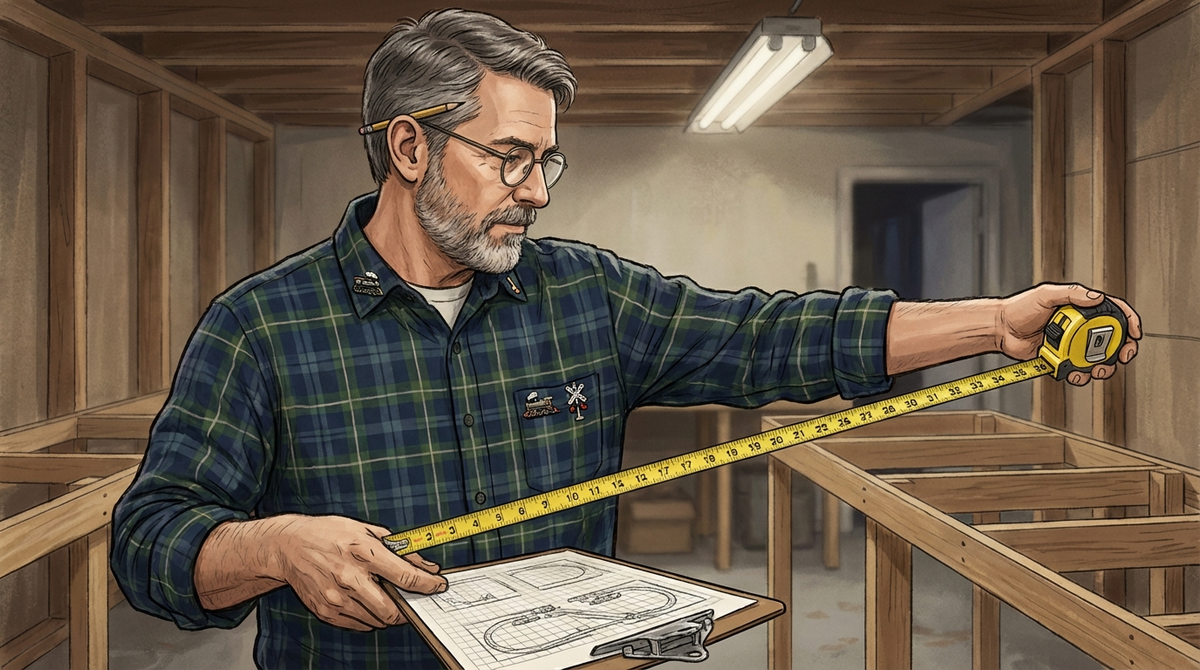
I get this question at least once a week in my DMs: "How much space do I need for a model train layout?" And honestly, the old answer of "just get a 4x8 sheet of plywood" is one of the biggest lies the hobby ever told itself.
After spending years wiring layouts (professionally and for fun), I've watched too many hobbyists build themselves into corners they can't escape. The real answer isn't just about square footage. It's about understanding curves, aisles, reach, and what you actually want to run. Let me break this down with actual numbers instead of guesswork.
Here's something that blew my mind when I first dug into the data: somewhere between 70-80% of award-winning home layouts since 2018 are wall-mounted designs, not freestanding islands. That's not a coincidence.
The math is brutal for island layouts. Put a 4x8-foot table in a 10x12-foot room, and you've got maybe 24-inch aisles on all sides. You can barely squeeze past, let alone invite a friend over to run trains. And your curves? Locked into a tight 18-inch radius that makes long equipment look like it's doing gymnastics.
Switch to an around-the-walls configuration in that same room, and you can gain up to 65% more mainline run. You'll fit broader, better-looking curves. And your "aisle" becomes the entire center of the room.
The strategic shift is simple: start your layout sketch against the longest wall, keep benchwork depth to 24-30 inches max, and only add peninsulas when you need extra run. I've seen guys turn cramped spare bedrooms into genuinely impressive railroads using this approach.
Every locomotive box has a "minimum radius" printed on it. Here's what they don't tell you: that number means the train can physically navigate the curve without derailing. It doesn't mean it'll look good or run smoothly.
Kato lists 249mm (9.75 inches) as the minimum for their N scale equipment. Atlas and Bachmann HO track comes in 18-inch radius sections. Märklin specs 145mm for Z scale.
But real-world operation tells a different story. NMRA Recommended Practice RP-11 and countless community discussions show you often need 25-50% more radius than the manufacturer minimum for reliable, good-looking operation.
Want to run that gorgeous Big Boy model? You're looking at 30 inches minimum to make it look and run well, despite claims of 18-inch compatibility. Those 85-foot passenger cars from Walthers? Same story.
Here's a quick sanity check I use: multiply your longest car's length by three. That gives you a minimum radius that won't embarrass you. For an 85-foot HO car (about 11.75 inches scale length), that's roughly 30 inches. Not 18. Not 22. Thirty.
Your minimum curve radius dictates how much benchwork width you need for a 180-degree turn. The formula is simple: (Radius × 2) + Safety Margin. Most modelers use a 2-4 inch safety margin from track centerline to benchwork edge.
| Scale | Manufacturer Minimum | Realistic Minimum (Long Equipment) | Benchwork Width for 180° Turn |
|---|---|---|---|
| Z (1:220) | 145mm (5.7") | 220mm+ (8.7"+) | ~22 inches |
| N (1:160) | 249mm (9.75") | 381mm+ (15"+) | ~31 inches |
| TT (1:120) | 267mm (10.5") | 439mm+ (17.3"+) | ~34 inches |
| HO (1:87.1) | 18" (457mm) | 30"+ (762mm+) | ~54 inches (4.5 ft) |
| S (1:64) | 21" (533mm) | 36"+ (914mm+) | ~66 inches (5.5 ft) |
| O (1:48) | O-31 / 15.5" Radius | O-72+ / 36"+ Radius | ~60 inches (5 ft) |
| G (1:22.5) | 24" (600mm) | 60"+ (5 ft+) | ~102 inches (8.5 ft) |
I can't tell you how many layouts I've worked on where the owner says, "I wish I'd made the aisles wider." It's the number one regret.
The Layout Design Special Interest Group and countless forum threads confirm what my aching back already knew: 24 inches is a bare minimum for a single person. You can squeeze through, but you won't enjoy it for long.
Long-term comfort starts at 30 inches. But for two operators passing each other, or for anyone who isn't built like a flagpole, 36 inches should be your target.
Here's the thing that makes this manageable: you don't have to sacrifice layout space. Trimming shelf depth from 24 inches to 18 inches often reclaims enough floor space for proper aisles. And 18 inches of benchwork depth is plenty for most switching scenes.
| Width | Use Case | Reality Check |
|---|---|---|
| 18" | Short pinch points only | Requires turning sideways; not for operational areas |
| 24" | Single operator, no passing | Tight for larger people; gets old fast |
| 30-32" | Two people can squeeze past | Minimum for operating sessions with guests |
| 36" | ADA compliant; comfortable operation | The sweet spot for most home layouts |
| 42-48"+ | Yard areas, clubs, high traffic | Ideal if you have the space |
One more gotcha: fascia-mounted throttles and card boxes can steal 3-6 inches of effective aisle width. Plan for them.
This is where I see modelers get burned constantly. They plan a 2% grade, build a helix, and then wonder why their locomotives stall or slip.
Here's the physics: a grade on a curve is harder to climb than a grade on straight track. The formula for HO scale is:
Effective Grade % = True Grade % + (32 ÷ Radius in inches)
So that "reasonable" 2% grade on a 24-inch radius helix? It actually behaves like 3.33% (2 + 32/24). That's punishing for most locomotives pulling a decent train.
Case studies from the LDSIG show helix reliability exceeds 95% only when effective grade stays at or below 2.5%. For a 30-inch radius HO helix, that means your true grade can't exceed about 1.4%.
If space forces you into tight radius helixes, you have options: train elevators, switchbacks, or just accepting shorter trains.
Let's say you need to climb 18 inches between decks for an HO layout running modern autoracks.
That's steep. A 36-inch radius helix would drop the effective grade to about 2.6%. A 30-inch radius helix needs roughly 5.5 × 5.5 feet of floor space when you include supports.
The NMRA publishes recommended practices that'll save you from expensive mistakes. Here are the ones that matter most for space planning:
Track-to-Edge: Minimum 2-3 inches from track centerline to benchwork edge. I prefer 4 inches because derailed cars happen, and I'd rather they don't hit the floor.
Parallel Track Spacing (Straight): NMRA RP-7.1 recommends 1-13/32 inches for modern HO equipment, 15mm for N scale.
Parallel Track Spacing (Curves): This is where people mess up. On an 18-inch radius HO curve, center spacing jumps to 3-5/32 inches. That's more than double the straight track spacing. Check the RP-7.2 tables before you lay curved parallel track.
Vertical Clearance: This one shocked me when I started modeling modern railroads. For HO scale double-stack containers, you need 13.60 inches from railhead to overhead obstructions. Classic-era equipment only needs about 3.19 inches. Plan 4 inches of rail-to-rail clearance on multi-deck layouts to accommodate track, roadbed, and scenery.
I used to think staging was an afterthought. Somewhere to hide trains when they weren't on the "real" layout. I was wrong.
Analysis of operating sessions shows nearly half of train movements involve staging. It's where trains come from and where they go. Without good staging, your operations become a frustrating game of manually swapping trains by hand.
Joe Fugate's rule of thumb: "Twice the train length plus one track." For 10-foot HO trains, that means planning at least 21 feet of hidden trackage per staging yard.
Plan staging first, not last. The visible scenery fills whatever space remains.
Turnouts (switches) eat up more space than people realize, especially in yard ladders.
A #4 turnout saves space but limits you to short cars and slow speeds. #6 turnouts are the workhorse choice for most yards. #8 and larger work best for mainline crossovers where speed matters.
Using Atlas HO turnouts with 2-inch track centers, each additional yard track adds about 8.75 inches for #4 turnouts or 11.75 inches for #6 turnouts. A six-track yard with #6 turnouts needs nearly five feet just for the ladder.
The Dog & Caboose yard ladder calculator can help you figure exact dimensions before you commit to a design.
The best-designed trackplan becomes miserable if you can't comfortably reach it or see it.
Height choices:
The corner trap: Two 36-inch shelves meeting at a right angle create a diagonal reach of 50 inches to the back corner. That's unreachable for most humans. Never put trackwork beyond arm's reach.
For multi-deck HO layouts, plan 14-16 inches between railheads. You can squeeze tighter, but you'll regret it when trying to work on the lower deck or see the scenery.
The upper deck should be 33-50% narrower than the lower deck to avoid a cave-like viewing experience. Keep the upper deck's benchwork, fascia, and lighting valance as thin as possible to maximize lower-deck visibility.
Any around-the-walls layout eventually hits a doorway. Duck-unders are a terrible idea. Your knees and back will hate you, especially as the years go by.
Swing gates work best for frequently used doors. A continuous piano hinge provides the best alignment. Make sure you have clearance for the gate to swing fully open.
Lift-out sections suit infrequently accessed areas like closets. They're simpler to build but need a safe storage spot when removed.
Vertical lift bridges are elegant but complex. Counterbalancing makes them easy to operate and they don't need swing clearance.
For any movable section: precision alignment pins or tapered guides are mandatory, and electrical interlocks that cut power when the bridge is open will prevent disaster. Seasonal wood movement can throw off alignment, so build in adjustability.
I'll admit, I resisted track planning software for years. "I'll just wing it," I said. Then I tore out and re-laid a yard ladder three times because the turnouts didn't fit like I'd imagined.
Track planning software lets you test ideas, validate clearances, check grades, and print 1:1 templates before you touch a saw.
| Program | Price | Platform | Best For |
|---|---|---|---|
| XTrackCAD | Free | Win/Mac/Linux | Power users, any OS |
| AnyRail | $59 | Windows | Beginners, ease of use |
| SCARM | ~$40 | Windows | Quick 3D visualization |
| RailModeller Pro | ~$45 | Mac only | One-click PDF export |
| 3rd PlanIt | ~$125 | Windows | Complex 3D engineering |
My workflow: draw the room boundaries, set minimum radius and maximum grade constraints, lay track using built-in libraries, check the elevation profile, then print 1:1 templates to transfer the design to benchwork.
An around-the-walls shelf layout with 18-inch deep benchwork leaves a 7×9-foot central operating pit with comfortable aisles. You can fit 24-inch minimum radius curves in the corners and a lift-out section across the door.
Compare that to a 4×8 island in the same room: you're stuck with 18-22 inch radius curves and cramped 24-inch aisles on all sides. The around-the-walls approach wins on every metric.
O scale needs serious real estate. A perimeter layout with 30-inch deep shelves works well. Add a 4-foot-wide central peninsula for extra mainline run, but remember: the turnback loop needs O-72 (36-inch radius), making the peninsula end nearly 6.5 feet wide.
Keep aisles at 36 inches minimum in O scale. Everything is bigger, including the people trying to operate the layout.
Space planning without budget planning is fantasy. Here's what you're actually looking at:
Track costs: Based on 2024 prices for Atlas Code 83 HO flex track (~$7/yard) and #6 turnouts (~$25 each), a simple mainline runs $9-12 per foot. N scale is slightly cheaper at $7-9 per foot.
DCC vs. DC: A basic DC power pack costs under $100. Entry-level DCC starters (NCE Power Cab, Digitrax Zephyr) run $185-200. The real cost difference is in decoders: non-sound decoders are $20-30 per locomotive, while sound decoders run $70-90+.
DCC does eliminate the need for massive control panels with block toggles, which frees up fascia space and simplifies wiring.
Rarer scales cost more. S scale and TT scale have fewer ready-to-run manufacturers, leading to higher prices and more kit-building or hand-laying track. Z scale carries a premium due to precision manufacturing requirements.
After all these numbers, here's how to actually move forward:
1. Map your space. Measure everything. Mark doors (including swing direction), windows, columns, electrical panels. This is your non-negotiable boundary.
2. Define your must-haves. What scale? What era? What equipment must you run? Your longest piece of rolling stock sets your minimum radius.
3. Rough sketch → software validation. Sketch ideas on paper, then transfer to track planning software. Let the software catch geometric impossibilities before you buy materials.
4. Build a mock-up. Use cardboard boxes and planks to create full-size benchwork shapes in the actual room. Stand in the planned aisles. Reach for the back corners. Check sightlines. This step catches problems that look fine on paper but feel terrible in reality.
5. Budget gate review. Generate the parts list from your software. Price it out. If it exceeds your budget, scale back now, not after you've started cutting wood.
6. Build modular. Even for a "permanent" layout, building in sections lets you work at a comfortable bench, makes future moves possible, and means you can run trains on a finished section while still building others.
So how much space do you need for a model train layout? The honest answer: less than you think, if you plan smart.
A well-designed 24-inch-wide shelf along your garage wall will give you more satisfying operations than a poorly planned 4×8 island. A corner of a spare bedroom can become a legitimate railroad with proper curve radii and thoughtful design.
The space you have today isn't a limitation. It's a design constraint. And constraints, when you respect them, make for better railroads.
New technologies like 3D printing and battery-powered locomotives are making creative layouts easier than ever. Start with the numbers in this article, validate your plan in software, mock it up in cardboard, and then build something you'll actually enjoy operating for years to come.
By Derek Olson
✨ Complete Your Layout: Explore our wide selection of Photo Real buildings, diorama backdrops, detail parts, and accessories in every popular scale.
✨ Unmatched Realism: From chrome detailing products to neon lighting kits – every piece is designed to make your miniature world come alive.