
The Complete HOn3 Narrow Gauge Modeling Guide for Serious Builders
Posted by Harold Lindgren on 31st Dec 2025
Order by phone: 763-231-7847
Free Shipping On Orders Over $100!
If you are already registered, please log in.
Create your account and enjoy a new shopping experience.
Create A New AccountPosted by Harold Lindgren on 31st Dec 2025
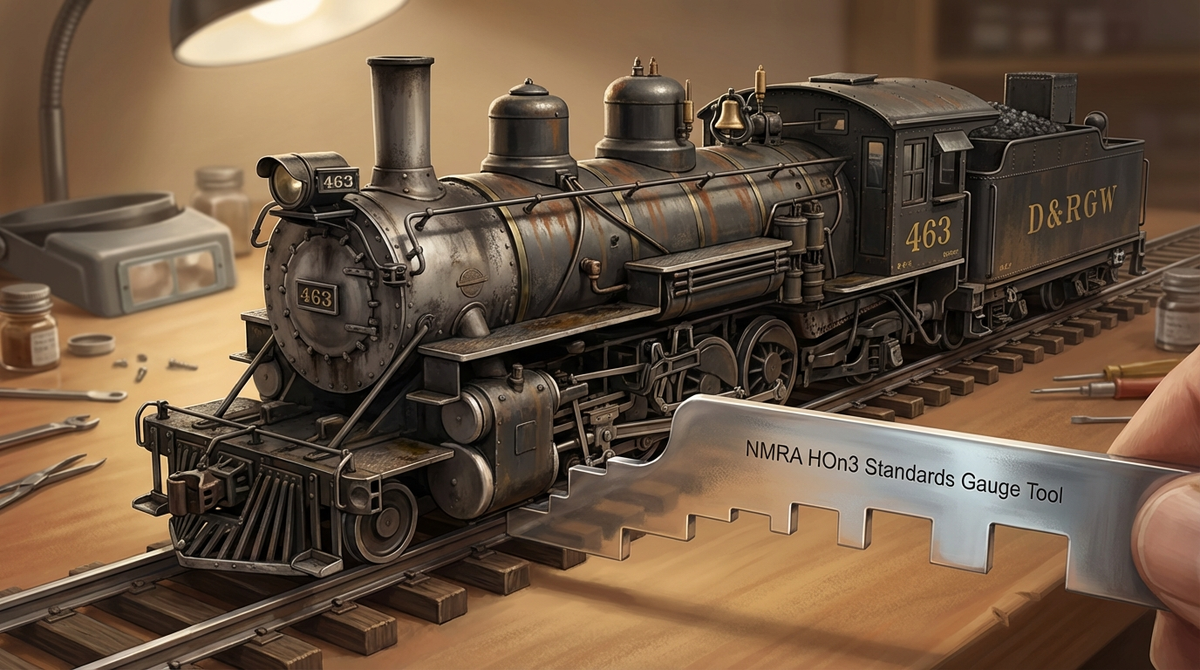
I spent four decades building houses in the St. Croix Valley, and if there's one thing that career taught me, it's this: measure twice, cut once, and never skip the foundation work. When I started my first HOn3 layout three years ago, I brought that same philosophy to the workbench. Good thing, too. HOn3 rewards careful planning and punishes shortcuts with derailments that'll make you question your life choices.
My wife told me model railroading would be a "clean" hobby compared to carpentry. She clearly hadn't seen what happens when you try to run a K-27 through a turnout that's two thousandths of an inch out of gauge. But I'm getting ahead of myself.
Before you buy a single locomotive or lay an inch of track, invest eighteen dollars in an NMRA HOn3 standards gauge. I'm not being dramatic when I say this tool will save you hundreds of dollars and countless hours of frustration. The folks I've met at local operating sessions who skipped this step? They spend more time chasing derailments than running trains.
HOn3 uses a track gauge of 10.5mm (0.413 inches) to represent three-foot prototype track at 1:87.1 scale. That's the easy part. The tricky stuff lives in the tolerances.
The NMRA S-3.2 trackwork standard specifies a check gauge of 0.379 inches with tight tolerances. Get this wrong at your frogs and guard rails, and wheels will "pick the point" and derail every single time. The S-4.2 wheel standard calls for a back-to-back dimension of 0.301 inches. That's your critical measurement for rolling stock.
The Fine HOn3 specifications tighten these tolerances further for modelers chasing maximum realism. I stick with standard NMRA specs because my eyes aren't what they used to be, and I'd rather have bulletproof operation than bragging rights at the coffee shop.
Use your standards gauge on every piece of rolling stock before it touches your layout. Check the track gauge on straight sections, then pay extra attention to turnouts. The NMRA data sheets explain that curved portions of turnouts need gauge widening - roughly 2% for a #6 turnout - to let longer wheelbases negotiate the curve without binding.
When I started researching HOn3 track, I assumed I'd have a dozen options. Turns out the market's pretty slim. Peco and Micro Engineering dominate what's available. Shinohara is effectively gone - Walthers closed that line, and whatever's left is collector pricing on eBay.
Peco's HOn3 flex track comes in 36-inch sections with wooden sleeper styling. Their medium radius Unifrog turnouts have a 30-inch radius and 11.42-degree frog angle. That broader geometry works great for larger brass locomotives that need room to swing.
The Unifrog design gives you wiring flexibility - you can power the frog or leave it dead, depending on your DCC setup. At around $32-42 per turnout, they're not cheap, but they're consistent.
Micro Engineering offers Code 40, 55, and 70 flex track with exceptionally realistic tie plates and irregular spacing. Their #6 turnouts have a tighter 19.5-inch centerline radius, which eats less real estate on compact layouts.
For modelers recreating dual-gauge scenes like the East Broad Top's Mount Union interchange, Micro Engineering's HO/HOn3 dual gauge flex track is basically your only commercial option.
From the track planning guides I've studied and my own experience, Code 70 is the forgiving choice for mainlines. Code 55 looks stunning in photographs, but those shorter rails are less tolerant of slight irregularities in your benchwork. Save Code 55 for sidings and exhibition modules where you'll fuss over every detail.
Here's where my builder's brain perks up. Commercial turnouts run $32-45 each. If your layout needs twenty of them, that's nearly a thousand dollars in turnouts alone. The Fast Tracks fixture system offers a different path.
A #6 turnout fixture runs around $190-200. Material cost per turnout drops to roughly $10-15. After building a dozen turnouts, you've recouped your investment and you're saving real money on every additional switch.
But here's the part that sold me: hand-laid turnouts using jigs have dramatically better reliability than mass-produced options. The soldered construction means permanent gauge accuracy. No batch-to-batch variation. No mysterious derailments at the same spot for months. I built three Fast Tracks turnouts for my staging yard and haven't touched them since.
The filing jigs and CopperHead PC board ties make the process remarkably straightforward. Fast Tracks claims you can build a perfect turnout in an hour. My first one took three hours. My tenth took forty-five minutes. The learning curve is real but short.
Now we get to the elephant in the roundhouse. Blackstone Models produced the finest ready-to-run HOn3 locomotives ever made. Their K-27 and C-19 steamers, with factory-installed sound and excellent slow-speed performance, set the standard. The problem? Production has been paused since 2020 with no firm return date.
The Blackstone catalog shows what these locomotives were designed to do - 18-inch minimum radius operation with bulletproof pickup. What it doesn't show is current pricing. A K-27 that retailed for $475-500 now sells for $900-1,100 on eBay. I've seen weathered versions close even higher.
ReSourced Rails and similar dealers occasionally have Blackstone stock, but expect to pay a premium. For C-19 models, the situation is equally tight.
The brass market offers alternatives, but they require different expectations. Older Westside brass K-27 models start around $225. Premium manufacturers like PSC and Key command $1,200 and up. And here's the catch: most brass requires significant work to add DCC sound - motor replacement, frame milling, decoder installation. Budget another $200-350 for professional conversion.
Brass locomotives also tend to need broader curves - 22 to 24 inches for larger prototypes like the K-36. Your layout's geometry needs to match your intended roster.
Harris Hobbies stocks various passenger car kits. Banta Model Works offers structures. Wiseman Model Services acquired the Roundhouse locomotive kit line. For someone who enjoys building, HOn3 kits offer an affordable entry point, though they demand intermediate to advanced skills.
Blackstone freight cars remain more available than their locomotives. Check Facebook groups for new-in-box lots at reasonable prices. Trainz.com and ReSourced Rails carry what's available on the secondary market.
Fitting modern sound decoders into HOn3 steam requires planning. The SoundTraxx TSU-1100 at 27 x 10.5 x 5mm is the standard for Blackstone installations. ESU's LokSound 5 Micro shrinks to 21 x 10 x 5.4mm with excellent motor control. For truly cramped installations, ZIMO's MS500 Nano measures just 14 x 10 x 2.6mm.
Dirty track and unpowered frogs cause sound resets that destroy immersion. The SoundTraxx CurrentKeeper II provides 1.5-3 seconds of power backup. ESU's PowerPack Mini does similar duty for LokSound decoders.
For passenger car lighting, a DIY flicker-free circuit using a bridge rectifier, capacitor, and buck converter runs under 10mA and eliminates that annoying stutter over dirty track. The MRH forum thread on this design is worth bookmarking.
In HOn3 geared steam installations, every millimeter counts. Hardwire everything - plugs waste space. Use 32-36 AWG ultra-flexible wire. Twist speaker leads to reduce interference. The SoundTraxx C-19 application note details proper motor suppression and wire management.
Your choice of prototype determines minimum radius, rolling stock length, and scenic character. Three regions dominate HOn3 modeling, each with distinct requirements.
The D&RGW and RGS offer dramatic mountain scenery, high trestles, and iconic locomotives like the K-27 "Mudhen." Blackstone's K-27 handles 18-inch minimum radius. Short ore cars and 30-foot boxcars mean longer trains in less space. Model availability is excellent with multiple RTR and kit options.
The EBT's history as Pennsylvania's coal hauler offers a completely different flavor. Steel equipment, brick shop buildings, and that fascinating dual-gauge interchange at Mount Union. Blackstone's EBT 3-bay hoppers are excellent models, but their longer length means shorter train counts in the same staging space. An EBT layout works well with 18-inch minimums.
Steep grades, sharp curves, and geared locomotives define eastern coal-hauling short lines like the Manns Creek. Small 20-ton wooden hoppers and compact Shays make this ideal for tight spaces. Switchbacks replace run-around loops. The trade-off: sourcing equipment requires kits, 3D printing, and scratchbuilding skills.
A 2x8-foot shelf gives you real switching operations without taking over the basement. Here's what I'd spec for a Colorado mining theme.
Three sections of Micro Engineering Code 70 flex track provide your mainline and spurs. Two ME #6 turnouts at around $36-45 each handle your switching moves. Caboose Industries ground throws keep it simple.
Campbell Scale Models offers affordable wood structure kits. Bar Mills makes beautiful freight houses. For couplers, Kadee #714 is the standard. Check coupler height with a Kadee #704 gauge.
An NCE Power Cab handles a small layout nicely. Tam Valley Depot frog juicers automate polarity switching at turnouts. Follow standard DCC wiring practice - 14 AWG bus, 22 AWG feeders to every rail section.
Total budget runs around $1,500 including a used Blackstone locomotive. Build time: four weekends if you stay focused. My wife would tell you I never stay focused.
A Micro-Mark Truck Tuner costs $20 and solves half your derailment problems before they start. The Atlas forum discussions on this tool are worth reading. Roll it through truck bearing pockets to clear burrs and true the bearing surfaces.
Schedule monthly wheel and gauge checks. Data from clubs implementing this practice shows derailments dropping from 1.6 to 0.4 per operating session. That's not a small improvement - that's the difference between frustration and fun.
When derailments happen, resist the urge to just re-rail and continue. Check the car's back-to-back dimension with your standards gauge. Verify trucks swivel freely. Then check track gauge at the derailment site. For turnout problems, verify guard rail dimensions per NMRA specs. The frog juicer manual covers troubleshooting powered frogs.
With 37% of projects in the 2024 HOn3 Annual using home-printed parts, resin printing has become standard practice. When Shapeways exited the hobbyist market, the cottage industry stepped up. The 2025 HOn3 Annual devotes significant coverage to living with this technology.
A quality resin printer runs about $300. Temperature control and ventilation matter - without a proper enclosure, expect 18% failure rates. If that sounds like too much hassle, cultivate relationships with vendors who produce custom parts.
White Rose Hobbies and Train World stock new production items at standard discounts. Arizona Hobbies and LaBelle Woodworking specialize in narrow gauge.
For discontinued items, HOn3 Yard Sale on Facebook often beats eBay prices. The BrassTrains consignment service handles high-end brass with proper grading.
When buying used, demand clear photos of the mechanism, wheels, and original box. "Untested" almost always means "broken." Missing boxes reduce value 15-25% and dramatically increase shipping damage risk. For anything over $200, request a test run video.
The HOn3 Annual is the single best investment for newcomers. Every issue focuses on how-to content specifically for the scale. The Narrow Gauge & Short Line Gazette provides prototype documentation and scale drawings for scratch builders.
For real-time troubleshooting, the NMRA beginner's guide covers fundamentals. Convention clinics offer hands-on learning that no publication can match.
I've built four layouts in six years. Each one taught me something I couldn't have learned from reading alone. HOn3 rewards patience, punishes sloppiness, and delivers satisfaction that standard gauge just can't match. Start with your standards gauge, plan for the locomotives you want to run, and build track you'd bet money on. That's the formula. Everything else is just details.
✨ Complete Your Layout: Explore our wide selection of Photo Real buildings, diorama backdrops, detail parts, and accessories in every popular scale.
✨ Unmatched Realism: From chrome detailing products to neon lighting kits – every piece is designed to make your miniature world come alive.