
HO Scale Train Table Size Requirements: A Data-Driven Planning Guide That Prevents Costly Mistakes
Posted by Carol Fitzgerald on 29th Dec 2025
Order by phone: 763-231-7847
Free Shipping On Orders Over $100!
If you are already registered, please log in.
Create your account and enjoy a new shopping experience.
Create A New AccountPosted by Carol Fitzgerald on 29th Dec 2025
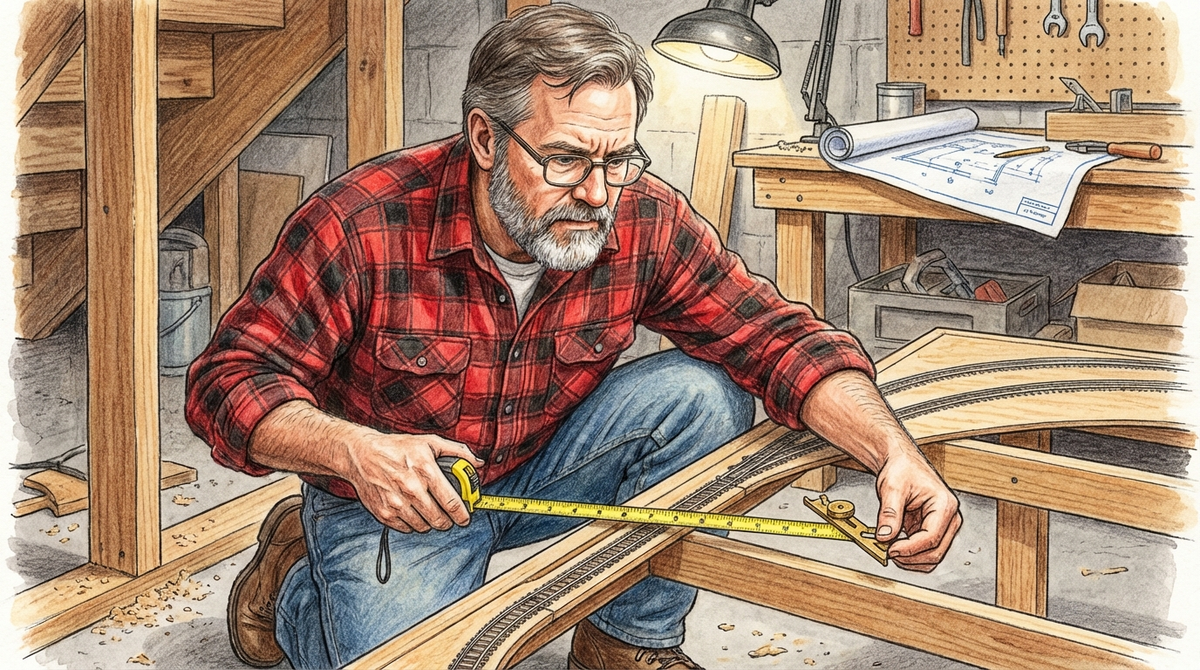
When my husband passed in 2008, he left me a basement full of trains and a half-finished layout that made absolutely no sense to me. I spent the first six months just staring at it, wondering why the beautiful 85-foot passenger cars he'd collected kept derailing on certain curves while his little 40-foot boxcars rolled through without complaint.
Turns out, the answer had everything to do with table size-or more precisely, the wrong table size for what he wanted to run. After fourteen years of rebuilding, expanding, and yes, tearing out entire sections in frustration, I've learned that layout planning comes down to hard numbers, not wishful thinking.
Let me save you from my mistakes.
Walk into any hobby shop and someone will tell you to start with a 4x8 sheet of plywood. It's the standard recommendation, the training wheels of model railroading. And for many of us, it becomes a frustrating dead end within two years.
Here's the math nobody tells you: a 4x8 table only gives you 32 square feet of modeling space, but it actually consumes 96 square feet of room when you factor in the three-foot aisles needed to access all sides. That's a 1:3 ratio of usable space to total footprint. In my old dining room (don't tell my kids), I could fit a 4x8 island OR an around-the-walls shelf layout. The shelf layout gave me 54 square feet of scenicked area-69% more modeling space in the same room.
But the real killer isn't the footprint. It's the curves.
Every beginner set comes with 18-inch radius curves. NMRA Recommended Practice RP-11 technically allows for them. And yes, your locomotive will probably negotiate them without flying off the table.
The problem isn't whether equipment can run on 18-inch curves. It's whether it should.
I learned this the hard way with my husband's collection of prototype-length passenger cars. Those gorgeous 85-foot streamliners looked ridiculous swinging around tight curves, their ends jutting out like elbows at a crowded dinner table. But the real trouble came when I coupled them together. The coupler swing on 24-inch curves caused constant derailments with long cars, and 18-inch curves made the situation hopeless.
Forum discussions consistently confirm what I experienced: 22-inch radius is the practical minimum for most modern HO equipment, and 30 to 32 inches is best if you want to run anything with confidence.
The rule of thumb that finally clicked for me: your minimum radius should be 2.5 to 3 times the length of your longest car. For an 85-foot passenger car (about 11.7 inches in HO), that means a radius between 29 and 35 inches. Suddenly, that 4x8 table with its maximum 22-inch curves looks pretty limiting.
Here's something my artist's brain understood immediately once I started working on the layout: you can only paint what you can reach. The same applies to model railroading.
Comfortable reach for detailed work maxes out at 24 to 30 inches for most adults. Push past 32 inches, and you're stretching, straining, and probably knocking over that water tower you spent three weekends building. NMRA data sheets confirm this limitation, and experienced operators reinforce it.
This means any peninsula or island layout wider than 60 inches becomes problematic-you simply can't reach the center from either side. Anything beyond a 30-inch reach from each side requires an access hatch, and those interrupt your scenery.
When I first started working on the layout, I kept the benchwork at my husband's preferred 36 inches. My back hurt after every session. When I raised it to 48 inches, suddenly I could see the details I was working on, and my reach actually improved because I wasn't bending over.
But here's the catch: higher benchwork reduces your effective reach. A layout at belt-buckle height (around 36 inches) might allow a 36-inch reach, but at chest height (50 inches), you're down to 20-24 inches of comfortable working distance. Pick your height based on viewing preference, then design your depth accordingly.
My husband had double-track mainlines throughout his layout. The track centers looked fine-about two inches apart, standard practice. Then I watched his Reading T-1 side-swipe a passing freight on a curve.
Straight track and curved track play by completely different rules.
NMRA RP-7.1 covers tangent track centers, but RP-7.2 handles curved track-and the numbers are eye-opening. On straight track, modern-era equipment needs about 1 15/16 inches between track centers. But on an 18-inch radius curve? That spacing balloons to nearly 3 inches.
The physics behind this are simple: cars overhang on curves. The center swings inward while the ends swing outward. Longer cars mean more overhang. The same principle applies to obstacles like tunnel portals and station platforms.
I now add a full inch to my tangent spacing for any curve under 24 inches. It costs me a little modeling space, but I haven't had a side-swipe in years.
When I started scratch-building structures, I developed an appreciation for how small decisions compound into major consequences. Turnout selection is exactly like that.
The frog number of a turnout determines its angle. A #4 turnout diverges sharply-1 inch of separation for every 4 inches of length. A #8 turnout takes twice as long to diverge the same distance. The practical effects ripple through your entire layout.
I wanted a six-track classification yard. Using #4 turnouts would have given me a yard ladder about 32 inches long. Upgrading to #6 turnouts extended that to 46 inches-a foot and a half longer, eating into my scenery space. But the #6 turnouts handle longer cars without the derailments that plagued my original #4 installation.
The cost difference adds up too. Current Atlas Code 83 pricing puts #6 turnouts around $30-43 each, while reliable sources show similar ranges. Swapping six #4s for six #6s added about $42 to my yard project. Worth every penny in reduced frustration.
My strategy now: #6 turnouts for mainlines and primary yards, #5 turnouts for industrial spurs where space is tight, and #8s only where high-speed diverging routes justify the expense and length.
The angle and substitution radius of turnouts matter beyond just length. NMRA RP-12 provides dimensional standards, but the practical takeaway is this: a turnout's curved leg has an effective radius that must accommodate your rolling stock. Peco's "large" turnouts have roughly a 60-inch substitution radius, making them far gentler than their physical size suggests.
Peco #8 turnouts run about 322mm (12.7 inches) long, while their #5 turnouts measure 211mm (8.3 inches). That 4.4-inch difference multiplied across a complex throat or yard adds up fast.
I am not an electrical person. When I took over the layout, the wiring looked like spaghetti someone had abandoned mid-meal. But I've learned enough to understand why my trains used to stall in the far corners of the basement.
NMRA Technical Note TN-9 explains that DCC signals degrade over distance. The recommendation: keep voltage drop under 5%. For a typical 5-amp HO system using 14 AWG wire, that means a maximum one-way bus run of about 31-40 feet.
My layout runs about 50 feet along the walls. With a single booster in one corner, the far end was basically starving for power. Sound decoders would reset, locomotives would hesitate, and short-circuit protection became unreliable.
The fix was splitting the layout into separate power districts, each with its own circuit breaker. Now a short in my yard doesn't kill power to the whole railroad. The NMRA beginner's guide walks through proper feeder spacing, but my rule is simple: solder a feeder to every rail section, never trust rail joiners alone.
New England basements are damp. I learned this the hard way when track I'd carefully laid in August started buckling by February.
Wood moves with humidity changes. Plywood can shift dimension by about 0.3% for every 10% change in relative humidity. Over a 10-foot yard, that translates to roughly 1/8-inch of movement-enough to kink Code 83 rail.
Layouts in climate-controlled spaces between 45-60% relative humidity report almost no track problems over years of operation. Stable environments matter more than starting humidity levels.
My basement runs a dehumidifier year-round now, keeping things around 50%. I also sealed all my benchwork with polyurethane-top, bottom, and ends. The track expansion problems disappeared.
After wrestling with that inherited 4x8 for two years, I tore it out and went around the walls. Best decision I ever made.
An 18-inch deep shelf layout hugging the walls of a 10x12 room gives you more modeling space than a 4x8 island in the same footprint. You gain access to every square inch from the aisle, you can run curves of 30 inches or more in the corners, and you never have to crawl under the benchwork to reach derailed equipment.
The trade-off is crossing the doorway. I chose a swing gate rather than a duck-under. My knees aren't what they used to be, and ducking under benchwork gets old fast. The gate requires precise alignment for reliable track connections, but it beats stooping every time I enter the room.
My husband built with L-girder construction, and I've kept most of it. L-girder systems excel for freeform layouts because the joists can be repositioned without rebuilding the whole frame. The NMRA's benchwork guide covers the basics well.
L-girder construction suits large, free-standing layouts with complex shapes, but it's bulky. For my narrow around-the-walls sections, I switched to wall-mounted shelves with foam board on plywood for the subroadbed. Lighter, quieter running, and easier to shape for varied terrain.
Some modelers swear by hollow-core doors for small, flat layouts. They're lightweight and stable, though they can warp if you don't seal all surfaces.
I watched a brass Pennsylvania K4 take a header off my husband's layout during his first operating session after a rebuild. That locomotive cost more than my first car. The memory still makes my stomach turn.
Minimum track setback from the edge should be 3 inches for home layouts. Some modelers prefer 6 inches to allow for foreground scenery and extra safety margin.
For tracks closer to the edge, a fascia lip extending 1 to 1.5 inches above track level catches most derailments. Plexiglass barriers work even better for high bridges or display areas, and 3 to 4 inches of clear shielding provides solid protection without obstructing the view.
I also added guard rails on my highest bridges and planted dense, wire-core vegetation along exposed edges. Belt and suspenders, but I sleep better.
When I die, my kids will have to deal with this layout. I've tried to make that easier by building in sections that can be disconnected, moved, and potentially even sold.
Free-mo standards provide a blueprint: 24-inch wide endplates for single-track modules, 50-inch rail height, 42-inch minimum radius on mainlines, and #6 minimum turnouts. Even if you never plan to exhibit your layout, building to these specs means your sections can connect with club layouts if you want, and they'll command better resale prices than custom-fitted pieces.
The HUB Division module handbook offers another approach with different specifications, and European modelers follow FREMO standards with their own dimensional requirements.
I think of modular construction like teaching: break big concepts into manageable chunks. Build one section, get it running, add scenery. Then build the next. You'll improve with each module, and you can always revisit earlier work without demolishing the whole project.
I sketch structures by hand before building them. Track planning works the same way, except software does the geometry for you.
SCARM offers an intuitive interface with over 255 track libraries and a dedicated Euler spiral easement tool. The free version handles basic plans; the $39 license unlocks full-size 1:1 printing.
AnyRail has a gentler learning curve and extensive track libraries, though some users report alignment issues with PDF exports. At $65, it's pricier than SCARM but friendlier for beginners.
XTrackCAD is free and powerful, with automatic Cornu easement calculation and cross-platform support. The interface takes longer to master, but for complex designs, it's worth the effort.
For anyone hand-laying track (my eventual goal), Templot creates full-size construction templates with millimeter accuracy. It's free and designed specifically for prototype-accurate geometry.
Real railroads don't jump from straight track into curves. They use easements-gradual transitions with progressively tightening radii. Ignoring this on a model railroad causes the lurching, jerking motion that derails long cars on tight curves.
NMRA data sheets on easements explain the geometry, but the software tools handle the math. Templot's tutorials walk through creating flowing trackwork that looks and runs better than track planned with simple tangent-to-curve joints.
I modeled a branch line railroad because I didn't have room for 20-car freight trains. But even my modest 8-car locals needed passing sidings longer than I initially planned.
A 40-foot boxcar measures about 6 inches coupler-to-coupler in HO. A 50-foot car runs 7.5 inches. Eight 50-foot cars plus two diesels and a caboose total about 83 inches-nearly 7 feet. Add 18 inches of clearance at each end so trains can stop without fouling the turnout, and your siding needs to be 10 feet long for reliable operation.
I've seen too many layouts where beautiful sidings can only hold three cars before the tail blocks the main. Plan your siding length before you commit to a track plan, not after.
Multi-deck layouts use helixes to gain elevation. They're space-efficient but unforgiving in their geometry.
The grade through a helix combines the actual calculated slope with additional drag from constant curvature. A common estimate: add a percentage equal to 32 divided by the radius in inches. So a 22-inch radius helix with a calculated 2.9% grade has an effective grade of about 4.35%-too steep for most trains.
A 22-inch radius helix is marginal at best. 30-inch minimum radius provides acceptable operation, and 36 inches or more handles longer trains without struggle. Free-mo's 42-inch standard ensures smooth operation for almost any equipment.
Before you cut lumber, prepare your space:
Everything I've discussed rests on NMRA standards-the dimensional baselines that ensure equipment compatibility across manufacturers.
HO scale is defined as 1:87.1, with 3.5mm equaling one prototype foot. Track gauge per NMRA standards is 0.649 inches minimum. An NMRA Standards Gauge is the cheapest insurance against track problems-use it on every turnout and track section.
Clearance diagrams in RP-7.1 specify vertical clearance (3.00 inches for classic era, 3.15 inches for modern equipment) and side clearance from track centerline. The curved track clearance assistant helps calculate exact requirements for your specific situation.
Fourteen years ago, I inherited a layout built on intuition and starter-set recommendations. The curves were too tight, the reaches too deep, the wiring too thin. I've rebuilt most of it at least once.
The numbers I've shared aren't arbitrary-they come from NMRA engineering, modeler experience, and hard-won lessons from forums and clubs. Plan for 24-inch minimum curves if you're running pre-1970s equipment, 30+ inches if you want modern flexibility. Keep benchwork reachable-24 to 30 inches deep maximum from any aisle. Use #6 turnouts unless space absolutely demands smaller. And seal your wood against humidity.
The 4x8 table in hobby shop lore? It's fine for learning to solder feeders and testing equipment. It's a lousy foundation for the railroad you actually want to build.
Start with the numbers. The dreams come later.
By Carol FitzgeraldBuild Your Dream Railroad with Innovative Hobby Supply!
?️ Complete Your Layout: Explore our wide selection of Photo Real buildings, diorama backdrops, detail parts, and accessories in every popular scale.
✨ Unmatched Realism: From chrome detailing products to neon lighting kits – every piece is designed to make your miniature world come alive.