
The Complete HO Scale Track Planning Guide: Standards, Geometry, and Lessons from 35 Years of Mistakes
Posted by William Jeffries on 29th Dec 2025
Order by phone: 763-231-7847
Free Shipping On Orders Over $100!
If you are already registered, please log in.
Create your account and enjoy a new shopping experience.
Create A New AccountPosted by William Jeffries on 29th Dec 2025
I've been modeling the Pennsylvania Railroad since 1989, and my HO layout has been "almost finished" since 2014. If that timeline tells you anything, it's that I've had plenty of time to make mistakes and learn from them. Most of those mistakes happened during track planning, not scenery. A crooked tree can be replanted. A mainline curve that's too tight for your 85-foot passenger cars? That's a $200 weekend you'll never get back.
After three decades of research, museum work, and staring at my own trackwork wondering why that one autorack keeps derailing in the same spot, I've developed some strong opinions about what works. This guide is my attempt to save you from the trial-and-error approach that has defined my own journey.
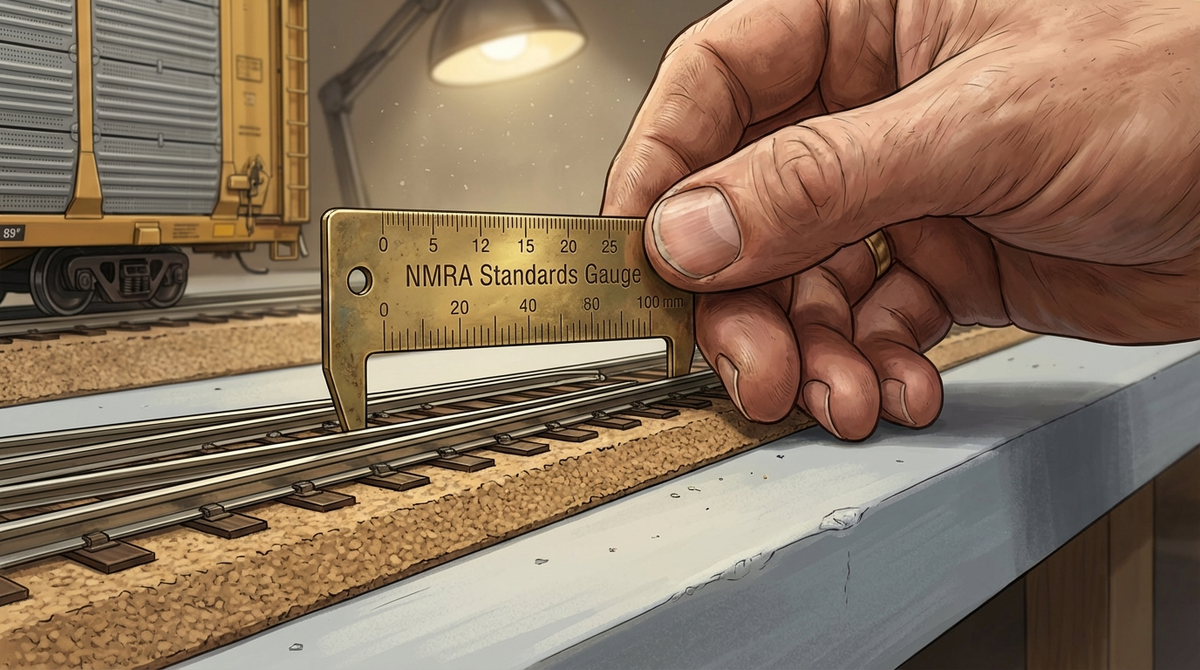
The National Model Railroad Association's Standards and Recommended Practices aren't arbitrary rules dreamed up by committee. They're the distilled result of decades of testing and operational experience. When I first started, I thought I could eyeball everything. The prototype didn't use a gauge, right? Wrong approach. The NMRA Standards Gauge is the single most important tool in your kit.
Before you lay a single piece of track, get familiar with the core standards documents. The gauge itself lets you check wheel spacing, track gauge, turnout flangeways, and clearances for platforms and structures. Using it consistently during construction prevents about 90% of the derailments that plague layouts.
The S-3.2 Standard for Track specifies the fundamental dimensions that all commercial track should meet. If your ready-to-run turnouts don't pass gauge checks, send them back.
Here's where I'll probably make some enemies. That 18-inch radius that came with your starter set? It's fine for running a 4-4-0 around a Christmas tree. For anything resembling prototype operation with modern equipment, you need at least 30 inches on your mainline.
I know, I know. Space is precious. But the math doesn't lie. According to NMRA RP-11 on Curvature and Rolling Stock, equipment should operate at restricted speed through minimum curves without issues. The problem is that "minimum" assumes older, shorter cars. Forum discussions consistently report that 22-inch curves cause regular problems with anything over 85 feet.
Modern 89-foot autoracks and intermodal cars need 30 to 32 inches minimum for reliable operation. A practical rule I use: benchmark your minimum mainline radius at 2.5 to 3 times the length of your longest car. If you're running Walthers 89-foot autoracks, do the math.
Different eras and equipment types have different needs. Early 40-50 foot freight cars from the steam era can handle 18-inch radius curves without major issues, though they'll look terrible doing it. Transition-era 60-70 foot cars need 24-26 inches minimum.
Modern passenger cars are where things get tricky. Walthers 85-foot Amtrak cars technically specify 24 inches, but for realistic appearance and reliable operation with diaphragms, you want 36 inches or greater. At my museum job, I've seen enough prototype passenger operations to know that tight curves on long passenger cars look absurd.
Six-axle diesels like SD40-2s present their own challenges. Most can technically handle 18-inch radius, but they'll push cars behind them into derailments due to coupler swing. ScaleTrains recommends 22-inch minimum for their SD40-2, but 30 inches is where you stop worrying.
Large articulated steam locomotives? Those long rigid wheelbases demand 32-36 inch minimum radius. An Allegheny on a 20-inch curve isn't running anywhere.
This is where old track plans become dangerous. The NMRA defines four distinct modeling eras with different clearance requirements, and the differences matter.
For Modern era equipment (post-1983), the minimum tangent track center is 1.93 inches. Classic era (1920-1969) used 1.79 inches. That's over an eighth of an inch difference. On straight track, you might get away with the tighter spacing. On curves, the problem compounds.
The Free-mo standard requires Modern Equipment spacing for good reason. On an 18-inch radius curve, Modern era track centers need to be nearly 3 inches. Use a plan from the 1970s without adjustment, and you'll get sideswipes between your longest cars.
The NMRA provides a web-based Curved Track Center and Obstacle Clearance Assistant that lets you input your specific equipment dimensions and calculate custom clearance values. This beats the worst-case assumptions in the standard tables and prevents expensive rework after you've started scenery.
I wish this tool had existed when I started my layout. The companion RP-7.3 document on Curved Track Obstacle Clearances covers single-track situations where structures and platforms need to clear long overhang.
More operating sessions have died in turnouts than anywhere else on a layout. The geometry varies between manufacturers, and NMRA Technical Note TN-12 reveals that some commercial #6 turnouts have significantly shorter lead lengths than the standard specifies.
This matters because a shorter lead effectively shrinks the closure radius. Modern 89-foot autoracks and passenger cars consistently pick the points on these undersized frogs. The solution is simple: use #8 or larger turnouts on mainlines and save the #6 and #5 turnouts for yards and industrial spurs.
The Peco Code 83 line is scaled from American AREA prototype drawings and is fully NMRA compliant. Their Unifrog turnouts offer flexibility in wiring, working as either powered or unpowered frogs straight from the package.
The Atlas Custom-Line series features prototypically accurate geometry with their Mark V versions specifically designed to be DCC-friendly. Their shorter diverging track on #6 turnouts makes them particularly useful for yard ladders where space is tight.
Micro Engineering turnouts are praised for visual realism but may have tighter flangeways that demand well-gauged wheels. The HO Turnout Compendium provides detailed comparisons if you want to dive deeper.
The NMRA RP-13.5 on Guard Rail and Frog Relationship specifies minimum guard rail setback distance from the theoretical frog point. For HO scale, this is 1/16 inch. The companion RP-13.6 covers guard rail geometry in detail.
Your NMRA gauge checks the critical "check gauge" dimension between guard rail face and the opposite running rail. Get this wrong and wheels will drop into the frog gap.
Prototype railroads never transition directly from straight track into a fixed-radius curve. They use spiral easements where the radius gradually decreases. For models, easements are even more critical because our curves are disproportionately sharp relative to the trains running on them.
The Scenic Express trackwork guide covers practical easement layout methods. The "bent-stick" approach works well: tack a flexible wood or plastic spline at the tangent point and bend it to meet your fixed-radius curve, then trace the resulting natural transition.
Grade transitions need easements too. An abrupt change from level track to a 2% grade causes locomotive pilots to bottom out and couplers to disengage. The transition length should be at least 1.5 times your longest car to prevent the teeter-totter effect that lifts wheels.
Using 1/2-inch or 3/4-inch plywood subroadbed helps enforce gentle vertical curves naturally. Modelers recommend building mockups before committing to final construction.
Banking your curves adds visual realism, but tests show that 0.040 inches of superelevation without adequate transition can increase derailment rates by over 700%. Cap superelevation at 0.030 inches maximum and use stepped shims over 14-18 inches of transition.
Abrupt superelevation changes rock rolling stock and cause derailments. If you're going to superelevate, do it gradually.
Here's a truth I learned the hard way: anything over 2% on visible track kills operational realism. The John Allen formula quantifies what curves add to effective grade: Compensated Grade = Measured Grade + (32/Radius in inches).
Run those numbers for a typical scenario. A modest 2.5% grade on a 28-inch radius curve? You're looking at an effective load equivalent to a 3.5% grade. Forum reports indicate that trains capable of pulling 30 cars on level track get reduced to 9 cars on that grade.
Best practice: hold visible mainlines to 1.5% and hide steeper climbs in helices or staging.
A helix is the most space-efficient way to manage large elevation changes, but it's also a long, continuous curved grade that must be engineered for absolute reliability.
A 28-inch radius helix with 4-inch rise per turn gives you a 2.3% physical grade. Add curve compensation and you're at 3.4% effective grade. That's challenging for shorter trains.
A 32-inch radius helix with the same rise drops to 2.0% physical and 3.0% effective grade. The larger footprint pays off in reliability.
For vertical clearance, the NMRA minimum is 3 inches, but 4 inches from railhead to the next level's underside is practical minimum. You need room for roadbed thickness and hand access for the inevitable rerailing.
Modern DCC systems demand robust electrical infrastructure. Unlike DC where voltage drop just slows a train, in DCC it corrupts the digital signal and causes erratic behavior or total loss of control.
Use 14 AWG or larger stranded wire for your main power bus. Testing shows 0% failure rate on layouts using 14 AWG bus versus 28% failure rate with 18 AWG. An undersized bus creates both operational problems and fire risks.
For feeders, use 18-20 AWG wire soldered every 3-6 feet from the bus to the rails. Don't rely on rail joiners for electrical continuity. They oxidize and fail.
The definitive wiring QA check: place a metal coin across the rails at the furthest point from your booster. The booster's short-circuit protection must trip instantly. If it doesn't, your wire gauge is too small or you have excessive resistance, and you're risking melted turnouts or worse.
Divide any layout larger than a simple 4x8 into electrically isolated power districts, each with its own fast-acting circuit breaker. Products like the DCC Specialties PSX series trip faster than booster internal protection, isolating faults to a single area while the rest of the layout continues running.
Reverse loops, wyes, and turntables create polarity conflicts that require automatic reversing modules. The reversing section must be longer than your longest train.
An unpowered frog is where locomotives stall. The Tam Valley Depot Frog Juicer automatically sets correct polarity. You can also use the built-in contacts on Circuitron Tortoise motors to power frogs through their internal SPDT switches.
Out of sight should never mean out of mind. Analysis of Free-mo modular layouts found that 92% of operational stalls in hidden staging came from poor visibility and access.
Use 32-inch minimum radius in hidden areas even if your visible mainline uses 30 inches. You can't see problems developing in staging, so prevent them with more forgiving geometry.
#8 turnouts are preferred for staging yard throats. Using robust Code 100 track in staging is smart practice even if your visible layout uses Code 83. Install commercial rerailers at the entrance and exit of every staging track.
Plan access from the start with removable scenery sections, hinged lift-up panels, or roll-out drawers. An access hatch should be at least 18x24 inches for workable room.
Minimum 7-8 inches vertical clearance is needed for basic hand access. For comfortable maintenance, 12-16 inches is far better.
LED strip lighting is the modern standard for hidden areas. For monitoring train movements, inexpensive wireless cameras provide live video feeds that eliminate guesswork.
A layout that's painful to work on becomes a layout that gathers dust. The critical relationship between height and reach determines whether you can actually maintain your trackwork.
At a 36-inch waist-high level, you can reach 30-32 inches comfortably. At a 48-50 inch mid-level, reach drops to about 24 inches. At 54-inch eye-level height, comfortable working reach shrinks to 18 inches.
Anything beyond 30 inches from an aisle edge requires either pop-up access hatches or a service aisle behind the scenery. Don't create inaccessible dead zones.
A 24-inch aisle is functional for single operators but 30 inches is more comfortable. For operating sessions with multiple people, 36 inches is the absolute minimum. Near busy yards or switching areas, 40-48 inches is highly recommended.
Any track crossing a doorway needs a movable section. Lift-outs are often simpler and more reliable than hinged gates because they don't sag over time.
Precise, repeatable alignment is everything. Use tapered dowel pins or bullet-nose pins fitting into precisely drilled holes. Install a microswitch that cuts power to approach tracks when the gate is open. This prevents trains from launching off the layout when someone forgets to close it.
A representative 10x12-foot HO layout using Code 83 flex track, #8 turnouts on the mainline, #6 in the yard, Tortoise switch motors, and an NCE PowerCab DCC system totals approximately $1,800-$2,600 in 2025 prices. That excludes locomotives, rolling stock, and scenery.
Invest in turnouts. They're mechanical devices and the primary source of operational problems. Buy quality units from Peco, Walthers, or Atlas Custom-Line for all visible trackage.
Invest in wiring. The cost difference between 14 AWG and undersized wire is minimal compared to troubleshooting or fire damage.
Economize on staging track. Use less expensive Code 100 flex track in hidden yards where appearance doesn't matter.
With a Fast Tracks jig system (initial investment around $320), per-unit turnout cost drops to about $9 in materials compared to $21-43 for commercial turnouts. The break-even point is around 18-20 turnouts. For large yards, this approach makes financial sense.
In 2024 and 2025, brands like Peco and Micro Engineering have experienced stock-outs and extended lead times. Check multiple retailers and consider phased purchasing to lock in availability.
The Free-mo standard prioritizes prototypical operations and flexible layout design. Adhering to its interface specifications means your modules can connect with others at shows and events.
Key specs: 24-inch wide endplates of 3/4-inch birch plywood, 42-inch minimum mainline radius, Code 83 rail, 14 AWG bus wires, Anderson PowerPole connectors, and powered frogs on all turnouts.
Building your home layout as a series of Free-mo compliant sections gives you flexibility for future moves, expansions, or participation in group setups.
High-resolution 3D printing is changing custom trackwork. Modelers are successfully printing turnout bases and frog assemblies using tough resin or nylon, then inserting commercial metal rail. Tests on printed frogs with metal inserts show minimal wear after thousands of wheel passes.
Before any glue or ballast touches the track, run every section through systematic testing.
First, visual inspection: sight down the rails at a low angle checking for kinks at joints. Second, run your NMRA Standards Gauge along every inch of track. It should slide smoothly without binding.
Check turnout flangeways at all frogs and guard rails. Verify wheel back-to-back spacing on representative rolling stock. Check coupler heights with a Kadee gauge.
Run your tallest and widest car through all tunnels and past all structures. Push your most derailment-prone car (usually a lightweight 40-footer) through all trackwork at slow speed. Back a long string of 10+ cars through all mainline curves and crossovers.
Do the coin test. Run trains continuously for 48 hours to identify intermittent electrical issues.
The Model Railroader Beer Line demonstrates that even 18-inch minimum radius and #4 turnouts can create compelling operations by focusing on dense urban prototypes. Its sectional design allows reconfiguration over time.
The Virginian 4x8 design by David Popp maximizes operations with 22-inch minimum radius, a large sorting yard, and multiple industries. Three planned exit points make it expandable.
Tony Koester's NKP layout uses 42-inch minimum radius and #8 mainline turnouts because it runs long, high-speed freight trains. The mushroom multi-deck design maximizes mainline run in a given footprint.
Lance Mindheim's Downtown Spur proves that a large footprint isn't necessary for engaging operations. Using 24-inch radius and #6 turnouts, the design focuses on complex switching puzzles.
The Layout Design Special Interest Group offers forums and publications for validating plans against operational goals. Posting your track plan on Model Railroad Hobbyist forums or Trains.com forums for public critique catches flaws before you build.
Your local NMRA division can connect you with experienced modelers who provide hands-on mentorship.
After 35 years of modeling the Pennsylvania Railroad, I've learned that track planning mistakes are the hardest to fix and the easiest to prevent. The time you spend with an NMRA gauge, a good CAD program, and the research I've shared here will pay dividends for decades.
My layout has been "almost finished" since 2014, but at least the trackwork runs right. When I finally get around to that last bit of scenery, I won't be tearing up mainline curves because my newest passenger cars won't track through them.
That's the real goal of track planning: building something that works so well you forget about it and focus on the trains.
By William JeffriesBuild Your Dream Railroad with Innovative Hobby Supply!
?️ Complete Your Layout: Explore our wide selection of Photo Real buildings, diorama backdrops, detail parts, and accessories in every popular scale.
✨ Unmatched Realism: From chrome detailing products to neon lighting kits – every piece is designed to make your miniature world come alive.