
HO Scale Freight Car Types Explained: A Practical Guide to Prototype-Accurate Modeling
Posted by William Jeffries on 30th Dec 2025
Order by phone: 763-231-7847
Free Shipping On Orders Over $100!
If you are already registered, please log in.
Create your account and enjoy a new shopping experience.
Create A New AccountPosted by William Jeffries on 30th Dec 2025
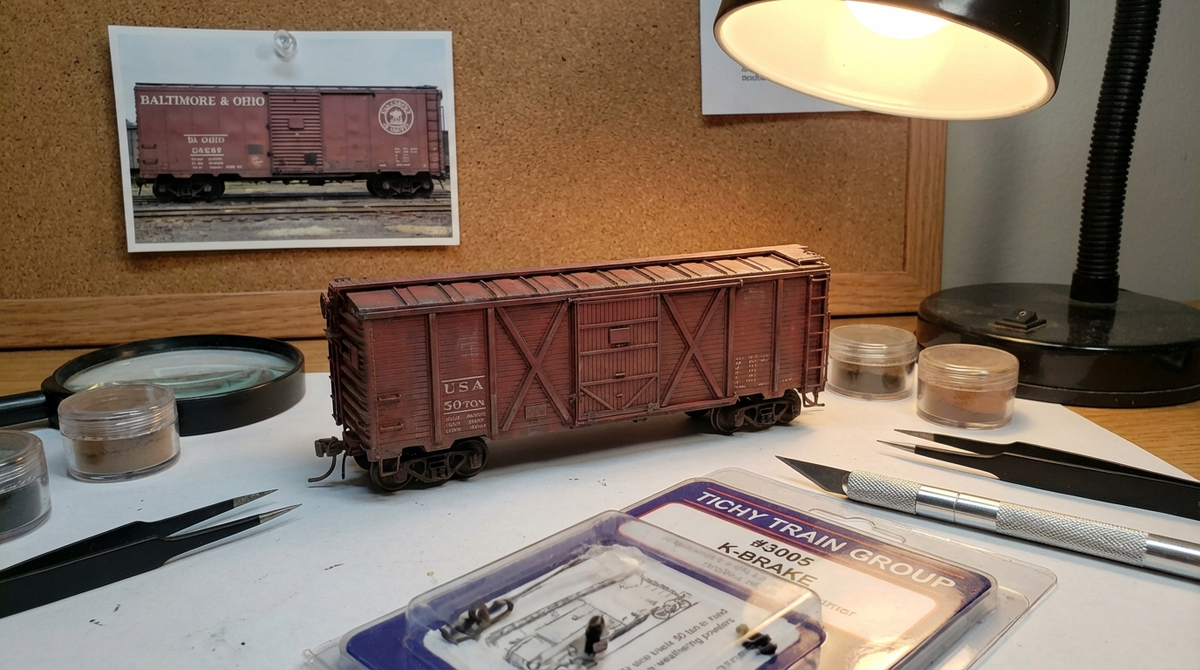
I bought my first Broadway Limited locomotive in 1989 and immediately realized I had a problem: I had no idea what an actual Pennsylvania Railroad freight train looked like. That single question sent me down a research path that, frankly, I never came back from. Now I spend my days as an archivist at the Railroad Museum of Pennsylvania, surrounded by the very documents and photographs that answer questions like mine.
If you're reading this, you probably have similar questions. What freight car types should populate your HO scale layout? Which models represent real prototypes? And how do you avoid the embarrassing mistakes that scream "I didn't do my homework" to anyone who knows better?
Let me walk you through everything I've learned about HO scale freight car types, from the basics to the details that separate a good layout from a great one.
The 1920s weren't just another decade in railroading. They represent the transition from wooden cars with truss rods to steel construction that would define American freight service for generations. And at the center of this story sits the United States Railroad Administration, which nationalized the railroads during World War I.
To solve crippling equipment shortages, the USRA developed standardized freight car designs built by the tens of thousands. Three designs became so common that, if you're modeling the 1920s, you could fill your entire yard with them and be prototypically correct:
These weren't just wartime stopgaps. Many railroads loved the designs so much they continued building "clones" throughout the 1920s. For modelers, this history is gold. A fleet based on USRA prototypes gives you instant plausibility, representing interchange traffic from dozens of different home roads with just a few basic car types.
Canadian railroads weren't part of the USRA system, but they developed their own distinctive cars. The Canadian Pacific's 36-foot Fowler-patent single-sheathed boxcar was their standard before the 1920s. Later, CP received 7,500 all-steel "Minibox" cars between 1929 and 1930, making them the first mass-produced steel boxcars in Canada. These Minibox cars lasted in revenue service until 1983, so they're appropriate for a surprisingly wide range of eras.
Every freight car has an AAR mechanical designation stenciled on its side. Learning these codes is like learning a new language, except this one tells you exactly what a car was built to haul.
| AAR Code | Car Type | Typical Use |
|---|---|---|
| XM | Boxcar | General merchandise, protected from weather |
| RB/RBL | Refrigerator Car | Perishables (meat, produce, dairy) |
| HT/HM | Hopper | Coal, ore, aggregates |
| LO | Covered Hopper | Grain, cement, fertilizer |
| GB/GS | Gondola | Scrap, steel, bulk materials |
| FM | Flatcar | Machinery, lumber, vehicles |
| TM | Tank Car | Liquids and gases |
| SM | Stock Car | Livestock |
| MWB | Ballast Car | Track maintenance |
The suffix letters indicate special features. An "R" on a gondola means it has a roof. An "S" might indicate special modifications. Once you crack this code, you can read any freight car like a book.
HO scale runs at 1:87.1 ratio, which translates to 3.5 millimeters per prototype foot. This isn't just trivia. It's the foundation for everything from scratch-building to layout planning.
Quick conversion: Multiply prototype feet by 0.1378 to get HO inches.
Here's where this gets practical. A 40-foot boxcar measures about 5.5 inches in HO. A modest 10-car local freight with a locomotive and caboose stretches over 5 feet. Now think about your sidings. Think about your staging tracks. If you're modeling modern 89-foot autoracks at over 12 inches each, you need serious real estate.
The NMRA publishes recommended practices for clearances and curved track centers. These standards recognize that modern, longer equipment needs wider clearances than classic steam-era cars. Don't skip this step before buying that impulse autorack.
The boxcar evolved more dramatically between 1910 and 1940 than in any other period. For 1920s modelers, the key distinction is between wood-sheathed construction and the first all-steel designs.
The "rule of thumb" that double-sheathed cars came before single-sheathed is wrong. Both types coexisted, serving different purposes.
Single-sheathed (outside-braced) cars have their steel truss frame exposed on the exterior with a single layer of horizontal wood siding inside. You'll see that distinctive "X" or "Z" bracing pattern on the car sides. Double-sheathed cars sandwich the structural frame between interior and exterior wood sheathing, giving them a smooth, wood-sided appearance.
The USRA built massive quantities of both. Starting in 1918, 25,000 single-sheathed boxcars rolled out from multiple builders to address wartime traffic demands. Many of these USRA cars were still running in the 1950s.
The Pennsylvania Railroad's X29 became the standard steel boxcar of the 1920s. Between 1924 and 1934, PRR purchased or built over 30,000 of these 40-foot, 50-ton all-steel cars. They appeared in every corner of the US and Canada during the late steam and transition eras.
The X29's defining features include a low profile (8'7" interior height), Creco three-panel doors, and flat plate or corrugated Dreadnaught ends. After intense WWII service, many were rebuilt into X29b and X29d subclasses with larger doors.
For HO models, the 1923 ARA recommended practice (basically the X29 design) set the pattern for steel boxcar production. Atlas offers excellent tooling with various roof styles, ends, and doors.
The Rapido USRA Double-Sheathed Wood Boxcar represents state-of-the-art ready-to-run modeling. For single-sheathed cars, Accurail's 4100 series with wood doors and ends covers CN, AC&F, and GTW prototypes built in 1923. Accurail also produces various sheathed boxcar configurations at reasonable prices.
If you're hunting for a New York Central double-sheathed prototype, keep your eyes open. They occasionally turn up in surprising places.
If you're modeling any railroad that touched coal, hoppers should dominate your fleet. The USRA 55-ton twin hopper was a ubiquitous design, with 25,000 built and assigned to 23 railroads between 1919 and 1920.
The Baltimore & Ohio's N-17 class follows the USRA Specification 1005-B exactly. If you're modeling B&O in 1926, these twins are mandatory.
My home railroad, the Pennsy, ran the largest hopper fleet in the country. The GLa was a 50-ton car with seven stakes, no fishbelly, and over 30,000 in service by the late steam era. The H21 four-bay design became their most prominent hopper, with 70-ton capacity after conversion to H21a class in the early 1920s.
Rapido's PRR H21 model captures the four-bay design with construction cues from the smaller GLa. PRR hoppers are well-documented, and the Keystone Modeler provides extensive resources for getting the details right.
By 1926, the ARA developed a preliminary design for a 70-ton quadruple hopper with offset-side panels. Nearly 12,000 were built between 1926 and 1930, making them common on several major railroads through the 1930s, 40s, and 50s. Broadway Limited offers N scale versions, with undecorated six-packs available for custom painting.
For HO, Fox Valley Models produces USRA 55-ton two-bay hoppers in PRR lettering. The Owl Mountain Models version is considered the best-detailed and most accurate available. Bachmann offers a budget-friendly USRA 55-ton two-bay with removable coal load.
The USRA Specification 1005-B hopper design was so successful that modelers of the Railroader video game have recreated it digitally.
New modelers often confuse gondolas and hoppers. Here's the simple test: a hopper is designed to be self-clearing through bottom gates. A gondola typically has a flat floor and must be unloaded from the top or through side doors.
Look at the interior. If the ends and sides slope inward to funnel material toward center discharge gates, it's a hopper. If the floor is flat from end to end, it's a gondola, even if it has "drop-bottom" doors.
The USRA's principal gondola design, specification 1002-B, was a 50-ton composite drop-bottom model. 20,000 were built and 4,500 of the 70-ton steel drop-end version were assigned in 1919.
The PRR G22 was a 46-foot, 70-ton gondola with fixed ends and bottom doors. The PRR transition-era gondola fleet included thousands of these cars in various rebuilds.
Lehigh Valley gondolas are documented for those modeling anthracite roads. Boston & Maine freight car records show their 21400-series gondolas and USRA composite gondolas in the 90000 series.
For models, the USRA 46-foot drop-end steel gondola is available digitally. Reading composite mill gondolas had wood floors, drop ends, and 50-ton capacity. Many gondolas from the 1920s remained in service into the 1950s.
The NYC freight car roster includes multiple gondola classes. Their USRA hoppers are well-documented, with 3,000 55-ton cars allocated from USRA production.
B&M's G-4 class consisted of 1,500 USRA 1002-B composite drop-bottom gondolas built by Pressed Steel in 1919.
The flatcar is the oldest freight car type: a simple deck for oversized loads. Its modern descendants include bulkhead flats (with reinforced end walls), centerbeam flatcars (adding a tall longitudinal spine), and spine cars for intermodal service.
Bulkhead flats became common in the 1950s and standard for lumber by the 1980s. Centerbeams developed in the 1960s, providing structural stiffness for heavier loads. Modern centerbeams must be loaded symmetrically to avoid tipping. CSX's equipment guide shows 70-foot centerbeams as standard for bundled lumber and wallboard.
Spine cars are minimalist articulated designs for truck trailers or containers, always in 3- or 5-unit sets.
For 1920s modeling, general service flatcars are your focus. Tichy's 40-foot fishbelly centersill flatcar is based on a 1926 NC&StL prototype similar to cars on many other railroads.
In the 1920s, most tank cars were riveted, unpressurized vessels of 8,000 to 10,000 gallons on arch bar trucks. The AC&F Type 21, introduced in 1921, became a workhorse for petroleum products.
Insulated tank cars hauled thick liquids like asphalt or molasses. Steam coils inside the tank kept the contents fluid for unloading. Heated tank car patents document these specialized designs.
Modern DOT-117 tank cars feature thick shells, head shields, and thermal protection, replacing the older DOT-111 standard for flammable liquids.
Stock cars are defined by their slatted sides for ventilation. The Twenty-Eight Hour Law required that animals be unloaded for feed, water, and a five-hour rest every 28 hours (or 36 hours by shipper request). This necessitated stock pens at division points and heavily influenced train scheduling.
For HO, Steve Sandifer's stock car models guide covers the options. Central Valley's 40-foot NP stock car kit is based on a 1930s prototype, but it requires narrowing for dimensional accuracy.
Beginning in the 1870s, railroads developed wooden refrigerator cars to transport perishable products. With insulated sides, the cars were cooled using ice blocks loaded through four rooftop hatches at each end.
The Tiffany design mounted the ice tank in a clerestory atop the roof, relying on train motion to circulate cool air. Most reefers had two ice hatches at each end opening into a single bunker.
Most reefer owners placed hinges toward the car center, allowing an open hatch cover to lie flat on the roof. Only Santa Fe had cars with hinges at the outside edge.
The typical ice-bunker reefer from the 1920s was originally constructed with wood sheathing. Walthers' early wood reefers are based on cars built in the 1920s and 1930s.
Ice reefers typically had four rooftop hatches at each end, where ice was loaded at specially built icing platforms. The Western Pacific Railroad Museum features one of the most complete collections of refrigerator cars in the country.
For PFE modeling, Fox Valley Models offers PC&F R-40-2 wood reefers in multiple road names including PFE/Western Pacific. The outside-metal roof surface should be black and wood roof parts boxcar red for a car built in 1928. PFE reefer rebuild programs affected R-30 and R-40 series cars.
Atlas O offers traditional 40-foot steel body ice reefers for O scale modelers.
Here's where many modelers get tripped up. The vast majority of plastic models come with post-1933 AB brake systems, which are incorrect for 1920s layouts.
The visual difference is stark. The K-type brake system combines the brake cylinder, reservoir, and valve into a single unit. The AB system features a distinctive two-part reservoir. K-type brakes were banned from interchange service in 1953.
The AB brake system became mandatory for new cars in 1933.
Tichy Train Group makes KC brake sets (#3005) and K-brake components for backdating models. Their #3013 AB brake set is perfect for post-1933 cars. Cal-Scale also produces brake components.
Tahoe Model Works offers era-correct trucks for prototype modelers. Andrews trucks were common on USRA-era cars. Truck identification guides help sort out the evolution of freight car trucks from arch bars to Andrews to Bettendorf.
Arch bar trucks were banned from interchange service in 1940. LDSIG's hints and tips cover these dating details.
Federal regulations dictated the placement of safety appliances like ladders, grab irons, and running boards. The ICC order of March 13, 1911 set the standard for the steam era, with proposed rules and miscellaneous revisions over the years.
Cars built before October 1, 1966 could retain older appliance locations until shopped for major repairs. Hopper cars and high-side gondolas had their own requirements.
Tony Thompson's Modeling the SP blog covers these details extensively.
Getting the paint scheme right matters. Most 1920s freight cars wore shades of "boxcar red" or "mineral brown" derived from iron oxide pigments. The exact shade varied by railroad and even by paint batch. Roofs and underframes were typically black.
Before 1925, cars were marked with "CAPY" (capacity) and "LT WT" (light weight). On May 1, 1925, the ARA mandated adding "LD LMT" (load limit). To backdate a model, you might need to remove the "LD LMT" stencil.
Before March 1, 1929, journals were repacked "when necessary." After that date, a 12-month interval became mandatory, and the date, location, and railroad were stenciled on the car body. Repack data often appeared on a black or Tuscan red patch above the truck.
Speedwitch Media produces era-specific decals, and Model Railroad Hobbyist has covered decal techniques.
For open-top cars, the load is as important as the car itself. Prototype railroads follow strict AAR Open Top Loading Rules. The US Army's railroad loading course covers blocking and bracing techniques.
The Alaska Railroad Load Manual provides specific figures for steel pipe loads. Key elements include scaled lumber for bearing pieces (minimum 4"x6" scale), styrene chock blocks, and fine wire or thread representing high-tension steel bands.
AAR Open Top Loading Rules Section 2 specifies that coal and ore in hoppers must be loaded with a "bread loaf" profile, mounded no more than 26 inches high. Dust management studies document these loading practices.
MOW equipment offers unique modeling flexibility because many prototypes saw 50+ years of service.
The Jordan Spreader has been in service since the 1920s for ditching, ballast profiling, and snow removal. WalthersProto's HO scale Jordan Spreader is based on a 1949-built machine still running with BNSF today. The same model works for a 1920s work extra or a modern track gang.
Modern MOW operations use GPS-guided ballast trains that can unload material with precision at speeds up to 20 mph. These operate within work windows established by rules like GCOR Form B, which gives a foreman absolute authority over a track section. FTA standards development documents these procedures.
FRA 49 CFR Part 224 requires reflective striping on most modern freight cars, but MOW equipment is often exempt and carries a simple "MW" stencil instead.
Tichy Train Group's 120-ton wrecking crane kit models another long-lived prototype. Their HO scale freight car parts page lists all available kits.
The Car Builder Bibliography points to historical cyclopedias from different years. Prototype info discussions on the Trains.com forums are goldmines.
The Railway Prototype Cyclopedia Article Index covers specific car types in depth. Northern Pacific Railway Historical Association equipment pages document NP-specific prototypes.
For PRR modelers, the Pennsylvania State Archives PRR drawing collection and related documentation are invaluable. PRR Mechanical Department files and periodicals database provide primary source access.
Additional resources include B&M 70000-series boxcar drawings, B&M 8000-series hopper records, and Washington, Idaho & Montana Railway records.
Historical images are available through Wikimedia Commons hopper car photographs, preserved equipment images, and NARA flatcar load photographs.
The National Museum of Transportation collection includes composite construction cars with steel underframes and wood plank walls from the early 1900s.
I've been building this layout since 2014. It's still not done. But every car that rolls across it tells a story because I took the time to understand what the prototype actually looked like.
Start with the common car types: USRA boxcars and hoppers form your foundation. Add era-correct trucks and brakes. Check your safety appliances against the timeline. Match your lettering to your chosen year.
The details matter because they're what separate a collection of models from a miniature railroad. When you get it right, you're not just playing with trains. You're preserving a piece of railroad history in 3.5 millimeters per foot.
? Complete Your Layout: Explore our wide selection of Photo Real buildings, diorama backdrops, detail parts, and accessories in every popular scale.
✨ Unmatched Realism: From chrome detailing products to neon lighting kits – every piece is designed to make your miniature world come alive.
.jpg)

