
The Complete HO Scale Decoder Installation Guide From a Railroad Veteran
Posted by Gerald Hoffmann on 30th Dec 2025
Order by phone: 763-231-7847
Free Shipping On Orders Over $100!
If you are already registered, please log in.
Create your account and enjoy a new shopping experience.
Create A New AccountPosted by Gerald Hoffmann on 30th Dec 2025
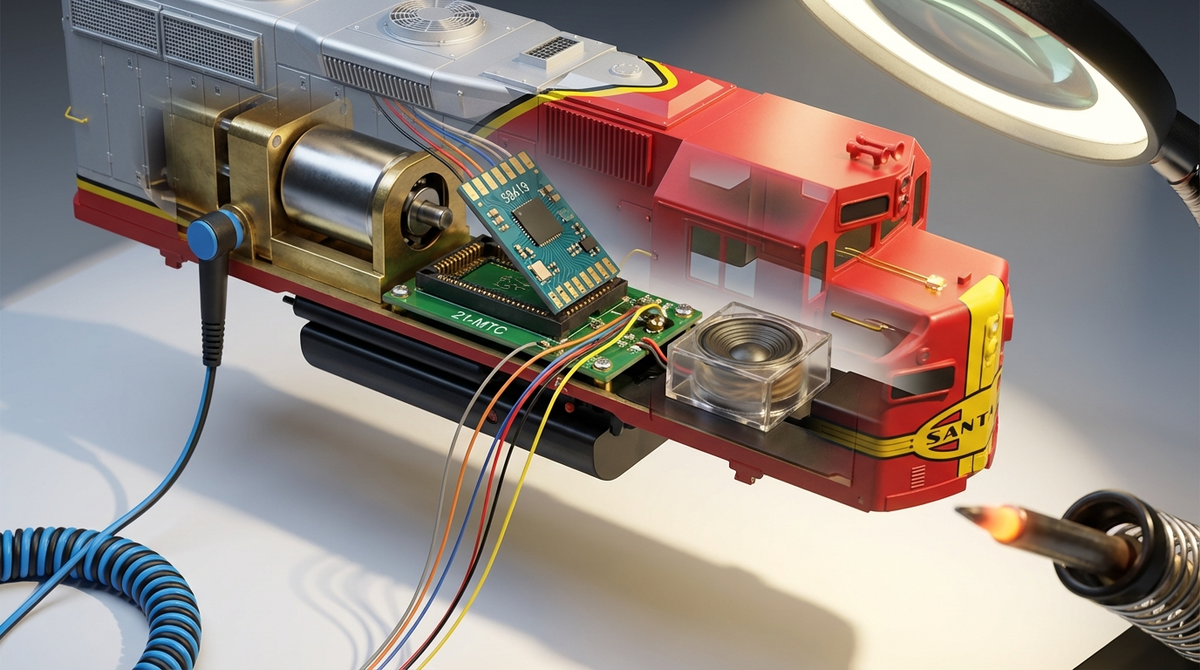
I spent 35 years working for Burlington Northern Santa Fe before hanging up my lantern in 2019. In all that time running real trains, I never imagined I'd end up spending just as much energy wiring up the miniature versions in my Duluth basement. But here I am, and honestly? Installing DCC decoders has become one of my favorite parts of this hobby.
When I first started converting my Great Northern and Northern Pacific fleet to DCC back in the early 2000s, I fried more decoders than I care to admit. Back then, we were hardwiring everything, crossing our fingers, and hoping for the best. These days, the technology has caught up with our ambitions. Modern locomotives ship with standardized sockets that make plug-and-play upgrades a reality. But whether you're dropping a decoder into a brand-new Kato or breathing life into a dusty Athearn Blue Box, the fundamentals haven't changed: preparation beats prayer every single time.
This guide is everything I wish someone had handed me twenty years ago. We're going to cover it all, from picking the right decoder for your motor to troubleshooting those maddening "Cannot Read CV" errors that'll have you questioning your life choices.
Before you buy a decoder, you need to know what socket your locomotive has. The industry has moved beyond the old solder-everything approach, and today's "DCC-Ready" models typically feature one of several standardized interfaces. Getting this right saves you hours of frustration.
The 8-pin NEM 652 socket dominated HO scale for decades. It's robust and reversible without damage (though your loco will run backward if you flip it). The downside? It only supports three functions: forward light, rear light, and one auxiliary output. For basic DC-to-DCC conversions, it still gets the job done.
The 21-MTC interface offers a direct board-to-board connection with up to 12 function outputs. It's become standard on many European and American models alike. But here's a gotcha that catches a lot of folks: on many decoders like the ESU LokSound series, AUX3 and AUX4 are logic-level outputs only. They can't drive an LED directly. You need an amplifier circuit on the locomotive's motherboard, or you'll be scratching your head wondering why your ditch lights won't work.
The PluX22 connector brings serious capability to HO scale: nine or more powered function outputs, speaker connections, and dedicated pins for keep-alive capacitors. The NEM 658 standard makes it a forward-thinking choice for anyone who wants room to grow.
The Next18 interface is the new kid on the block, designed for N scale and small HO locomotives. It packs sound support into an 18-pin footprint, but there's a catch similar to 21-MTC: AUX3 through AUX6 are logic-level only. If you're planning elaborate lighting schemes, you'll need to verify your locomotive's motherboard can handle the amplification.
Here's where I've seen more newcomers destroy expensive decoders than anywhere else. Your decoder's continuous current rating must exceed your motor's stall current. Period. No exceptions. No hoping it'll be fine.
Stall current is the maximum amperage your motor draws when it's physically stopped but still receiving full power. Most modern HO can motors stall at well under 1.5 amps. But older brass locomotives with Pittman or open-frame motors? Some of those beasts can exceed 3.5 amps. Wire a 1-amp decoder to one of those monsters, and you'll smell that distinctive "magic smoke" within seconds.
You'll need a DC power pack, a multimeter set to measure DC amps (use the 10A setting), and an isolated test track. Tony's Train Exchange has an excellent walkthrough on this process. The basic steps:
James' Train Parts explains the physics behind why this matters. When a motor stalls, current draw peaks, sometimes exceeding 1 amp. That spike is what kills decoders. And for the love of all things holy, never perform a stall test with a decoder already installed. You'll destroy it instantly.
With your stall current measured, picking a decoder becomes straightforward. The ESU LokPilot 5 delivers 1.5A continuous and covers most HO applications. For locomotives with stall currents between 1A and 2A, the SoundTraxx TSU-2200 gives you a 2A safety margin. The ESU LokSound 5 provides both premium sound and 1.5A motor control for most HO sound installations.
For smaller locomotives with efficient modern motors, the SoundTraxx TSU-1100 at 1A continuous works beautifully. The TCS WOWSound decoders offer 1A continuous with 2A peak and excellent BEMF motor control. Digitrax's DH166 series handles 1.5A continuous and works great for Athearn Blue Box conversions.
Zimo's MS440C delivers 1.2A continuous with 2.5A peak for demanding applications. And for general-purpose plug-in installations, NCE's D13J provides reliable 1.3A continuous operation.
A clean, organized workspace isn't just about convenience. It's about protecting sensitive electronics from your own carelessness. Trust me, I learned this the hard way.
Throw away that old soldering gun from your garage. Digitrax's installation guide makes clear that temperature-controlled stations are mandatory for decoder work. For leaded solder (60/40 or 63/37), set your tip to around 700°F. Lead-free solder needs higher temps, often 750°F. The Adafruit soldering guide provides excellent technique fundamentals.
Use a small diameter rosin-core solder, around 0.031" or 0.8mm. Wiring for DCC recommends applying flux to the joint, not the iron, and cleaning burnt flux residue with isopropyl alcohol afterward. Pre-tin both the wire and solder pad, heat the joint for 2-3 seconds, apply solder, and let it cool undisturbed.
Most decoder wires are 28-30 AWG stranded. For high-current connections like track pickups, Tony's installation guide recommends slightly heavier 24 AWG wire. Silicone or PTFE insulated wire resists melting from your soldering iron better than standard PVC.
Heat-shrink tubing in 1/16" or 3/64" diameter is the professional standard for insulating solder joints. Kapton tape works best for insulating decoder boards from locomotive frames since it's extremely thin with high temperature tolerance. Here's a rule I wish I'd followed earlier: never wrap a decoder completely in electrical tape. It traps heat and leads to thermal failure.
DCC decoders contain microelectronics that die from static discharges you can't even feel. NASA's workmanship standards aren't overkill here; they're good practice. The ESD Association's guidelines explain why grounding is everything.
At minimum, use a commercial ESD wrist strap connected to a common ground point. Work on an ESD-safe mat connected to the same ground. Handle decoders by their edges and keep them in anti-static bags until installation time.
The NMRA's RP-9.1.1 standard defines the universal color code that makes decoder installations consistent across manufacturers. Memorize it. Live it. Tattoo it on your arm if you have to.
Here's the breakdown that TCS's lighting documentation and the NCE support pages both reference:
The DCCconcepts wiring guide hammers home the critical point: the Blue wire is always the positive common for lighting. All function wires complete circuits to ground when activated. Never mix the blue common with a track pickup wire for lighting, or you'll damage your decoder faster than you can say "warranty claim."
The JST-9 interface provides a standardized 9-pin harness common in North American models. The PluX pinout and 21-MTC standard follow MOROP's European specifications harmonized with NMRA standards. The OpenDCC interface reference provides detailed diagrams if you need to verify specific pin functions.
This 10-step process works for most "DCC-Ready" HO diesels with 8-pin sockets. I've done hundreds of these installations, and this workflow prevents 90% of the disasters I see newcomers encounter.
Run the locomotive on a DC test track. Verify it moves smoothly in both directions with working lights. Measure motor stall current to confirm your decoder choice. Then test the new decoder itself on a decoder tester to catch out-of-the-box defects before you're buried elbow-deep in the installation.
Remove the shell, watching for delicate handrails and grab irons. Take photos at each stage to document wire routing and component placement. Your future self will thank you.
DCC-Ready locomotives have a "dummy plug" routing track power directly to the motor for DC operation. Unplug and remove this jumper before installing your decoder.
This is the "no-smoke" check. Set your multimeter to continuity mode. Place one probe on a motor terminal, the other on the locomotive frame. You should get no continuity, showing as "OL" or infinite resistance. Repeat for the other motor terminal. If you find continuity, stop. Locate and fix the short before proceeding.
Identify where the decoder will sit without interfering with the shell, weights, or moving parts. Ensure air can circulate to dissipate heat. Plan wire routing away from the drivetrain.
Align Pin 1 of the decoder's 8-pin plug (marked with a dot or triangle, corresponding to the orange wire) with Pin 1 on the locomotive's socket. Press firmly but gently.
Secure the decoder using quality double-sided foam tape. Remember: no electrical tape wrapping.
This step is non-negotiable. Place the locomotive on an isolated, current-limited programming track. Attempt to read CV 8 (Manufacturer ID) or CV 1 (Address). A successful read confirms your core wiring is correct and short-free. The default address for new decoders is 03.
Move to test rollers or the mainline. Test forward and reverse movement, headlight operation, and listen for smooth motor performance.
Reinstall the shell, ensuring no wires get pinched. Add a small label to the underframe noting the decoder's address.
The Athearn Blue Box diesel is a rite of passage for model railroaders. Its design uses the metal frame to conduct electricity, making motor isolation the primary challenge. These models are considered "Anti-DCC" in factory state.
Remove the shell and discard the long metal clip running from the trucks to the motor top. The DCC Geek clinic notes explain that the bottom motor brush clip has two small prongs contacting the frame. Clip these off and file them flat. A popular alternative swaps the top (smooth) and bottom (pronged) motor clips, placing the smooth clip on the bottom.
Apply Kapton tape to the frame where the motor sits, especially in the fuel tank well. Solder the decoder's Orange and Gray wires directly to the motor brush clips. Solder Red and Black track wires directly to the truck side frames, bypassing the unreliable frame-contact method.
Replace original 1.5V incandescent bulbs with 3mm warm white LEDs. Each LED needs a 1k Ohm resistor. Secure LEDs in headlight housings with hot melt glue. The TCS installation pictures show excellent examples of completed conversions.
Bachmann Spectrum steam locomotives are popular but notorious for two issues: suppression components that interfere with DCC signals, and poor electrical pickup.
The factory circuit board contains capacitors designed for DC operation. These interfere with DCC decoder signals, causing poor slow-speed control and buzzing. The yellow capacitors (often labeled C1, C2) must be removed. Clipping one leg of each capacitor is the safest method.
The inductors (green, resistor-like components) can typically stay in place, but for best performance, remove them and replace with jumper wires. A forum discussion on ZTC decoders confirms this improves DCC performance.
Adding weight to the tender improves tracking and wheel contact. Enhance pickups by bending existing wipers for better contact or adding all-wheel pickup using Kadee springs on opposite truck sides. Given persistent pickup challenges, a TCS KA-series keep-alive is highly recommended.
Upgrading a vintage brass steam locomotive transforms a display piece into a smooth operator. The process centers on replacing inefficient original motors.
Original open-frame motors draw high stall currents, often exceeding 2A, and run poorly at slow speeds. Re-motoring with a high-quality can motor from NWSL, Sagami, or Mashima addresses all these issues. The Guide to Repowering and Regearing covers motor selection in depth.
Rebuilding brass steam locomotives requires fabricating new motor mounts, often from brass stock, ensuring complete motor isolation from the frame. A flywheel improves smooth operation. Connect the new motor using universal joints and a torque arm. NWSL thrust washers minimize end-play and reduce "coffee-grinder" noise.
Retrofit all-wheel electrical pickup by adding phosphor-bronze wire wipers to insulated driver and tender wheels. Route wires from engine to tender decoder using micro-connectors hidden in the drawbar area.
Modern sound decoders from ESU and TCS deliver 2-3 watts of audio power. But that power means nothing without proper speaker selection and enclosure design.
Impedance matters most. SoundTraxx Tsunami2 decoders require 8 ohms or greater. Using 4 ohms will overload the amplifier. ESU offers more flexibility, supporting 4 to 32 ohms. The TCS 28mm high bass speaker handles impedances as low as 4 ohms.
Match speaker power rating to amplifier output. Using a 0.5W speaker with a 3W amplifier risks destroying it at high volume. Limit master volume to 50-60% with lower-rated speakers. The TCS 17x12mm micro speaker works well in tight spaces.
A speaker without an airtight enclosure sounds tinny and quiet. The SoundTraxx installation guide explains that enclosures isolate sound waves from front and back of the speaker cone, preventing cancellation. Use styrene cement, Walther's Goo, or RTV silicone to seal all seams.
SBS4DCC's speaker installation tips recommend 1mm styrene for stiff enclosure walls that won't vibrate. ESU's adaptable enclosures allow stacking frames to increase baffle height from 6mm to 13mm for better bass response.
Two speakers can increase volume and improve frequency response. Wire them with correct polarity to prevent phase cancellation. Two 8-ohm speakers in parallel give a 4-ohm load (louder, for ESU/TCS). Wired in series gives 16 ohms (safer, for SoundTraxx).
Keep-alive devices store power to bridge dirty track and unpowered frogs, eliminating stalls, sound resets, and light flicker. They've become standard equipment in my fleet.
TCS KA-series modules provide 2-5 seconds of hold-up with simple 2-wire installation. No CVs needed for TCS decoders manufactured after 2012.
The SoundTraxx CurrentKeeper II offers up to 10 seconds of backup with a 2-pin plug for most Tsunami2 decoders. No additional programming required.
ESU PowerPacks use a 3-wire active charging circuit that prevents booster overload. The decoder controls charging to manage inrush current. CV113 sets buffer time.
Zimo's STACO controllers work with their decoder's built-in charging circuits. Older models need external resistor/diode components.
Correct polarity is critical. Reversing positive and negative connections destroys the capacitor, often with a loud bang. For decoders without dedicated KA pads, connect to the decoder's common positive (Blue wire) and ground.
When a locomotive with a large keep-alive first touches the track, the empty capacitor draws massive inrush current that can trip booster protection. A 100-ohm resistor in DIY charging circuits limits this surge.
One operational concern: a locomotive with keep-alive can run several seconds after derailing, unable to receive stop commands. Disable analog mode operation in CV29 to mitigate this risk.
Incandescent bulbs are inefficient, generate heat, and have high inrush currents that can damage decoder outputs. LEDs are the superior choice.
LEDs need current-limiting resistors or they die instantly. Railwayscenics offers a handy calculator. The formula: Resistor = (Supply Voltage - LED Forward Voltage) / Desired Current.
Decoder function output voltage typically equals track voltage minus about 1.5V. Use 13V as a safe average for HO scale. White/blue LEDs have roughly 3.0V forward voltage; red/yellow/green LEDs around 2.0V. 5-10mA provides sufficient brightness and extends LED life.
Example for a white LED: R = (13V - 3.0V) / 0.01A = 1000 ohms. A standard 1kΩ, 1/4-watt resistor handles most single HO LED applications.
LEDs are polarized. The anode (+) connects to the decoder's Blue wire. The cathode (-) connects to the resistor, which then connects to the function wire (White, Yellow, etc.).
Modern decoders replicate real-world lighting through CV programming. For FRA-compliant ditch lights that flash alternately at 40-180 flashes per minute, Digitrax FX3 programming uses CV51=106 and CV52=107. ESU LokSound 5 offers "Ditch Light Type 1" and "Type 2" effects through function mapping.
Rule 17 dimming, where headlights dim when stopped in sidings, uses Digitrax FX3 CV49=8. ESU's "Rule 17 Forward" effect automatically dims to 60% brightness when stopped. SoundTraxx Tsunami2 decoders offer similar Mars and Gyralite effects.
Effective locomotive performance depends on correct decoder programming. Using JMRI's DecoderPro with a dedicated programming track is industry best practice.
Service Mode programming uses an isolated, current-limited track defined by NMRA S-9.2.3. It allows two-way communication so you can read CV values. A programming track booster like the SoundTraxx PTB-100 or DCC Specialties PowerPax is often required for sound decoders. NCE Power Cab users generally don't need boosters.
Operations Mode (POM) lets you change CVs on the mainline with instant feedback, but you can't read CVs back without RailCom.
The goal is making all locomotives in a consist run at the same scale speed for a given throttle setting. Model Train Operations' speed-matching guide outlines the process.
Select one locomotive as your benchmark. Set CV3 and CV4 to 0 on all locomotives to remove acceleration lag. Use a 28-step speed table (CV67-94) for precise matching. Run the benchmark at each speed step, record its scale speed, then adjust other locomotives' CVs until they match.
Use JMRI's Consist Manager to create Advanced Consists, writing a common address to CV19 in each decoder.
Digitrax decoders disable BEMF by default in consists, controlled by CV57. When paired with ESU or SoundTraxx decoders where BEMF is active, this causes surging. Set Digitrax CV57 to 85 to enable BEMF in consists. For SoundTraxx units, reduce BEMF intensity (CV212) on trailing locomotives to prevent fighting.
ESU LokSound decoders offer an Auto-Tune feature (CV54=0, press F1) for automatic motor calibration. TCS Audio Assist provides guided, menu-based programming without memorizing CVs. Zimo decoders require awareness that sound projects overwrite default CVs.
A structured diagnostic process saves hours of frustration. Always start on the programming track.
This is the most common failure. TCS documentation explains that decoders confirm programming commands by briefly pulsing the motor, creating a 60mA current spike. NMRA standards specify this acknowledgment pulse. Without a motor load, most command stations can't read CVs.
Sound decoders and those with keep-alives draw more current than standard programming track limits can supply, preventing successful reads. Add a programming track booster to resolve this.
Use your multimeter in continuity mode. Test between each motor terminal and the locomotive frame. Any continuity indicates the motor isn't properly isolated. Disassemble and insulate using Kapton tape. Understanding why isolation matters helps prevent future errors.
If your locomotive moves but in the wrong direction, the motor is wired in reverse. Either swap the Orange and Gray wires at the motor terminals, or change Bit 0 in CV29 through programming.
A brief short circuit can cause some DCC systems to output current-limited DC power. The decoder sees this, switches to analog mode, and runs full speed. Program CV29 to disable analog mode conversion.
Decoder warranties, while often generous, contain specific clauses you must respect.
TCS's Goof-Proof warranty covers operator error but doesn't officially condone soldering directly to decoder boards. SoundTraxx's 90-day Safety-Net is voided by removing shrink tubing, drilling the circuit board, or unauthorized repairs.
ESU's 2-year warranty is voided by removing heat shrink, soldering directly on the circuit board, or damage from incorrect connections. Digitrax's No Worries warranty doesn't cover damage from exceeding specified track voltage.
MRC's warranty explicitly warns against removing components from the decoder board. DCCconcepts offers 50% cost replacement for accidental damage but voids full warranty for visible physical damage or board modifications.
Do not modify the decoder board. Don't remove shrink wrap. Don't solder directly to the PCB unless specific pads are provided. Pre-test every decoder before installation to catch manufacturing defects while warranty eligibility remains intact.
The hobby keeps evolving. NMRA Standards continue expanding, and MOROP's NEM standards influence global development. Next18 will likely dominate N scale and small HO by 2028. PluX22 is becoming standard for mainstream HO diesels and steam tenders.
On-board keep-alives are becoming standard features rather than add-ons. 32-bit processors in Tsunami2 decoders enable more complex sound processing. CD-quality 16-bit, 44.1kHz audio is the new benchmark.
The shift to socketed decoders means the core installer skill is evolving from soldering to diagnostics, programming, and speaker/keep-alive integration. Hardwiring will become specialized repair work for legacy models. When performing hardwire installations, consider adding standardized sockets instead of wiring directly to decoders. Future-proof your fleet by making the next upgrade a simple plug-in job.
After thirty-five years on real railroads and almost as long modeling them, I've learned that preparation and patience trump raw skill every time. Take your time, follow the fundamentals, and you'll be running smooth, sound-equipped locomotives before you know it. Happy modeling.
✨ Complete Your Layout: Explore our wide selection of Photo Real buildings, diorama backdrops, detail parts, and accessories in every popular scale.
✨ Unmatched Realism: From chrome detailing products to neon lighting kits – every piece is designed to make your miniature world come alive.