
HO Scale Building Kits for Beginners: Your First Structures Without the Frustration
Posted by William Jeffries on 30th Dec 2025
Order by phone: 763-231-7847
Free Shipping On Orders Over $100!
If you are already registered, please log in.
Create your account and enjoy a new shopping experience.
Create A New AccountPosted by William Jeffries on 30th Dec 2025
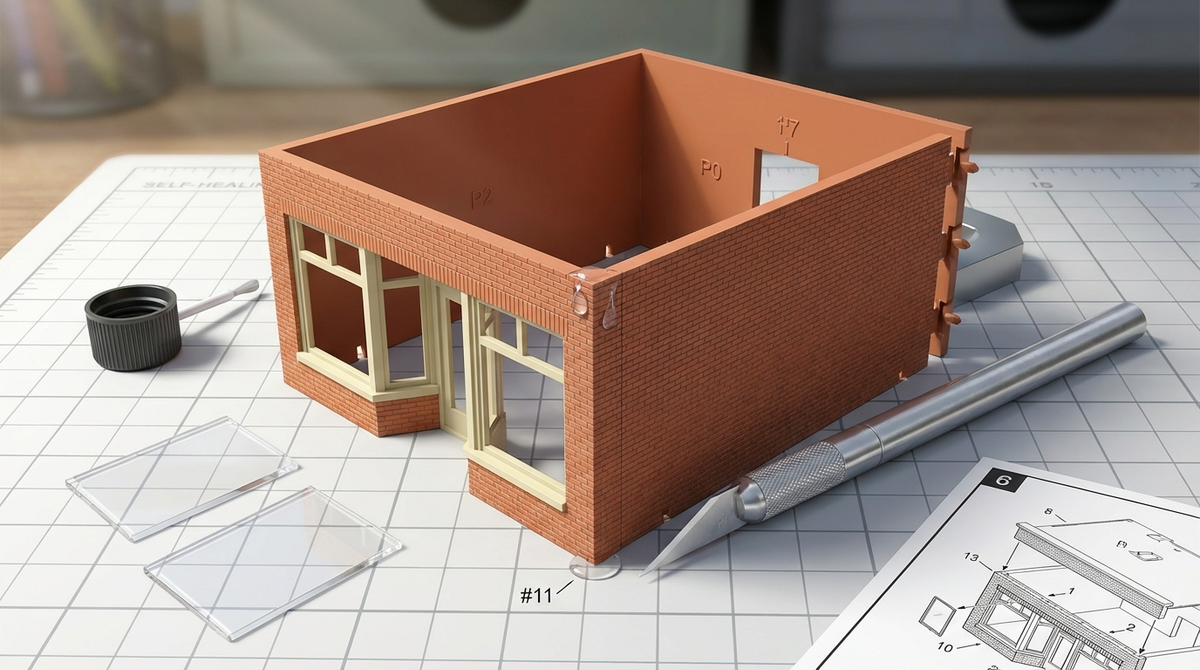
I built my first HO scale structure in 1991. It was a Walthers depot, and I managed to glue the roof on crooked, fog every window with superglue fumes, and create a building that looked like it had survived a minor earthquake. The thing sat on my shelf for three months before I finally stripped it and started over.
Thirty-four years later, I can tell you exactly what went wrong and how to avoid every one of those mistakes. That depot taught me more about structure building than any article I'd read up to that point. The lessons stuck because they cost me time, money, and a fair amount of pride.
If you're staring at a wall of building kits at your local hobby shop or scrolling through endless online listings, you're probably wondering which one won't end up as an expensive learning experience. I've built hundreds of structures since that first disaster, from simple snap-fit buildings to full craftsman kits, and I'm going to walk you through everything you need to know to get started right.
Before you buy anything, you need to understand what you're working with. HO scale uses a ratio of 1:87, meaning every model is 1/87th the size of the real thing. The name comes from being approximately "Half O" scale, which was the dominant size before HO took over in the late 1950s.
In practical terms, 3.5 millimeters on your model represents one real foot. A six-foot-tall person becomes a figure just three-quarters of an inch tall. A standard seven-foot door stands at about 0.875 inches. This matters when you're choosing structures because it affects how much detail you can see and how much space buildings consume on your layout.
All HO trains run on track with a gauge of 16.5 millimeters between the rails, representing the prototype standard gauge of 4 feet 8.5 inches. This consistency means any HO locomotive will run on any HO track, and any HO structure will work with any HO rolling stock. You don't have to worry about compatibility issues the way you might with some other scales.
HO has become the most popular scale worldwide because it hits a sweet spot. The models are large enough to show impressive detail but small enough to fit a meaningful layout in a spare room or basement. You get the best selection of locomotives, rolling stock, and structures in HO, which means more options for every prototype and era you might want to model.
The term "beginner-friendly" gets thrown around a lot, but it actually means something specific. When I'm evaluating a kit for a newcomer, I look at five factors: assembly method, materials, part count, instruction quality, and whether it requires painting.
The biggest divide is between snap-fit and glue-together kits. Snap-fit kits require no adhesive at all. You literally push the parts together, and they stay. These are sometimes called "shake-the-box" kits because you can practically assemble them by accident.
Glue-together kits require adhesive, which introduces more variables but teaches real modeling skills. For plastic, you'll use solvent-based plastic cement that chemically welds the parts. For wood, you'll typically use PVA wood glue or CA (superglue). The key advantage of glue-together kits is they produce stronger, more permanent assemblies.
Beginners have three main material options:
Some manufacturers provide explicit ratings. Walthers Cornerstone marks many kits as "Novice" skill level, indicating they're suitable for first-time builders. Bachmann's Plasticville line uses numerical skill ratings, with Level 1 being the simplest. When these ratings exist, trust them.
Clear, illustrated instructions make a bigger difference than most beginners realize. The best kits provide step-by-step diagrams showing exactly how parts fit together. Some manufacturers have better track records than others in this department. Before buying, check if instructions are available online so you can preview the assembly process.
After three decades of building structures and watching others learn, I've developed strong opinions about where beginners should start. Here's my breakdown by material type.
For your absolute first kit, plastic is hard to beat. Walthers Trainline Iron Ridge Station remains one of my top recommendations. Parts come pre-colored, clear window glazing is included, and injection-molded components snap together easily. You can have a finished building in two to three hours.
The Walthers Cornerstone line offers hundreds of options once you're ready for glue-together construction. Their depot, freight house, and commercial building kits share a consistent style that works well together. I've used them extensively on my PRR layout, and they respond well to weathering.
For urban scenes, DPM (Design Preservation Models) kits offer excellent brick commercial buildings at reasonable prices. Their modular wall sections let you combine kits to create custom buildings. The catch is that DPM walls often require sanding on the edges to ensure square assembly, but that's a good skill to develop.
Once you've completed a few plastic kits, laser-cut wood opens up new possibilities. Tab-and-slot construction in modern kits makes assembly far easier than traditional craftsman kits. The parts lock together at precise 90-degree angles, which solves the biggest problem beginners face.
FOS Scale Models offers an excellent beginner line with low part counts and clear instructions. Their Crossing Shed set ($10) gives you two small structures to practice on before committing to larger projects. Blair Line kits feature peel-and-stick trim pieces that simplify the most tedious part of wood kit construction.
Bar Mills has pioneered the "Over-Nighter" series specifically for beginners. These kits feature pre-printed, pre-weathered MDF walls that eliminate the most time-consuming painting steps. You're adding trim and details to an already-finished surface, which dramatically reduces both time and frustration.
If you want brick structures that look genuinely realistic, Monster Modelworks laser-engraved panels deliver texture that plastic simply cannot match. The 3D-etched mortar lines create shadows and depth that photograph beautifully.
These kits cost more than comparable plastic options, often double the price. They also require careful painting to bring out the detail. But the visual payoff can be stunning, and many manufacturers now offer starter kits designed to teach their specific techniques.
Not all manufacturers think about beginner needs equally. These five have earned my recommendations through consistent quality and thoughtful design.
Walthers dominates HO structures for good reason. Their Trainline series provides true entry-level kits with pre-colored parts and snap-fit assembly. The Cornerstone line steps up to glue-together construction with thousands of prototypes covering every era and region.
The company designs their buildings as an ecosystem. Depots pair with freight houses, industries connect to warehouses, and commercial blocks combine into city scenes. This makes layout planning easier because you know the buildings will work together visually.
Part fit can be inconsistent. Some modelers report issues with walls not meeting perfectly, likely due to Walthers acquiring tooling from various companies over the years. A small hobby square and some sanding sticks solve most problems.
FOS maintains a dedicated beginner line with over twenty simple laser-cut wood kits. Part counts stay low, footprints stay small, and many kits include color signage that adds immediate visual interest.
Their materials quality consistently impresses me. The laser cutting is precise, tabs fit their slots cleanly, and the wood takes stain and paint well. When I'm teaching someone their first wood kit, FOS is usually what I hand them.
Bar Mills has long been known for complex craftsman kits, but their Over-Nighter series changed the game. These simplified kits use MDF cores with pre-printed textures, reducing a multi-week project to a weekend affair.
The stable MDF construction resists warping, which plagues many wood kits. Quick Step kits give you small, achievable projects that build confidence before tackling larger structures.
ITLA's philosophy centers on flexibility. Their kits can be assembled in multiple configurations, from full-depth structures to shallow background flats. Tab-and-slot construction with dovetail joints ensures square assembly, and their MDF walls resist the warping that affects thinner wood parts.
The company backs their products with layered components designed for mask-free painting and a part replacement guarantee. If you lose or damage something, they'll send replacements. That's rare in this hobby.
Blair Line's approach to trim deserves special mention. Their peel-and-stick system delivers all the detailed trim work for each wall face in single pieces. You position once and press down, eliminating the fiddly process of gluing dozens of individual pieces.
Their published construction tips walk beginners through painting and assembly with clear, practical advice. When they say to paint all parts before assembly and use gray primer as a base, they're sharing techniques that actually work.
One of the biggest misconceptions about structure building is that you need expensive tools. You don't. A complete starter toolkit costs less than a modern HO locomotive.
| Tool | Purpose | Cost |
|---|---|---|
| Hobby knife with #11 blades | Cutting, trimming, cleaning parts | $8 |
| Sprue cutters | Removing parts from sprues cleanly | $15-20 |
| Sanding sticks/emery boards | Smoothing edges, fitting parts | $5 |
| Small hobby square | Ensuring 90-degree corners | $10 |
| Tweezers | Handling small parts | $5 |
| Self-healing cutting mat | Protecting your work surface | $10 |
Complete model tool kits bundle these items together at lower prices than buying separately. The HOPLEX 20-piece set includes nippers, tweezers, files, and polishing bars for under $20.
Using the wrong glue is one of the fastest ways to ruin a kit. Here's what works for each material:
For plastic: Tamiya Extra Thin liquid cement is my go-to. It barely leaves a trace, and what little residue remains disappears under paint. Apply sparingly with the built-in brush and let capillary action draw it into the joint.
For wood: Yellow carpenter's glue (Titebond, Aleene's Tacky Glue) provides strong bonds and allows repositioning before it sets. For instant bonds where you can't clamp, thin CA (superglue) works well. Faller Expert Laser Cement, a specialized PVA, has become popular for its ability to wick into wood fibers.
For windows: This is where many beginners make costly mistakes. Standard CA fumes will fog clear plastic permanently. Use Micro Kristal Klear or Testors Clear Parts Cement instead. These dry clear and won't cloud your glazing.
Precision needle-tip applicator bottles ($7-10 for a pack) transform glue application. Fill them with your adhesive and apply exactly where needed without mess. Extension tips for CA bottles provide similar control for superglue.
For plastic kits, many modelers skip painting entirely on pre-colored parts. If you want to eliminate the plastic sheen, a coat of Testors Dullcote does the job without changing colors.
When painting is required, Vallejo Surface Primer provides excellent adhesion and works through airbrush or hand brush. Their acrylic paint sets cover common structure colors at reasonable prices. Craft acrylics from hobby stores work well too and cost even less.
After you've chosen a kit and gathered tools, here's the workflow that produces clean results.
Wash all sprues in warm, soapy water to remove mold release agents. These invisible coatings repel both paint and glue. Let parts air dry completely before proceeding.
Read the instructions completely. Identify all parts and understand the assembly sequence. Test-fit major wall components by taping them together temporarily. This reveals any fit issues before glue makes them permanent.
Use sprue cutters to remove parts, leaving a small nub attached. Trim the nub flush with a fresh hobby knife blade, then smooth with a sanding stick. Taking time here prevents visible seams in the finished model.
For DPM and similar brick kits, the wall edges often have a slight bevel from molding. Sand these edges flat before assembly, or your corners will have gaps.
Small detail parts like windows, doors, and trim are much easier to paint while still on the sprue or before attachment. Pre-painting ensures clean color separation without the frustration of masking around assembled parts.
This is where most beginners make their biggest mistake: out-of-square corners. The solution is simple and cheap. A magnetic gluing jig holds walls at perfect 90-degree angles while cement sets. A small machinist's square works if you can hold steady for 30 seconds.
Apply liquid plastic cement sparingly to the inside corner after positioning the walls. Capillary action draws it into the joint. Check squareness immediately because the cement sets fast.
Reinforce corners from inside with scrap styrene strips. This adds strength and blocks light that would otherwise glow through thin walls when your layout is illuminated.
Test-fit the roof before gluing. If it's warped, add styrene strip bracing underneath to flatten it. Paint the underside flat black to prevent light glow. For shingled roofs, Blair Line and similar manufacturers offer peel-and-stick roofing sheets that simplify installation.
Install window glazing after all painting and weathering. Use canopy glue or clear parts cement to avoid fogging. A small amount goes a long way. Press glazing firmly against molded muntins from inside the structure.
Wood kits require different techniques than plastic. The biggest difference is moisture management. Wood absorbs water from paint and stain, causing warping that can destroy hours of work.
Before painting or staining any wood part, seal both sides. Automotive sandable primer works well and provides a good paint base. Shellac is another option. The goal is preventing moisture from penetrating unevenly.
When you apply stain or paint, coat both sides of every part. Cheap craft paints work fine for this. Let parts dry flat, weighted between sheets of wax paper. Rushing this step is the primary cause of warped walls.
Glue stripwood bracing (1/8" square basswood works well) to the inside faces of walls before assembly. Run braces perpendicular to the wood grain and around all window and door openings. This keeps walls flat even as humidity changes over time.
Yellow wood glue provides the strongest bonds for wood-to-wood joints. Apply it with toothpicks to control placement. Tite-Bond remains the standard recommendation among experienced wood kit builders.
Use a square to verify 90-degree corners before glue sets. Unlike plastic cement, wood glue allows repositioning for several minutes. Take advantage of this to get alignment perfect.
Many modern wood kits use layered construction for facades. Separate window frames, sills, and trim pieces build up to create shadow and depth. Peel-and-stick components simplify this dramatically. For parts requiring glue, apply with a toothpick to avoid visible squeeze-out that resists stain.
Every modeler makes mistakes. Knowing how to recover matters more than avoiding errors entirely.
| Problem | Cause | Fix |
|---|---|---|
| Out-of-square corners | Gluing without a guide | Add interior corner bracing to force walls into alignment |
| Fogged windows | CA fume exposure | Polish with fine sanding pads (up to 12,000 grit), coat with Future floor polish |
| Visible glue smears (plastic) | Excess liquid cement | Let dry completely, sand smooth with progressively finer grits |
| Warped plastic walls | Heat or uneven paint application | Gentle heat from hairdryer, bend back while warm, hold until cool |
| Warped wood walls | Moisture on one side only | Wet the unpainted side, press flat under heavy books overnight |
| Silvered decals | Applied over matte surface | Apply gloss coat first, use Micro Set and Micro Sol solutions |
| Gaps at joints | Poor part fit | Fill with putty (Squadron, Tamiya) or sprue goo |
| Light leaks | Thin walls, unsealed corners | Paint interior flat black, seal with ribbon putty |
| Glue stains on wood | Squeeze-out on unsealed surface | Sand carefully, disguise as weathering |
| Paint lifts with tape | Paint not cured, aggressive tape | Wait 24 hours, use low-tack Tamiya tape |
Decal silvering deserves extra attention because it frustrates so many modelers. The problem occurs when air gets trapped between decal and surface. Always apply decals over a gloss surface. If silvering occurs anyway, prick the affected area with a pin and reapply setting solution.
Nothing breaks the illusion faster than a modern glass building next to a steam locomotive. Choosing structures appropriate for your modeled era creates believable scenes.
If you're running steam locomotives, stick with brick and wood construction. Late 1800s through mid-1900s architecture features ornate brickwork, corbelled cornices, large display windows with transoms, and cast-iron storefronts. DPM's brick commercial buildings nail this aesthetic.
This period, when steam and early diesels shared the rails, offers the most flexibility. You can mix older brick structures with simpler post-war buildings. Model Railroader's beginner guide covers era selection in more detail.
Diesel-era layouts call for pre-fabricated metal buildings, tilt-up concrete, and steel roll-up doors. The ornate brickwork of earlier eras gives way to functional simplicity. Faller's modern industrial kits and their glass-facade office buildings capture this look.
Most beginners start with modest space. The common 4x8-foot layout can feel cramped once you add buildings. Low-relief structures solve this problem elegantly.
A low-relief building has a fully detailed front but only 1-2 inches of depth. Placed against a backdrop, it creates the illusion of a full structure without consuming valuable real estate. Monster Modelworks, Walthers, and ITLA all produce dedicated background kits.
Any kit can become a background flat. Use only the front wall and about one inch of each side wall. Substitute plain styrene sheet for the back wall and roof. This doubles the utility of each kit purchase.
Hide the shallow sides with scenery. Trees, bushes, or smaller foreground structures block the viewer's line of sight to where the building meets the backdrop. Photo backdrops of continuing city streets behind your physical flats enhance depth perception dramatically.
Kitbashing means modifying or combining kits to create something unique. It's easier than scratch-building but produces custom results. Here's a simple project to try once you've completed a few standard builds.
Take any Walthers Merchant's Row kit. Instead of building it as designed, assemble the front wall and rear wall as separate, shallow structures. Cut the original side walls to about one inch depth for each. Use styrene sheet for new back walls and roofs.
You now have two distinct background buildings from one kit. The front creates a different scene than the rear. Total cost per building drops by half, and you've learned basic cutting and splicing skills.
Video instruction has transformed how beginners learn this hobby. The NMRAx YouTube channel offers expert clinics covering plastic kit assembly, adhesives, weathering, and laser-cut construction. Clark Kooning's "How to build a plastic structure kit" clinic provides the foundation every beginner needs.
For ongoing inspiration, Jason Jensen Trains demonstrates building techniques across a wide range of kits. His factory kit build video walks through the entire process in detail. Luke Towan's channel focuses on scenery and weathering but includes techniques directly applicable to structures.
Published guides provide structured learning paths. Start with basic assembly, move to weathering, then tackle kitbashing. Give yourself permission to make mistakes on early projects. The skills compound quickly with practice.
Model building is safe when you respect the materials. Solvent-based cements release fumes that irritate eyes and lungs. Work in ventilated areas with a fan or open window.
Some older adhesives contained methylene chloride, which has been largely phased out due to health concerns. Check product labels and Safety Data Sheets for any chemicals you're unsure about.
Sharp hobby knife blades cause more injuries than any other modeling tool. Always cut on a mat, cut away from your body, and replace dull blades immediately. A dull blade requires more pressure and slips more easily.
Pick one kit from this article. Walthers Trainline Iron Ridge Station if you want snap-fit simplicity. FOS Scale Models Greely's Bar if you're ready for laser-cut wood. Either will teach core skills without overwhelming you.
Order or buy a hobby knife, a small square, appropriate glue, and a cutting mat. You're looking at maybe $60 total for tools plus kit. Watch one NMRAx clinic video before starting.
That first build won't be perfect. Mine certainly wasn't. But you'll learn more in those few hours of hands-on work than in months of reading about techniques. And unlike my crooked 1991 depot, you'll have the knowledge to fix your mistakes.
My layout has been "almost finished" since 2014, but every new structure teaches me something. That's the real joy of this hobby. The learning never actually stops.
✨ Complete Your Layout: Explore our wide selection of Photo Real buildings, diorama backdrops, detail parts, and accessories in every popular scale.
✨ Unmatched Realism: From chrome detailing products to neon lighting kits – every piece is designed to make your miniature world come alive.