
Getting Started With Model Trains Checklist: A 12-Month Plan That Actually Works
Posted by Benjamin Park on 31st Dec 2025
Order by phone: 763-231-7847
Free Shipping On Orders Over $100!
If you are already registered, please log in.
Create your account and enjoy a new shopping experience.
Create A New AccountPosted by Benjamin Park on 31st Dec 2025
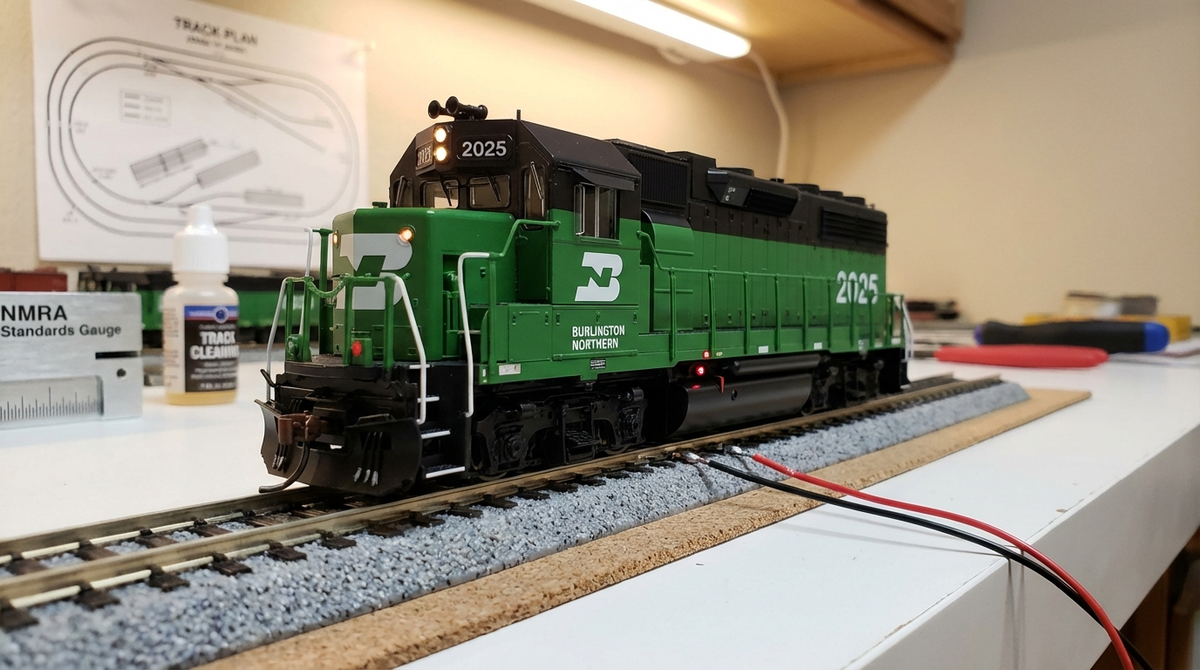
I got into model railroading because I thought running miniature trains would be relaxing. Then I discovered operations, and now I spend Friday nights yelling about train orders while my teenagers pretend not to know me. But here's the thing: those first twelve months building a layout? They don't have to be chaotic.
Most people abandon their first layout. NMRA data shows 61% of first-time projects larger than 4x8 feet stall within nine months. That's not a hobby statistic. That's a failure rate that would get you fired from most jobs. The good news? Layouts that start smaller have a 73% success rate reaching operational status.
What follows is the getting started with model trains checklist I wish someone had handed me fifteen years ago. It's organized into phases because your brain (and your wallet) can only handle so much at once.
Here's where most beginners go sideways: they buy whatever locomotive catches their eye, then buy another one that doesn't match, then end up with a collection instead of a railroad. A clear theme, prototype, and era guide every subsequent choice.
You've got three approaches here. Prototype modeling means faithfully reproducing a real railroad, location, and time period. Freelance modeling means creating your own fictional railroad. And protolancing splits the difference: you model a real railroad but take creative liberties with geography and operations.
Your era choice dictates what equipment you can run, what buildings look right, and even what color the diesels should be. A layout set in the 1950s allows for a mix of late-steam and early-diesel motive power. A modern layout means GE ES44ACs and EMD SD70ACes.
For prototype research, the Library of Congress Sanborn Fire Insurance Maps show incredible detail from the late 19th and early 20th centuries. USGS topoView offers historical topographic maps from 1884 to 2006, letting you see how rail lines changed over time.
HO scale captures approximately 70% of rolling stock sales and offers two to three times more ready-to-run products than any other scale. That's not just marketing. That's parts availability, community support, and resale value if you ever decide to sell.
HO (1:87) provides an optimal balance of size, detail, and practicality for small-to-medium rooms. The minimum practical radius for modern equipment is 22 inches in HO, which fits on a 4x8-foot table with room to spare.
N scale (1:160) shines when space is severely limited. In the same footprint that accommodates a simple HO oval, N scale lets you build a multi-level division with flowing mainlines. If you've got less than 30-40 square feet, N scale makes sense. Otherwise? Stick with HO.
G scale trains run outdoors and handle weather and kids remarkably well. O gauge offers maximum detail and is famously family-friendly, but requires serious space. S scale exists between O and HO but has limited product availability. Z scale (1:220) works for briefcase layouts where space is measured in inches, not feet.
Benchwork is the foundation of your layout, and all methods should use screws instead of nails for future adjustments. You've got three main options, each with trade-offs.
Open-grid construction uses a perimeter of 1x4 lumber with cross-members every 16-24 inches. It's exceptionally sturdy when topped with 1/2-inch plywood and forms the basis of most modular standards.
L-girder benchwork uses L-shaped beams to support adjustable cross-members. Its primary advantage is flexibility: joists move easily to accommodate scenery or under-layout hardware. Ideal for layouts with flowing track plans and varied elevations.
Foam-on-frame construction uses a simple box with 2-inch extruded polystyrene foam on top. It's lightweight, perfect for portable modules, and the foam carves easily for rivers and valleys. The foam can act as a drumhead if track goes directly on it without cork roadbed, though.
For a first 4x8 layout, open-grid with plywood or foam top offers the best combination of speed, cost, and rigidity.
Here's the brutal truth: a single poorly installed turnout causes nine out of ten beginner derailments. Forum data analysis confirms this "90/10 rule" consistently. Turnout-related issues cause over 80% of beginner problems.
Roadbed track systems like Kato Unitrack snap together with "click-and-forget" reliability. Geometry is fixed but locking mechanisms ensure solid alignment. Perfect for beginners or temporary setups on floors and carpets.
Traditional flex track with cork roadbed allows infinitely variable curves and custom ballasting for prototypical appearance. Requires permanent fixing to your sub-roadbed and careful alignment. Code 83 nickel-silver flex track is the preferred choice for permanent HO layouts prioritizing realism.
The frog is the X-shaped casting where rails cross in a turnout. How it's powered determines whether small locomotives stall.
Insulfrog turnouts have plastic, unpowered frogs. Simple to wire, DCC-friendly out of the box, but small switchers stall at slow speeds.
Peco Unifrog turnouts function like Insulfrogs initially but convert easily to powered frogs. This "best of both worlds" design offers beginner-friendly setup with an upgrade path to superior reliability.
Electrofrog turnouts have all-metal powered frogs that eliminate stalling entirely. Requires extra wiring to switch polarity. The choice for exhibition layouts where reliability matters most.
Powering frogs with a frog juicer or switch machine contacts reduces stalls by up to 80% for locomotives with fewer than four axles. This single step prevents the most common operational frustration.
Traditional DC control varies track voltage to control one train. Running a second train independently requires complex block wiring with switches.
DCC sends constant power and digital commands to the track. Each locomotive has a decoder that listens for its unique address. This simplifies wiring dramatically and unlocks realistic independent control of multiple trains, lights, and sounds.
While an entry-level DCC system like the Digitrax Zephyr Express ($185) or NCE Power Cab ($195) costs about $120 more than a basic DC pack, the investment pays back within six months. For any layout planning multiple locomotives or sound, DCC is the strategic choice.
The Digitrax Zephyr Express provides 3.0 amps with a color LCD, runs up to 20 locomotives, and expands via LocoNet for wireless throttles and computer control.
The NCE Power Cab offers 2.0 amps in an intuitive handheld design. Expansion requires the SB5 Smart Booster ($150+) to use the Power Cab as a walkaround throttle.
The ESU CabControl delivers 7.0 amps with Wi-Fi built in and connects to JMRI via LAN. It's the premium choice at $400-500.
The MRC Prodigy Express² starts at $165 and offers expansion with MRC boosters and a WiFi module for app control.
For most beginners planning layout growth, the Digitrax Zephyr Express offers the best combination of power, features, and expandability for its price.
JMRI telemetry shows layouts enabling WiFi smartphone throttles report 30% longer operating sessions. Engine Driver (Android) and WiThrottle (iOS) are free apps that connect through JMRI's WiThrottle server.
Statistical analysis of build-along series shows splitting costs into phases reduces abandonment by 45% compared to one big upfront purchase. This applies equally to N and HO scales.
Build your benchwork. Acquire basic hand tools and a soldering iron. Get an NMRA standards gauge. Set up proper ventilation and PPE for soldering.
Install your track system. Kato Unitrack starter sets include everything needed for an oval with sidings. Connect your DCC or DC power. Purchase one reliable locomotive. If DCC, install a non-sound motor decoder for $20-35.
Add rolling stock to your roster. Begin scenery with foam, plaster cloth, and Sculptamold. Set up JMRI on a laptop if running DCC.
Reliable operation depends on solid electrical foundations. Poor wiring is a primary frustration source for beginners.
Do not rely on rail joiners to carry power. They will eventually fail. Run a 14 AWG twisted-pair power bus underneath the layout.
Solder 18-22 AWG feeder wires to every rail section. Keep feeders under 6 inches long. Twist bus wires together 3-5 times per foot to cancel electrical noise. Use consistent color coding throughout.
Place a coin across the rails at the furthest point from a feeder. Your DCC booster should trip instantly. If it doesn't, your feeders are too thin or too far apart. This is a fire and equipment hazard.
Any track where trains re-enter from the opposite direction creates a short. Automatic reverse loop modules like the Digitrax AR1 solve this by flipping polarity automatically. On larger layouts, power districts with electronic circuit breakers keep shorts from shutting down the whole layout.
NMRA build-along data shows layouts where basic landforms get painted within 90 days are 2.7 times more likely to reach final detailing stages. Don't let scenery slip.
Four landform methods work for beginners: stacked foam, cardboard lattice, wire screen, and wadded paper. Cardboard lattice with plaster cloth offers the best balance of low cost and flexibility.
Sculptamold is highly recommended for smoothing. It's durable, adheres well to foam and plaster, and gives you 30 minutes of working time. Drywall joint compound works but can crack if applied thick.
Paint the entire shell with flat earth-toned latex paint before adding texture. This provides a natural base color and the wet paint acts as adhesive for your first ground cover layer.
Static grass applicators make realistic fields by using static charge to stand fibers upright. A simple puffer bottle works for first layouts, though electronic applicators give better results.
For water features, two-part epoxy resin works best. Woodland Scenics "Realistic Water" can fail to cure properly, remain soft, and cause bubbles when reacting with foam. Work in low humidity and pour thin layers to prevent problems.
Ballasting turnouts is risky. Glue can foul the moving points. Use very little ballast around turnouts, apply diluted glue sparingly with a pipette, and keep moving the points as glue dries.
Your layout's primary locomotive should be its most reliable. In 2025, the market has clear quality tiers.
Entry-level brands like Bachmann and Walthers Mainline work for beginners, though some models may be lightweight with basic decoders. Mid-grade brands like Kato and Atlas offer the sweet spot for reliability and detail. Premium brands like ScaleTrains Rivet Counter deliver museum-quality detail but can be more delicate.
DCC-ready locomotives let you start on DC power and upgrade without complex soldering. Hard-wiring decoders into older locomotives is an advanced task not recommended for beginners.
Kadee-compatible knuckle couplers are the standard. Use a Kadee #205 height gauge to check every car. Coupler height is critical: the NMRA standard for HO is 25/64 inch from railhead to knuckle centerline.
Low trip pins cause derailments at turnouts. Adjust them so they just clear the gauge plate.
A simple maintenance routine reduces electrical stalls by 70%. Wipe rails with 99% Isopropyl Alcohol followed by a sparse application of contact enhancer like NO-OX-ID "A-Special" every 30 operating hours.
Avoid abrasive cleaners like Bright Boy for routine cleaning. They create micro-scratches in nickel-silver that attract more dirt. Reserve abrasives for removing paint or heavy corrosion only.
When locomotives stall, clean wheels and track first. Check electrical pickups for adequate spring pressure. Use a multimeter to confirm power at the stall location.
When cars derail, check wheels and couplers with an NMRA gauge. Verify track geometry by pushing the derailing car slowly through problem areas. Look for kinks, bumps, or track gauge issues at turnouts.
Never use WD-40 on locomotives. It's a solvent, not a lubricant, and damages plastics. Use plastic-compatible light model oil on motor bearings only after significant running hours.
JMRI connects to DCC systems via USB. NCE systems use a USB adapter. A minimal setup needs just your DCC system and a laptop.
DecoderPro manages your locomotive fleet. Instead of remembering addresses, create roster entries with user-friendly names like "UP SD40-2 #3085." Programming CVs becomes graphical with plain-English descriptions instead of cryptic number punching.
PanelPro creates on-screen control panels. Draw your track schematic in the Layout Editor and throw turnouts with mouse clicks. Advanced automation with LogixNG can wait until your skills grow.
Building a first module compliant with Free-mo standards costs less than $250 and provides immediate access to mentorship. NMRA-sponsored events include liability insurance. Data shows 88% of modular builders complete scenery within a year versus 42% of solo builders.
Free-mo uses free-form, point-to-point design with single track centered on 24-inch wide endplates. Free-moN applies the same principles to N scale.
T-TRAK uses Kato Unitrack for small tabletop modules. Quick setup, simple standards, perfect for apartment modelers. NTRAK offers large multi-track modules designed for long trains at shows.
Membership provides standards documents, the NMRA Magazine, and the Achievement Program. It also includes liability insurance for club activities at public events. A Rail Pass trial membership for new US members runs $19.95 for 9 months. Full Basic membership costs $68.00 per year.
GFCI protection is required for basement, garage, and workshop outlets. These devices cut power rapidly when detecting ground faults. Use UL 1449-rated surge protectors for your DCC system and computers.
Solder in a well-ventilated area with a fume extractor. Rosin flux fumes are respiratory irritants. Always wear ANSI Z87.1-rated safety glasses.
Solvent-based paints release Volatile Organic Compounds. Wear a NIOSH-approved half-face respirator with organic vapor cartridges when airbrushing. Work in a portable spray booth that vents outside.
Use guards and proper PPE with power tools. Keep a Type ABC fire extinguisher mounted visibly in your workspace. Benchwork height should fall between 38 and 52 inches for comfortable access without back strain.
Phase 1: Foundation (Months 0-3)
Phase 2: Operations (Months 3-6)
Phase 3: Realism (Months 6-12)
The hobby doesn't have to swallow your life or your savings. Stick to this getting started with model trains checklist, respect the phases, and you'll have trains running reliably within six months. Then you can start obsessing over timetable-and-train-order operations like I do.
✨ Complete Your Layout: Explore our wide selection of Photo Real buildings, diorama backdrops, detail parts, and accessories in every popular scale.
✨ Unmatched Realism: From chrome detailing products to neon lighting kits – every piece is designed to make your miniature world come alive.