
G Scale Trains for Outdoor Gardens: The Practical Guide to Building a Railway That Actually Works
Posted by Tamara Brooks on 31st Dec 2025
Order by phone: 763-231-7847
Free Shipping On Orders Over $100!
If you are already registered, please log in.
Create your account and enjoy a new shopping experience.
Create A New AccountPosted by Tamara Brooks on 31st Dec 2025
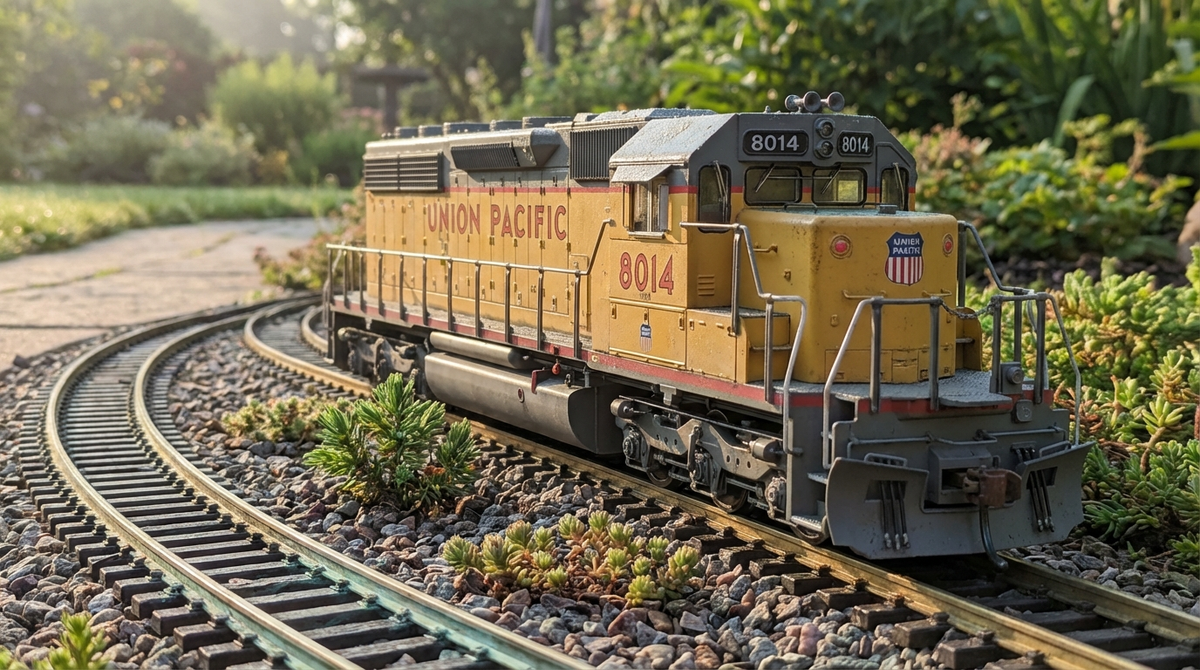
I run N scale. My layout fits in a spare bedroom, and I spend most of my time designing custom detail parts on my 3D printer. But last summer, a friend asked me to help troubleshoot her outdoor G scale railway, and I fell down a rabbit hole that lasted months. What I discovered surprised me: the G scale garden railway world operates by completely different rules than indoor modeling, and getting those rules wrong costs real money.
If you're thinking about running G scale trains for outdoor gardens, this guide is what I wish someone had handed me before I started giving advice.
Here's where G scale gets weird, and I mean genuinely confusing for anyone coming from other scales. The term "G scale" refers to trains running on 45mm gauge track, but the actual scale ratio of the models varies wildly depending on the manufacturer and what prototype they're replicating.
The gauge (distance between the rails) stays fixed at 45mm. But the scale (proportion of the model to the real thing) bounces between 1:32, 1:29, 1:24, 1:22.5, and 1:20.3. LGB pioneered the market in 1968 with 1:22.5 scale models representing European meter-gauge prototypes, and the "G" originally stood for "Groß" (German for "large"). When American manufacturers entered the market, they adopted different scales to make their standard-gauge and narrow-gauge models work on that same 45mm track.
The practical result? A 1:32 scale standard-gauge boxcar looks noticeably smaller than a 1:20.3 narrow-gauge boxcar, even though they're rolling on identical track. If you care about visual consistency, you'll need to commit to one scale family or strategically separate different scales on your layout. If you just want to watch trains run through your garden, it matters less.
The NMRA Large Scale standards cover all commercial scales on 45mm track to allow interchange, defining wheel profiles and track dimensions. One detail worth knowing: there's both a "Standard" and a "Deep Flange" specification for wheels. Deep flanges offer operational security on uneven garden trackwork but look less realistic. Finescale modelers prefer shallower flanges, but that demands more precise track leveling.
This is where outdoor modeling diverges sharply from anything indoors. Your track material choice dictates roughly 80% of your future maintenance workload, and I'm not exaggerating.
Most starter sets ship with Code 332 brass track, and brands like LGB, PIKO, and USA Trains all offer brass as their primary material. Brass is robust, weathers to a realistic brown color, and carries current reasonably well when clean.
The problem: brass oxidizes outdoors. That oxide layer isn't conductive, and it forms fast in humid or coastal climates. You'll be cleaning track regularly with abrasive pads or chemical cleaners. Anti-corrosion paste in rail joiners helps, but the cleaning commitment remains. If you're using track power (more on that shortly), dirty track means locomotives stall mid-run. Frustrating doesn't begin to cover it.
For brass track with track power, budget for aftermarket rail clamps from Hillman or Split-Jaw or plan to solder jumper wires across every joint. The stock joiners corrode, and you'll lose electrical continuity at the worst possible moment.
Stainless steel track costs more upfront (around $13.95/foot versus $9.40/foot for brass flex track), but it doesn't oxidize. You'll still clean off physical debris like dirt, tree sap, and bird droppings, but the electrical conductivity stays consistent. For layouts exceeding 200 feet or in wet climates, the labor savings alone make stainless pay for itself in roughly four years.
One catch: stainless has lower conductivity than brass, so you'll need more frequent power feeders along the track. Sunset Valley Railroad is a popular source for stainless track.
Llagas Creek aluminum track runs about $5.90/foot for Code 250, making it the budget option. Aluminum conducts electricity well when freshly cleaned, but it forms a hard, white, non-conductive oxide layer almost immediately outdoors. For track power, it's a nightmare. For battery-powered or live steam operations where track conductivity doesn't matter, aluminum is the smart money choice. It's also soft, so ground-level layouts with foot traffic can deform it.
This surprised me more than anything else in my research. I assumed track power with DCC would be the default recommendation for serious garden railways. The numbers tell a different story.
Battery-powered radio control systems, sometimes called "Dead Rail," have matured to the point where they're often the fiscally rational choice for larger layouts. Here's the math: converting a locomotive to battery power costs roughly $250-$350 (including the R/C system and lithium battery). Compare that to the cost of trenching for buried power busses, installing GFCI-protected outdoor circuits, maintaining electrically clean track, and replacing corroded joints over time.
For new layouts exceeding about 180 feet, battery power eliminates enough infrastructure and maintenance costs to offset the per-locomotive conversion expense. You literally don't care if your track is dirty because no electricity passes through it. Your trains run reliably in rain, snow, or after weeks of neglect.
Major systems include AirWire from CVP Products (mature wireless DCC with 10A motor drive on the G4X decoder), RailPro from Ring Engineering (user-friendly color touchscreen controller), and Revolution from Precision RC (affordable 2.4 GHz system with 400-500 foot range).
If you prefer track power, DCC offers independent control of multiple trains with sound and lighting effects. But G scale locomotives draw serious amperage, typically 1-4 amps each. You need high-current systems. NCE 10-amp boosters, Digitrax DB210/DB220 8-amp units, and Massoth DiMAX 12-amp systems are designed for this load. Decoders must handle the current too; the ESU LokSound 5 XL with 5-amp capacity is popular.
Just accept that track cleaning becomes part of your routine, and budget for quality rail clamps or soldered feeders.
Live steam is its own discipline. You're acting as both engineer and fireman, managing butane or alcohol fuel, monitoring boiler water levels, and respecting strict safety protocols. Prices start around $2,000 for entry-level models from Roundhouse Engineering and climb to $7,500+ for high-fidelity Aster kits. The experience is immersive and rewarding, but the learning curve is steep. Accucraft's manuals are worth reading even if you never buy one, just to understand what's involved.
The G scale market has consolidated over the past two decades. LGB went through bankruptcy in 2006-2007 before Märklin acquired the brand. Aristo-Craft closed in 2013. MTH restructured in 2021. The result is fewer choices for off-the-shelf American prototypes, but the surviving brands have improved quality control.
Still the benchmark for outdoor durability. LGB products are explicitly designed to be weatherproof, using UV-resistant plastics and robust sealed gearboxes. Production in Hungary and Germany is considered excellent after initial post-acquisition concerns. Best for European narrow-gauge modeling and operators who want reliable set-and-forget operation.
A major German competitor that's aggressively expanding its G scale line. Their track uses UV-stabilized HDPE plastic ties and pure virgin brass rail. PIKO's power supplies carry IP67 ratings for outdoor use, and their waterproof switch motors are well-regarded. Early models had some plastic gear issues, but newer locomotives have addressed those concerns.
The entry-level and mid-range leader. Bachmann's Large Scale lines (Big Haulers, Spectrum) work both indoors and outdoors. The classic 4-6-0 has been retooled with metal gears and Pittman motors. Their Spectrum line offers high-fidelity 1:20.3 narrow-gauge models with equalized suspension and plug-and-play electronics. A known issue across some models has been cracking plastic axle gears, though aftermarket metal replacements exist.
Specialists in 1:29 scale American diesel and modern rolling stock. Known for highly detailed models with dual-motor "PowerTrac" drivetrains and 12-point electrical pickup. They draw high current, so powerful transformers are required. Their long intermodal cars need very broad curves (8-10 foot diameter minimum). The company remains active under Charles Ro Supply Company ownership with new products for 2025.
The high-end finescale and live steam choice. Accucraft produces museum-quality brass models in scales including 1:20.3 and 1:32. Their live steam locomotives are built for outdoor operation using durable brass and stainless steel. The American Mainline (AMS) brand offers more accessible electric models and rolling stock.
This is the uncomfortable truth: almost no G scale components carry formal IP ratings. Manufacturers use vague terms like "weather-resistant" without specifying what that means. The exceptions are few: LGB's 51090/51095 power packs carry IP67 ratings (dust-tight and can handle temporary water immersion), and PIKO's turnout motors are described as weatherproof with sealed casings.
For everything else, DIY weatherproofing isn't optional. Applying conformal coating to circuit boards protects decoders from moisture and corrosion. Housing trackside electronics in IP65+ rated waterproof enclosures with bottom-entry cables prevents water wicking in. Dielectric grease on all electrical connectors displaces moisture. UV-resistant clear coats protect painted surfaces from sun degradation.
Many starter sets from PIKO and LGB include R1 (600mm or roughly 24-inch radius) curves to fit a simple loop in a small space. Most starter locomotives handle these curves, but longer rolling stock and larger locomotives won't. American-prototype 1:29 scale equipment often needs 8-foot diameter curves minimum. If you buy a starter set with R1 curves and then add prototypical equipment, you'll be replacing your track almost immediately.
Plan for R3 (920mm/36-inch radius) or larger curves from the start if you have space. An 8-foot diameter is a functional minimum for running diverse equipment.
Grades exceeding 2.5%, especially on curves, cause derailments and operational strain. For every 1% of grade, live steam pulling capacity drops noticeably. The practical maximum is 2% on straight track, less on curves. Smooth vertical easements between level sections and grades prevent coupler problems. This stuff is boring to plan for and expensive to fix later.
A stable, well-drained roadbed prevents frost heave, track warping, and derailments. The common approach is a "floating" ballasted trench: excavate 4-6 inches deep, line with geotextile fabric, fill with crushed stone. This handles drainage and allows natural expansion with temperature changes. In clay soils or areas with heavy rain, French drains beneath the roadbed prevent waterlogging. Expect to re-level track each spring in freeze-thaw climates.
The plants around your garden railway do more than look nice. A well-planned palette of zone-appropriate dwarf conifers and groundcovers provides shade that reduces rail temperatures and cuts UV degradation of plastic track ties. Strategic shade can extend component life by half compared to layouts in bare gravel.
For groundcovers, Sedum spurium handles full sun and drought. Creeping thyme works in temperate zones. Small-leaf shrubs like dwarf boxwood make convincing hedges at G scale. The key is choosing dwarf varieties whose mature size and leaf structure stay proportional to your trains.
Budget at least 15% of your initial layout cost for landscaping and micro-irrigation. Drip irrigation systems deliver water directly to roots, minimizing evaporation and keeping foliage dry to reduce disease.
If I were advising someone just entering G scale garden railroading, here's what I'd say:
For a small patio layout under 100 feet where you just want trains running, a PIKO or LGB starter set gets you operational fast. Understand that the included R1 curves limit your future equipment choices, and plan to expand with larger-radius track before buying bigger locomotives.
For a larger layout with operational ambitions, start with a battery R/C strategy and aluminum track from Llagas Creek. Convert your locomotives to AirWire or similar systems. You'll pay more per locomotive but save on infrastructure and maintenance. Plan for 8-foot minimum curve diameters and 2% maximum grades.
For live steam ambitions, start with an electric layout first. Learn the civil engineering of outdoor trackwork (drainage, grades, curves) before adding the complexity of fuel management and boiler safety. Then consider an entry-level gas-fired locomotive from Roundhouse or Accucraft.
The G scale community has adapted well to the decline of print media. GRNews.org publishes a free bi-monthly digital magazine and maintains connections with over 140 clubs globally. The G Scale Society offers membership benefits including liability insurance for hosting layout tours. Trains.com's Garden Railroading forum provides real-time troubleshooting and a wealth of archived discussions.
Local club membership is worth pursuing. Attending layout tours lets you see different construction methods, scales, and control systems in action before committing your own money. The announced return of Garden Railways magazine in 2026 signals renewed interest in the hobby.
One final piece of practical advice: when you buy a locomotive, purchase spare motor blocks and gears at the same time. The market consolidation means discontinued parts become unavailable faster than anyone expects. Ask MTH enthusiasts how that feels.
✨ Complete Your Layout: Explore our wide selection of Photo Real buildings, diorama backdrops, detail parts, and accessories in every popular scale.
✨ Unmatched Realism: From chrome detailing products to neon lighting kits – every piece is designed to make your miniature world come alive.