
Choosing Your First Model Train Locomotive: The No-Regrets Guide for 2025
Posted by Tamara Brooks on 31st Dec 2025
Order by phone: 763-231-7847
Free Shipping On Orders Over $100!
If you are already registered, please log in.
Create your account and enjoy a new shopping experience.
Create A New AccountPosted by Tamara Brooks on 31st Dec 2025
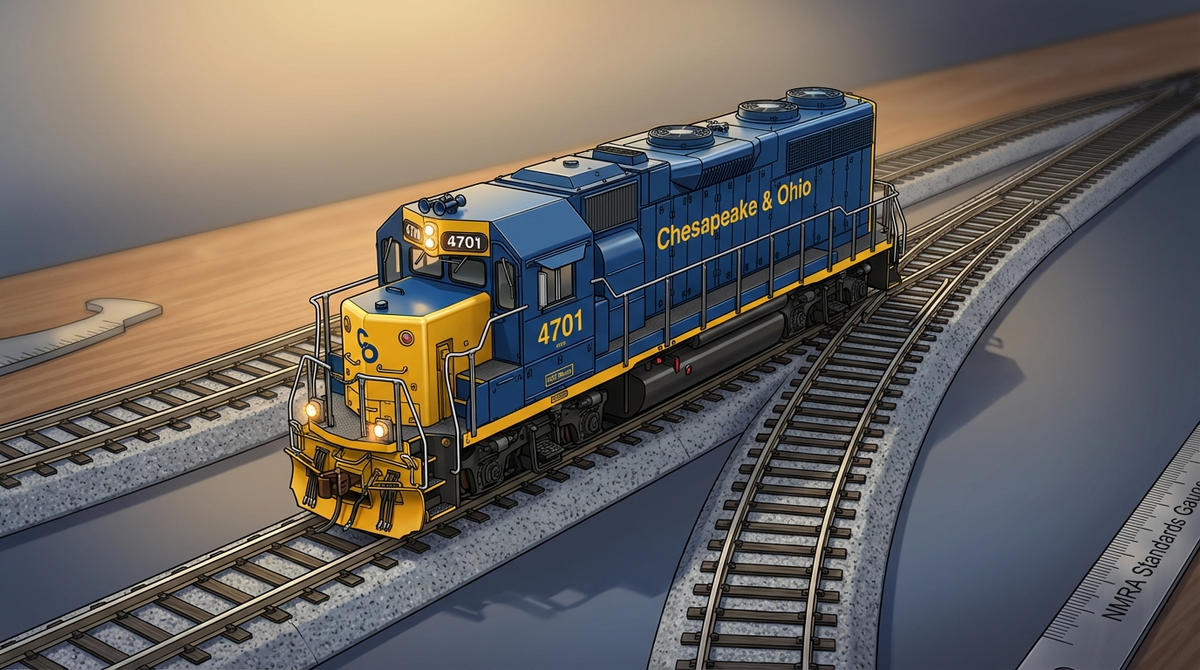
I'm going to be blunt with you: the locomotive you buy first will shape everything that comes after. Your track geometry. Your budget. Whether you stick with this hobby or abandon it in frustration within eighteen months. I've watched too many newcomers make preventable mistakes, and I'm tired of seeing good money get wasted on locomotives that don't fit their layouts.
When I started my N scale Detroit intermodal operation, I made my share of dumb choices. I bought a beautiful 6-axle diesel before I'd even thought about curve radii. Guess what happened? Derailments. Constant, maddening derailments. So let's make sure you don't repeat my mistakes.
Here's the uncomfortable truth that nobody tells beginners: 43% of first-year hobbyists end up rebuilding or abandoning their initial layouts because their locomotives can't handle the curves. That's nearly half of us learning the hard way.
The problem isn't complicated. Big locomotives need big curves. Most starter layouts get built on a 4x8-foot table with tight 18-inch radius curves. But those impressive-looking modern 6-axle diesels and long steam locomotives? They need 22 to 24 inches minimum. Mismatch those, and you've got an expensive paperweight.
Model train scales come in several commercial sizes, and picking the right one starts with measuring your available space. HO scale at 1:87 remains the world's most popular choice because it balances detail with reasonable space requirements. TT scale at 1:120 offers a middle ground between N and HO that's gaining traction. And G scale garden railroads require outdoor space most of us don't have.
Before you buy anything, grab a tape measure. Your available space dictates your maximum curve radius, which dictates locomotive size. Period. No negotiation.
For a coffee table or shelf layout, you're looking at Z or N scale with 6 to 9.75-inch curves. A standard 4x8 sheet of plywood can handle N scale at 11-inch radius or HO at 18-inch radius. If you've got a spare room, you can run HO with 22-inch-plus curves or even S scale. Basement builders can go wild with O or G scale.
The NMRA standards gauge for O scale helps you verify your trackwork meets specifications. Similarly, the official NMRA HO standards gauge will save you headaches down the road. For O gauge specifically, this pocket-sized gauge checks wheels, track, flangeways, and points. The O Scale 2-rail standards are maintained by the NMRA and worth understanding before you invest.
The best locomotive in the world will run like garbage on bad track. I learned this when I cheaped out on my first track purchase and spent six months chasing electrical gremlins.
Kato Unitrack is the standard for T-TRAK layouts because of its reliability and ease of use. The system spaces rails at 33mm center-to-center with a standard radius starting at 315mm.
For N scale, Kato's ground-level single track offerings include semi-circles with 7-inch curves, 248mm straight pieces, and essential accessories like rerailers and feeder tracks. HO modelers can explore Kato's HO ground-level single track with options like the #6 manual turnout featuring a 867mm radius curve.
When choosing your HO track brand, think of Peco Setrack as their answer to Atlas SnapTrack. Peco Set Track curves increase in 67mm increments, giving you flexibility in your layout design.
Don't skip the gauges. I know they seem boring compared to locomotives, but they'll save you countless hours of frustration. The HO scale Mark V Standards Gauge measures track gauge, turnout geometry, wheel gauge, coupler height, points, and platform height. For N scale, the N Scale NMRA Standards Gauge helps you make adjustments to end those annoying derailments.
The NMRA N Scale Standards Gauge from Midwest Model Railroad is designed to check all dimensions on track and rolling stock. Mark Twain Hobby Center stocks them too. HO modelers should grab the NMRA HO Standards Gauge as part of their starter toolkit.
The NMRA uses five types of Technical Documents to present information that keeps the hobby standardized. This matters because it means your Kato locomotive can run on Atlas track with Kadee couplers and everything works together.
Kato designs their N scale models for a UNITRACK 249mm (9-3/4 inch) ground-level curve, with HO scale targeting the 457mm (18 inch) ground-level curve. If you're using tighter curves, you'll need to experiment or switch to longer shank couplers.
Curved track from Hornby and Peco comes in various set radii. The Atlas track catalog explains that rail "code" refers to height in thousandths of an inch, with Code 83 at 0.083 inches being more prototypical than Code 100. The Kato Unitrack catalog shows radii from R117 to R718, fitting spaces of any size.
Peco's curved turnout has an 11.25-degree frog angle with an inner radius of just 438mm (17.2 inches). The NMRA Standards were developed to ensure equipment can be interchanged between layouts. The National Model Railroad Association advances the global community through education, advocacy, and standards.
The NMRA Beginner's Guide explains that in HO scale, Code 100 and Code 83 are common, while N scale uses Code 80 and Code 55. The HO wheel standards document notes that HO standard wheels work on HO fine track but the reverse isn't true.
Modern Märklin locomotives feature mfx digital decoders with sound functions and can motors, representing how far the hobby has come. And if you're wondering about product availability, the Bachmann Trains Online Store stocks everything from gift items to track and DCC components.
If you're drawn to something different, narrow gauge modeling offers unique prototypes and tighter curves. On30 modelers often worry about Bachmann's continued support of the scale since they're a major supplier. The Märklin Central Station 3 plus is multi-device compatible with a built-in s88 connection for those who want digital control.
Understanding scale versus gauge trips up many beginners. Scale implies a scaled-down version of the real thing. The NMRA S-1.2 Standards for Scale Models explains that standard scale models follow popular scales with some wheel and track compromises to improve operation.
An On30 locomotive will run on HO gauge track, though it won't look completely correct because the scale is wrong. The ties are larger but fewer than HO track. HOn3 trains are HO scale models of 3-foot narrow-gauge while On30 trains are O scale models of 30-inch narrow-gauge.
Märklin Curved C Track R5 offers a 643.6mm (25-5/16 inch) radius for H0/1:87 gauge. The Märklin Start up 2016 catalog shows their complete track system options.
Kato is the gold standard of reliability in N scale and should last far longer than 150 hours. I've never heard of a Kato engine failing under normal conditions. But reliability means nothing if your locomotive can't make it around the curves.
Can a GG1 run on 18-inch radius curves? 22 inches would be the absolute bare minimum, especially if you want to run standard-length passenger cars. A guide to N scale trains and tight radius rails notes that most N scale gives minimum radius in terms of 9.75 inches, 11 inches, and 15 inches due to Atlas's dominant position.
Some modelers ask whether small steam locos can negotiate Kato HO 16⅞-inch radius curves. Turns out they can. For N scale locomotive turn radii, transition curves work better than a straight 19-inch radius by itself.
If you're running four-axle diesels and short cars, you might be okay on tight curves, but bigger locomotives and longer cars probably won't work well. The operator's manual for a real GP15 says single unit curve negotiation is limited to a 49-degree or 36.6m (120 ft) radius curve. In model terms, that scales down to quite reasonable dimensions.
For steam locomotives, multiply the number of driver wheelsets times 3 for minimum radius and times 4 for ideal radius. A 4-6-2 steam engine needs a minimum of 18 inches and an ideal of 24 inches or more. A 2-10-4 needs a minimum of 30 inches.
The 18-inch curve works with four-axle diesels, 40 and 50-foot cars, and medium-size steam like 4-6-2 Pacifics and 2-8-2 Mikados. For N scale, regular sectional track comes in 9-3/4-inch and 11-inch radius.
I expected challenges with my 6-axle loco when I got it home, and sure enough, there were three locations where derailments occurred. A little adjustment of the track soon got it going both directions.
The single most reliable engines in HO scale are old Mantua/Tyco steam engines. They're indestructible. Some that were built in the 1950s still run with only annual oiling.
When planning a layout with minimum curve radius restrictions, a double mainline for passenger cars might require 26-inch minimum curves. Rolling stock that requires the largest curve sets the standard for your operation. You can sometimes run long cars on tighter curves if the trucks swivel sharply, but it looks odd.
The Walthers Mainline SD70ACe handles 18-inch radius curves (22-inch or larger recommended) with six powered axles per unit. SD40-2s will generally prefer at least 22-inch curves, and 24 or more is better.
Research shows that Kato produces an 8.5-inch radius for tighter space layouts overseas. For beginner help with N scale maintenance, Kato is a solid brand choice.
The minimum radius for an N scale SD40-2 is listed as 9-3/4 inches based on online research. And for those modeling modern passenger, 25-foot radius works for 8-foot long coaches in articulated form, a bit tighter for individual use.
When drifting at slower speeds, some steam locos put the valve gear in the corner, which reduces the compression stage and evens up valve wear. Are steam locomotives supposed to shake a bit? Sometimes, yes.
The Athearn Genesis GP38-2 offers excellent DCC and sound in a four-axle package. Most HO scale locomotives are made to operate on a minimum radius of 18 inches, though more prototypical models require 22 inches or larger.
The Athearn Genesis 71831 EMD GP38-2 lists an 18-inch minimum radius with 22 inches recommended. Meanwhile, the WalthersMainline SD70ACe had no problem with 19-inch curves and no. 5 Peco turnouts, even performing well on 18-inch radius Bachmann E-Z Track including a double S curve.
The perennial question: Is an 18-inch turn radius okay for HO? For four-axle diesels and shorter rolling stock, generally yes. For modern six-axle power, you'll want more.
Kato's design curve for N scale is a UNITRACK 249mm (9-3/4-inch) ground-level curve. For the Kato N SD70ACe diesel series in a shunting yard, you'll want to confirm the minimum reliable turning radius before ordering.
Understanding locomotive track radius requirements is essential for any N scale modeler. The Kato Unitrack Compact range is not compatible with regular N scale trains and can only be used by specific trains like UNITRAM and Pocket Line.
When running in and warming up locos, poor running in steam models often relates to valve gear, rods slightly out of straight, or sticking pivots. For beginner locomotive kits, the DJH 02 shunter is ideal but hard to track down.
In N scale, 9-3/4 inches has been the standard minimum radius for most locomotives and rolling stock. The 9-3/4 inch minimum works for smallest layouts, while 11 inches is a good compromise for handling larger equipment.
N scale's minimum radius curve is 9 inches, which is 18 inches diameter. The Kato Unitrack "Compact" range goes even smaller for specific trains.
The fast lubrication study shows that if over-lubrication is a problem, a small lubricator could be installed on every locomotive rather than including a lubricator car on every train. The principle applies to models: use less lubricant than you think.
A Broadway Limited SD40-2 can haul the equivalent of 65 HO scale freight cars on straight and level track. The Kato USA ACS-64 with a 9-3/4-inch minimum turning radius handles curves smoothly.
Regular inspection of steam engines is fundamental for safety, longevity, and performance. This applies to models too: catch problems before they strand your locomotive mid-layout.
When rethinking power yards, remember the diesel era cuts down on maintenance needed to keep wheels turning, but the volume of oil needed for the prime mover would measure in barrels. On models, a single drop goes a long way.
The Hornby R7345 HM7000-N18TXS represents the Bluetooth and DCC sound decoder future in the Next18 format. The HM7000 system lets you alter control mode by tapping the Bluetooth button for wireless control or DCC for digital use.
The NMRA Digital Command Control Standards extend the base electrical standards covered in S-9. The S-9.2.2 Draft covers the format of information sent via Digital Command Stations to Digital Decoders.
The NMRA standards website includes TN 1-05 for Service Mode Decoder Lock and TN 2-05 for Electrical Specifications for DCC. The S-9.2 Communications Standards cover the format of information sent via Digital Command Stations.
The NMRA Standards ensure equipment interchangeability. For traditional wiring, layout wiring standard procedures for cab control happen before the layout, not on it. Gap the layout for sections and wire back to common terminals.
Basic DCC wiring uses direct current that flows in only one direction, used for control of most model railroads before command control. The S-9.2.1 DCC Extended Packet Formats adhere to the general packet format with data bytes separated by "0" bits.
The S-9.1 Electrical Standards for Digital Command Control were updated April 30, 2025. The Service Mode standard describes how NMRA Standards define two modes of Digital Decoder operation: Operations Mode and Service Mode.
The Layout Command Control (LCC) Section standards were approved January 24, 2025. DC block control remains viable and can always be converted to DCC later.
For DC wiring on a new layout, everything works great with DCC because the 8.5kb data rate works on even the worst wiring. An HO locomotive uses about 600-700ma under full load. The NMRA Beginner's Guide on adding power explains cab control for running multiple trains using Atlas selector switches to route power from different packs.
To block a DC layout, use plastic rail joiners at the point where the yard starts, keeping power from each block separated.
The HM7000 family of decoders uses Bluetooth Low Energy communications with a dedicated control app. OTA updates allow over-the-air firmware upgrades. HM7000 Wireless DCC Control revolutionizes model railway operation.
LionChief Plus 2.0 locomotives won't come with an individual remote but can run via Bluetooth controller or Universal Remote. Bluerail offers an alternative to DCC for model train control, with the Bachmann EZ link app compatible with BlueRail, Tam Valley, and Bachmann hardware.
On the topic of EZ Commands, EZ App was developed in partnership with Blue Rail Trains, who offer Bluetooth boards for any DCC-ready locomotive. Samples of new EZ APP products debuted at the NMRA Convention.
LionChief Plus 2.0 combines the best features of LionChief Plus locomotives with TMCC command control and enhanced sound and lighting. The LionChief Universal Remote 6-83071 controls these locomotives. The LionChief Plus 2.0 Genesis supports Bluetooth in addition to other control methods.
The LionChief Plus 2.0 GP38 includes improved sounds, additional light and smoke features, speed control, and the ability to run via conventional transformer or TMCC Command Control. The FT LionChief Locomotive uses the free LionChief app, automatically connecting within seconds when powered up.
Bachmann Trains partnered with BlueRail Trains to develop Bluetooth Smart trains controlled by iPhones, iPads, and Androids. The E-Z App Train Control system allows direct control from your Bluetooth Smart Smartphone without additional equipment. Sound works with any Bluetooth speaker for audio flexibility.
For N scale, Bachmann partners with BlueRailTrains for Bluetooth control. The Soundtraxx Blunami suggests a partnership between SoundTraxx and BlueRail Trains, making sense given that the budget decoder line was called "Econami."
MTH's Proto-Sound 3.0 equipped locomotives can be controlled in command mode with any DCC-compliant system. The Lionel Base3 bridges the gap between LEGACY, TMCC, LionChief+2.0, and LionChief. LionChief remotes only control paired locos, while Universal Remotes control all LionChief locos.
The MTH ProtoSound 3.0 troubleshooting guide addresses common issues for HO gauge locomotives. The Western Maryland MTH F-7 B Unit makes Proto-Sound 3.0 features accessible when using a DCC controller.
The MTH Pennsylvania GG-1 can be independently controlled alongside other DCC-equipped locomotives. The PS3E+ decoder runs in five modes: conventional AC, conventional DC, DCS on DC current, DCS on AC current, and DCC/Motorola.
The Union Pacific MTH F-3 A Unit offers extensive DCC function outputs from F0 through F28, including PFA, extended start-up/shut-down, one-shot Doppler, and cab chatter. MTH does NOT use DCC. It runs on DCS with minor DCC compatibility enabled.
Lionel Base3 brings control of all Lionel engine command types to a single controller. Charles Ro Supply Company stocks the L2208010 Lionel Base3 for immediate shipping. The Lionel 2208010 supports up to 10 total devices in any combination of Cab2, Cab-1L, or Cab3 APP.
The Lionel Base3 features built-in Wi-Fi for full functionality with the Cab3 APP and compatibility with Cab2 or Cab-1L remotes.
Digitrax Starter Sets include the DCS52 Zephyr Express as an all-in-one Command Station, Booster, and Throttle. The Digitrax DTXZEPE features a 3.0 Amp LocoNet Command Station with a color 2.4-inch LCD display and large backlit keypad.
The Digitrax DCS52 Zephyr Express from Lombard Hobby offers the same features. Current sales prices beat the original MSRP of $245.
The Digitrax Zephyr Express review notes that running a model railroad with Digital Command Control is simple with the DCS-52. The Zephyr Express manual explains that the DCS52 does everything you need to get up and running in one unit.
The Digitrax Zephyr Express on Amazon lets you run multiple trains at once without blocking, with jump ports for using DC power packs as additional throttles. The unboxing and setup video shows the MSRP at $235.
The Midwest Model Railroad page explains that Zephyr Express gives you simple-to-use Digitrax Complete Train Control for any size layout. For DCS52 address programming, place the locomotive on your program track connected to the PROG A and PROG B outputs.
The programming instructions state: be sure only the locomotive you want to program is on the programming track, then press the PROG key. For Z scale Digitrax setups, the PS314 power supply provides power to run the DCS52.
The Digitrax Command Control Starter Set Manual includes a Decoder Manual for use with any Digitrax decoders. The Digitrax Zephyr Express DCS52 Manual on ManualsLib provides complete train control starter set documentation.
For DCC controller programming, the system can read values already in your decoder and gives you a form to alter those values. Help with Zephyr DCS52 and Unitrack setup is available from the community.
One hobbyist's layout with a Digitrax Zephyr Express DCS52 3 AMP is powered at multiple points with no dead or slow spots. The official Digitrax page lists the MSRP at $245.00. The spec sheet details maximum output current.
The DCS52 Quick Start Guide gets you running fast. For larger layouts, the DB220 Dual 3/5/8 Amp AutoReversing DCC Booster expands capacity. On the back of the DCS52, locate the gray screw terminal strip with RAIL A and RAIL B terminals.
The Digitrax boosters page lists the DCS52 among compatible command stations. The Layout Power and Wiring section explains that boosters have maximum output current limits of either 5 or 8 amps.
The Quick Start Guides include basic DT400 and DT402 throttle operating instructions. For interfacing with a programming track from DecoderPro, some MacOS users report difficulties with the DCS210+.
Some ask whether you can drive on the programming track; there's always the chance of bridging the isolation gap with a DPDT toggle. Command Stations and Boosters from Digitrax offer options for every layout size.
The Manuals and Instruction Sheets page includes DCS52 documentation. Digitrax, Inc. is dedicated to bringing superior engineering and affordability to model railroaders.
JMRI hardware support for the DCS52 explains that when acting as an interface, the USB connection allows JMRI to interact with devices on LocoNet. The Zephyr Xtra Manual provides programming instructions with additional information about CV29.
For decoder programming, place the decoder-equipped locomotive on an electrically isolated service-mode programming track connected to Prog A and B outputs. The Digitrax LNWI LocoNet WiFi Interface provides Wi-Fi interface for up to four compatible mobile devices and apps.
When asking what hardware is needed for a Digitrax 152 setup, users report using a DCS 52 with built-in USB interface for programming. Fifer Hobby Supply stocks Digitrax DCC Systems with the 3.0 Amp LocoNet Command Station.
Streamlined Backshop carries the Digitrax DCS52 Zephyr Express Starter Set. For help with Digitrax wiring, remember you can't use two power sources on a layout because they'll fight with each other.
The Specialist Collectors' catalog lists the Digitrax Zephyr Express 3.0 Amp Starter Set. The March/April 2023 Walthers Flyer featured the Zephyr Express DCC Starter Set at $245.00 regular price.
The Walthers 2023-02 catalog also featured the Zephyr Express with quick-start guide and instruction manual. Current eBay listings for the DCS52 Zephyr Express advertise all-in-one throttle, command station, and booster functionality with LocoNet expandability.
Your first locomotive sets the trajectory for your entire hobby experience. Match it to your space, your curves, and your control system. A four-axle diesel running smoothly on an 18-inch radius layout beats a beautiful six-axle model that derails every third lap.
Spend the extra $12 on a coupler height gauge. Get a standards gauge for your scale. Clean your track monthly and your wheels when they look dirty. These boring basics will keep your first locomotive running for decades while flashier purchases sit in the repair box.
I've watched this hobby consume beginners who tried to buy the dream before they understood the reality. Start practical. Start small. Your collection will grow with your skills, and you'll actually enjoy the journey instead of fighting your equipment at every turn.
✨ Complete Your Layout: Explore our wide selection of Photo Real buildings, diorama backdrops, detail parts, and accessories in every popular scale.
✨ Unmatched Realism: From chrome detailing products to neon lighting kits – every piece is designed to make your miniature world come alive.