
Choosing the Right Model Train Scale: What Actually Matters in 2025
Posted by Tamara Brooks on 31st Dec 2025
Order by phone: 763-231-7847
Free Shipping On Orders Over $100!
If you are already registered, please log in.
Create your account and enjoy a new shopping experience.
Create A New AccountPosted by Tamara Brooks on 31st Dec 2025
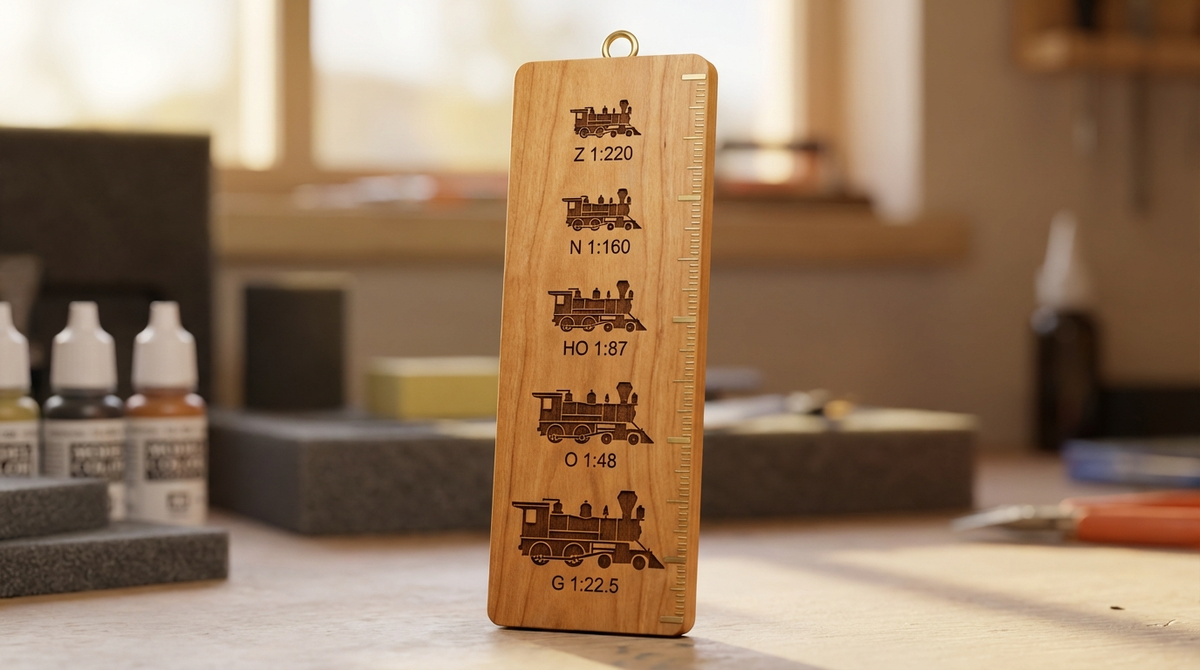
Look, I spent six months agonizing over whether to build in N scale or HO before I finally committed to my Detroit intermodal layout. I measured my basement seventeen times. I read every forum thread. I made spreadsheets. And you know what? Most of that hand-wringing was unnecessary because I was asking the wrong questions.
Choosing a scale isn't about finding the "best" one. There isn't one. It's about matching a set of constraints and goals to a product ecosystem that can support your vision. After building two layouts and helping friends plan theirs, I've come to see this decision as an engineering problem with multiple valid solutions.
So let's cut through the noise and talk about what actually matters.
I can't tell you how many times I've seen newcomers use these terms interchangeably and then wonder why their equipment doesn't work together. Scale and gauge describe different concepts, and mixing them up leads to expensive mistakes.
Scale is the proportion of your model to the real thing. HO scale at 1:87.1 means your locomotive is 87.1 times smaller than the actual machine. This ratio determines the size of everything in your miniature world.
Gauge is just the distance between the rails. Standard HO gauge is 16.5mm, period. That's a fixed measurement, not a ratio.
Why does this distinction matter? Because narrow-gauge modeling exists. My friend runs an On30 layout where O-scale (1:48) trains run on HO-gauge (16.5mm) track to represent prototype narrow-gauge railroads. Same track gauge, completely different scale. NMRA standards exist precisely to prevent interoperability nightmares between manufacturers.
After watching countless modelers struggle with this choice, I've boiled down the decision to seven variables. They're listed roughly in order of how constraining they tend to be.
Grab a tape measure. Be brutally honest about how much room you can dedicate to this. Layout planning starts with physical reality, not dreams.
Here's the math that matters: N scale is roughly 54.5% the size of HO. That means you can fit about four times the trackage and scenery in the same footprint. A layout that needs a 4x8 sheet of plywood in HO can fit on a 2x4 surface in N.
Layout size descriptions can help you calibrate expectations. A "mini layout" typically means 2x4 feet or less. A "medium" layout might fill a spare bedroom. A "large" layout consumes a basement.
This is where people fool themselves. N scale track costs less per foot than HO, sure. But DCC sound decoders for N scale can run 23% more than their HO equivalents because of miniaturization challenges.
Real cost analysis has to include the whole lifecycle: track, turnouts, DCC systems, decoders, rolling stock, structures, and scenery. A moderately detailed HO layout runs around $100 per square foot, but that's a rough guide at best.
The smartest modelers I know budget $75-150 per month and build in stages over years. Trying to complete a large layout in one spending spree usually ends in either bankruptcy or an abandoned project.
How much do you want to see when you look at your models? Larger scales offer more surface area for super-detailing, weathering, and craftsmanship. My O-scale friends spend hours on a single locomotive. I spend that time watching trains run.
Smaller scales like N and Z excel at conveying vast landscapes and the sense of a train moving through grand scenery. You're trading individual model detail for overall scene impact.
Be honest with yourself here. Handling tiny N scale couplers requires steady hands and decent vision. I use an OptiVISOR for decoder installations, and I'm not even 40 yet.
Surveys show 38% of hobbyists over 65 have moved up at least one scale to accommodate changes in eyesight and dexterity. If you're planning a "forever layout," factor in how your physical capabilities might change.
If you want plug-and-play DCC with every option available, HO scale delivers the widest variety. Smaller scales require more delicate installation work. Large scales like G often lean toward battery power and radio control to bypass outdoor wiring nightmares.
What do you actually want to model? Popular North American prototypes are widely available in HO and N. European electrics have strong support in HO. British prototypes are overwhelmingly found in OO gauge. Niche prototypes like certain narrow-gauge logging lines might only exist as craftsman kits.
HO scale commands about 55% of the U.S. market, creating the largest community and most active secondary market. If you view your collection as an asset, postwar Lionel O gauge and high-end brass models from respected importers consistently retain 65-85% of value.
Niche scales like S and Sn3 often clear at just 35-45% of MSRP. Auction house data confirms this pattern repeatedly. If you're exploring niche scales, treat your purchases as a sunk cost for enjoyment, not an investment.
Your minimum curve radius determines what equipment you can run reliably. Manufacturer-listed minimums are usually for slow-speed operation with ugly appearance. Here's what actually works:
| Scale | Ratio | Absolute Min. Radius | "Looks Right" Minimum | Typical Footprint |
|---|---|---|---|---|
| Z | 1:220 | 5.7" (145mm) | 9" (229mm) | 1x2 ft (briefcase) |
| N | 1:160 | 9.75" (249mm) | 15" (381mm) | 2x4 ft (door) |
| TT | 1:120 | 10.5" (267mm) | 15" (381mm) | 3x5 ft |
| HO | 1:87.1 | 18" (457mm) | 24-30" (610-762mm) | 4x8 ft (plywood sheet) |
| S | 1:64 | 19" (483mm) | 27-36" (686-914mm) | 5x9 ft |
| O | 1:48 | 13.5" (O-27) | 36" (O-72) | 5x9 ft to room-sized |
| G | 1:22.5-1:32 | 24" (600mm) | 48"+ (1200mm+) | Room to garden |
For full-length 85-foot passenger cars in HO, you want 28-30" minimum with 36-42" preferred. Modern 6-axle diesels need similar breathing room. Don't learn this the hard way like I did with my first layout.
HO scale dominates globally, and that dominance creates a self-reinforcing cycle. Hundreds of manufacturers produce for HO because the user base is massive, and the user base is massive because product selection is unmatched.
Major manufacturers include Athearn, Atlas, Bachmann, Broadway Limited, Kato, and Walthers. Boutique firms like ScaleTrains fill the gaps. Parts availability averages 4-week lead times versus 9 weeks in N and 14 weeks in O.
Track code options range from Code 100 for durability to Code 83 for prototypical appearance. Finescale modelers can even use Code 70 in yards.
If you have no overriding constraint pushing you elsewhere, HO is probably your answer.
OO gauge runs on the same 16.5mm track as HO but at a slightly larger 1:76 scale. This historical compromise was needed to fit motors into smaller British loading gauge prototypes. The track gauge is technically inaccurate, but it's the UK standard with rich ecosystem support from Hornby, Bachmann Branchline, and Dapol.
I run N scale because I wanted operational complexity in a spare bedroom. The cost structure works differently than you might expect: track is cheaper, but you buy more of it, and electronics cost more.
Kato's Unitrack system is legendary for reliability. Track compatibility requires attention: Code 80 works with everything, while Code 55 looks better but can have issues with older "pizza cutter" wheel flanges.
Code numbers indicate rail height in thousandths of an inch. Code 80 is 0.080" tall; Peco's "Code 55" is actually Code 80 buried deeper in thicker ties.
N scale excels for Japanese prototype modeling, with Kato, Tomix, and MicroAce offering incredible Shinkansen and EMU variety.
TT:120's 2022 relaunch by Hornby and Peco offers British modelers a "true-to-scale" alternative to OO. The 12mm gauge correctly represents standard gauge at 1:120.
The ecosystem is growing fast but still has a 30% gap in available steam-era freight compared to established scales. Early adopters report track geometry quirks that require workarounds.
O scale splits into two camps. Three-rail "hi-rail" dominated by Lionel and MTH focuses on reliability with a center third rail. Two-rail scale modeling demands prototypical accuracy and much larger radius curves.
Curve diameters are denoted by names: O-27, O-31, O-72 represent 27", 31", and 72" diameters. Atlas O serves both two-rail and three-rail markets.
Bachmann's 1998 introduction of ready-to-run On30 was a market inflection point, driving massive growth for five years. The concept is brilliant: O-scale models run on standard HO-gauge track, giving you large-model presence with space-saving track geometry.
Minimum radius drops to 18 inches. Today, 83% of new On30 locomotives come with factory-installed DCC. Use Code 83 or Code 100 rail to avoid flange noise issues.
S scale sits between HO and O, offering noticeable size increase for easier detailing without O's space demands. The ready-to-run market is smaller, with American Models and S-Helper Service as key manufacturers. It's particularly suited for steam-to-diesel transition era modeling.
Z scale is the smallest commercially produced scale. Märklin and Micro-Trains Line dominate a limited but growing market. Track gauge is 6.5mm with Rokuhan offering 55mm radius curves for incredibly tight layouts.
Narrow-gauge railroads served industries in terrain where standard-gauge construction was impractical. Modeling them allows tighter curves, shorter trains, and unique character.
The naming convention combines model scale with prototype gauge:
Digital Command Control varies wildly across scales. Decoder interfaces aren't universal:
| Interface | Pins | Typical Scales | Notes |
|---|---|---|---|
| NEM 651 | 6 | N, TT, small HO | Very small; complicates lighting |
| NEM 652 | 8 | HO, OO, O, S | The common "NMRA 8-pin" plug |
| Next18 | 18 | N, TT, small HO | Becoming the new small-scale default |
| 21MTC | 21 | HO, OO | Common in European models |
| PluX22 | 22 | HO, O | High-function-count interface |
| PluG | 16-44 | G, Large Scale | High-current for demanding power needs |
A typical N or HO locomotive draws 0.3-0.5A under load. Older O scale or G scale engines can pull 3A or more. This drives booster selection.
A 2-3A starter system like a Digitrax Zephyr or NCE Power Cab works for most N and HO layouts. O and G scale often need 5A-10A boosters divided into multiple power districts.
The ESU LokSound 5 Micro measures just 21mm x 10mm. The Nano version shrinks to 19.6mm x 8.5mm x 3.2mm. Installation is delicate, and bass response is limited by tiny "sugar cube" speakers.
ZIMO's MX616 at 8mm x 8mm x 2.2mm is even smaller for Z scale applications.
Keep-alive capacitors provide backup power during brief track interruptions. They prevent sound dropouts, light flicker, and stalling on dirty track or turnout frogs.
TCS Keep Alive, SoundTraxx CurrentKeeper, and ESU PowerPack offer various sizes. Micro-sized units like the ESU PowerPack Mini fit N scale, while larger capacitors in HO provide several seconds of backup.
Turnouts are identified by frog number (#4, #6, #8), indicating divergence angle. Higher numbers mean shallower angles and smoother high-speed operation.
#4 or #5 turnouts work in yards where speeds are low. #6 is NMRA's recommended minimum for mainlines. Passenger operations benefit from #8 or larger.
I've seen Peco medium-radius turnouts work well across layouts. Their Setrack turnouts have a larger 22-degree angle, fine for industrial sidings but not mainlines.
Abrupt transitions from straight track to curves cause derailments. Easements (spiral transitions) are essential for reliable operation, especially at speed.
Reach-in comfort drops from 30" on 36"-high benchwork to 22" on 52"-high "eye-level" layouts. Aisle width should be 24" minimum, 30-36" preferred.
52" benchwork height offers a good compromise between viewing angle and reach. Physically test tasks like re-railing and manual uncoupling at your proposed height before committing.
Outdoor modeling introduces challenges that don't exist indoors.
Standard model plastics fade and become brittle within a single outdoor season. UV-resistant plastics like those in LGB products, or UV-resistant clear coats, are mandatory.
A 100-foot brass track can expand over 0.87 inches during a 70°F temperature swing. Expansion gaps of 1/16" to 1/4" are essential. Mechanical rail clamps from Split Jaw beat standard joiners for both mechanical and electrical integrity.
61% of new G-scale buyers now choose battery power with radio control over traditional track power. This eliminates track cleaning requirements and makes cheaper aluminum rail viable.
Brass rail oxidizes and requires frequent cleaning. Nickel-silver and stainless steel resist corrosion better. O scale outdoors requires significant weatherproofing effort.
Options range from crushed rock trenches to pressure-treated lumber to concrete roadbed. Proper drainage prevents frost heave.
If you're shooting video or photos of your layout, scale choice matters for visual realism.
Smaller scales require closer camera positioning, which drastically reduces depth-of-field. A small aperture (high f-stop) maximizes sharpness but requires either long exposures or extremely bright lighting.
Cameras with smaller sensors actually produce greater depth-of-field for a given field of view. Your phone might outperform your DSLR for model photography.
Placing smaller-scale models in the background creates an illusion of greater distance. Lighter, less saturated colors mimic atmospheric haze. Selective compression reduces building footprints while retaining key features.
Running at plausible scale speed makes layouts appear larger. Measuring and calibrating speed improves realism. Professional miniature cinematographers use overcranking (higher frame rates) to give models a sense of weight.
North America is HO-dominated with strong N, O (3-rail), and G for gardens. The UK runs on OO gauge. Continental Europe favors HO with strong catenary system support. Major European players include Märklin, Roco, Fleischmann, and PIKO.
Accurascale offers lifetime warranties, setting a new benchmark. Most manufacturers like Athearn and Rapido offer 1-2 years. Athearn has discontinued support for older "Blue Box" lines entirely. Bachmann Europe and Märklin maintain better long-term parts databases.
Physical demands change dramatically with scale. Smaller scales require steady hands for coupler adjustments and detail work. Manual uncoupling tools and magnetic uncouplers can simplify operations.
Focus stacking software helps with photography limitations. Scale eye-level camera positioning creates realistic perspectives regardless of scale.
After all this analysis, here's how I'd match common situations to scales:
Apartment/condo with minimal space: N scale. You can build operational complexity on a hollow-core door.
Dedicated basement or spare room: HO scale. The ecosystem depth is unmatched. DCC starter systems are most affordable and plug-and-play.
Garden railway enthusiast: G scale. Built for outdoor abuse. Battery power eliminates electrical maintenance.
Photography/video focus: O scale. Higher cost per item, but larger models photograph with realistic depth-of-field.
Sharing with grandchildren: O gauge (3-rail). Lionel's legacy is family-friendly durability. Large trains survive small hands.
I've watched too many modelers pick a scale based on what looks cool at the hobby shop, only to discover their basement can't handle the curves their dream locomotives need. Or they choose the smallest scale possible for space reasons, then struggle with failing eyesight five years later.
Measure your space. Be honest about your budget and your body. Think about what you actually want to operate, not just what you want to own. The "right" scale is the one that fits your constraints today while leaving room for where you'll be in a decade.
And if you're still stuck? Start with HO. The ecosystem will support whatever direction you eventually want to go. You can always build a second layout in a different scale later. That's what I did.
✨ Complete Your Layout: Explore our wide selection of Photo Real buildings, diorama backdrops, detail parts, and accessories in every popular scale.
✨ Unmatched Realism: From chrome detailing products to neon lighting kits – every piece is designed to make your miniature world come alive.