
Cheapest HO Scale Train Sets That Actually Deliver Long-Term Value in 2025
Posted by Patricia Nakamura on 30th Dec 2025
Order by phone: 763-231-7847
Free Shipping On Orders Over $100!
If you are already registered, please log in.
Create your account and enjoy a new shopping experience.
Create A New AccountPosted by Patricia Nakamura on 30th Dec 2025
When I inherited my dad's N scale layout, I made every rookie mistake in the book. I bought cheap, regretted it fast, and ended up spending twice what a smarter purchase would have cost. So when friends ask me about finding the cheapest HO scale train sets, I always pump the brakes on that word "cheapest."
The sticker price is only part of the story. What matters is total cost of ownership: how much time you'll burn on maintenance, what upgrades you'll need immediately, and whether the set can actually grow with you. A $125 set that frustrates you into quitting the hobby isn't cheap. It's expensive.
Let me walk you through what I've learned about finding genuine value in HO scale model trains without lighting your wallet on fire.
Here's something nobody tells you at the hobby shop: the track in your starter set can make or break your experience.
Most budget sets under $140 ship with steel alloy E-Z Track (the kind with black roadbed). Steel corrodes. Steel oxidizes. And when it does? Your locomotive stutters, stalls, and generally acts possessed.
Users on the forums report cleaning steel track every 2-3 hours of operation just to keep things running. That's not a hobby. That's a chore.
Nickel-silver track (usually on gray roadbed) resists corrosion and conducts electricity far better. The difference in running experience is dramatic. According to TrainWorld's track guide, nickel-silver needs cleaning roughly every 8 hours instead of every 2-3.
The Bachmann Santa Fe Flyer at $134.99 comes with steel track. Spend just $13 more for the Bachmann Thoroughbred at $147.99, and you'll save yourself hours of frustration down the road.
When comparing Bachmann E-Z Track versus Atlas sectional track, hobbyists consistently recommend nickel-silver for anyone who plans to run trains more than a few times a year.
Let's look at what your money actually buys in this price range.
The Bachmann Yard Master at $123.48 includes a Baldwin 0-6-0 steam locomotive with smoke and operating headlight, a gondola, a caboose, and a 36-inch oval of E-Z Track. The locomotive features a die-cast metal chassis, which adds weight for better traction. Cars come with body-mounted E-Z Mate knuckle couplers instead of the old horn-hook style that plagued sets from the 90s.
The Yard Master's specifications make it a functional entry point. But "functional" and "hobby-grade" aren't the same thing.
According to the NMRA Beginner's Guide on rolling stock, freight cars should weigh 1 ounce plus 0.5 ounces per inch of car length (that's NMRA Recommended Practice RP-20.1). Most starter set cars come in underweight with plastic wheels.
Underweight cars derail on curves. Plastic wheels collect gunk faster than metal and have higher friction. So right out of the box, you're looking at spending another $2.50 per car on metal wheelsets and adding stick-on weights to bring everything up to spec.
Budget $30-40 for immediate upgrades if you want reliable operation from any sub-$150 set. That's not a knock against these sets. It's just the reality of the entry-level market.
If you can stretch your budget just a bit, this price tier offers a dramatic jump in quality.
The Walthers Trainline Flyer Express at $179.99 is my pick for the best value starter set on the market right now. Walthers explicitly designed these as hobby-quality sets built for years of fun, and the components back that claim up.
The Flyer Express includes metal wheels and Proto MAX metal knuckle couplers right out of the box. The track is nickel-silver on gray roadbed. The GP15-1 locomotive has a die-cast frame, a can motor with flywheel for smooth operation, and all-wheel drive.
Compare that to the Bachmann Rail Chief at $215.99. Yes, you get 130 pieces including figures and signs. But reviewers frequently criticize the quality of those accessories, describing the figures as "all pink" and the signs as unrealistic.
The Walthers set costs $36 less and gives you better core components where it counts: wheels, couplers, and track.
Digital Command Control lets you run multiple trains independently, control sound, and program locomotive behavior. It's addictive once you try it. But the all-in-one DCC starter sets? They're a trap.
The Bachmann Digital Commander DCC set runs $410.55. It's a complete package with two DCC-equipped locomotives and nickel-silver track. Sounds great, right?
The problem is the included E-Z Command Plus controller. It only supports single-digit addressing (locomotives 1-9), offers 1 Amp of power, and has limited programming capabilities. You'll outgrow it fast.
Buy a good DC set now. Add a better DCC system later.
Take that Bachmann Thoroughbred at $147.99. Pair it with an NCE Power Cab at $199.99 when you're ready. Total cost: $347.98. That's $62 less than the Digital Commander bundle.
And the NCE Power Cab? It delivers 2 Amps of power (enough for 4 HO locomotives), supports 4-digit addressing, offers full CV programming, and allows multiple throttles. It's a system you can grow with for years.
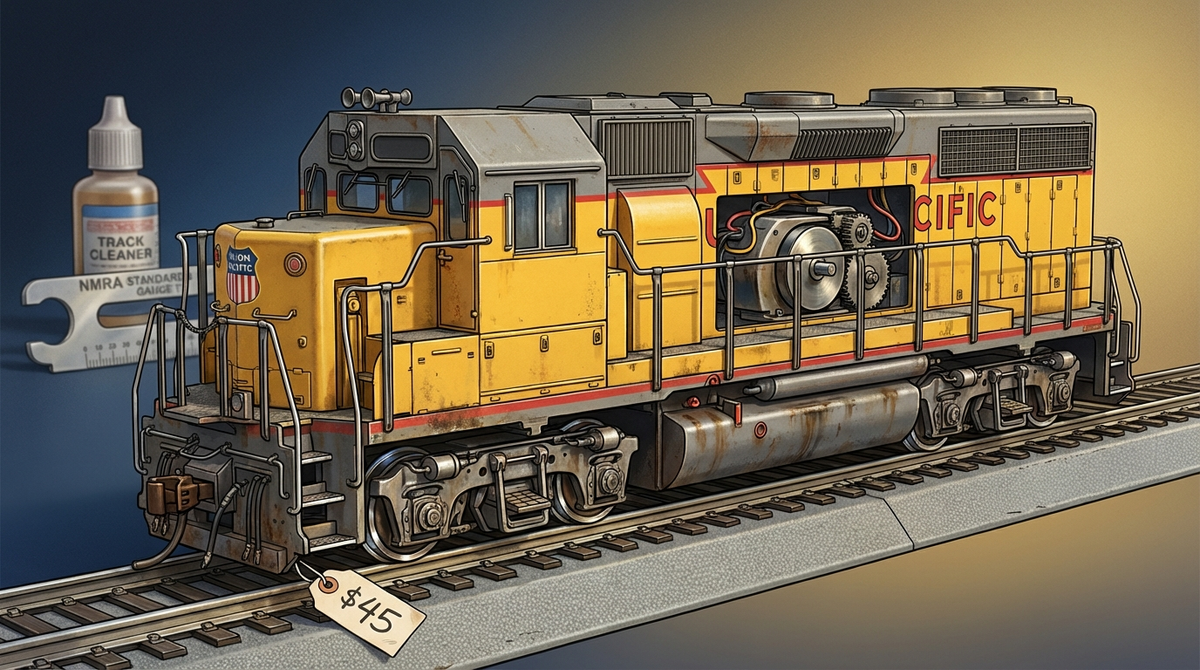
Most running issues in cheap sets come down to three things: dirty track, loose joiners, and out-of-gauge wheels. You can solve all of them for about twenty bucks.
When your train acts up, work through this in order:
1. Clean everything. Wipe down all locomotive wheels and rail tops with alcohol. According to veteran hobbyists on the Trains.com forums, this solves the majority of stalling issues.
2. Check your joiners. Run your finger over every track joint. Feel a bump? The joiner isn't seated. Use needle-nose pliers to gently squeeze loose joiners for a tighter fit.
3. Gauge your wheels. Out-of-gauge wheels cause derailments, especially at turnouts. The NMRA gauge will reveal the problem in seconds.
4. Add power feeders. For layouts beyond a simple oval, solder feeder wires to multiple track sections or use Atlas terminal joiners for consistent power around the entire loop.
Bachmann recommends cleaning after every 8 hours of operation and lubricating after 24 hours. Stick to that schedule and you'll avoid most problems.
For hands-on hobbyists willing to do some work, used equipment can stretch your budget dramatically.
Classic Athearn "Blue Box" locomotives run $35-60 on eBay or Facebook Marketplace. These old workhorses have simple mechanics, robust motors, and are easy to maintain. A running GP40 for $40 will often outperform the locomotive in a brand-new $130 starter set.
Avoid pancake motors. Older Tyco, Life-Like, and early Bachmann models used flat "pancake" motors mounted on one truck. According to discussions on the model railroad forums, these are noisy, unreliable, and not worth salvaging at any price.
Listen for cracked gears. Proto 2000 models (and some Athearn units) are notorious for cracked axle gears. The symptom is a rhythmic "clunk" as the locomotive runs. Experienced modelers recommend budgeting for gear replacement and keeping Athearn #60024 gear packs on hand.
Always ask for clear photos of the trucks before buying online. If the seller won't provide them, walk away.
A starter set locomotive is the most expensive component. Knowing what happens if it fails saves headaches later.
Bachmann offers a lifetime limited warranty on locomotives for original owners in the US and Canada. After the first year, service fees range from $39-75 for HO and N scale, which is reasonable compared to buying a new engine. They also maintain a dedicated online parts store.
Walthers provides a 1-year limited warranty, which is shorter but standard for the industry. You'll pay return shipping on warranty claims, which diminishes the value on lower-cost items.
Hornby's policy presents a real risk with only a 14-day window for reporting defects. Unless the retailer offers a strong in-house return policy, I'd steer clear.
A parent buying for a young child faces a different decision than someone entering the hobby themselves.
For kids ages 3-8, look at dedicated toy lines. Märklin "my world" sets feature battery power, child-safe magnetic couplers, and rugged construction designed for play. The ICE 3 starter includes infrared remote control and simplified track. But these are incompatible with standard 2-rail DC hobby systems.
Hornby Playtrains offers similar battery-operated sets for ages 5+ with remote controls and magnetic couplings. Again, not compatible with hobby equipment.
For an older child (8+) interested in the actual hobby? Start with a Bachmann Pacific Flyer or, better yet, a Walthers Trainline set (ages 14+ recommended). These use standard 2-rail DC track power and can grow with their skills. According to Reddit discussions about train sets for 8-year-olds, an engaged kid can handle these with some initial supervision.
Black Friday isn't always the best deal. Surprised?
TrainWorld's Black Friday 2025 event offered 10% off orders over $100. Solid, but not spectacular.
January clearance: Retailers dump holiday-themed sets and excess inventory after Christmas. Trainz.com runs clearance events with 50-70% discounts.
Year-round closeouts: TrainWorld maintains an ongoing HO Scale Train Sale section that's updated constantly with discontinued items.
Coupon stacking: Midwest Model Railroad offers numerous coupon codes year-round, often ranging from 5% to significant discounts. Their first-order discount for email signup can sometimes be combined with existing sale prices.
Pro tip: Hobby Lobby discontinued their famous 40% off single-item coupon back in 2021. Don't wait for it to come back.
If you're willing to source components separately, you can build a better starter package than any boxed set offers.
| Component | Product | Est. Price |
|---|---|---|
| Locomotive | Bachmann GP38-2 DCC-Ready | $120.70 |
| Rolling Stock | Walthers Trainline 40' Stock Cars (2x) | $45.96 |
| Track | Atlas Code 83 Starter Set | $63.99 |
| Power Pack | MRC Railpower 1370 | $54.39 |
This gives you a DCC-ready locomotive with an 8-pin socket for easy decoder installation later, hobby-grade rolling stock with metal wheels and knuckle couplers, and more prototypical Code 83 track. Total runs around $285, and you've bypassed every common starter set compromise.
The Atlas Code 100 Starter Set provides a 38"x56" oval with passing siding if you prefer the more common rail height. And if you shop the used market for a vintage MRC power pack (~$37) and used track bundles, you can bring the total down even further.
Before you click "buy," run through this:
Get the layout off the floor. Carpet fibers and dust are the enemy. Assemble track carefully, feeling for any bumps at the joints. Run your new locomotive at varied speeds for a few hours to seat the motor brushes. After 8 hours of runtime, do your first cleaning. After 24 hours, apply a tiny bit of hobby-grade lubricant per Bachmann's instructions.
The cheapest HO scale train set isn't the one with the lowest price tag. It's the one that delivers reliable operation without nickel-and-diming you into frustration. Spend smart now, and you'll have a foundation that grows with you for years to come.
✨ Complete Your Layout: Explore our wide selection of Photo Real buildings, diorama backdrops, detail parts, and accessories in every popular scale.
✨ Unmatched Realism: From chrome detailing products to neon lighting kits – every piece is designed to make your miniature world come alive.