
Best N Scale Locomotives for Beginners: Your First-Run Guide to Getting It Right
Posted by Diane Kowalski on 30th Dec 2025
Order by phone: 763-231-7847
Free Shipping On Orders Over $100!
If you are already registered, please log in.
Create your account and enjoy a new shopping experience.
Create A New AccountPosted by Diane Kowalski on 30th Dec 2025
I spend my weekends wrestling with a garden railway in Golden, Colorado, where the altitude, UV exposure, and temperature swings actively conspire to destroy anything smaller than a breadbox. My background in wildlife biology taught me one thing that applies directly to model railroading: you have to understand what you're working with before you can make it thrive.
When friends ask me about getting started in N scale, I tell them the same thing I'd tell a new field researcher: your first equipment choice will determine whether you love this work or quit in frustration. The incredible potential of N scale for creating expansive layouts in limited space means nothing if your locomotive can't make it around the first curve without derailing.
So let's talk about the best N scale locomotives for beginners, and more importantly, why these specific models will keep you in the hobby instead of driving you away from it.
I've watched too many newcomers buy whatever's cheapest at the hobby shop, then wonder why they can't get their train to run more than three feet without stopping. The problem isn't their enthusiasm or their layout. It's the locomotive.
Community forums from 2020-2025 tell the same story over and over: beginners who quit usually cite equipment problems, not lack of interest. These frustrations trace back to six failure points that a good first locomotive simply doesn't have:
The right first locomotive avoids all of these. The wrong one hits every single one.
When I'm evaluating N scale locomotives, I use the same systematic approach I'd use assessing habitat quality for a wildlife study. There are specific, measurable criteria that separate good equipment from paperweights.
A locomotive that runs smoothly out of the box builds confidence. You want excellent slow-speed "creep" and stall resistance. And since starter layouts often use tight curves, you need documented performance on 9.75-inch to 11-inch radius curves. Most Atlas N scale locomotives handle 9.75-inch minimums without complaint, as do most Kato models.
"DCC-Ready" means different things from different manufacturers. Look for simple drop-in board replacement sockets like Next18 or NEM651. A clear upgrade path to DCC matters for growing in the hobby.
On the track side, you need low-profile wheels compliant with NMRA standards with a maximum flange depth of 0.022 inches. This prevents the "pizza cutter" problem I'll explain later.
Body-mounted, Micro-Trains compatible knuckle couplers ensure reliable operation with the widest range of modern rolling stock. Rapido-style couplers are outdated and unreliable. Beyond that, you want robust construction that survives frequent handling, and a manufacturer who'll still have parts available in five years.
I'm going to give you specific recommendations by use case. Each of these models excels in reliability, performs well on typical starter layouts, and offers a clear path for growth.
If you're building a compact layout with tight curves and frequent stop-start operations, the Kato NW2 is the standout choice. Its newly designed compact drive mechanism provides sensational slow-speed creep without cogging, starting at just 1.9 volts. That's the kind of precision that makes coupling and uncoupling cars effortless.
The NW2 reliably navigates 9.75-inch radius curves and pulls up to nine cars on a grade. The 2025 release with factory-installed Zimo sound decoder includes "keep-alive" technology, which prevents stalling on dirty track or insulated-frog turnouts. For beginners, that's a game-changer.
Pricing runs $135 for DC, $235 for DCC, and $335 for DCC with sound. Parts are available from Kato's online store.
The Atlas GP38-2 might be the single most versatile locomotive for a beginner. The post-2018 redesign is praised for being very quiet with smooth throttle response, flawless pickup, and "one-tie-at-a-time" slow-speed creep.
These handle 9.75-inch curves with no issues and can pull 23-24 cars on level track. The redesign was specifically for DCC and sound, with "Silver Sound Ready" models equipped with a speaker for easy conversion.
A new Silver DC model has an MSRP of $177.95. One warning: avoid pre-2016 used models, which can be noisy.
When you want a modern, six-axle mainline locomotive, the ScaleTrains Rivet Counter SD40-2 delivers what the community describes as "very nice runners": smooth, whisper-quiet, excellent slow-speed creep, and flawless pickup.
They handle 9.75-inch curves but perform best on 11 inches or wider. Pulling power is strong at roughly 35 freight cars. Available with factory-installed ESU LokSound 5 decoder for about $310, or DC/DCC-Ready for $190.
The clincher for beginners is the ScaleTrains two-year warranty. That peace of mind is unmatched in the industry.
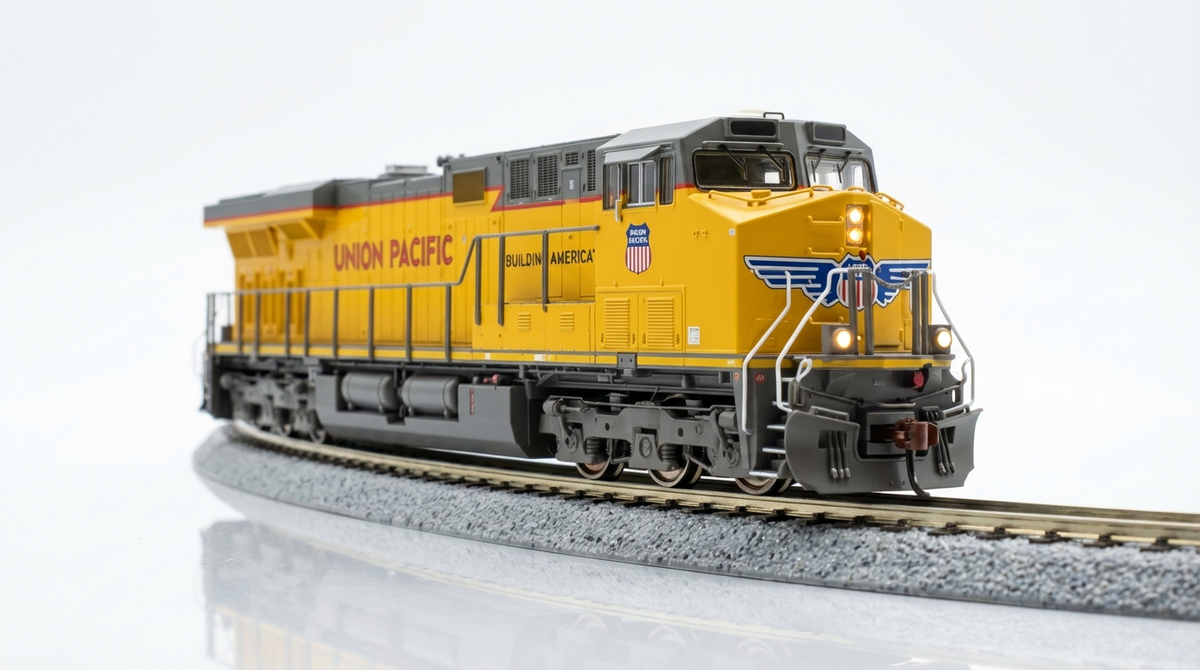
Kato's modern workhorses deserve mention. The ES44AC "Gevo" and SD70ACe feature legendary Kato reliability with smooth performance.
Both are DCC-friendly with simple drop-in board replacements. The ES44AC runs around $125 street price, making it accessible for beginners who want modern power without the premium price. Factory sound versions with ESU LokSound are available.
If you want a complete, matched train that's guaranteed to work out of the box, Kato's passenger and commuter starter sets are the gold standard.
The Chicago Metra MP36PH Bi-Level Starter Set includes locomotive, coaches, cab car, and Kato Unitrack forming a 3x4-foot oval. The locomotives feature five-pole motors with all-wheel electrical pickup for smooth operation.
With a street price around $250, purchasing the components separately would cost significantly more. The included Kato Power Pack SX and Unitrack system are high-quality and suitable for expansion.
For modern mainline passenger operations, Kato's P42 Genesis has simple drop-in DCC decoder options from Digitrax (DN167K0A) and TCS (K0D8-A). The Kato Budd RDC also makes an excellent self-contained passenger car for beginners.
Steam presents unique challenges in N scale due to fragile detailing and rigid wheelbases. But the Bachmann Spectrum 2-8-0 Consolidation has earned its reputation as reliable, smooth-running, and affordable.
It's praised for running "like a dream" right out of the box with good pulling power and 9.75-inch minimum radius capability. Newer runs come with factory-installed "Sound Value" DCC featuring SoundTraxx Econami decoders.
At around $135 for DC or $199 for sound-equipped, it's one of the best values in N scale steam. The fine details can be delicate, so handle with care.
This is the question I get asked most often. Factory DCC sound adds $90 to $150 to the locomotive's price. Is it worth it?
The immersive experience of sound can be the "wow" factor that hooks a newcomer. But N scale's small speaker size creates acoustic limitations. The sound can be perceived as "tinny" if not adjusted properly.
Retrofitting sound into a locomotive requires milling the frame, soldering tiny wires, and finding space for a speaker. That's not a first project. If you want sound, buy factory-installed.
My recommendation for budget-conscious beginners: start with a high-quality DCC-ready locomotive from Kato or Atlas. Run it on DC. When you're ready for DCC, a silent drop-in decoder costs $30-40 and takes minutes to install. Add sound later when your skills and budget allow.
Nothing kills enthusiasm faster than constant derailments. And in N scale, the most common cause is a mismatch between wheel flanges and track type.
N scale track comes in Code 80 (taller, older standard) and Code 55 (shorter, more realistic). Bachmann E-Z Track and Kato Unitrack use Code 80. Atlas and Micro Engineering make Code 55.
Older locomotives and rolling stock (pre-1990s) often have deep, oversized wheel flanges nicknamed "pizza cutters." On Atlas Code 55 track, these large flanges hit the molded plastic "spikes" that hold the rail, causing wheels to lift, bounce, and derail. You'll hear a characteristic buzzing or clicking sound.
The fix is simple: virtually all N scale equipment manufactured in the last 15-20 years comes with low-profile wheels that run perfectly on Code 55 track. When buying modern Kato units for modern Atlas Code 55 track, you'll have no problems.
If you're considering mixing Code 80 for hidden track and Code 55 for visible areas, newer equipment handles both fine. Just avoid vintage rolling stock with visible "pizza cutter" wheels.
"DCC-Ready" should mean easy installation, but you need to know exactly which decoder fits your locomotive. Here's the cheat sheet for the models I've recommended.
Both use the TCS K1D4 or Digitrax DN163K1C/D as drop-in replacements. Digitrax decoders may require trimming plastic pegs inside the shell for clearance. The ESU 58741 LokSound Micro Direct offers a "seamless" drop-in sound upgrade for the ES44AC.
The TCS K1D4-NC is the go-to option. Digitrax SDXN147K1E offers drop-in sound. The ESU 58741 LokSound Micro also fits.
The Digitrax DN147A0, TCS CN-GP, or NCE N12A2 are all simple board replacements on modern (post-2018) runs.
Budget $30-40 for a silent decoder or $80-100 for drop-in sound. Before buying any "DCC-Ready" locomotive, confirm a simple drop-in decoder exists.
This is where my scientific background kicks in. I want data, not marketing claims. Here's what you're actually getting from each manufacturer:
ScaleTrains: Two-year warranty with registration. Covers defects in material and workmanship. Customer pays shipping to service center.
Atlas: One-year warranty from authorized dealer. Requires registration and proof of purchase. Their online parts store has excellent selection for locomotives and rolling stock.
Bachmann: "Lifetime Limited" warranty, but after the first year, a $39-75 service fee applies. Voids if you install DCC.
Kato: Just 60 days of coverage. After that, service fees of $45-85 plus parts apply. They don't repair aftermarket DCC installs. Parts arrive 2-4 months after a model's release and are only restocked on subsequent runs.
For maximum peace of mind, ScaleTrains or Atlas are your safest bets. Kato's legendary quality helps offset their short warranty, but that 60-day clock is a risk.
The used market can save you money, but it's full of other people's problems. The most infamous issue is split axle gears, especially on pre-2010 Bachmann and Life-Like models that used brittle plastic.
Kato (any era, Japan-made): Universally praised for bulletproof mechanisms. Even 1980s models like the Kato GP38-2 are excellent if maintained.
Atlas (post-1996, China-made): Models like the GP40 and RS-3 are excellent runners.
Life-Like Proto 2000 (post-2001): Models like the GP20 (2011+), GP18 (2004+), and SW9/1200 (1997+) are fantastic performers, often on par with Atlas and Kato.
Athearn SD70/SD75 (post-2005): Superb runners, but early runs had mechanism changes affecting DCC compatibility.
Bachmann pre-2010 standard line: Considered "junk" by the community. High risk of split gears and poor electrical pickup.
Early Atlas (Mehano/Yugoslavia-made): 1960s/70s models are described as "terrible."
InterMountain F-units (post-2014): Requires soldering for DCC installation, not drop-in.
Before buying used, consult Spookshow.net's N Scale Locomotive Encyclopedia. Request a running video. Watch for wobble or grinding sounds. Ask about DCC status. Only buy from sellers with clear return policies.
MSRP is a starting point. Street prices at major retailers typically run 15-25% below. Here's what each price bracket gets you:
High-quality, DCC-ready four-axle or modern six-axle diesels with excellent mechanisms. This is where most beginners should shop.
Top-tier DCC-ready models with superior detail or factory-installed silent DCC. Includes "sound-ready" models with pre-installed speakers.
Locomotives with factory-installed ESU LokSound decoders. The ultimate out-of-the-box experience.
Price creep is real. An Atlas GP38-2 that was $99.95 in 2006 now runs $177.95, reflecting inflation and enhanced features.
Here's how to allocate your startup budget for maximum return:
A Kato starter set with locomotive, cars, Unitrack oval, and power pack. Everything works together out of the box.
Atlas GP38-2 (~$150) + Kato M1 Unitrack Set (~$120) + NCE PowerCab DCC system (~$140) + 3-4 Micro-Trains cars (~$90). Component-based for flexibility.
ScaleTrains SD40-2 with factory sound (~$310) + Kato M2 Unitrack Set with siding (~$220) + NCE PowerCab (~$140) + 5-6 quality cars (~$130). High-fidelity from day one.
For UK modelers, the Graham Farish Class 08 Shunter (2022+ run) is perfect for compact layouts. The latest versions feature coreless motors and Next18 DCC sockets with pre-fitted speakers. DCC-ready versions run about £120. Community consensus: stick to "new generation" Farish and Dapol in modern packaging.
For Japanese prototype enthusiasts, the Kato DE10 operates on an impressive minimum radius of just 192mm. Its flywheel-equipped motor ensures smooth performance at all speeds for about ¥6,930 (~$45 USD). Note that Kato models are easier to convert to DCC than Tomix.
For European modelers, the Fleischmann BR 218 (2020+ redesign) features fine details, a powerful motor with flywheel, and 192mm minimum radius. Equipped with a Next18 interface for plug-and-play DCC installation. DCC-ready versions run €180-200.
Getting overwhelmed is the enemy of getting started. Here's a simple progression:
Days 1-10: Set up an oval on a flat surface. Place your locomotive using the rerailer. Connect power. Watch it run. Congratulations, you're a model railroader.
Days 11-45: Practice smooth starts and stops. Add rolling stock one car at a time. Learn coupling and uncoupling. Add a passing siding (like the Kato V1 expansion). Learn to clean track and wheels.
Days 46-90: Install your first DCC decoder using the cheat sheet above. Program an address. If you have sound, experiment with bells and horns. You're now in command.
Your first N scale locomotive should run smoothly out of the box, handle your layout's curves, and offer a clear upgrade path when you're ready for DCC. The Atlas GP38-2 delivers the best balance of performance, price, and flexibility for most beginners. A Kato starter set provides the most complete and foolproof entry into the hobby. ScaleTrains gives you the strongest warranty protection.
Whatever you choose, check production schedules and community recommendations before buying. Your future self will thank you for starting with equipment that works instead of equipment that frustrates.
✨ Complete Your Layout: Explore our wide selection of Photo Real buildings, diorama backdrops, detail parts, and accessories in every popular scale.
✨ Unmatched Realism: From chrome detailing products to neon lighting kits – every piece is designed to make your miniature world come alive.