
Best HO Scale Trains for Beginners: An Electrician's Honest Guide to Your First Layout
Posted by Derek Olson on 29th Dec 2025
Order by phone: 763-231-7847
Free Shipping On Orders Over $100!
If you are already registered, please log in.
Create your account and enjoy a new shopping experience.
Create A New AccountPosted by Derek Olson on 29th Dec 2025
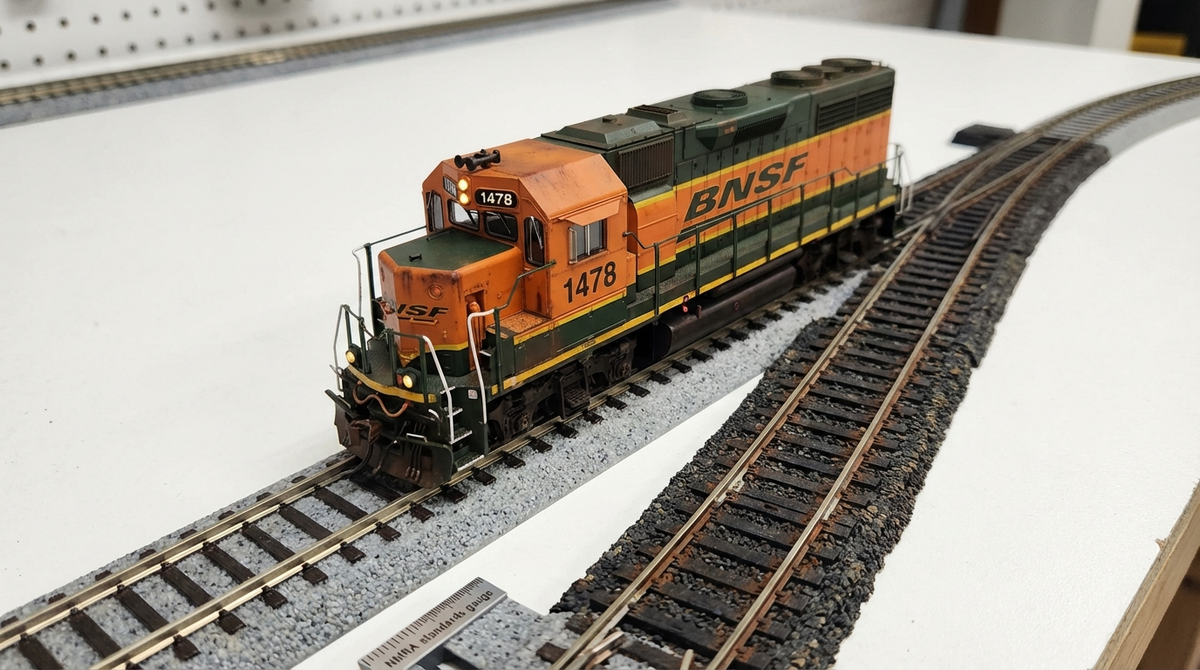
I got hooked on model trains the way a lot of millennials did. My grandfather had a Christmas layout in his basement, and I couldn't stop thinking about those little engines circling through tunnels and past miniature buildings. Fast forward two decades, and I'm running HO scale BNSF freight operations in my spare room.
But getting here? That took some trial and error. I bought the wrong track. I fried a cheap power pack. I watched beautiful passenger cars derail on curves that were way too tight. If you're staring at a wall of starter sets wondering where to begin, I've been there. And as an electrician by trade, I've picked up a few things about what actually matters when you're starting out.
Before we talk gear, let's talk scale. HO scale (1:87 ratio) dominates the North American market for good reason. It hits a sweet spot that nothing else quite matches.
The model train market is growing, projected to hit $1.9 billion by 2032. And HO leads that pack because the trains are big enough to show off great detail but small enough that you can build something satisfying on a 4x8-foot table. That's the classic beginner layout size, and it works.
The selection of HO scale locomotives and rolling stock is staggering. You've got entry-level stuff from Bachmann, mid-range workhorses from Athearn, and museum-quality models from ScaleTrains. Whatever railroad you love, whatever era you want to model, HO has you covered.
Most hobbyists recommend HO for beginners, and I agree. You can handle the trains without tweezers, see the details without a magnifying glass, and still fit a respectable layout in a spare room or garage corner.
Here's where I need to get real with you. The single biggest mistake I see beginners make is buying a cheap starter set without looking at what the track is made of.
There are two options: steel alloy and nickel-silver. Steel track rusts. It tarnishes. And when it does, your trains stall, your lights flicker, and you spend more time cleaning than running. I learned this the hard way with my first set.
Nickel-silver track is what you want. It conducts electricity better and resists corrosion, which means less maintenance and more time watching your trains run. The easy way to tell the difference in Bachmann sets? Gray roadbed means nickel-silver, black roadbed means steel.
That extra $50 upfront for nickel-silver track is the best investment you'll make. Trust me on this one.
Picture this: you buy a gorgeous six-axle diesel locomotive, set it on your shiny new layout, and watch it derail on every curve. What went wrong?
Curves that are too tight. This is the number one cause of beginner frustration.
Most starter sets include 18-inch radius curves. That's the bare minimum for HO, and it only works with smaller equipment. If you want to run modern passenger cars or big diesel locomotives, you need 22-inch radius curves at minimum. For full-length 85-foot passenger cars, go to 24 inches or more.
Here's my rule of thumb for a 4x8-foot layout: stick with 22-inch radius curves and run equipment from the transition era (1946-1960). Those shorter 40-foot boxcars and four-axle diesels look great on tighter curves and won't give you grief.
When I started, DCC (Digital Command Control) seemed like something only hardcore hobbyists needed. That's changed. In 2025, if you're planning to run more than one train or want to control lights and sounds, DCC is the way to go.
DC (analog) control is simple: turn the dial, train goes faster. But you can only run one train at a time on a single track section. DCC sends digital signals to decoders inside each locomotive, letting you run multiple trains independently on the same track.
The good news? Most brands now sell DCC-ready locomotives with sockets for easy decoder installation. And entry-level DCC systems have gotten affordable. You're looking at around $185-$200 for a solid starter system that will grow with you for years.
If you're on a tight budget and just testing the waters, start DC. But if you know you're in this for the long haul, go DCC from day one. You'll save money by not buying equipment you'll replace later.
Let me break down the main options by budget and what you're trying to accomplish.
The Bachmann Santa Fe Flyer runs around $135 and gives you everything to get started: locomotive, cars, track, and power pack. The price point around $135 makes it tempting.
The catch? It uses steel track. Buy this knowing you'll probably replace the track within a year if you stick with the hobby.
For steam fans, the Bachmann Pacific Flyer at around $153 gives you a charming 0-6-0 steam locomotive with operating headlight. Same limitations apply.
Here's where I tell everyone to spend their money. The WalthersTrainline Flyer Express costs around $230 and fixes most problems with budget sets. You get nickel-silver track, metal wheels on the cars, and a locomotive with a smooth can motor and flywheel.
WalthersTrainline sits in that sweet spot between toy-grade and hobby-grade. The Athearn Ready to Roll line offers similar quality in individual locomotives if you want to build your own starter bundle.
Want digital control out of the box? The Bachmann Digital Commander runs about $428 and includes two DCC-equipped locomotives, nickel-silver track with a siding, and Bachmann's E-Z Command system. You can control both trains independently right away.
The 56x38 inch oval with turnout gives you room to actually do something beyond watching trains circle. That siding opens up basic switching operations.
If you want to do this right from the start, pair Kato's HM-1 Unitrack set with a quality locomotive. Kato Unitrack is what I run on my layout. The track snaps together with bulletproof electrical connections, and I've never had a dead spot.
The Kato Unitrack system uses nickel-silver Code 83 rail on a realistic roadbed. It's the gold standard for sectional track. Add a HV2 Passing Siding set with #6 turnouts when you're ready to expand.
Let me break down your main options for beginner-friendly track.
| System | Rail Material | Best For | Watch Out For |
|---|---|---|---|
| Kato Unitrack | Nickel-Silver | Reliability, expansion | Higher initial cost |
| Bachmann E-Z Track (Gray) | Nickel-Silver | Starter sets, availability | Limited curve options |
| Bachmann E-Z Track (Black) | Steel | Lowest cost entry | Rust, poor conductivity |
| Atlas True-Track | Nickel-Silver | Realistic appearance | Fewer expansion sets |
Kato's boxed track sets make it easy to get started. The HM-1 basic oval with power pack gives you a foundation you'll never outgrow.
For ground-level track sections and manual turnouts, Kato offers everything you need to build a complete layout.
If you're going digital, here are the starter systems worth considering.
At around $185-$197, the Zephyr Express packs 3 amps of power and supports up to 20 throttles. The color screen makes programming easier than older systems.
The Power Cab from NCE is a handheld all-in-one system that many modelers swear by for its intuitive controls. It outputs 2 amps and can be upgraded with a booster as your layout grows.
Either system will handle a home layout with multiple locomotives. Pick based on whether you prefer a base station style (Digitrax) or handheld style (NCE).
Most modern locomotives come DCC-ready with an 8-pin or 21-pin socket. Installing a decoder is literally plug-and-play.
For Kato locomotives like the P42, the installation requires minor modifications but is well-documented. SoundTraxx and Digitrax both make plug-and-play decoders for popular locomotive models.
For 8-pin installations in Kato diesels, you pop off the shell, remove the dummy plug, and insert the decoder. Ten minutes, tops.
Beyond starter sets, here are some locomotives that perform well for beginners.
The Athearn RTR 2-6-0 Mogul brings old-time steam charm with upgraded drive systems. These run smooth out of the box and come DCC-ready.
For diesel fans, Athearn's diesel lineup covers most popular prototypes at prices that won't hurt. They feature McHenry operating scale knuckle couplers and run on all-wheel drive.
If you love Amtrak, the Kato GE P42 is a beauty. These locomotives handle curves down to 370mm (about 14.5 inches), making them workable on smaller layouts. The smooth mechanism and detailed shells make these crowd favorites.
Kato even sells a P42 starter set with Unitrack and accessories.
Let me save you from the errors I made and the ones I see constantly in forums.
I've beat this drum already, but it bears repeating. Steel rusts. Nickel-silver doesn't. Spend the extra money now or spend it later when you rip out your rusty track.
That beautiful modern SD70 locomotive with 30-inch overhang will look ridiculous on 18-inch curves and probably derail constantly. Match your equipment to your track radius.
Even nickel-silver track needs occasional cleaning. Dirty rails mean stalling trains. Wipe down your rails with isopropyl alcohol before running sessions, and clean your locomotive wheels regularly.
Those cheap power packs in starter sets can't handle much expansion. If your trains start running sluggish when you add track or locomotives, you've outgrown your power supply. Budget for an upgrade.
Before you nail anything down, lay out your entire track plan on the table or floor. Run trains through every turnout and around every curve. Fix problems now, not after you've ballasted everything.
The model railroading community is one of the hobby's best features. Here's where to find help.
The NMRA Beginner's Guide covers everything from choosing a scale to laying track. It's free and written by experienced modelers who remember what it was like to start out.
For DCC questions, YouTube channels like Larry Puckett (The DCC Guy) break down wiring and programming in ways that make sense.
Online forums like Trains.com and ModelRailroadForums have decades of archived discussions. Whatever problem you're facing, someone has solved it before and written about it.
If I had to start over today with a $300 budget, here's exactly what I'd buy:
That gives me a rock-solid foundation I won't have to replace. When I'm ready for DCC, I'll add an NCE Power Cab. When I'm ready for expansion, I'll grab the Kato HV-2 passing siding set.
The right starting equipment makes the difference between a frustrating hobby and one that keeps you coming back to the basement every night. Spend a little more upfront on quality, and you'll save money and headaches in the long run.
Welcome to the club. Your grandfather would be proud.
By Derek OlsonBuild Your Dream Railroad with Innovative Hobby Supply!
?️ Complete Your Layout: Explore our wide selection of Photo Real buildings, diorama backdrops, detail parts, and accessories in every popular scale.
✨ Unmatched Realism: From chrome detailing products to neon lighting kits – every piece is designed to make your miniature world come alive.