
What Scale Model Train Should I Start With? A Practical Guide to Getting It Right the First Time
Posted by Benjamin Park on 31st Dec 2025
Order by phone: 763-231-7847
Free Shipping On Orders Over $100!
If you are already registered, please log in.
Create your account and enjoy a new shopping experience.
Create A New AccountPosted by Benjamin Park on 31st Dec 2025
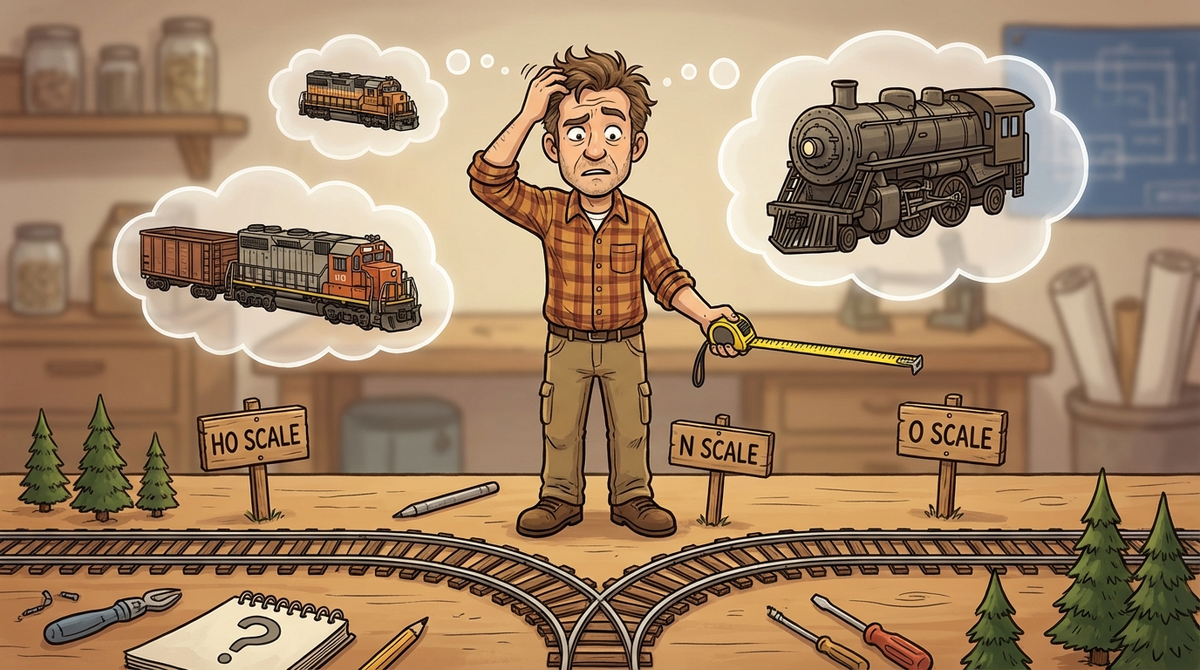
I've watched it happen a dozen times. A new modeler walks into our operating sessions with that familiar look of regret, explaining how they just sold off their entire HO collection because it "didn't fit" their apartment. Or worse, they're sitting on three half-finished layouts in storage because they kept switching scales trying to find the right one.
Here's the thing nobody tells you when you're standing in the hobby shop, credit card in hand: your choice of model railroad scale will shape every decision you make in this hobby for years. It's more permanent than your era, your prototype railroad, even your control system. Get it wrong, and you're looking at costly rebuilds, frustrating compromises, or boxes of equipment gathering dust in your closet.
I've been modeling the Milwaukee Road's stretch between Minneapolis and Miles City since the mid-1990s. I chose HO because that's what everyone around me ran, and honestly, it worked out. But I've seen enough scale-switching disasters in my club to know that luck shouldn't be your strategy. Let's fix that.
Model railroad scales aren't just about how big your trains look on the shelf. The ratio between your model and the real thing determines what you can realistically build in your available space, how much you'll spend, and whether you'll actually enjoy running your railroad or constantly fight derailments and operational headaches.
A scale that's too large for your room forces you into unrealistically tight curves. Those tight curves restrict which locomotives and rolling stock will run reliably. You end up with a layout that looks cramped and operates poorly. I've seen guys try to squeeze a big HO scale mainline into a bedroom, only to discover their brand-new SD70MAC won't make it around the corners without derailing.
On the flip side, choosing a scale that's too small can frustrate you in different ways. If your eyesight isn't what it used to be, or your hands aren't particularly steady, wrestling with tiny N scale couplers at midnight becomes an exercise in aggravation rather than relaxation.
The research is clear: space incompatibility is the number one reason hobbyists abandon their initial scale choice. Over 60% of scale-switchers cite it as their primary motivation. That's a lot of wasted money and lost time that could have been avoided with ten minutes of honest assessment upfront.
Let me be direct: if you have no strong constraints pushing you elsewhere, HO scale is probably your answer. It commands roughly 70% of the market for good reason.
At a 1:87.1 ratio with 16.5mm track gauge, HO models are large enough to showcase fine detail and handle comfortably. They're small enough that a spare bedroom or basement corner can host a satisfying layout. A 4x8 foot sheet of plywood gives you room for a basic oval with a few industries to switch.
The real advantage of HO isn't the size itself. It's what I call the "network effect." Major manufacturers like Athearn, Atlas, Bachmann, Kato, ScaleTrains, and Walthers release new products constantly. You'll find locomotives, freight cars, passenger equipment, and structures for virtually every prototype railroad and era imaginable.
This ecosystem depth translates to practical benefits. Need a replacement part at 9 PM on a Saturday? Your local hobby shop probably stocks it. Want to join a club and run your equipment on someone else's layout? HO clubs outnumber other scales by a factor of five to ten. Looking to sell some surplus equipment? The secondhand market is enormous, and well-maintained HO equipment holds its value better than any other scale.
Here's where I have to give you the hard truth. That classic 4x8 foot plywood layout? It's actually a compromise most experienced modelers advise against.
The problem is 18-inch radius curves. That's what fits inside a 4-foot width. While 18-inch curves technically work for small switchers and 40-foot freight cars, they're too tight for modern six-axle diesels, long passenger cars, and articulated steam locomotives. Your Big Boy won't make it around the corner. Neither will those beautiful 85-foot Amtrak Superliners you've been eyeing.
A better approach: build an "around-the-walls" shelf layout. By using 12 to 18 inches of depth along your room's perimeter, you can achieve 22-inch or larger radius curves while preserving floor space in the center. You'll run more equipment reliably and create a more visually impressive railroad.
A decent HO starter set runs $150 to $250. That gets you a locomotive, a few cars, an oval of track, and a basic power pack. Bachmann's Rail Chief set is a popular entry point.
Budget another $50 to $100 for extra track and turnouts. A simple oval gets boring fast, and turnouts run $25 to $40 each. You'll want at least two to create a passing siding or industrial spur.
If you're working with an apartment, a shared bedroom, or just prefer maximizing your modeling within a small footprint, N scale at 1:160 deserves serious consideration.
The math works in your favor. N scale models are roughly half the size of HO. That means you can fit twice the railroad into the same space, or build something comparable in half the footprint. A complete switching layout fits on a 2x4 foot board. A standard 4x8 table can host a multi-level empire with broad curves and realistic track spacing.
I've seen N scale layouts that genuinely take my breath away. The sense of distance and scale is remarkable when you're standing back and watching a long freight wind through mountain scenery. Because everything is smaller, your mountains can be taller, your rivers can be wider, and your mainline can have that sweeping, cross-country feel that's hard to achieve in larger scales.
There's no free lunch. N scale's space efficiency comes with what I call the "dexterity tax."
These models are small. Handling, weathering, and maintaining them requires steady hands and good eyesight. Installing a DCC decoder in an N scale locomotive involves components the size of your thumbnail. If you struggle with fine motor control or need reading glasses, this might not be your scale.
Track cleaning and maintenance also demand more precision. N scale wheels are tiny, and even small amounts of debris cause problems. You'll become intimately familiar with track cleaning techniques.
N scale enjoys the second-largest ecosystem after HO. Kato's Unitrack system is particularly popular with beginners for its snap-together reliability. Atlas, Bachmann, and Micro-Trains offer extensive product lines.
Starter sets are comparable to HO, running $120 to $270 depending on the locomotive and contents. Individual N scale locomotives may run 5-15% more than equivalent HO models, though this varies by manufacturer.
At 1:48 scale, O scale trains have presence. There's no other word for it. When a big O scale steam locomotive rumbles past, you feel it. The detail is visible from across the room. The weight in your hand is satisfying.
O scale splits into two camps that couldn't be more different.
Traditional three-rail O gauge is the classic American toy train format. Lionel has been making these since 1901. The center rail simplifies wiring, the trains are robust enough for young children to handle, and there's something magical about watching a Lionel train circle the Christmas tree.
Modern systems like Lionel's LionChief use Bluetooth remote control, making setup as simple as connecting a few track sections and pressing a button on your phone. Sound, smoke, and lighting effects add to the experience.
If you're building a family tradition around a holiday train, three-rail O gauge is hard to beat. It's durable, impressive, and forgiving of the rough handling that comes with excited kids.
Two-rail O scale is a different animal entirely. It uses standard two-rail track like HO and N, operates on DC or DCC, and prioritizes prototypical accuracy over toy-like durability.
The results can be stunning. Two-rail O scale models achieve a level of detail that smaller scales simply can't match. But the space requirements are substantial. Running larger equipment reliably requires O-72 curves, which create a circle six feet across. Your layout room needs to be large.
A quick note that trips up many beginners: O gauge curve designations refer to diameter, not radius. O-36 means a 36-inch diameter circle, not a 36-inch radius. That's a common source of "my layout won't fit" frustration.
For family layouts, O-36 curves offer a good balance between space efficiency and operational reliability. They'll fit most starter set equipment while keeping your footprint around 40 inches wide including roadbed.
G scale garden railroads represent a completely different hobby within a hobby. At 1:22.5 to 1:32 scale running on 45mm track, these trains are designed for outdoor use.
The appeal is undeniable. A train winding through actual landscaping, past real rocks and living plants, creates a visual impact no indoor layout can match. Weather-resistant materials and robust construction mean these trains handle sun, rain, and temperature swings.
Traditional G scale runs on track power, but outdoor environments create serious electrical challenges. Brass track oxidizes, requiring constant cleaning. Moisture causes shorts and corrosion. Many garden railroaders spend more time maintaining track conductivity than actually running trains.
Battery power with radio control eliminates these headaches entirely. The locomotive carries its own power source and receives commands wirelessly. No track wiring, no cleaning, no weather-related electrical gremlins.
The upfront cost is higher, roughly $150 or more per locomotive for battery/RC conversion. But the long-term savings in time and frustration often justify the investment within a few seasons.
G scale starter sets run $300 to $450 for basic equipment. Add track, a suitable outdoor space, and landscaping materials, and you're looking at a significant investment before your first train turns a wheel. This is not a budget-conscious entry point.
TT scale at 1:120 sits between N and HO, offering more detail than N with smaller space requirements than HO. It's been popular in Germany and Eastern Europe for decades.
The big news is Hornby's major investment in TT:120 starting in 2022. If you're interested in British prototypes, this scale now offers a growing range of quality locomotives, rolling stock, and track from Peco.
For North American prototypes, TT remains a niche with limited selection. Stick with HO or N unless you're specifically drawn to UK railways.
S scale at 1:64 is historically associated with American Flyer trains. It offers a pleasing size between HO and O, with good handling characteristics and room for detail.
The challenge is ecosystem. Product availability is limited compared to the major scales. While the NASG community provides solid support, you'll spend more time hunting for products and may need to embrace kit-building.
I'd recommend S scale for a second or third layout, not a first. The limited selection makes it harder for beginners to find exactly what they want.
Z scale at 1:220 is the smallest commercially available scale. Entire layouts fit inside briefcases. Märklin introduced it in 1972, and it remains a specialty product.
These models are fragile, challenging to maintain, and demand excellent fine motor skills. The ecosystem is small, with limited product availability. Starter sets run $170 or more.
Z scale is for experienced modelers fascinated by the challenge of working in miniature, not beginners seeking an easy entry into the hobby.
Your scale choice and control system choice are linked. Let me give you the quick version.
Traditional DC controls the track. Varying voltage and polarity determines speed and direction. Simple and cheap, but running multiple trains independently requires complex "block" wiring.
DCC (Digital Command Control) puts a decoder in each locomotive. Constant power stays on the track while digital commands tell specific locomotives what to do. Multiple trains run independently on the same track. Sound, lighting, and other functions become possible.
Here's my advice: even if you start with DC, buy locomotives that are "DCC-Ready" with standardized decoder sockets. The cost of retrofitting sound decoders into non-DCC-ready locomotives averages over $100 per unit. Buying smart now saves real money later.
Beginner-friendly DCC systems like the NCE Power Cab and Digitrax Zephyr Express run under $200 and are fully expandable as your layout grows.
I've watched these disasters unfold over three decades. Learn from other people's expensive lessons.
Space: 36 x 12 inches. Budget: $250-350.
Start with a Kato Compact oval set for around $30. Add a Kato or Bachmann 4-axle switcher ($80-120), three or four Micro-Trains 40-foot boxcars ($75 total), and a couple of compact turnouts ($60).
The included Kato DC power pack works fine to start. Build to T-TRAK standards and your layout becomes portable, expandable at club meets, and part of a larger modular community.
Space: 40-inch diameter circle. Budget: $300-450.
A Lionel LionChief starter set includes everything: locomotive with sound, cars, O-36 FasTrack, and Bluetooth remote. Set it up on Christmas Eve, pack it away in January.
The Bluetooth control means no complex wiring. Kids can operate it from a phone app. The O-36 curves accommodate a wide range of equipment if you decide to expand later.
Space: 10x20 feet minimum. Budget: $500-800 to start.
A basic LGB or PIKO starter set runs $300-450. Budget additional funds for track expansion and consider stainless steel rail over brass for lower maintenance.
Plan for battery power conversion in your future. The reliability benefits justify the upfront investment. Run all outdoor electrical from GFCI-protected outlets.
Where you live affects product availability and community support.
In North America, HO dominates, followed by N and O. NMRA standards prevail. Kadee-compatible knuckle couplers are the operational norm.
In the UK, OO gauge at 1:76.2 is standard, running on the same 16.5mm track as HO but with slightly larger models. Hornby and Bachmann UK dominate the market.
In continental Europe, HO remains popular, but Märklin's three-rail AC system is widespread, especially in Germany. It's electrically incompatible with standard two-rail DC/DCC equipment. European modelers should verify whether equipment is for the two-rail or three-rail market before purchasing.
After running timetable-and-train-order sessions on my Milwaukee Road layout for twenty years, I've come to appreciate that the right scale is the one that matches your specific constraints and goals. Not someone else's. Not what the internet says is "best." Yours.
Measure your available space honestly. Be realistic about your budget and your manual dexterity. Think about whether you want operational complexity or visual impact. Consider whether children will be involved.
For most people with a spare room or basement corner, HO offers the best combination of ecosystem support, cost, and operational possibilities. If space is genuinely tight, N scale lets you build something meaningful in a small footprint. If you want a family tradition around the Christmas tree, O gauge delivers durability and presence. If you have outdoor space and the budget, G scale creates an experience unlike anything else in the hobby.
The NMRA's Beginner's Guide is worth reading cover to cover before you buy anything. Visit a local club if possible. Handle equipment in different scales. See what feels right in your hands and fits your vision.
Your first scale choice doesn't have to be your last. But getting it right the first time means more time running trains and less time selling off equipment you can't use. Take the time to measure twice so you only have to buy once.
✨ Complete Your Layout: Explore our wide selection of Photo Real buildings, diorama backdrops, detail parts, and accessories in every popular scale.
✨ Unmatched Realism: From chrome detailing products to neon lighting kits – every piece is designed to make your miniature world come alive.