
What Does HO Scale Mean in Model Trains? The Complete 1:87 Breakdown
Posted by Tamara Brooks on 29th Dec 2025
Order by phone: 763-231-7847
Free Shipping On Orders Over $100!
If you are already registered, please log in.
Create your account and enjoy a new shopping experience.
Create A New AccountPosted by Tamara Brooks on 29th Dec 2025
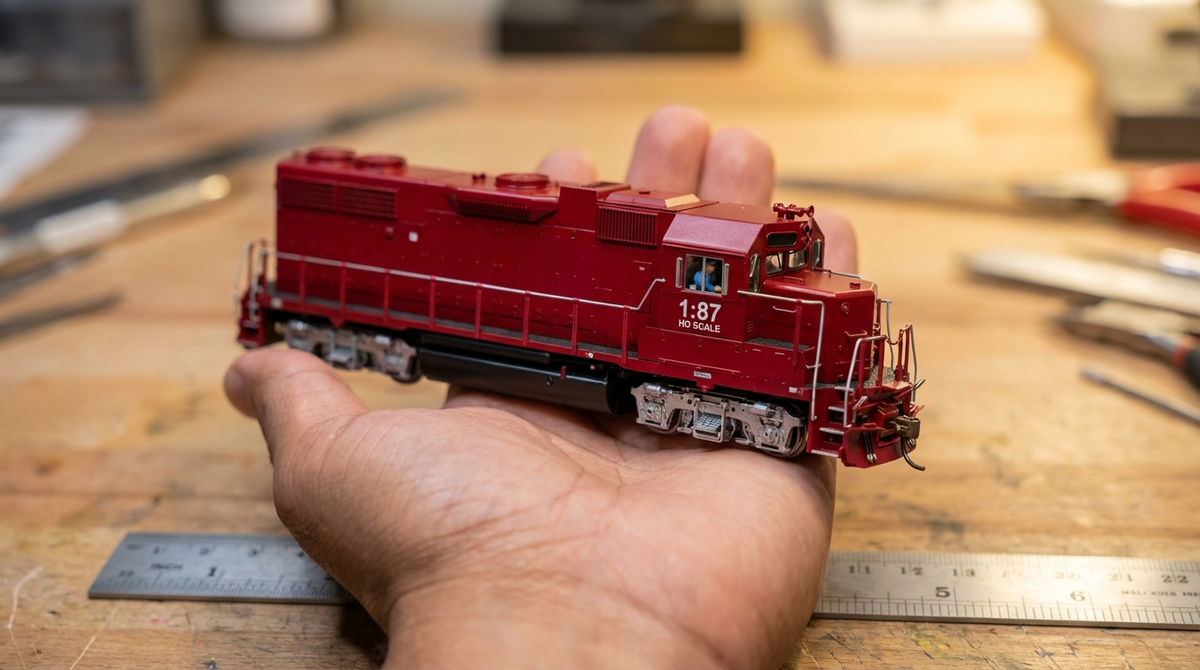
I run N scale. There, I said it. But if you're asking what HO scale means in model trains, you've landed in good hands because I've spent more hours than I'd like to admit helping friends troubleshoot their HO layouts, and I've got strong opinions about why this scale dominates two-thirds of the market.
Let me give you the short answer first, then we'll get into the weeds.
HO scale gets its name from the German phrase "Halb-null" meaning "half-zero" because it's roughly half the size of the older O scale that dominated the hobby before World War II. When manufacturers needed a smaller scale that could fit in apartments and spare bedrooms, they literally halved the track gauge from 32mm down to 16.5mm.
The scale ratio works out to 1:87, which means every inch on your model represents 87 inches on the real thing. A 40-foot boxcar? That's about 5.5 inches long on your layout. An 85-foot Amtrak passenger car? Just under 12 inches.
This makes HO the most popular model railway scale worldwide, commanding roughly 65% of the market. For hobbyists, this translates to unmatched variety in ready-to-run models, kits, and accessories from dozens of manufacturers.
Here's where things get a tiny bit complicated, though it barely matters in practice.
In Europe, the MOROP NEM 010 standard defines H0 as exactly 1:87. Clean, simple, elegant. The Europeans like their precision.
In North America, the NMRA Standard S-1.2 defines HO as 3.5mm representing one foot, which mathematically works out to 1:87.0857. Most people round this to 1:87.1.
The difference between 1:87 and 1:87.1? About the thickness of a coat of paint on an 85-foot passenger car. Equipment from both regions is fully interoperable. I've never heard of anyone having problems mixing European and American HO equipment.
New modelers mix these up constantly, so let me be blunt about the difference.
Scale is the ratio of your model to the real thing. In HO, that's 1:87.
Gauge is the distance between the rails. For HO scale representing standard-gauge prototype (4 feet 8.5 inches, or 1,435mm), that distance is 16.5mm.
Here's where the math actually works beautifully: 16.5mm multiplied by 87 equals 1,435.5mm. That's almost a perfect scale representation of real-world standard gauge track. This precise relationship is why HO locomotives and cars look "right" to most people.
You've got your 16.5mm gauge figured out. Now you need to pick a rail code, which refers to the height of the rail in thousandths of an inch.
Code 100 track stands 0.100 inches tall. It's been the industry standard for decades because it's incredibly forgiving. Got an older locomotive with deep "pizza cutter" wheel flanges? Code 100 doesn't care. Minor kinks in your track joints? Code 100 handles them.
The downside? That tall rail looks toy-like compared to prototype track. It's oversized compared to almost any real-world rail profile.
Code 83 track has become the go-to choice for realistic modeling. It scales to approximately 132 lb. rail, which matches modern mainline prototypes. Both Atlas and Peco offer extensive Code 83 product lines.
The catch: Code 83 works best with modern wheels built to the NMRA's RP-25 standard. Old deep-flange wheels will bump along the ties.
Finer rail profiles like Code 70 create a visual hierarchy on your layout. Use them for industrial spurs, sidings, and branch lines where prototype railroads ran lighter rail. Just know they demand well-maintained track and properly gauged wheelsets.
Mixing codes? You'll need transition joiners or shims to align the rail tops. Some manufacturers, like Atlas, design their Code 83 with thicker ties so railhead heights match their Code 100, simplifying the transition.
This is where I see people waste money. Multiple scales use that same 16.5mm track gauge but are NOT the same scale. If you don't understand this, you'll end up with mismatched equipment that looks terrible together.
OO gauge models are built to 4mm-to-the-foot scale, making them noticeably larger than true 1:87 HO. This historical compromise happened because early British motors were too bulky to fit inside smaller locomotive bodies at the correct scale.
The result? OO trains appear to run on narrow-gauge track. While OO trains can physically operate on HO track, they should never be mixed with true HO equipment because the size difference is obvious.
Many Japanese models are produced at 1:80 scale on 16.5mm track. This practice, sometimes called "16-ban," represents Japan's 1,067mm narrow-gauge prototypes. Major manufacturers like Kato and Tomix produce extensive lines this way.
For greater accuracy, some Japanese modelers use 13mm gauge track or model in true 1:87 on 12mm track.
Märklin produces H0 models at the correct 1:87 scale on 16.5mm gauge. Sounds compatible, right? Wrong. Their system uses a third rail of studs running down the center of the track for power pickup, operating on AC current.
This makes Märklin equipment incompatible with two-rail DC/DCC systems without serious modification. Know what you're buying.
The magic behind HO's interoperability comes from two standards organizations: the NMRA in North America and MOROP (publishing NEM standards) in Europe.
The NMRA publishes Standards and Recommended Practices that define everything from wheel dimensions to coupler heights. When you buy equipment advertised as NMRA-compliant, you're getting a baseline guarantee of interoperability.
Key specifications include:
European NEM standards cover similar ground. The NEM 362 standard defines a universal coupler pocket that allows interchangeable coupler mechanisms.
An NMRA Standards Gauge is the single most useful diagnostic tool you can own. It lets you check track gauge, wheel spacing, and flange dimensions in seconds. When a car derails repeatedly, the gauge tells you whether your wheels or your track are out of spec.
HO scale provides a complete ecosystem for modeling narrow-gauge railroads without leaving the 1:87 world. The naming convention is straightforward: "HO" denotes scale, letters indicate gauge type.
HOn3 represents American 3-foot gauge prototypes using 10.5mm track. This scale is perfect for modeling Colorado lines like the Denver & Rio Grande Western. Peco manufactures HOn3 track, and Blackstone Models offers ready-to-run equipment.
H0m represents metre-gauge (1,000mm) prototypes on 12mm track. Swiss and Austrian alpine railways are popular subjects.
This variant uses 9mm track (same as N scale standard gauge) to represent prototype gauges from 750mm to 30 inches. The "e" suffix follows European NEM designation. This opens up the entire N scale track catalog for your HO narrow-gauge railroad.
A 4x8 sheet of plywood is the classic beginner platform, but it's honestly terrible for HO. Here's why.
That 4-foot width limits your curve radii to 22 inches or less. While some 4-axle diesels handle 18-inch curves, modern 6-axle locomotives and 85-foot passenger cars need 24 inches minimum. Large articulated steam locomotives demand 28 inches or more.
A far better approach is the around-the-walls shelf layout. Run 18-24 inch shelves along your room's perimeter. This opens up the center for a wide aisle and allows 30-inch radius curves in the corners.
In a 10x12 room, you'll get more operational track, broader curves, and a layout that doesn't look like a pretzel.
Never transition directly from straight track into a curve. Use easements, which are gradual spiraling transitions. The NMRA provides formulas for laying these out. Your trains will run smoother, and the visual improvement is dramatic.
Most first-layout frustration traces back to a handful of avoidable problems. I've diagnosed enough friend's layouts to know the pattern.
Underweight cars derail. It's physics. Follow the NMRA RP-20.1 formula: one ounce initial weight plus half an ounce for each inch of car length. The NMRA weight recommendations exist because they work. Use a postal scale. Add weight low and centered over the trucks.
Mismatched couplers cause trains to come apart on grades. Get a Kadee #206 height gauge and set every coupler to the standard 25/64" height. Kadee makes offset shank couplers for adjustments.
Use that NMRA Standards Gauge to check that track gauge falls within tolerance and wheelsets have correct back-to-back spacing. This prevents wheels from "picking the points" at turnouts.
Poor wiring causes mysterious DCC problems. Here's what actually works.
Use 14 AWG or heavier wire for your track bus. Run feeder wires to every piece of rail. Do not rely on rail joiners for electrical conductivity. Solder all connections.
Test your short-circuit protection with the quarter test: place a coin across the rails at various points. Your booster should shut down instantly. If it doesn't, your wiring has too much resistance, which creates a fire and equipment hazard.
HO's massive market offers a clear progression from starter to advanced without requiring you to scrap everything and start over.
Start with a train set using Code 100 sectional track. Atlas snap track or Kato Unitrack are both solid choices. Get a DCC-ready 4-axle diesel from a reputable brand. A basic DC power pack is fine to start.
Transition to Code 83 flextrack. Learn to install quality turnouts like Peco Unifrogs. Upgrade plastic wheels to metal RP-25 wheelsets. Install a starter DCC system and basic mobile decoders.
Install premium sound decoders like ESU LokSound or SoundTraxx Tsunami2. Proper speaker enclosure design matters for audio quality. Start super-detailing and weathering.
Smart component choices now save headaches later.
When buying new DCC-ready locomotives, look for modern plug-and-play interfaces like 21MTC or PluX22. These multi-pin connectors provide more function outputs than the older 8-pin standard.
Standard DCC only talks one direction. RailCom enables bidirectional communication, letting decoders report their address and speed back to the command station. This enables programming on the main track and automatic locomotive recognition.
Dirty track and insulated turnout frogs cause power interruptions. A keep-alive capacitor stores energy to power through these dead spots. TCS, SoundTraxx CurrentKeeper, and ESU all make versions.
Proto:87 offers museum-quality accuracy by using prototype wheel and track dimensions. This means shallower flanges and much narrower flangeways than standard HO.
The visual gain is real. The commitment is total. Proto:87 wheels won't run on standard HO track, and standard wheels won't run on Proto:87 track. This path is for dedicated craftsmen who prioritize accuracy over flexibility.
I model N scale because I wanted tighter curves and longer trains in my basement. But I understand exactly why HO commands two-thirds of the hobby.
The 1:87 ratio hits a sweet spot. Models are large enough for serious detailing and easy handling but small enough to fit operational layouts in normal rooms. The scale-to-foot relationship makes mental conversions simple. And that massive ecosystem of manufacturers competing for your dollars keeps innovation flowing and prices reasonable.
For most people asking what HO scale means, it means options. More locomotives, more rolling stock, more track systems, more accessories than any other scale. Whether you're running your first train set or hand-laying Proto:87 track, HO provides a clear, well-supported path.
My cats remain unimpressed by both scales.
By Tamara BrooksBuild Your Dream Railroad with Innovative Hobby Supply!
?️ Complete Your Layout: Explore our wide selection of Photo Real buildings, diorama backdrops, detail parts, and accessories in every popular scale.
✨ Unmatched Realism: From chrome detailing products to neon lighting kits – every piece is designed to make your miniature world come alive.