
OO Gauge vs HO Gauge Differences: What Every 4mm Modeler Needs to Know
Posted by Patricia Nakamura on 31st Dec 2025
Order by phone: 763-231-7847
Free Shipping On Orders Over $100!
If you are already registered, please log in.
Create your account and enjoy a new shopping experience.
Create A New AccountPosted by Patricia Nakamura on 31st Dec 2025
When I first started helping out at my local model railroad club, someone asked me whether my dad's old British locomotives would run on their HO layout. "Same track gauge," they said with a shrug. "Should work fine."
It took me about thirty seconds of watching a Hornby Dublo steam engine waddle down their Atlas track, looking like a giant among Lilliputians, to realize something was very wrong. That moment taught me a lesson I'm passing on to you: OO and HO are not the same thing, even though they share identical rails.
Here's the source of all the confusion. Both OO and HO gauge models run on 16.5mm track. You can physically put an OO locomotive on HO rails and it will move. The wheels fit. The power works. Everything seems fine until you park them next to each other and the visual illusion shatters completely.
The math tells the story. HO scale operates at 1:87, meaning the models are 87 times smaller than the real thing. OO scale runs at 1:76.2, making those models about 14% larger in every direction. That percentage sounds small. It isn't.
Think of it this way: if HO is a medium coffee, OO is a large. They're both coffee. They both fit in your cupholder. But nobody would confuse them side by side.
I love a good origin story, and this one involves a real engineering puzzle from the 1930s.
The German firm Bing launched their Table Railway system in 1922, marketed in the UK by Bassett-Lowke. This tiny format let you run trains on your dining table instead of needing an entire room. Revolutionary stuff.
But here's where Britain hit a wall. British prototype locomotives are physically smaller than American or European ones because of the UK's restrictive loading gauge. When manufacturers tried to squeeze 1930s-era electric motors into true 1:87 scale British steam engines, especially those with narrow, tapered boilers, the motors simply didn't fit.
The solution? British manufacturers adopted 4mm-to-the-foot scale bodies while keeping the existing 16.5mm track that HO used. Bigger bodies meant room for the motors. Problem solved, sort of.
When Meccano Limited launched Hornby Dublo in 1938, this hybrid approach became the British standard. The new system used slightly oversized 4mm scale specifically so the same third-party accessories could work with both Trix and Hornby products. Smart business move that locked in the standard for nearly a century.
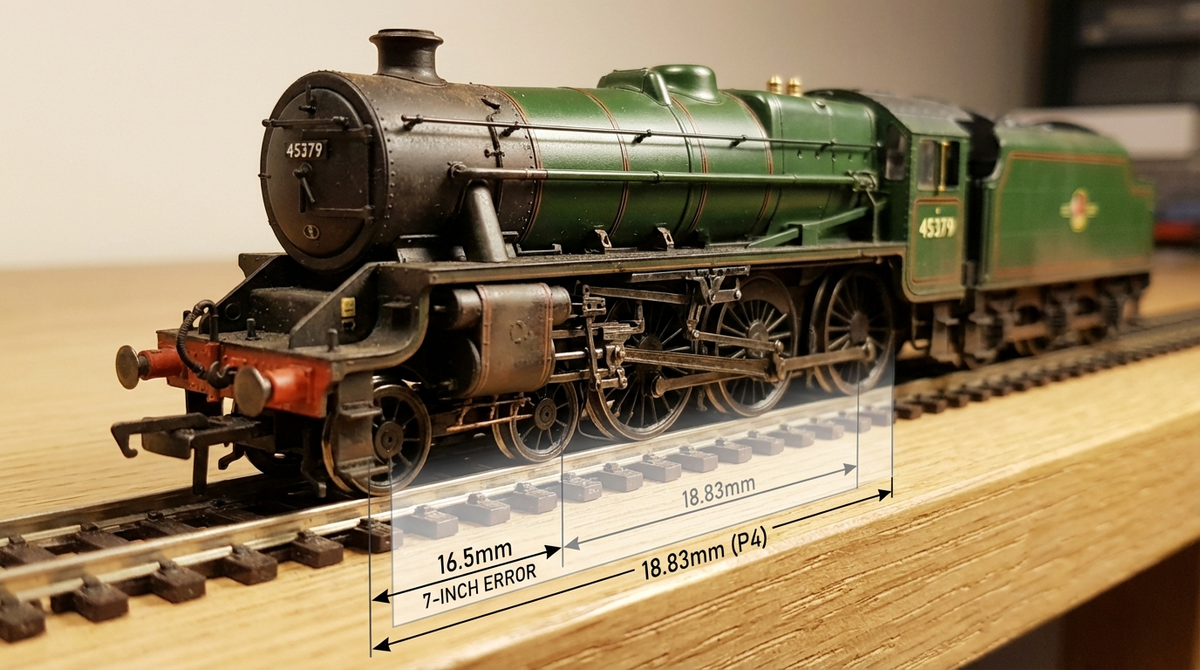
Here's the uncomfortable truth that purists won't let you forget. Those 16.5mm rails represent perfect standard gauge (1,435mm) when you're working in true HO scale at 1:87. But in OO scale, that same track represents only 1,257mm, about 7 inches too narrow.
Every OO train technically looks like it's running on narrow gauge track. Most of us accept this as part of the deal. If you can't live with it, you're looking at EM gauge at 18.2mm or the exacting P4 standard at 18.83mm, which requires re-wheeling your entire fleet and building your own track.
That 14% linear difference cascades into something much bigger when you consider volume. An OO model has roughly 49% more volume than its HO equivalent. They don't just look a bit bigger. They feel substantially different in your hand.
For practical comparison, a 6-foot person scales down to 24mm in OO but only 21mm in HO. A BR Mark 1 coach at 64.5 feet comes out to 258mm in OO versus 226mm in HO. Over an inch longer.
You can, but you need tricks. Placing HO items 2-4 feet behind OO foreground elements creates forced perspective that can fool the eye. But you can't mix figures from different scales in the same crowd. Your brain instantly spots the "giants" and "dwarves."
Some building kits get labeled "OO/HO" because real-world architecture varies enough in size that the discrepancy matters less. A small OO structure can pass for a larger HO one. Just don't put a figure in the doorway.
When I started building my dad's layout, I assumed track was track. Wrong again.
HO scale benefits from globally recognized standards. The NMRA Standards and Recommended Practices govern North American HO, while the NEM standards from MOROP handle Europe. These systems largely agree on critical dimensions like wheel back-to-back (14.55mm target for NMRA) and flangeway widths.
OO is messier. Ready-to-run British models follow legacy practices that differ from the strict NMRA numbers. Modern Hornby and Bachmann stock typically runs 14.4mm back-to-back, while finescale OO tightens those tolerances. The OO-SF standard uses 16.2mm track gauge for a better look without forcing you to re-wheel everything.
Translation: you need to pick a standards path and stick with it. Running NMRA-standard HO wheels on Peco OO track might work fine. Running finescale P4 stock on standard OO track guarantees derailments.
Track geometry determines what you can actually run. This is where layout planning gets real.
Hornby's Radius 2 curves measure 438mm. Modern OO locomotives from Bachmann, Dapol, and Hornby handle these curves reasonably well. That means a basic OO oval fits on a 6x4 foot board.
But here's the catch. Full-length HO passenger cars like Walthers' 85-foot heavyweights demand 24-inch (610mm) minimum curves to look convincing. Want to run mainline trains that don't look like toys navigating a carnival ride? You need bigger radius curves regardless of scale.
Peco Setrack turnouts work with Hornby geometry but have wide spacing (67mm center-to-center) that looks out of scale. Peco Streamline offers tighter 12-degree turnouts with more prototypical 50mm spacing, but requires larger radius curves to prevent collisions.
Your prototype focus determines your scale, period.
If you model British railways, OO gauge dominates the UK market. Hornby, Bachmann Branchline, Dapol, Heljan, Accurascale, and Rapido Trains UK offer extensive coverage from pre-grouping to modern privatization eras.
Model anything else? HO is the global standard. The Walthers catalog alone lists more freight car options than the entire UK OO market combined. Athearn, Trix, Roco, and Fleischmann serve European prototypes. For Pacific Northwest logging operations like I model, HO gives me vastly more choices.
Note that Märklin runs a separate 3-rail AC system that's incompatible with standard 2-rail DC/DCC. That's a whole different discussion.
DCC is universal. Your command station doesn't care whether you're running OO or HO. But the decoder interface inside your locomotives? That's diverging.
North American HO manufacturers still rely heavily on 21MTC and 8-pin sockets. British manufacturers have jumped ahead. Bachmann's new Class 37 and Class 40 use PluX22 sockets. Dapol favors Next18 for smaller locomotives. Hornby's HM7000 system adds Bluetooth into the mix.
If you collect locomotives from both sides of the Atlantic, you'll need either multi-interface decoders from ESU LokSound or Zimo, or a drawer full of different decoder types.
The good news? Miniature coreless motors as small as 8x16mm and sugar cube speakers mean sound fits in almost anything now. The LokSound 5 Nano decoder measures just 19.6 x 8.5mm. The original reason OO gauge existed, those bulky motors, is ancient history.
British OO stock typically comes with tension-lock couplers. They're robust and forgiving, great for beginners and exhibition layouts that get handled a lot.
But for operational realism, many of us convert to Kadee knuckle couplers. The NEM 362 pocket system standardizes the physical interface, and Kadee makes plug-in couplers that drop right in.
Except when they don't. Many Bachmann and Hornby models have incorrectly positioned pockets, mounting the coupler head too high or low. You'll need a Kadee #52 adjustable height coupler or some creative shimming to fix this.
The larger size of OO models creates sturdier details. Wire handrails come out thicker, surviving more handling abuse. If you're building a layout for kids or planning to exhibit at shows, that durability matters.
On cost, Hattons and Rails of Sheffield offer competitive OO pricing in the UK. But HO track and rolling stock from the larger global market often comes in cheaper. An enthusiast-level HO layout can run 10-20% less than an equivalent OO setup, especially once you factor in track and turnouts.
Spare parts availability is solid for both. Hornby and Bachmann maintain extensive spare parts inventories. Walthers stocks detail parts for most major HO brands.
With modern motors eliminating the original engineering constraint, you'd think manufacturers would offer true-scale British HO. Heljan tried to gauge interest in an HO Class 37 and couldn't hit even 25% of their pre-order target.
The sunk cost problem is staggering. The UK modeling community has billions of pounds invested in OO rolling stock, track, and accessories. Nobody's throwing that away. Hornby's successful TT:120 launch shows new scales can work, but only with massive, coordinated manufacturer commitment.
For now, OO remains Britain's standard. Accept the gauge compromise or pursue finescale EM/P4. British HO stays a niche for scratch-builders.
I'll make this simple.
Choose OO if: You model British prototypes, want maximum product availability in the UK, need durability for kids or exhibitions, or can accept the visual gauge compromise.
Choose HO if: You model North American, European, or other non-British prototypes, want true scale proportions, prioritize budget on a larger layout, or value the global product ecosystem.
Check your available space with track geometry calculators. Audit any existing stock for DCC socket types. Pick your standards path before you buy a single piece of track.
Download the NMRA standards documents and NEM specifications if you want to understand the technical details. The EM Gauge Society and Scalefour Society support modelers pursuing British finescale.
Whatever you choose, commit to it. Half-measures in model railroading lead to derailments, both on the track and in your wallet.
✨ Complete Your Layout: Explore our wide selection of Photo Real buildings, diorama backdrops, detail parts, and accessories in every popular scale.
✨ Unmatched Realism: From chrome detailing products to neon lighting kits – every piece is designed to make your miniature world come alive.