
On30 Narrow Gauge for Beginners: Your Complete Guide to Big Trains in Small Spaces
Posted by Patricia Nakamura on 31st Dec 2025
Order by phone: 763-231-7847
Free Shipping On Orders Over $100!
If you are already registered, please log in.
Create your account and enjoy a new shopping experience.
Create A New AccountPosted by Patricia Nakamura on 31st Dec 2025
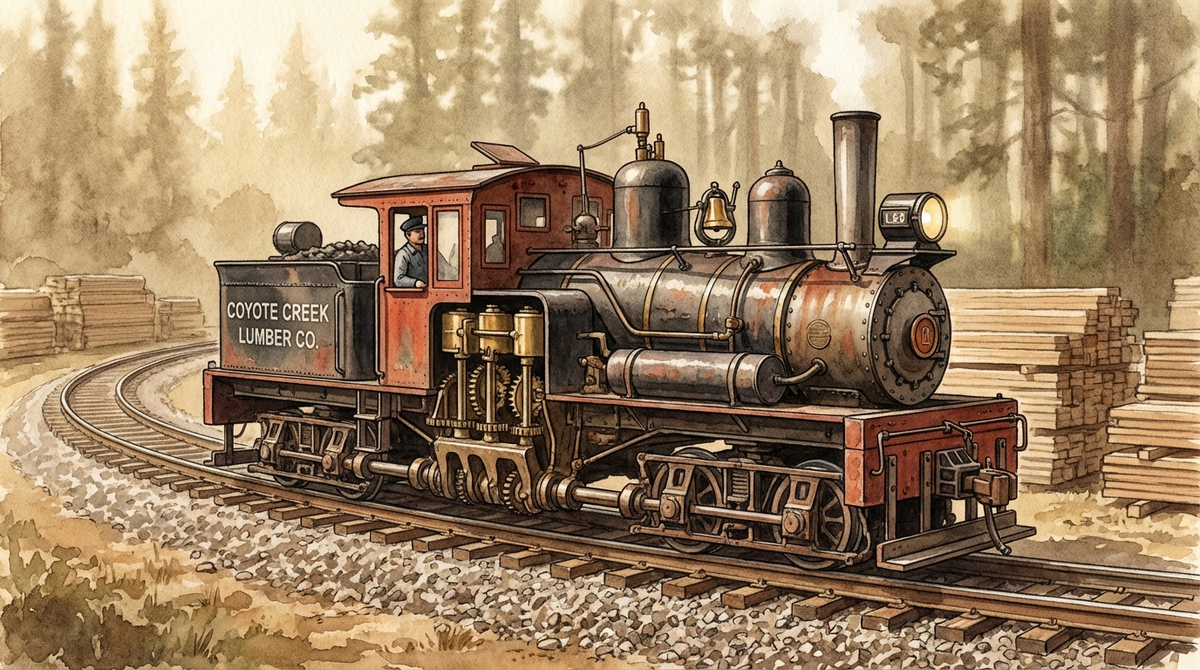
When I inherited my father's unfinished N scale layout back in 2011, I remember staring at those tiny locomotives thinking, "How am I supposed to weather something I can barely see?" My background in landscape architecture meant I had ideas for scenery, but the scale felt limiting. Then a friend dragged me to a train show in Portland, and I watched an On30 logging layout rumble past with those chunky, beautiful engines. I was hooked before I understood what I was looking at.
If you've been eyeing model railroading but feel paralyzed by all the options, On30 might be exactly what you need. It's the scale I wish someone had told me about from the start. You get the satisfying heft and gorgeous detail of O scale models, but they run on the same track your HO friends use. That means tighter curves, smaller footprints, and a much gentler learning curve for your wallet.
Let me walk you through everything I've learned about getting started in this wonderful corner of the hobby.
The name breaks down simply: O for O scale (1:48), n for narrow gauge, and 30 for the 30-inch prototype gauge it represents. O scale narrow gauge modeling gives you models that are roughly twice the size of HO, which means details you can actually see and handle without tweezers.
Here's the clever bit. In O scale, standard HO track (16.5mm) equates to about 31.2 inches in prototype terms. That's a mere 3.2% oversize from a true 30-inch gauge and about 4% undersized from the more common 3-foot narrow gauge lines. Most people can't spot the difference, and this small compromise unlocks massive practical benefits.
You get to use affordable, widely available HO track components. You can negotiate curves that would derail a standard O gauge locomotive. And your layout footprint shrinks dramatically compared to true-scale narrow gauge modeling.
The NMRA officially recognizes this scale/gauge combination, so you're not working in some fringe backwater. This is a legitimate, well-supported modeling standard.
Hobbyists tinkered with O scale on HO track for decades, often calling it "On2½." But the scale only hit the mainstream in 1998 when Bachmann Industries introduced an inexpensive, ready-to-run 2-6-0 Mogul steam locomotive. That single product transformed On30 from a niche for dedicated scratchbuilders into something any beginner could try.
By 2002, Bachmann released their popular On30 Shay geared locomotive. In 2006, the first On30 Annual was published, giving the scale its own dedicated magazine. Throughout the 2010s, the product line expanded with Forney, Climax, and Heisler locomotives.
The 2025 On30 Annual marks the publication's 20th year, and Bachmann continues releasing new products. Their 2024 catalog features the East Broad Top "Rockhill Limited" passenger set and newly-tooled 3-Bay Hoppers. The scale has real momentum behind it.
When I was starting out, I kept hearing "choose the scale that matches your space and budget." Helpful advice, but vague. Let me be specific about why On30 works so well for newcomers.
The models are big enough to enjoy. O scale means locomotives you can actually hold, detail, and weather without magnification. When I'm adding rust streaks to a Bachmann Shay, I can see what I'm doing. That wasn't true with my father's N scale equipment.
The space requirements stay reasonable. Most Bachmann On30 locomotives handle 18-inch radius curves reliably. That means a standard 4x8-foot table can hold a complete, operational layout with room for scenery. Compare that to On3 (true 3-foot gauge), where you'd need 28-30 inch curves and a much larger space.
Ready-to-run equipment is available and affordable. You don't need to build from brass kits or master soldering before you can run a train. Bachmann sells DCC-ready locomotives starting around $329, with rolling stock beginning at roughly $62 for a gondola.
Before you commit, it helps to understand what else is out there. I've watched friends go down different paths, and each has trade-offs.
| Scale/Gauge | What It Models | Minimum Radius | Ready-to-Run Availability | Cost |
|---|---|---|---|---|
| On30 | ~30-inch prototype (1:48) | 18 inches | High (Bachmann) | Low-Medium |
| On3 | 3-foot prototype (1:48) | 28-36 inches | Low (mostly brass) | High |
| On2 | 2-foot prototype (1:48) | 24-30 inches | Very Low (kits) | High |
| O-16.5 (European) | European 750mm gauge | 18-24 inches | Medium (Peco, Bachmann UK) | Medium |
| HOn30 | 2'6" prototype (1:87.1) | 10-15 inches | Low (kits) | Low |
On30 occupies a sweet spot. It halves the minimum radius and entry cost compared to "true scale" options like On3, while retaining the visual impact and detailing potential of O scale. For someone just getting started, that balance is hard to beat.
This is where I see beginners make expensive mistakes. Not every On30 locomotive can handle every curve. Plan your track around your locomotives, not the other way around.
I keep this minimum radius guide bookmarked. Here's a simplified version:
| Locomotive Type | Practical Operating Radius | Where It Fits |
|---|---|---|
| 0-4-0 Porter | 12 inches | Micro-layouts, tight industrial spurs |
| 2-6-0 Mogul | 18 inches | Most 4x8 layouts, shelf designs |
| Shay, Climax, Heisler | 18 inches | Logging and mining themes |
| Whitcomb 50-Ton Diesel | 15 inches | Post-steam era operations |
| 2-4-4 Forney | 22 inches | Around-the-walls layouts |
| 2-8-0 Consolidation | 22 inches | Larger layout rooms |
| 4-6-0 Ten-Wheeler | 22 inches | Mainline passenger themes |
If you're building on a 4x8 table, stick with locomotives rated for 18-inch curves. If you've fallen in love with the Forney or Consolidation, you'll need to plan for 22-inch minimums, which typically means an around-the-walls shelf layout rather than a tabletop oval.
Here's a decision that'll affect both your budget and your layout's appearance. You have three paths forward.
The cheapest option. HO flex track runs about $8.75 per yard for Atlas Code 83. You can be running trains the same weekend you start. The downside? Those HO ties look too short, too narrow, and spaced too closely together in O scale. Some modelers describe it as a "laid-down picket fence."
For rustic logging spurs where track would realistically be buried in dirt and weeds, this works fine. Heavy ballasting and ground cover disguise the compromise.
You can dramatically improve the look by removing every other tie and re-spacing the remainder. This creates a more prototypical "airy" appearance for narrow gauge. The trade-off is time-figure 30-45 minutes per yard of track. If you enjoy craft work and have patience, this is solid value.
Peco's O-16.5 (On30) flex track features correctly proportioned and spaced ties right out of the box. It runs about $14.84 per yard. That's roughly $6 more per yard than HO track, but you skip all the tie surgery. For a showcase layout where appearance matters, I think it's worth every penny.
Micro Engineering also produces On30 flex track in various rail codes if you want options.
Turnouts (switches) deserve special attention. Peco O-16.5 medium radius turnouts are designed with On30 operation in mind. They have a 12-degree frog angle and 610mm (24-inch) radius through the diverging route. Using HO turnouts works, but you may need to adjust the guard rails and check the frog geometry to prevent derailments.
I'm going to give you the single best piece of advice I received when starting out: buy an NMRA HO Standards Gauge and use it on everything.
Because On30 uses HO wheel and track geometry, a $17 NMRA HO Standards Gauge is your most valuable tool. It checks track gauge, wheel back-to-back spacing, and flangeway clearances. Most derailment problems come from one of these dimensions being off.
| What to Measure | Target Dimension | Why It Matters |
|---|---|---|
| Track Gauge | 16.5mm - 17.1mm | Too narrow binds wheels; too wide causes turnout derailments |
| Wheel Back-to-Back | 14.4mm minimum | The #1 cause of turnout derailments |
| Flange Depth | 0.71mm maximum | Oversize flanges ride up on ties |
| Coupler Height (HO) | 9.93mm ± 0.43mm | Mismatched heights cause uncoupling |
Before any locomotive or car touches your layout, check it with the gauge. Twist wheelsets gently on their axles to adjust back-to-back spacing if needed. This proactive step eliminates about 80% of the operational frustrations that chase beginners away from the hobby.
For couplers, grab a Kadee #205 HO coupler height gauge. Bachmann RTR models use HO-height couplers, so check every piece of rolling stock against this standard.
When I started, I figured I'd save money with DC and upgrade to Digital Command Control later. That was a mistake. The cost difference has shrunk so much that DCC makes sense from day one.
An NCE Power Cab system runs about $195-$215. That's comparable to buying two quality DC power packs, but you get independent control of multiple locomotives, sound and lighting effects, and programmable motor characteristics. Most new Bachmann On30 releases come DCC and sound ready, so you're set up to take advantage of those features immediately.
| System | Power | Street Price | Best For |
|---|---|---|---|
| NCE Power Cab | 2 Amps | ~$195-215 | User-friendly starter, expandable |
| Digitrax Zephyr Express | 3 Amps | ~$245 | All-in-one console, computer ready |
| Bachmann E-Z Command | 1 Amp | ~$190 | Very basic, limited expansion |
The NCE Power Cab hits the sweet spot for most beginners. Two amps is plenty for running up to four sound-equipped locomotives simultaneously.
Good wiring prevents more headaches than any other single factor. Here's the simple approach the NMRA recommends:
For turnout frogs (the X where rails cross), consider a Tam Valley Frog Juicer. This little device automatically manages polarity, eliminating shorts and stalling. It's a "set and forget" solution that costs about $19 and saves hours of troubleshooting.
Space drives everything. Be honest about what you have, and design around reality rather than wishes.
This classic footprint works well for On30. You can fit a continuous loop with passing sidings and industrial spurs. Keep curves at 18-inch radius and you'll accommodate most Bachmann locomotives. Model Railroader published a nice logging-themed On30 plan that fits this space with room for a sawmill scene.
If you have a spare wall, an 8-foot by 18-inch shelf offers excellent possibilities. Point-to-point operation feels more realistic than round-and-round running, and you can negotiate broader curves (22+ inches) by using the length creatively. Shelf layouts also work well in shared spaces because they stay out of the way.
Keep mainline grades at 2-4%. Steeper grades look dramatic but murder your locomotive's pulling power and increase derailment risk. Reserve anything over 3% for short industrial spurs served by geared locomotives like Shays.
Let me give you three concrete examples with real specifications. Pick whichever matches your space and interests.
Perfect for beginners wanting continuous running with basic switching.
Point-to-point operation with a dramatic mine tipple as the focal point.
An Inglenook-style puzzle layout for operational challenge in minimal space.
Money talks. Here's what you can accomplish at different investment levels.
This gets you running trains. It's a learning platform, not a showcase layout.
Now you have real DCC control, room for scenery, and the tools for quality work.
This is a showcase-quality starter layout with sound, reliable trackwork, and a centerpiece structure.
Skip the harbor freight specials. A few quality tools make everything easier.
A basic 25-watt pencil iron works for feeders. If you plan to do much electronics work, a temperature-controlled station like the Hakko FX-888D makes life much easier. Expect to spend $100-120 for quality.
Once your track is down and trains are running, you'll want buildings. On30 has a strong ecosystem of kit makers.
Banta Modelworks offers over 40 O/On30 structure kits, from $40 tool sheds to $500 mining complexes. Wiseman Model Services carries detail parts, logging camp cabins, and mine interior kits. B.T.S. (Better Than Scratch) produces laser-cut kits with tab-and-slot construction that goes together easily.
And then there's 3D printing. Marketplaces like 3DP Train and Etsy now host growing catalogs of resin-printed rolling stock and details. A Gilpin Tramway Ore Car runs about $45. Quality varies, so check seller reviews and look for photos of actual prints rather than just digital renders.
You don't have to figure this out alone. The On30 community is welcoming and well-organized.
The On30 Kitbashing Facebook group is active and helpful. TrainBoard forums and the MRH forum have dedicated members who answer questions thoroughly.
YouTube channels like Thunder Mesa Studio offer detailed video series covering everything from benchwork to weathering. Watching someone else work through a problem often teaches faster than reading about it.
Here's how I'd structure the first three months if I were starting fresh today.
When something goes wrong, work through this sequence:
For derailments:
For electrical problems:
Most problems have simple solutions once you know where to look.
Looking at market trends, expect the pace of new ready-to-run releases from Bachmann to slow as production costs rise. The current 2024-2025 catalog represents a good buying window for core equipment.
Meanwhile, the cottage industry and 3D printing sectors are booming. This means more variety in rolling stock and details, but also more responsibility on you to evaluate quality. Build your core roster of reliable locomotives now, then supplement with boutique products as your skills grow.
The community remains strong. Twenty years of the On30 Annual, growing Facebook groups, and active forums mean plenty of help is available whenever you need it.
On30 gave me what I couldn't find in my father's N scale layout: models I could see, handle, and detail without losing my mind. It fit in my spare bedroom. It didn't require a trust fund to stock. And the community welcomed me when I didn't know what I was doing.
If you're drawn to the romance of narrow gauge railroading but worried about space or cost, this scale deserves your attention. Grab a Bachmann catalog, measure your available space, and start sketching track plans. You might be surprised how quickly "someday" becomes "this weekend."
✨ Complete Your Layout: Explore our wide selection of Photo Real buildings, diorama backdrops, detail parts, and accessories in every popular scale.
✨ Unmatched Realism: From chrome detailing products to neon lighting kits – every piece is designed to make your miniature world come alive.