
O Gauge Track Layouts for Beginners: A Builder's Practical Guide to Your First Railroad
Posted by Harold Lindgren on 31st Dec 2025
Order by phone: 763-231-7847
Free Shipping On Orders Over $100!
If you are already registered, please log in.
Create your account and enjoy a new shopping experience.
Create A New AccountPosted by Harold Lindgren on 31st Dec 2025
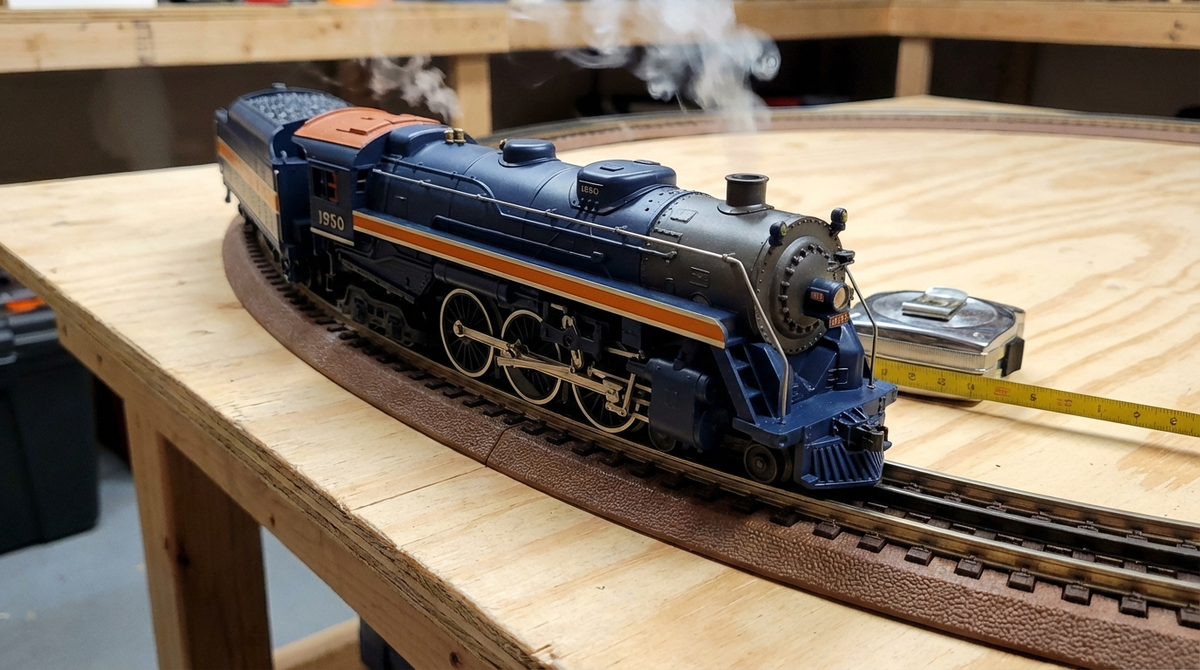
I spent forty years building houses before I picked up model railroading, and I'll tell you something that applies to both: the foundation matters more than the paint color. Too many beginners grab a starter set, dump it on a 4x8 sheet of plywood, and wonder why their brand-new locomotive keeps derailing six months later when they try to run something bigger.
The problem isn't the train. It's the track geometry they locked themselves into before they understood what they were building.
I've constructed four layouts since I retired in 2018, and the lessons I learned framing houses in the St. Croix Valley translate surprisingly well to model railroads. Measure twice, cut once. Build for tomorrow, not just today. And never skip the planning phase because you're eager to see something run.
Let me walk you through what actually matters when you're building your first O gauge layout.
Before we touch a single piece of track, let's clear up some terminology that trips up newcomers. O gauge and O scale get used interchangeably, but they refer to different things.
Scale describes the proportion of your model to the real thing. In the United States, O scale runs at 1:48 ratio, meaning one-quarter inch on your model equals one foot on the prototype. Gauge refers to the distance between the rails, which is 1.25 inches (31.75mm) for O gauge.
The NMRA publishes detailed standards covering everything from wheel profiles to track dimensions. You don't need to memorize them, but knowing they exist helps when equipment from different manufacturers doesn't play nice together.
Now, within O gauge you'll encounter two-rail and three-rail systems. Three-rail dominates the beginner market for good reason. That center rail provides power while both outer rails serve as the common return, which simplifies wiring dramatically. Reverse loops that would cause dead shorts in two-rail systems work without special electronics in three-rail.
Why choose O gauge over smaller scales? The models are big enough to handle, detail, and maintain without tweezers and magnifying glasses. Modern locomotives from Lionel and MTH pack sophisticated sound systems, synchronized smoke units, and Bluetooth control via smartphone apps. That presence and interactivity comes at a cost, both in dollars and square footage, but the payoff is an immersive experience smaller scales can't match.
Here's where most beginners go wrong, and I mean wrong in a way that costs them hundreds of dollars down the road.
O gauge curve designations refer to the diameter in inches. An O-36 curve has a 36-inch diameter. An O-72 curve stretches six feet across. That number tells you what locomotives can physically navigate that curve without their wheels lifting off the rails or their pilots scraping the roadbed.
Most starter sets ship with O-31 or O-36 track. A circle of O-36 FasTrack requires at least 40 inches of width once you account for the integrated roadbed. But here's the trap: that starter locomotive runs fine on O-36, so you build your whole layout around those curves. Then you fall in love with a scale Big Boy or a long passenger train, and suddenly your carefully constructed railroad can't accommodate your new equipment.
Minimum curve requirements vary wildly by locomotive class. Small switchers and starter set engines handle O-27 or O-31. Traditional semi-scale equipment typically needs O-31 to O-36. But large steam locomotives like the Union Pacific 4-12-2 require O-72 curves minimum. Those massive articulated steamers won't even negotiate anything tighter.
Before buying a single piece of track, identify the largest locomotive you might want to run in the next five years. Check its minimum curve specification. Then plan your layout around that number, not the starter set curves.
Here's the practical breakdown:
A locomotive rated for O-31 can run on any larger curve. But an O-72 locomotive derails on O-36 track, period. The minimum curve is the sharpest turn that locomotive can handle, not a suggestion.
That classic 4x8 sheet of plywood everyone talks about? It's actually pretty limiting for O gauge. You can fit a basic oval with maybe a passing siding, but don't expect operational complexity.
A 5x9 table opens up real possibilities: double loops for two-train operation, reverse capabilities, or a more interesting track arrangement with wider curves.
If you have a dedicated room, consider an around-the-walls shelf layout. You'd be amazed what you can accomplish with 18-24 inch deep shelves running the perimeter, plus wider turnback sections in the corners. This approach maximizes run length while keeping everything within arm's reach.
I've worked with every major O gauge track system, and each has legitimate strengths. The choice depends on whether you're building for immediate gratification or long-term realism.
Lionel FasTrack dominates the beginner market. The pieces snap together with a satisfying click, the connections stay secure, and you can have a working oval assembled on your living room floor in fifteen minutes. The gray plastic roadbed looks decent and eliminates the need for separate roadbed material.
MTH RealTrax offers similar convenience with rust-proof nickel silver rails and spring-loaded contacts that maintain solid electrical connections. The RealTrax system includes 72 different components for serious expansion capability.
The downside? Those plastic roadbeds can amplify noise, especially on a hollow tabletop. And the fixed geometry limits your design flexibility. You can't bend FasTrack into custom curves or trim it to precise lengths without destroying the snap-lock connectors.
When I built my current layout, I went with Atlas O 21st Century Track. The scale-sized brown ties with simulated wood grain look fantastic, and the solid nickel silver T-rail provides superior conductivity. Independent testing shows it's the quietest track system on the market.
GarGraves track has been the go-to for serious modelers for decades. The 37-inch flexible sections bend into whatever curve radius you need, and the wooden or plastic ties provide excellent isolation between rails. Pair GarGraves track with Ross Custom Switches and you have a combination that works together seamlessly.
Traditional track requires separate roadbed material and more installation effort, but the results speak for themselves. You can cut it, bend it, and customize it to fit your vision rather than adapting your vision to fit pre-formed pieces.
Here's practical advice: you can mix systems with the right transition pieces. Lionel's 6-12040 transition track connects FasTrack to tubular track. MTH's 40-1011 adapter links RealTrax to traditional systems.
Connecting Atlas O track to Ross switches requires standard Atlas rail joiners with minor modifications. The rail profiles match well, and many modelers use Ross switches in their yards for their tighter geometries while running Atlas O on the mainline.
My recommendation for beginners: start with an integrated-roadbed system for immediate enjoyment, but buy a few transition pieces from day one. When you're ready to expand into more realistic track, you won't need to rip everything out.
A model railroad is only as good as what it sits on. I've seen gorgeous scenery and expensive equipment ruined by benchwork that warped, sagged, or amplified every wheel click into a thundering racket.
Foam-over-plywood is the quickest path to a running railroad. Glue a sheet of 2-inch extruded foam insulation onto half-inch plywood supported by sawhorses or a simple frame. You can carve the foam for basic terrain, and the whole thing stays portable if you need to move it. The downside is that foam can act like a sounding board, amplifying noise unless you add proper roadbed on top.
Open-grid construction uses a lattice of 1x3 or 1x4 lumber topped with plywood or Homasote. This method is strong and eliminates the drum effect of a solid tabletop, but it's less flexible if you need to move wiring or switch motors later.
L-girder benchwork remains my preferred method. You build two main girders by screwing 1x2s perpendicular to 1x4s, creating an L-shaped cross-section. These girders rest on legs, and adjustable cross-members span between them to support your roadbed at whatever height you need. The L-girder system was designed specifically for modelers who aren't expert carpenters, and it's incredibly forgiving of changes.
O gauge trains are not quiet. Those big wheels on steel rails create a rumble that your spouse will hear two rooms away if you don't plan for it.
Never lay track directly on plywood. Use a layer of cork or Homasote as your sub-roadbed. Homasote, that half-inch pressed-paper board, absorbs sound better than anything else I've tested, though it's dusty to cut. Cork is easier to work with and provides good damping.
The room acoustics play a huge role too. Adding carpet to a basement layout room or hanging curtains can drop the ambient noise level dramatically.
Here's a truth that took me two frustrating layouts to learn: most "dead spots" and power problems trace back to inadequate wiring, not defective track or locomotives.
If you rely on a single lock-on connection to power anything larger than a simple oval, you're asking for trouble. Voltage drops across rail joiners, resistance builds up at connection points, and your locomotive slows to a crawl at the far end of the layout.
The fix is straightforward and takes one evening. Run a pair of 14-gauge stranded wires (one for the center rail, one for the outer rails) underneath your layout, roughly following the track route. These are your bus wires.
Every six to ten feet, tap into those bus wires with shorter 18-gauge feeder wires soldered directly to the track. Color-code everything consistently: red for hot, black for common. You'll thank yourself when troubleshooting later.
This practice becomes mandatory if you're running MTH's DCS command system, which requires clean signal transmission across the entire layout. MTH recommends star wiring with power drops at regular intervals.
The wall-pack power supplies included with starter sets max out around 50-80 watts. That's fine for running one train on a basic oval, but add a few lighted switches and operating accessories and you'll overload it quickly.
For a modest layout, the Lionel CW-80 provides 80 watts with fold-back current protection. The MTH Z-1000 delivers 100 watts plus a separate accessory port.
Serious layouts call for serious power. The MTH Z-4000 supplies 400 watts across two independent throttles with fast-acting breakers. The Lionel ZW-L offers 620 watts on four outputs with Legacy integration.
Modern O gauge locomotives contain sophisticated electronics that don't react well to voltage spikes. A derailment that momentarily shorts the center rail to an outer rail can send a destructive surge through sensitive circuit boards.
Adding TVS diodes across your power outputs provides cheap insurance. A 1.5KE36CA diode costs about a dollar and clamps voltage spikes before they reach your locomotive's control board.
For faster protection than the thermal breakers in older transformers, consider an Airpax magnetic-hydraulic breaker or the DCC Specialties PSX-AC wired in series with your center rail feed.
Adding a second level or an overpass creates visual drama, but grades cause more beginner frustration than almost anything else. Get this wrong and you'll spend your operating sessions watching locomotives struggle, slip, and stall.
I follow what modelers call the 2-3-4 rule:
Those commercial trestle sets from Lionel and MTH can create grades of 5-6%. Yes, your locomotive can technically climb them. But expect wheel slippage, shortened train lengths, and coupling strain. Reserve steep grades for display pieces, not operating mainlines.
An abrupt transition from flat track into a grade is a recipe for derailments. The front pilot of a long locomotive bottoms out, or the rear drivers lose traction as they crest the transition.
The solution is a vertical easement: a gradual curve that eases the train into the grade. A flexible sub-roadbed like half-inch plywood naturally creates this curve when you secure one end flat and gently lift the other. The transition should extend at least as long as your longest locomotive.
Woodland Scenics SubTerrain incline sets provide pre-engineered foam risers in 2%, 3%, and 4% grades if you'd rather not calculate this yourself.
When building an overpass, you need at least 5.5 inches from the top of the lower rail to the bottom of the upper structure. Modern equipment like double-stack container cars may require 7 inches or more. The NMRA publishes clearance diagrams for various eras, but I recommend testing with your tallest piece of rolling stock before finalizing any overhead structure.
A quality starter set remains the smartest entry point for beginners. You get a tested combination of locomotive, rolling stock, track, and power supply that works together out of the box.
Lionel's LionChief sets dominate the current market. The Bluetooth 5.0 app control lets you run your train from your phone while the included remote handles traditional operation. The locomotives feature maintenance-free motors, realistic sounds, and puffing smoke.
Most LionChief sets include O-36 FasTrack ovals with a 54-watt wall-pack power supply. That's adequate for the included equipment but limiting for expansion.
MTH RailKing sets offer Proto-Sound 3.0 with DCS compatibility, flywheel-equipped motors, and RealTrax with O-31 curves. Finding new MTH starter sets has become more challenging recently, but the used market offers plenty of options.
Let me give you realistic numbers for three common beginner projects:
Holiday Oval (40"x60"): A starter set gets you running for $400-600. You'll have a basic loop suitable for seasonal display or initial experimentation.
4x8 with Siding: Add a couple of powered switches, extra straight sections, and a transformer upgrade. Budget $800-1200. This gives you genuine operational interest with the ability to park one train while running another.
Compact Shelf Layout (12'x2'): This requires more planning and construction. Separate locomotive and rolling stock purchases, flex track, L-girder benchwork, proper roadbed, and realistic scenery push the budget to $1500-2500. But you end up with something you can operate for years.
You don't need a fully equipped workshop to build a decent layout. Here's what I consider the essential starter kit:
That gets you started for around $125-150 if you don't already own the basics.
As you advance, add a soldering station (40 watts minimum for O gauge track), an NMRA standards gauge for checking wheel spacing and track geometry, and rail nippers for cutting track cleanly.
Budget for consumables too: wire in various gauges, track pins (both conducting and insulating for creating blocks), and ballast for finishing your trackwork.
After building four layouts and helping friends with several more, I've seen the same problems repeat. Here's how to diagnose and fix them.
First, check the obvious: is your locomotive's minimum curve rating compatible with your track? If you're running an O-54 locomotive on O-36 track, no amount of adjustment will fix that fundamental mismatch.
Next, use an NMRA gauge to check wheel spacing. Wheels that have spread or narrowed from the standard gauge will catch on turnout points or drop into flangeways.
Finally, check track levelness. A small twist in your benchwork translates to wheels lifting off the rails. Run a level across your curves and shim where needed.
Most switch derailments come from point rails not closing fully, misaligned guard rails, or the track approaching the switch not being perfectly level with the switch itself. Use a straightedge across the connection and shim the adjoining track until everything sits flat.
Clean your track with a cloth dampened with rubbing alcohol. Inspect your track pins for corrosion. Use a multimeter to check for voltage drop at the far end of your layout compared to right at the transformer. If voltage drops more than a volt or two, add more feeder wires from your bus.
If your DCS system shows "Check Track" errors, the issue is almost always inadequate wiring. DCS signals travel through the rails, and poor connections attenuate those signals. Follow MTH's recommendation for star wiring from a centrally located TIU.
The O gauge community has kept me sane through many late-night troubleshooting sessions.
The OGR Forum is the most active online community for three-rail modelers. You'll find sub-forums dedicated to specific control systems, track construction, and vintage equipment. The Model Train Forum's O Scale section welcomes beginners with patient, detailed responses.
Subscribe to O Gauge Railroading Magazine for layout photos, how-to articles, and product reviews. Classic Toy Trains covers similar ground with a focus on traditional equipment.
On YouTube, channels like Eric's Trains offer layout tours and reviews. Toy Train Tips and Tricks focuses on practical repair and operation.
If you can swing it, the York Train Meet in Pennsylvania is worth the trip. Twice a year, thousands of collectors and operators gather for the world's largest model train event. You'll see equipment you didn't know existed, find deals on used gear, and meet people who've solved every problem you'll ever encounter.
The best advice I can give you is this: plan your first layout knowing it won't be your last.
Build something simple enough to finish. Run trains on it. Learn what you enjoy about the hobby: is it watching trains roll through scenery? Switching cars into industries? Collecting vintage equipment? Your answer shapes what your second layout should become.
Don't lock yourself into tight curves because the starter set track was free. Don't skip the wiring bus because it seems like extra work. Don't build the benchwork so flimsy that it wobbles every time a train passes.
Build it right the first time, and you'll save yourself the frustration of tearing it apart later. That's a lesson that applies to houses, and it applies to model railroads. The foundation matters more than the paint color.
Now stop reading and start planning. Measure your space, check your locomotive's minimum curves, and sketch something on paper before you buy a single piece of track. Your future self will thank you.
✨ Complete Your Layout: Explore our wide selection of Photo Real buildings, diorama backdrops, detail parts, and accessories in every popular scale.
✨ Unmatched Realism: From chrome detailing products to neon lighting kits – every piece is designed to make your miniature world come alive.