
N Scale vs HO Scale Detail Comparison: What You Can Actually See and Build
Posted by Tamara Brooks on 30th Dec 2025
Order by phone: 763-231-7847
Free Shipping On Orders Over $100!
If you are already registered, please log in.
Create your account and enjoy a new shopping experience.
Create A New AccountPosted by Tamara Brooks on 30th Dec 2025
I'll be honest with you: when I made the jump into model railroading, I spent way too much time reading forum arguments about whether N scale or HO scale was "better." Six years and one completed layout later, I can tell you that question misses the point entirely. The real question is what you want to see and what you're willing to do to get there.
My name's Tamara, and I model modern intermodal operations in N scale out of my basement in Ypsilanti. I came to this hobby sideways through 3D printing, which means I've spent a lot of time staring at tiny parts under magnification and asking myself whether anyone will actually notice the difference. Spoiler: sometimes they won't. And that's okay.
What I want to give you here isn't another cheerleading session for my preferred scale. You'll get the actual numbers on what the human eye can perceive, what manufacturers are building right now, what it costs to reach a given level of fidelity, and how much work you're signing up for. By the end, you'll know which scale fits your hands, your space, and your patience.
Let's start with the statistic everyone throws around: N scale gives you roughly four times the modeled landscape of HO in the same physical footprint. At 1:160 versus HO's 1:87.1, the math checks out. But here's what the glossy magazine photos don't show you: that extra space doesn't automatically translate to better scenery or more satisfying operations.
The two most popular scales worldwide attract different types of modelers for different reasons. HO commands about 78% of the market share, with N scale holding around 20% and growing. That HO dominance means something practical: more products, more choices, more aftermarket support. When you model a specific prototype in HO, you're more likely to find exactly what you need on a hobby shop shelf.
But if you're working with a spare bedroom or a finished basement that also needs to function as a family space, N scale's efficiency isn't just a nice bonus. It's the whole ballgame. I run 15-car intermodal trains through sweeping curves that would eat an entire room in HO. My layout lives on a series of shelves and modules that I can work around when my sister visits.
Here's where we need to get uncomfortable. A lot of the detail we're paying for in N scale simply disappears at normal viewing distances.
Human visual acuity follows specific rules. With 20/20 vision, your minimum angle of resolution is about 1 arc minute. At a typical viewing distance of 30 inches from your layout, that translates to a minimum resolvable feature size of roughly 0.22 millimeters. Anything smaller than that blurs into the background, no matter how much money you spent on it.
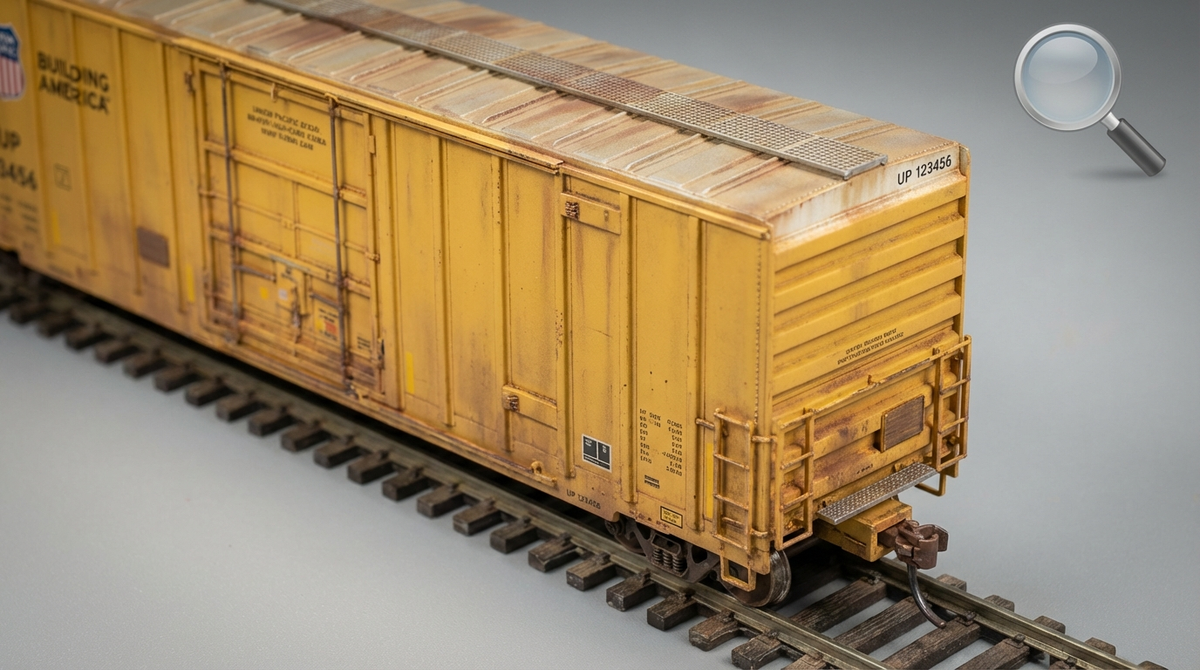
This creates what I call the visibility cliff. Look at a grab iron on a freight car. The prototype is about 1 inch in diameter. In HO scale, that becomes 0.29 millimeters-visible. In N scale? 0.16 millimeters. Gone. You won't see it without magnification.
The contrast sensitivity function of human vision makes this worse. Our ability to perceive detail depends on contrast and spatial frequency, not just raw size. Fine details close together become invisible even when individual elements might theoretically be large enough to see. That gorgeous photo-etched grating on your locomotive? At arm's length, it's a gray smudge.
HO scale keeps more details above that visibility threshold, which is why modelers who spend hours super-detailing and weathering often gravitate there. When I install wire grab irons on my N scale cars, I'm doing it mostly for close-up photography. Trackside? They register as texture, not distinct components.
If you're going to work in N scale seriously, good lighting and magnification aren't optional extras. Target 750 to 1000 lux on your work surface with a CRI of 90 or higher for accurate color work. I keep a 5000K lamp at my main workstation because that crisp white light helps me spot tiny flaws.
The OptiVISOR is practically a religious artifact among N scale modelers. For decoder work and decal application, I use a 2.75x or 3.5x magnification lens. Some folks swear by stereo microscopes for the really fine stuff. HO modelers can get away with lighter magnification because the parts are larger and easier to manipulate.
Let's talk about what's actually on the market right now. The 2020-2025 period has been wild for both scales, with manufacturers pushing detail levels that would have seemed impossible a decade ago.
ScaleTrains set the bar with their Rivet Counter GE C39-8, featuring etched see-through grilles and road-number-specific tooling with three distinct body phases. That's not mass-market compromise-that's obsessive accuracy.
Rapido's GE Dash 8-40CM continues that trend with fully redesigned tooling, rubber MU hoses, and road-specific lighting packages. Street price runs around $250 for DCC/Sound.
The Athearn Genesis 2.0 SD70ACe introduced factory weathering in their "Primed for Grime" series. Etched see-through steps and dual speakers make these locomotives ready for serious operations straight from the box.
For rolling stock, Tangent's Greenville 86' boxcars represent the pinnacle. They offer 13 build variations, 12 different brake stands, rotating bearing caps, and genuine Kadee couplers. These are museum pieces that happen to run.
N scale has closed the gap faster than anyone expected. The ScaleTrains Rivet Counter GE AC4400CW features wire grab irons, industry-leading LED lighting, and road-number-specific details that rival HO products from five years ago.
Kato's upcoming SD70ACU promises new tooling with extensive printing and rear ditchlights. The Rapido Procor GP20 tank car drawn from original blueprints demonstrates that N scale can achieve photo-etched metal walkways and detailed brake equipment.
Broadway Limited has announced a new 2-8-0 Consolidation for 2026 with working smoke and Paragon4 Sound. Steam fans finally have options beyond the handful of models that have been around for decades.
HO still holds an edge in sound reproduction. Larger speakers (28mm round, 16x35mm ovals) can reproduce lower frequencies around 300 Hz, giving you that chest-thumping bass. Tang Band speakers have become the go-to upgrade for serious HO sound installations.
N scale is limited to sugar cube speakers that struggle below 500-600 Hz. The result is tinnier, but not hopeless. The SoundTraxx Tsunami2's 7-band equalizer and bass-boost features help compensate. ESU LokSound decoders offer similar tricks. With the right decoder and speaker placement, N scale sound can approach standard HO quality.
Modern micro-decoders like the ESU LokSound 5 micro pack six or more amplified function outputs into a package that fits N scale frames. Complex lighting effects are feasible in both scales now.
Walthers Cornerstone remains the workhorse brand for both scales, offering Cornerstone Series Built-ups that let you add detailed structures in minutes. For craftsman kits, Blair Line offers laser-cut wood with impressive detail in both scales.
European manufacturers like Faller and Kibri/Vollmer under the Viessmann umbrella provide options American manufacturers often overlook. Faller's N scale buildings are compact yet quite detailed, with features like interior equipment and LED lighting available as accessories.
HO scale structures show more visible detail because the larger size keeps textures like brick and board patterns above that visibility threshold. Window mullions are more delicate, and adding interior details actually pays off when someone walks past your layout.
N scale structures require more selective compression and simplified interiors. When you search for N scale structures, you'll find the selection smaller but still workable for most prototype eras.
This is where I get excited. 3D printing has democratized custom parts in ways that favor N scale modelers who are willing to learn the technology.
Resin printers with XY resolution of 22-50 microns can produce details that would be impossible to manufacture any other way at N scale prices. I print see-through steps, custom handrails, and prototype-specific brake equipment that manufacturers will never tool up for.
The minimum feature size for resin printing is around 0.1-0.2mm for embossed or engraved details. That's perfect for N scale handrails and ladders. FDM printing, with minimum wall thickness around 0.4-0.6mm, works for building shells and layout infrastructure but can't produce fine detail parts.
The Phrozen Sonic Mini 8K and similar consumer machines have brought high-resolution resin printing under $500. If you're serious about N scale and frustrated by the limited aftermarket, learning to design and print your own parts is the answer.
This is where HO scale wins for most people, and I won't pretend otherwise.
In HO, a typical decoder install is often plug-and-play via 8-pin or 21MTC sockets. Board-replacement decoders are common, and many models require no soldering whatsoever. You can upgrade a locomotive to DCC sound during a single evening session.
N scale is different. Space constraints force manufacturers into proprietary solutions. Hard-wiring is common, and you're often soldering to pads smaller than a pinhead. Sound installs frequently require milling the locomotive's metal frame to create space for a micro decoder like the ZIMO MX660.
Keep-alive capacitors highlight the gap. HO locomotives have room for TCS KA1/KA2 units or ESU PowerPack Mini providing 6-20 seconds of backup power. N scale? You're looking at nano keep-alives that give you maybe 1-2 seconds. That difference matters when crossing turnouts at slow speed.
Working with photo-etched metal parts requires patience in any scale. Grain direction affects how parts bend, and annealing can help with delicate frets. But N scale parts are so small that a sneeze can launch them into the carpet monster's domain forever.
Adhesive choice matters. CA glue is brittle, which becomes a liability on N scale models that get handled during operations. Solder provides stronger bonds but requires temperature-controlled stations with fine tips to avoid melting adjacent plastic.
Photo-etching technology has physical limits. Minimum hole diameter runs about 1.2 times the metal thickness, and minimum line width is 0.8 times thickness. For N scale parts etched from 0.1mm material, features smaller than 0.08-0.12mm simply aren't feasible.
The NMRA Recommended Practice RP-11 provides the authoritative guide for minimum curve radii. These numbers determine whether your prized locomotives can actually navigate your trackwork.
For HO, 18 inches is the bare minimum suitable for 4-axle diesels and 40-50 foot cars. Six-axle locomotives want 22 inches or more. For 85-foot passenger cars, 24 to 30 inches is strongly recommended.
N scale's effective minimum is often cited as 9.75 inches. Most modern equipment wants 11 to 13 inches for reliable operation, with 15 inches or more improving aesthetics and reducing wear.
Track spacing on curves follows NMRA RP-7.2. Long cars can sideswipe each other if you don't spread parallel tracks further apart than on straightaways.
The classic 4x8 starter layout demonstrates the scale difference starkly. In HO, you get a simple continuous loop with maybe 22-inch radius curves. That limits you to smaller locomotives and rolling stock under 60 feet. Room for industries or a functional yard? Forget it.
In N scale, that same 4x8 becomes a multi-level twice-around mainline with 12-15 inch radius curves, a small yard, multiple industries, and train lengths of 5-7 cars that look plausible rather than toylike.
"N scale is cheaper" is a myth that needs to die. Per-item costs can be lower, but the total cost of a finished layout tends to equalize.
Track costs are nearly identical. Atlas HO Code 83 flex track runs $7-10 per 3-foot section. Micro Engineering N scale Code 55 costs about the same per foot. N scale's advantage comes from needing less physical track for a given scale mile.
HO turnouts and Peco offerings run $20-40. N scale pricing is comparable.
The NCE Power Cab starter system costs $185 regardless of scale. Your DCC investment doesn't change.
Sound-equipped locomotives have reached price parity. ScaleTrains HO Dash 9-44CW and Athearn Genesis 2.0 diesels range $250-350. ScaleTrains N scale AC4400CW and Dash 9 models hit $250-320.
High-detail freight cars show a modest N scale advantage. Tangent PS-4750 covered hoppers run $40-57 in HO. Micro-Trains offerings like their Rio Grande 40' Hi-Cube boxcar and Atlas weathered cars range $30-53.
Walthers Cornerstone structure kits cost essentially the same in both scales.
Here's what actually happens: N scale's space efficiency encourages you to build more track, add more turnouts, and accumulate a larger fleet. A 3x7 foot N scale layout with 23 turnouts and a full fleet was estimated at $3,000-4,000 AUD over five years. That's not cheap, and it's comparable to what an HO modeler might spend on a similarly ambitious project.
N scale demands more frequent attention to keep things running smoothly. The smaller contact patches between wheels and rails mean contamination has a proportionally larger effect.
A typical HO layout in a clean indoor environment might need major track cleaning 3-4 times per year. N scale can require cleaning every few days in dust-prone areas. An N scale layout at a children's hospital that ran 8-10 hours daily needed track replacement every 3 years and wheelset replacement every 100 hours.
The CMX Clean Machine works well for both scales. For N scale specifically, the Tomix Track Cleaning Car with its vacuum function removes physical debris that can derail lightweight stock.
Isopropyl alcohol and denatured alcohol are common cleaning agents. Some modelers avoid isopropyl, believing it leaves residue. Applying No-Ox-ID "A-Special" to rails can significantly reduce cleaning frequency.
Abrasive blocks like the Bright Boy should be used sparingly. They create micro-scratches on the railhead that attract more dirt over time, a bigger problem on N scale's smaller rail profile.
N scale couplers have their own quirks. The "slinky effect" (longitudinal bounce with spring-loaded Micro-Trains couplers) is a common complaint, especially on grades. Various fixes exist, but it's a problem HO modelers rarely encounter because Kadee's larger couplers handle train dynamics better.
Environmental control matters more than you'd think. Humidity between 30% and 50% keeps wood benchwork stable. Extreme temperatures cause rail expansion and buckling, which is a real risk in unconditioned garages. Dust control through air filters and layout covers pays dividends in both scales.
If you want to participate in club operations or train shows, the dominant standards in each scale reflect different philosophies.
Free-mo for HO emphasizes prototypical operations with a single-track mainline, Code 83 rail, and broad minimum radii (42 inches, 48+ preferred). Large turnouts (#8 or larger on mainline) allow reliable operation of long, modern trains. The module shape is free-form between standardized endplates.
NTRAK for N scale specifies three mainlines on modules of fixed depth (2 feet). The 40-inch rail height is better for public viewing and seated operators. The focus is on interoperability and the spectacle of multiple long trains.
T-TRAK uses small, lightweight modules based on Kato Unitrack geometry. It's designed for quick setup and accessibility. The considerations for T-TRAK modules prioritize portability over broad curves.
Both Free-mo and Free-moN mandate powered frogs, which improves slow-speed performance and reduces stalling. This matters when you're running sound-equipped locomotives in front of an audience.
If you want to photograph your work for social media or publications, N scale presents unique challenges.
Depth of field shrinks dramatically the closer your camera gets to the subject. To get a frame-filling shot of an N scale locomotive, you're working at extreme close range. Even stopped down to f/16 or f/22, a single shot rarely renders an entire scene sharp.
Focus stacking is the solution. Take multiple images focused at different points, then merge them with software like Helicon Focus or Zerene Stacker. For N scale, focus stacking isn't optional; it's required for realistic results.
A 90mm or 100mm macro lens provides comfortable working distance for lighting. Standard kit lenses work when focus stacking. Ultra-wide macro lenses like the Laowa 15mm can provide greater single-shot DOF.
Diffused lighting from two softboxes minimizes harsh shadows. A sturdy tripod is essential for the multi-shot exposures needed for stacking. Low ISO settings (100-400) ensure print-quality images.
Cameras with built-in focus bracketing like the Nikon D850 simplify the process. Helicon Remote can automate focusing rails for maximum control.
Interestingly, smartphones excel at N scale photography. Their small sensors naturally provide greater DOF than DSLRs, and their compact size enables unique low-angle railfan perspectives.
For video, run trains at realistic slow scale speeds. Smooth panning shots work better than handheld movement. Clean the track, check for floating buildings, and remove unprototypical distractions before shooting.
The model train market was valued at US$1.18 billion in 2024 and is projected to reach $2.22 billion by 2033. HO's dominant market share generally translates to higher liquidity and faster resale.
N scale's growing popularity is improving its secondary market. High-quality locomotives from Kato hold value exceptionally well.
Factory-weathered Tangent boxcars have sold on eBay for 120% of MSRP. Limited editions and out-of-production items from premium brands command premiums. Kato steam locomotives with DCC/Sound retain nearly all their value.
HO brass locomotives from importers like Key and Overland have historically doubled or tripled in value, though the market can be volatile. Manufacturers now intentionally limit run sizes to fuel collector demand.
The secondary market for OOP Micro-Trains cars has seen fluctuating values as eBay revealed larger supplies than once thought. True rarities still command premiums.
Factory-weathered models are increasingly popular. Athearn Genesis began offering factory-weathered N scale in 2022, and weathered Micro-Trains cars are popular collector's items.
One risk that crosses scale boundaries: zinc pest can affect models made in China regardless of scale. There's documented evidence of relatively new Tomix N scale models developing zinc rot, a destructive corrosion that causes parts to swell and crumble.
After all these numbers and comparisons, the choice comes down to what you actually want from this hobby.
N scale makes sense if:
HO scale makes sense if:
If you're undecided, here's my practical suggestion: build a single T-TRAK module or small diorama in N scale before committing to a full layout. The investment is minimal, and you'll learn quickly whether the challenges energize or exhaust you.
I chose N scale because I wanted my layout to feel like a window into a larger world, not a display case for individual models. The trains that cross my basement are part of a system that moves freight from one place to another, and the scenery stretches in every direction. When I walk past, I see operations. When I sit down with my camera, I see details.
Both experiences are valid. Pick the one that matches how you want to spend your time.
? Complete Your Layout: Explore our wide selection of Photo Real buildings, diorama backdrops, detail parts, and accessories in every popular scale.
✨ Unmatched Realism: From chrome detailing products to neon lighting kits – every piece is designed to make your miniature world come alive.