
N Scale Turnout Installation Tips That Will Save You Hours of Frustration
Posted by Derek Olson on 31st Dec 2025
Order by phone: 763-231-7847
Free Shipping On Orders Over $100!
If you are already registered, please log in.
Create your account and enjoy a new shopping experience.
Create A New AccountPosted by Derek Olson on 31st Dec 2025
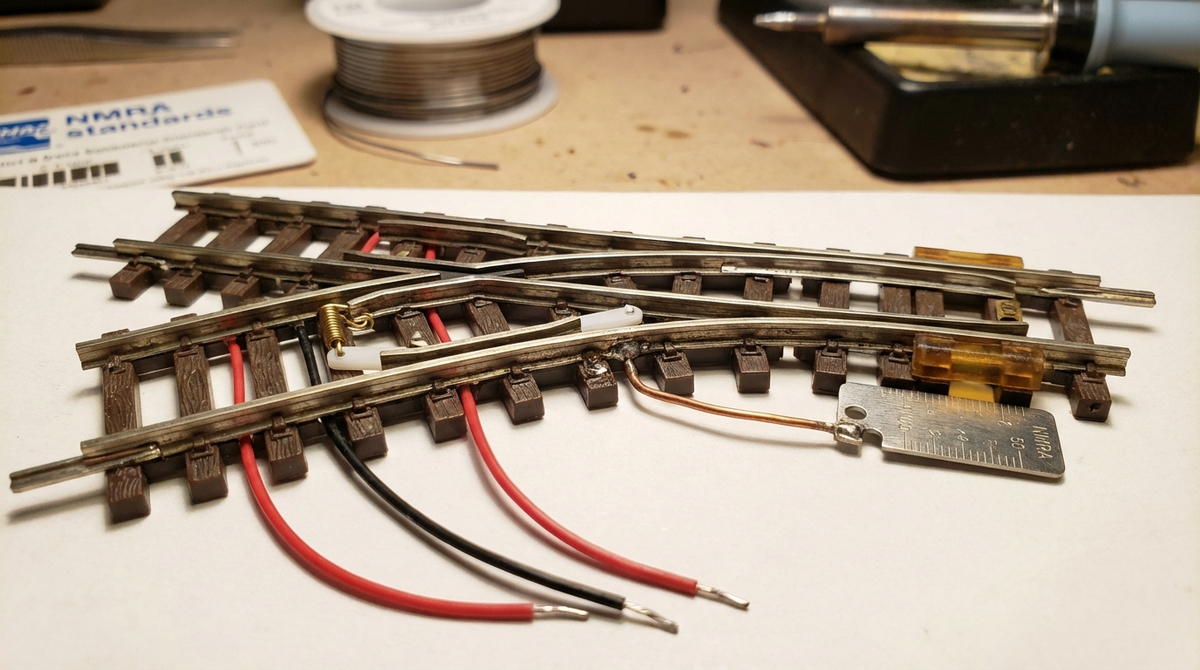
I've spent more hours than I care to admit lying on my back under a layout, cursing at a turnout that worked perfectly on the bench but decided to short out the moment I ballasted it. If you've been there, you know the special kind of frustration that comes with N scale trackwork. The tolerances are tight, the contact patches are tiny, and there's zero margin for error.
But here's the thing: most turnout problems aren't bad luck. They're predictable failures that happen because we skip steps or trust factory connections that were never designed to last. After wiring layouts for clubs and friends (and rewiring my own more times than I'd like), I've learned that bulletproof N scale turnout installation comes down to doing the boring stuff right the first time.
Before you do anything else, buy an NMRA N Scale Standards Gauge. I know, another tool. But turnouts are the leading cause of derailments, and a five-dollar gauge will save you fifty dollars worth of headaches.
The gauge lets you verify the critical dimensions that matter: track gauge, check gauge, and flangeway width. These aren't arbitrary numbers dreamed up by committee. They're an engineered system where each dimension relates to the others.
Here's how to use the gauge: check every new turnout before installation, and check your rolling stock too. Even factory-fresh equipment can be out of spec, and the time to discover that is on the workbench, not after everything is glued down and ballasted.
For N scale, the wheel back-to-back target is 0.208 inches, and track gauge should fall between 0.355 and 0.360 inches. The minimum recommendation is to keep straight track as close to the minimum gauge as practical.
This decision shapes everything that follows. Each manufacturer has a different philosophy, and understanding the tradeoffs will save you from discovering them the hard way.
Atlas Code 55 track looks fantastic. The rail height is prototypically scaled, the ties are finely detailed, and it's pretty much the standard in N scale these days. The Code 55 #5 turnout is a workhorse for yards and sidings.
But that realism comes with a catch. Those finely detailed molded spike heads will catch the oversized flanges on older rolling stock. Pre-1995 wheelsets (the "pizza cutters") will audibly clunk or derail on Atlas C55 track. If you've got a collection of vintage equipment, you'll need to either re-wheel everything or choose a different track system.
On the electrical side, Atlas turnouts are generally DCC-friendly. The cast metal frog has a tab you can solder a wire to for powering. The frog powering process is straightforward: slip your feeder through the hole, hit it with solder, and you're done.
Peco takes a clever approach. Their Code 55 achieves the same visual appearance by burying Code 80 rail deeper into the ties. This means the track looks like Code 55 from above but has extra clearance underneath for those deeper flanges.
The result? Roughly 88% compatibility with legacy rolling stock. That's a significant advantage if you're running club events or borrowed equipment.
Peco's new Unifrog design is worth understanding. The Unifrog wiring diagram shows it works as an insulated-frog turnout out of the box, but includes a pre-attached wire so you can easily power the frog like an Electrofrog turnout. The Unifrog's isolating section is much smaller than traditional Insulfrogs.
For Electrofrogs and powered Unifrogs, you'll need to do some prep work. Allan Gartner's guide to Peco turnouts walks through the process, including where to cut the factory jumpers and add insulated joiners.
If speed of construction matters more than customization, Kato Unitrack delivers. The integrated roadbed and snap-together Unijoiners make setup fast and reliable. The T-TRAK modular standard is built around Unitrack for good reason.
Kato offers geometry PDFs for planning, including #6 turnout specifications. For DCC, though, there's a catch. Kato turnouts use a powered metal frog that's power-routing by default. You'll need to install insulated joiners on all four rails at the frog end for reliable DCC operation.
The wiring modifications aren't difficult, but you need to know about them beforehand. Kato's DCC guide covers the basics.
The "number" on a turnout describes the frog angle, which determines how gently trains diverge. A #4 has a sharp 1-in-4 angle, while a #8 has a gentler 1-in-8 divergence.
The NMRA Technical Note TN-12 provides the math, but here's what matters practically:
The substitution radius is the equivalent curve radius of the entire turnout path. When planning, avoid placing turnouts directly in curves, which creates geometric kinks that bind rolling stock.
For S-curves (like in crossovers), include a straight tangent of at least 1.5 to 2 times your longest car length between opposing curves. Body-mounted couplers especially hate S-curves.
Here's my order of operations, refined through too many "learning experiences."
Mark your turnout centerline using a printed 1:1 template. Fast Tracks offers free printable templates that include PC board tie locations. Place the turnout and adjoining track, then use a straightedge to confirm there are no kinks at the rail joints.
Before any adhesive touches anything, verify track gauge and flangeways with your NMRA gauge. Test with a variety of rolling stock, especially short and long wheelbase pieces. Now is when you find problems, not after ballasting.
It's far easier to solder feeder wires to rails on the workbench than while lying under the layout. Solder to the outside of the rails to avoid wheel interference.
For maximum reliability, add jumper wires to the point rails at this stage. I'll explain why this matters in the wiring section.
Drill the hole for your switch machine throw-wire from the top down, using the throwbar as a guide. The Tortoise instruction sheet shows the proper hole sizing for under-table installation.
For plywood, I use DAP Alex Plus latex caulk. It's strong but flexible, dampens noise, and allows future removal if needed. Track nails can supplement for positioning but pre-drill to avoid distorting gauge.
For foam roadbed, use foam-safe adhesives. Woodland Scenics Track-Bed works well with their Foam Tack Glue. Avoid solvent-based adhesives that melt foam.
On cork, wood glue works for cork-to-plywood. Pre-cut cork turnout pads simplify fitting.
Secure the turnout with weights while the adhesive cures. Give it a full 8-24 hours. After curing, run locomotives through all routes at various speeds before any scenery work.
Ballasting seals your work permanently. Mask the throwbar and points before applying ballast glue. A drop of plastic-safe oil on the point hinges will repel water-based glue.
While the glue dries, cycle the points back and forth to break any forming bonds. After curing, clear any stray ballast from flangeways with a hobby knife.
This is where most N scale layouts fail. The contact patches are so small that even minor oxidation kills conductivity. Let's fix that.
Rail joiners are for mechanical alignment, not electrical conductivity. They oxidize, they loosen, and they create intermittent dead spots. Solder feeder wires to every section of rail, including all three legs of a turnout.
The mechanical contact between point rails and stock rails degrades over time. Dirt, oxidation, and scenery adhesives all take their toll. Adding a #30 AWG jumper wire from each point rail to its corresponding stock or closure rail bypasses this problem entirely.
Testing shows that factory wipers can degrade to over 30 microhms of resistance within six months. A soldered jumper maintains a consistent 2 microhm connection. That's a 15x improvement for less than a nickel per turnout.
Insulated frogs (like basic Peco Insulfrogs) have a plastic, electrically dead frog. Simple wiring, but the dead spot can stall short-wheelbase locomotives at slow speeds.
Live frogs (like Peco Electrofrogs) have a powered metal frog. This eliminates stalling but requires the frog polarity to be actively switched. Fail to switch it, and you get an immediate short circuit.
For live frogs, you must install insulated rail joiners on the two rails departing the frog. On Peco Electrofrogs, cut the factory wire links connecting the frog to the point rails. The new Unifrog design already has the frog isolated.
You've got three main approaches:
Switch Machine Contacts: A Tortoise slow-motion machine has built-in SPDT contacts. As it throws the points, it simultaneously switches frog polarity. The Circuitron application note shows the wiring.
DPDT Slide Switch: For manual operation, a double-pole double-throw slide switch can throw the points and switch frog polarity in one motion. Low cost but requires careful linkage setup.
Frog Juicers: For DCC, Tam Valley Depot Frog Juicers are magic. Connect them to your track bus and frog, and they automatically detect and correct polarity in microseconds. The Mono Frog Juicer runs about $18, but the simplicity is worth it for complex trackwork.
Manual or automated? Let me break down the real costs.
Basic Manual (No Frog Power): A Caboose Industries 206S ground throw costs $3.65 and works fine for simple DC layouts or visible yard areas.
Manual with Frog Power: The Blue Point Controller at $14 adds built-in frog-powering contacts, making it a smart upgrade for DCC layouts.
Servo Automation: A Tam Valley servo decoder with servo runs about $22 per turnout. You get remote control and DCC integration at a reasonable price. Multi-servo drivers reduce per-turnout costs further.
Stall Motor Automation: A Tortoise switch machine provides the most reliable, prototypical slow motion, plus those useful auxiliary contacts for frog powering and signaling. When paired with a multi-channel decoder, expect about $34 per turnout in a bulk setup.
The break-even point for automation is around 25 turnouts. Below that, manual control usually makes sense unless you specifically need computer-controlled routing or remote dispatching.
Complex trackwork multiplies the wiring challenge, but it's manageable with the right approach.
A 3-way contains two sets of points and two frogs in a compact footprint. Searching for Peco 3-way wiring diagrams will show you various configurations.
For the Insulfrog version, wiring is straightforward, but place insulated joiners on the inner rails departing both frogs. The spacing is tight enough that metal wheelsets can bridge them.
For Electrofrog 3-ways, you need two switch machines, one for each point set. Each frog gets powered separately by its respective machine.
The Peco double slip wiring is counter-intuitive: the machine at one end controls points at that end but powers the frog at the opposite end. Both frogs need powering via their opposite switch machines.
For diamond crossings with live frogs, isolate all four rails and treat the crossing as its own block. The Hex Frog Juicer manual shows how to pair diagonally opposite frogs on separate circuits.
For specialwork, electronic frog juicers dramatically simplify wiring. Each frog gets its own juicer channel rather than complex relay logic.
For a double crossover, a Dual Frog Juicer pairs the diagonally opposite frogs. For 3-way turnouts, a Hex Frog Juicer handles multiple frogs effortlessly.
For wye configurations, isolate the entire wye section and use a juicer channel configured as an auto-reverser for the whole section.
If you're building for shows or club use, standardized wiring saves massive headaches. NTRAK, Free-moN, and T-TRAK all provide proven blueprints.
NTRAK electrical standards specify 12 AWG stranded wire with Anderson Powerpole PP30 connectors. Color coding distinguishes different mainlines.
Free-moN standards go further, mandating separate 12 AWG buses for track and accessory power. Powered frogs are required, with no reliance on point contact. Red connectors stack vertically for track power, black horizontally for accessories.
T-TRAK standards use 12 AWG stranded bus wire with Anderson Powerpole connectors. The separate accessory bus is typically 15-16V AC.
Always run a dedicated accessory power bus separate from DCC track power. A short in a turnout motor shouldn't kill your entire railroad.
Anderson Powerpoles have a wiping action that ensures positive, low-resistance connections. They're genderless and color-codable. Use them.
For internal module connections, pluggable terminal blocks or Wago-style lever nuts allow quick disconnection for service without cutting wires.
Visually inspect for loose ballast or debris in the points. Manually throw every turnout to check for smooth movement. For turnouts relying on point-to-stock contact, slide a clean business card between the closed point and rail to wipe the contact surfaces.
Use a stiff brush and 91% isopropyl alcohol to clean point rails, hinges, and throwbar areas. A pipe cleaner works for tight spaces. For stubborn contacts, electronic contact cleaner that's safe for plastics does the job.
Apply a minuscule amount of plastic-safe, conductive lubricant to pivot points only. Don't oil the railheads or electrical contact surfaces, which attracts dirt.
Loco stalls on frog: Clean the frog and wheels first. Test for power with a multimeter. If unpowered, install a frog juicer or wire to switch machine contacts.
Loco shorts on frog: Reverse the frog feeder wires at your switch or juicer. Check wheelsets with your NMRA gauge. For persistent issues, adding a guard rail shim can tighten the flangeway. A thin coat of clear nail polish on the frog point provides extra insulation.
Loco stalls on points: Clean the contact area. The permanent fix is to solder a jumper wire from the point rail to the stock rail, bypassing the mechanical contact entirely.
Turnout binds or won't throw: Inspect for debris. If glue has seeped in, warm water or rubbing alcohol can dissolve water-based adhesives.
Use these to avoid sealing in problems.
Let me bust some common misconceptions:
"Rail joiners conduct power just fine." They don't. They oxidize, loosen, and create dead spots. Solder feeders to every rail section.
"I can power my whole siding through the turnout." Using power-routing to feed an entire siding relies on flimsy point contacts. Power-route the frog only and run a dedicated feeder to the siding.
"DCC-Friendly means no extra wiring." It means the turnout minimizes shorts out of the box. For bulletproof operation, you still want point rail jumpers and powered frogs.
"Insulated frogs work fine for everything." The unpowered dead spot stalls short-wheelbase switchers at slow speeds. Powered frogs are the standard for reliable operations.
"Abrasive bright boys are the best track cleaners." They create micro-scratches that accelerate oxidation. Use 91% isopropyl alcohol on a soft cloth for routine cleaning.
"I can ballast first and fix problems later." Ballast and glue are permanent. Any hidden faults become exponentially harder to fix. Always run trains extensively before committing to scenery.
Good planning prevents expensive mistakes. The Atlas Track Catalog includes full geometry specifications for their turnout lines. Peco turnout dimensions are available from community resources.
For track planning software, Atlas offers their own program for Windows with libraries for all their track lines. Third-party options like AnyRail and SCARM include extensive N scale track libraries from all manufacturers.
For Kato layouts, their #6 turnout geometry PDFs are particularly useful for planning interlocking yards.
Peco templates are available from various sources. Community-created templates match both Code 55 and Code 80 geometry, since the geometry is identical between codes. Walthers offers printable templates for their WalthersTrack line as well.
After years of wiring layouts and fixing other people's mistakes, here's what I keep coming back to: the boring stuff matters most. Checking gauges, soldering jumper wires, testing before ballasting. None of it is glamorous. All of it prevents the kind of problems that make you want to rip up track and start over.
N scale's small size makes it tempting to skip steps or assume factory connections will hold. They won't. Treat every turnout as a precision electrical device that needs proper feeders, proper frog management, and regular maintenance.
The payoff is a layout where trains run reliably through every turnout, every time, at any speed. And that's worth all the prep work in the world.
By Derek Olson
✨ Complete Your Layout: Explore our wide selection of Photo Real buildings, diorama backdrops, detail parts, and accessories in every popular scale.
✨ Unmatched Realism: From chrome detailing products to neon lighting kits – every piece is designed to make your miniature world come alive.