
N Scale Trains for Small Spaces: A Working Guide to High-Performance Mini Layouts
Posted by Derek Olson on 30th Dec 2025
Order by phone: 763-231-7847
Free Shipping On Orders Over $100!
If you are already registered, please log in.
Create your account and enjoy a new shopping experience.
Create A New AccountPosted by Derek Olson on 30th Dec 2025
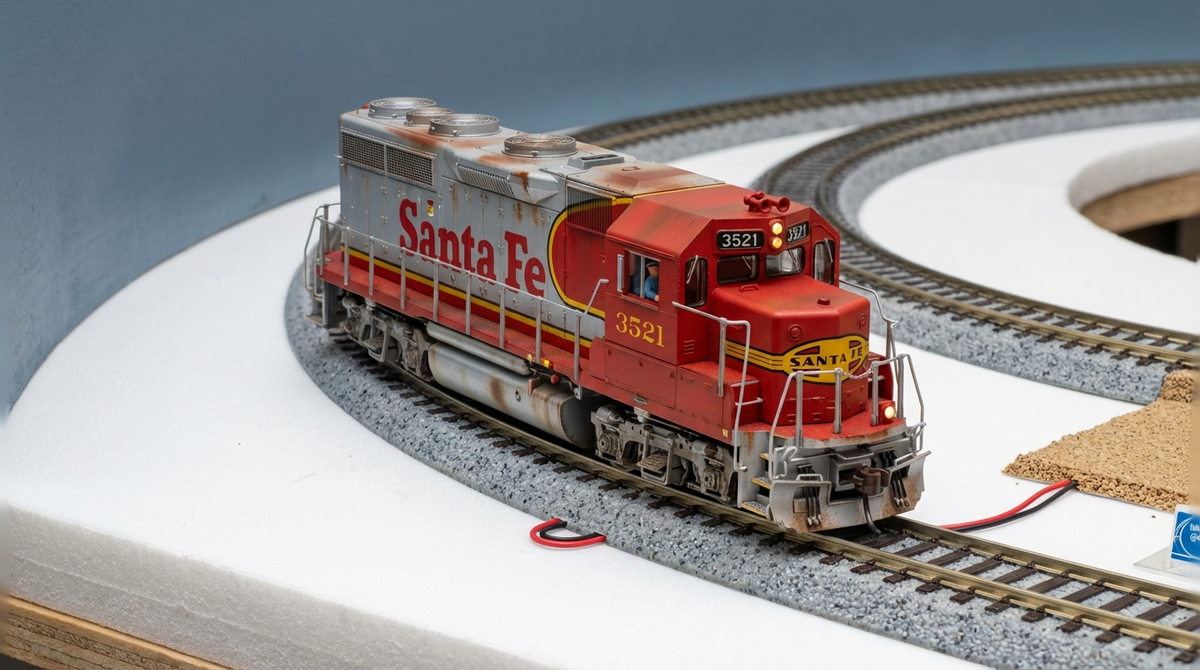
I'll never forget the first time I saw an N scale layout crammed into a space smaller than my kitchen table. A friend had built a twice-around mainline with a passing siding, a small yard, and enough industries to keep him busy for hours. All of it fit on a 2x3 foot board propped up in his apartment closet. That moment changed how I thought about the hobby.
If you're working with limited real estate and dreaming of running trains, N scale trains for small spaces might be your ticket. I've spent years helping newer hobbyists avoid the pitfalls that send 30% of them packing, and I'm going to walk you through what actually works when every square inch counts.
At a 1:160 ratio, N scale packs roughly double the railroading potential per square foot compared to HO. That's not marketing fluff. A 9mm track gauge means you can run realistic-looking mainlines with actual passing sidings in footprints that would barely hold an HO oval.
Think about what that means practically. A 2x3 foot space can host a complete layout with scenic depth and operational interest. You're not just running trains in circles. You're building something that feels like a real railroad, even if it lives on a bookshelf or slides under your bed.
The NMRA defines these scales precisely, and N scale sits in a sweet spot where modern manufacturing produces incredibly detailed models without requiring warehouse-sized rooms to run them.
Before you buy a single piece of track, grab some cardboard and painter's tape. Seriously. Mock up your layout footprint and test whether you can actually reach everything. The average adult can comfortably reach about 24 inches for detailed work, and pushing beyond 30 inches means you'll hate maintaining anything in the back corners.
I've crawled under enough layouts to know that height matters. For standing operation, shoot for 50 to 56 inches. This brings N scale's tiny details closer to eye level. If you're sitting, 42 to 52 inches works well. Planning a multi-deck layout? Leave at least 16 inches between levels so you can actually see what's happening.
Aisles get overlooked too. A 24-inch aisle sounds fine until you're squeezed against the wall for a two-hour operating session. I recommend 28 inches minimum if you want to stay comfortable.
This is where my electrician brain kicks in. Bad lighting will shorten your sessions and make your carefully painted scenery look flat. Aim for 400 to 500 lux for general illumination and bump that to 600-750 lux over work areas. Use LEDs with a Color Rendering Index of 90 or higher so your colors pop. A color temperature between 3000K and 4000K gives you that natural daylight feel without the harshness of cool white bulbs.
Here's where I see the most beginners get burned. Starter sets ship with 9.75-inch radius curves because they fit in small boxes, not because they work well. The NMRA Recommended Practice RP-11 spells out minimum radii by equipment class, and it's worth memorizing.
For modern 70-foot freight cars, you need at least a 12-inch radius. Running 6-axle diesels? 13-inch radius curves will look and run much better. Drop to 11 inches only if you're sticking with 4-axle units and shorter cars.
Want to add an overpass or second level? Keep your grades at 2% or less for mainline running. That's a 2-inch rise over 100 inches of track. Sounds gentle, but here's the catch: curves add to the effective grade. An 11-inch radius curve on a 2% grade can feel like 4-5% to your locomotive. Steep grades kill pulling power fast.
Forum discussions on practical grades confirm what I've seen firsthand: push past 2.5% and you're limiting yourself to very short trains or industrial spurs where a single car is the norm.
Vertical clearance for overpasses needs to be at least 2 inches to handle double-stack containers and anything else you might run.
I've laid all the major systems over the years, and they each have their place.
If you're starting out or need something portable, Kato Unitrack is hard to beat. The Unijoiner system snaps together with solid electrical and physical connections. You can set up a layout in an hour, tear it down, and know it'll work the same way next time. The integrated roadbed even dampens noise a bit.
The smallest standard radius is 8.5 inches, but stick with the 11-inch or larger curves for most equipment. Kato's #4 and #6 turnouts are reliable straight out of the box.
Peco's Code 55 flex track looks stunning. The lower rail profile is more prototypical, and you can bend graceful curves that sectional track can't match. But there's a learning curve. You're soldering rail joiners, cutting and fitting, and dealing with Electrofrog versus Insulfrog versus Unifrog turnout options.
Worth it for experienced modelers chasing realism. Not where I'd point a beginner.
Atlas Code 55 splits the difference nicely. The fine brown ties and smaller rail look great, and their turnouts work well with DCC. The full track catalog gives you plenty of geometry options. Check that older locomotives with deep flanges can handle the lower rail profile before committing.
For ultra-tight tram layouts, Tomix FineTrack and Kato's Compact line offer curves down to 4-6 inches. But here's the catch: most North American N scale locomotives won't work on these. They're designed for Japanese trams and the Kato Pocket Line.
Bachmann E-Z Track is the budget entry point. It works, but the 11.25-inch curves limit your equipment choices, and I've heard enough stories about turnout derailments to recommend upgrading when funds allow.
My first apartment layout sounded like a drum. Every wheel on rail echoed through the floor. The neighbors were... not thrilled. Since then, I've learned that noise control starts with material choices.
A hollow-core door makes a lightweight, rigid base and doesn't amplify sound like solid plywood. For even better results, use 2-inch extruded polystyrene foam over a simple pine frame. It's incredibly light, easy to carve for scenery, and deadens sound naturally.
For roadbed, skip traditional cork glued down with yellow carpenter's glue. That combination creates a soundboard. Instead, use EVA foam roadbed or camper tape adhered with flexible acrylic latex caulk. Testing shows this approach can cut perceived noise by 40% or more.
Under the layout, add Sorbothane pads or rubber grommets to isolate vibrations from the table or wall brackets. These little details add up to a layout your neighbors won't hate.
For a small N scale layout, you don't need a high-amperage system. A 1.5 to 3-amp starter setup will run several locomotives without breaking a sweat.
The NCE PowerCab is my go-to recommendation. It's an all-in-one handheld that works beautifully for single operators. Clear upgrade path too.
The Digitrax Zephyr Express offers 3 amps, a nice big LCD, and USB connectivity for computer control. Reviews praise its beginner-friendly design.
For smartphone control, the Roco z21 start unlocks wireless operation through an app. Tech-savvy modelers love it.
Rail joiners are for mechanical alignment, not electrical conductivity. Run a 14 AWG bus under your layout and drop 22-24 AWG feeders to the rails every 3 feet. In N scale, the smaller rail creates higher resistance, so frequent feeders prevent voltage drop and erratic decoder behavior.
The NMRA DCC standard specifies 12 volts for N scale. Make sure your system is set correctly to avoid cooking those tiny decoders.
Solder a feeder to every piece of track, including both rails of each turnout. Yes, every piece. NMRA Technical Note TN-9 covers this in detail. It's tedious work, but you'll thank yourself when everything runs smoothly.
A loop of track gets boring fast. The secret to small-layout satisfaction is operations, and you don't need miles of mainline to achieve it.
The traditional car cards and waybills system uses physical cards to route freight cars between industries. It's tactile, forces you to learn your layout, and works perfectly for a roster of 6-20 cars.
JMRI OperationsPro automates the logic, generating switch lists and manifests. More setup time upfront, but powerful for those comfortable with computers.
The classic Inglenook puzzle fits on a 1x4 foot shelf and challenges you to assemble a specific 5-car train from 8 cars using only a headshunt and sidings. I've watched grown adults spend hours on this thing.
The Timesaver, designed by the legendary John Allen, adds complexity with five turnouts. It fits in about 1.5x5 feet and can be run against a clock for added pressure.
Both puzzles work beautifully when you add prototype-based industries and use a car-forwarding system to generate realistic work orders.
Standardize on Micro-Trains (MTL) couplers. They're the gold standard for N scale operations. Use the MTL #1055 gauge to set coupler height at 0.216 inches above the railhead, and the #1056 gauge to set trip pins at exactly 0.010 inches for magnetic uncoupling.
Steel axles can get attracted to under-track uncoupling magnets, causing cars to re-couple after you've separated them. Replacing them with non-magnetic wheelsets solves the problem.
Not everything will work on an 11-inch radius, and pretending otherwise leads to frustration.
Shorter wheelbase units are your friends. Four-axle diesels from Atlas and Kato handle 9.75-inch curves reliably. For extremely tight radii down to 6-7 inches, you're looking at the Bachmann 44-ton switcher, 70-ton diesels, and Kato Pocket Line trains.
The Kato minimum radius chart is your reference here. Most of their standard equipment is designed for the 9.75-inch (249mm) curve.
40-foot and 50-foot cars run fine on 9.75-inch radius. Once you get into 70-foot and longer cars, you need 13-19 inches or more to prevent binding. 85-foot passenger cars demand at least 15-18 inches, and even then they'll look odd on tight curves.
Body-mounted couplers attached to the car frame are better for operations, especially when pushing long cuts of cars. Truck-mounted couplers swing with the trucks and can be more forgiving on tight curves, but they cause problems when backing trains. Experienced operators recommend body-mounted MTL couplers for reliability.
Small layouts need help looking bigger than they are.
Skip bright sky blue. A soft, desaturated blue-gray recedes visually and mimics atmospheric haze. Make it lightest at the horizon and darker toward the top. Use flat or matte paint to eliminate reflections, and curve the backdrop in corners to create a seamless horizon.
Place smaller-scale items in the background. Z-scale buildings (1:220) behind your N scale scene create the illusion of distance. Low-relief building flats against the backdrop suggest depth without eating up footprint.
Mount LED strips behind a fascia to hide the source. COB LED strips or SMD strips in aluminum channels with opal diffusers create smooth, even light without the dotted appearance of visible diodes.
You can start small and grow smart.
A Kato starter set with a modern locomotive, a few cars, and the M1 oval running 12-3/8 inch radius gets you on track fast. The included Power Pack SX works for DC operation. You'll be running trains within an hour of opening the box.
Keep your Kato track and add an NCE PowerCab for full DCC control. A Kato V1 siding set with #6 turnouts gives you passing sidings and basic switching. Now you can run two trains and start practicing meets.
Add Peco Code 55 turnouts for a dedicated switching area. Grab some Atlas flex track, download JMRI (it's free), and invest in the Micro-Trains gauges for coupler setup. You're now running proper operating sessions with computer-generated switch lists.
Clean track means reliable operation. Here's what I do before every session:
Start with a soft brush to sweep loose debris, especially around turnout points. Spot-clean any black oxidation streaks with a non-abrasive track cleaning block using light pressure.
Wipe all rails with a lint-free cloth dampened with 90-99% isopropyl alcohol, followed immediately by a dry pass. For locomotive wheels, place an alcohol-dampened paper towel on the track, hold one truck on powered rail and the other on the towel, and spin the wheels until no black streaks appear.
Use appropriate track cleaners for deeper cleaning. For lubrication, plastic-safe oils like LaBelle #108 go only on bearings and gears, never on wheels or rails.
Check your track and wheels periodically with an NMRA Standards Gauge. It's the definitive tool for diagnosing derailment causes and confirming everything is in spec.
The NMRA Standards and Recommended Practices are your technical bible. Download the PDFs for S-3.2 (trackwork), S-4.2 (wheels), and RP-11 (curvature). Use them to double-check your track plan and equipment purchases.
Spookshow.net is the N scale locomotive encyclopedia. Mark Peterson has tested every North American N scale loco for pulling power, slow-speed performance, and DCC-friendliness. Before buying anything used, check his grades and notes.
For free track plans in small footprints, SCARM.info has hundreds filterable by size and scale. And Track-Plans.net offers plenty of N scale inspiration for tight spaces.
For most modern equipment, 11 to 13 inches works well. Passenger cars over 70 feet need 15-18 inches minimum. The tighter you go, the more you limit what you can run.
A continuous-run oval fits in 2x3 feet. Switching layouts work on 1x6 foot shelves. Micro layouts as small as 12x18 inches can provide satisfying operation if designed around switching puzzles.
Absolutely. Independent control of multiple locomotives, realistic slow-speed performance, momentum effects, and onboard sound all work on the smallest layouts. DCC transforms a simple oval into a dynamic operating experience.
Only if you have the curve radius to support them. 85-foot cars need 15-18 inch radius minimum, with 22 inches preferred. On tighter layouts, model branch lines or eras with shorter cars.
Kato Unitrack for ease of use and reliability. You can always add Peco or Atlas flex track sections later as your skills grow.
N scale trains for small spaces aren't a compromise. They're an opportunity to build something complete, operational, and satisfying in the room you actually have. Start with good geometry, reliable track, and proper wiring. Everything else is just scenery on a solid foundation.
By Derek Olson
✨ Complete Your Layout: Explore our wide selection of Photo Real buildings, diorama backdrops, detail parts, and accessories in every popular scale.
✨ Unmatched Realism: From chrome detailing products to neon lighting kits – every piece is designed to make your miniature world come alive.