
N Scale Sound Decoder Options: Your Complete Guide to Big Sound in Small Locomotives
Posted by Carol Fitzgerald on 31st Dec 2025
Order by phone: 763-231-7847
Free Shipping On Orders Over $100!
If you are already registered, please log in.
Create your account and enjoy a new shopping experience.
Create A New AccountPosted by Carol Fitzgerald on 31st Dec 2025
When my husband passed in 2008 and I inherited his layout, I inherited something else too: a bin of decoder boxes he never got around to installing. Back then, getting sound into an N scale locomotive felt like trying to paint the Mona Lisa on a grain of rice. The decoders were too big. The speakers were tinny. The whole thing seemed like more trouble than it was worth.
I'm here to tell you that world has completely changed. The N scale sound decoder options available in 2025 would have blown my husband's mind. Decoders now fit into spaces we once thought impossible, and the sounds they produce can make you forget you're looking at something that fits in your palm.
Let me walk you through what's actually worth your money and time.
If you've been away from the hobby for a few years, here's the biggest shift: we finally have a standard. The NEM 662 "Next18" socket has become the common language that decoders and locomotives now speak. Think of it like USB-C replacing that drawer full of random chargers you used to keep.
Major manufacturers including Atlas, Kato, and most European brands now equip their models with Next18 sockets. Pop off the shell, unclip the factory board, plug in your new decoder. No soldering to frame tabs. No deciphering cryptic wiring diagrams at midnight.
ESU, Zimo, SoundTraxx, and Digitrax all offer Next18 decoders, so you're not locked into one brand. I like having options. It reminds me of choosing between different brands of acrylic paint: they all cover the canvas, but each has its own personality.
After spending way too many hours reading forum posts and installing decoders in my own locomotives, I've sorted the market into clear tiers. Here's how I think about it.
When I was teaching, I'd tell students that good brushes make a difference. You can paint with cheap brushes, but quality tools reward you. That's ESU's LokSound 5 series in a nutshell.
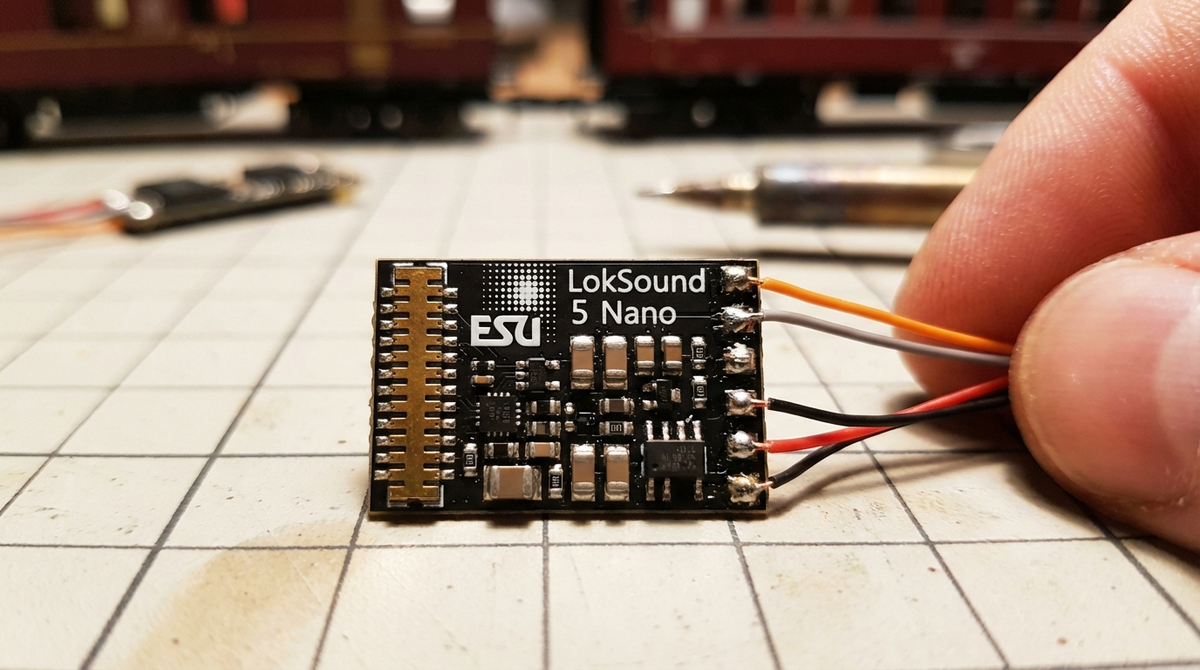
The LokSound 5 Micro measures just 21 x 10 x 3.8mm. The LokSound 5 Nano shrinks even smaller at 15 x 9.5 x 3.5mm. These decoders deliver 16-bit audio at 31,250 Hz sampling, which means your locomotive sounds like an actual locomotive, not a 1980s video game.
Community forums consistently praise ESU for two things: motor control that produces glass-smooth slow speed and a sound library so extensive you can find files for obscure prototype variations most of us have never even heard of.
Street prices have dropped too. I've seen the LokSound 5 Micro selling for as low as $97 at SBS4DCC, down from MSRPs around $129. That price compression puts premium sound within reach for more of us.
Zimo's MS591N18 currently holds the crown for the smallest full-featured sound decoder: 15 x 9.3 x 3.1mm. When you're fitting sound into a tiny steam locomotive tender or a compact switcher, those fractions of a millimeter matter.
Zimo decoders match ESU's 16-bit audio quality and offer 128 Mbit of sound memory. Where they differ is in philosophy. Zimo gives you more CVs to tweak, more settings to adjust. If you enjoy spending evenings fine-tuning motor response curves, you'll appreciate what Zimo offers.
The learning curve is steeper. I'll be honest: some forum users find Zimo's documentation less polished than ESU's. But if you're the type who reads instruction manuals for fun, Zimo rewards that patience.
Not everyone wants to become a CV programming expert. Some of us just want our locomotive to sound good without a weekend project. That's where SoundTraxx Tsunami2 fits in.
SoundTraxx takes a different approach: they've pre-loaded carefully curated sound sets and don't let you upload your own. You can't import custom WAV files, which frustrates tinkerers. But the sounds they include, especially for North American prototypes, are recorded by professional audio engineers.
The TSU-N18 runs about $101-126 at street price. It fits Next18 sockets and includes SoundTraxx's "Dynamic Digital Exhaust" feature, which adjusts engine sounds based on motor load. When your locomotive struggles up a grade, you hear it working harder. That's a nice touch.
Let's say you're converting a fleet of twenty locomotives. Or you're just starting out and don't want to spend $100+ per engine while you learn. Digitrax SDXN decoders sit at the $69-79 range and offer something the premium brands don't: value.
Digitrax also provides SoundLoader software for free, letting you build and edit your own sound projects. That's unusual at this price point. The motor control isn't quite as refined as ESU's, and some users report finicky behavior, but you're paying half the price.
For a beginner's first sound installation, a drop-in Digitrax board for a Kato wide-body makes a lot of sense. You can always upgrade later once you've caught the bug.
Here's where my art teacher brain kicks in. I've watched so many people obsess over decoder specifications, comparing bit depths and sampling rates like they're buying studio recording equipment. Then they stick a bare speaker in their locomotive and wonder why it sounds like music playing through a tin can.
The speaker enclosure matters more than your decoder choice. Full stop.
Think about it this way: a speaker cone moves air. When it pushes forward, it also sucks air behind it. Without a sealed enclosure, those two sound waves meet and cancel each other out. You lose bass. You lose volume. You lose everything that makes sound satisfying.
I've had the best results with enclosures between 500 and 1000 cubic millimeters. For the popular 9x16mm "sugar cube" speakers, aim for at least 750 cubic millimeters.
Here's my approach, refined through trial and error:
I've installed the same decoder in two identical locomotives with different enclosure setups. The difference was night and day. The sealed enclosure produced bass I could feel through the benchwork. The unsealed one sounded like someone whispering into a paper bag.
N scale locomotives are light. They have tiny wheels. They lose contact with the rails constantly, especially over turnouts. Without supplemental power storage, your sound decoder reboots every time this happens. That means your locomotive goes silent, then blasts through its startup sequence again. And again.
A keep-alive capacitor stores enough juice to run the decoder through those power blips. You get smooth, uninterrupted operation.
| Product | Size | Run Time | Price |
|---|---|---|---|
| SoundTraxx CurrentKeeper | 40 x 6 x 11mm | Up to 10 seconds | ~$33 |
| SoundTraxx CurrentKeeper II | 20 x 13 x 11mm | Up to 10 seconds | ~$33 |
| ESU PowerPack Mini | 15.7 x 9.7 x 13mm | ~3 seconds | ~$52 |
| Digitrax PX112-6 | 40 x 14 x 8mm | Varies | ~$31 |
The ESU PowerPack talks directly to ESU decoders, automatically disabling during programming. SoundTraxx's capacitors work with any brand but require soldering to the decoder's power leads. Digitrax uses a proprietary plug that only fits their Series 6+ decoders.
Budget for one of these with every sound installation. I consider them as necessary as the decoder itself.
You have two basic paths to get a decoder into your locomotive. Each has trade-offs.
ESU makes boards that replace factory light boards in specific Kato and Atlas locomotives. Pop out the old board, drop in the new one. Installation takes maybe 35 minutes instead of 95+.
Sounds perfect, right? The catch is that drop-in boards often rely on pressure contact for power pickup. If anything shifts, you lose connection. Some installers add solder to the contact pads or use foam shims to maintain firm pressure.
For a Kato SD70M with an ESU 58741, some installers report zero machining required. Others find they need to mill the frame to fit a proper speaker enclosure. Your mileage varies depending on your standards for sound quality.
For older locomotives, brass imports, or anything without a matching drop-in board, you're wiring by hand. This means soldering decoder leads directly to motor tabs, running pickup wires from both trucks, and building custom speaker enclosures.
The payoff? Rock-solid connections that won't loosen over time. The ability to use any decoder you want. Complete control over speaker placement and enclosure design.
I've done both. For a Kato GS-4 steam locomotive, I placed the decoder and speaker in the tender, ran power pickup wires through a dual-wire drawbar, and isolated the motor from the frame using Kapton tape. It took an entire Saturday. But that locomotive has never given me a moment's trouble.
All decoders can be programmed through your DCC system. But if you want to load custom sounds or access the full feature set, you need brand-specific hardware.
The ESU LokProgrammer costs about $73-170 depending on the bundle. It connects to your computer and provides a graphical interface for every CV, plus the ability to load any sound file from ESU's free library. You can also update decoder firmware, which matters for bug fixes and new features.
If you own more than a few ESU decoders, the programmer pays for itself in convenience. Plus, some retailers like SBS4DCC load sounds for free when you buy a blank decoder, which helps if you're not ready for the programmer investment.
Zimo's MXULFA programmer runs $160+ and works with their ZSP sound programming software. Sound loading is fastest through the SUSI interface, about 15 minutes for a full project. Loading via the programming track can take over two hours for modern MS-series decoders. Plan accordingly.
SoundTraxx doesn't require a programmer for basic use. You select sounds using CV programming through your DCC system. But you can't load custom sounds at all. What's on the decoder is what you get.
A PTB-100 Programming Track Booster (about $58-73) helps with reliability when programming Tsunami2 decoders. Many command stations don't provide enough power for the decoder to respond properly during read-back operations.
The Digitrax PR4 interface runs about $95 and connects to their free SoundLoader software on Windows or Mac. You can import WAV files and build custom sound projects. It's not as polished as ESU's software, but it gets the job done at a lower cost.
Just when we all got comfortable with Next18, a new standard appeared. The E24 interface (also called Next28 or NEM 664) offers 28 pins in a smaller footprint than Next18's 18 pins.
What does that mean for you? More lighting outputs. Up to 13 discrete function outputs for headlights, ditch lights, marker lights, numberboards, and cab interiors. Plus, E24 includes a dedicated pin for keep-alive capacitors, simplifying installation.
Atlas and ScaleTrains are already shipping E24-equipped locomotives. The MOROP standardized NEM 664 in 2025, which means it's official, not just a manufacturer experiment.
My advice: Next18 remains a safe choice for current projects. But when buying new locomotives, look for E24 sockets. You'll thank yourself in three years.
I've made most of these mistakes myself. Here's what I learned.
The motor tabs are touching the frame. This creates a direct short that can destroy your decoder instantly. Before powering up any new installation, use a multimeter to verify the motor is completely isolated. Kapton tape is your friend.
Your enclosure leaks. Go back and seal every joint, every wire pass-through. Even a pinhole gap bleeds bass and volume.
The decoder's BEMF settings don't match your motor. ESU includes an Autotune function that calibrates itself: set CV 54 to 0 and press F1. The locomotive runs through a tuning routine and adjusts CVs 51-56 automatically.
For SoundTraxx, try adjusting CV 212 (BEMF Feedback Intensity). The default is 255; lowering it smooths operation, especially in consists.
Zimo motors can be finicky. CV 9 controls motor frequency: try values like 44, 33, or 22 for coreless motors. CV 56 adjusts the PID regulation loop.
Your programming track doesn't provide enough current. Sound decoders draw more power than basic decoders, and many command stations can't source enough for reliable acknowledgment. A programming track booster solves this.
After all these words, let me give you the short version.
If you want the best motor control and access to the largest North American sound library, this is your decoder. Street prices around $97 make it surprisingly affordable for a premium product.
When every tenth of a millimeter matters, Zimo's micro decoder wins. It fits where others can't.
The TSU-KN1 includes decoder, speaker, and enclosure in one package for specific Kato locomotives. No guessing, no sourcing parts, no fabrication. Just plug and play.
At $70 with free sound customization software, Digitrax gives you the most features per dollar. Perfect for fleet installations or learning the ropes.
I remember the first time I ran a sound-equipped locomotive on my layout. It was a Kato SD40-2 with an ESU decoder and a speaker enclosure I'd built from scrap styrene. When I notched up the throttle and heard that EMD 645 prime mover rumble through the room, something clicked.
This wasn't just a model anymore. It was a tiny piece of the railroad I'd been trying to capture with paint and styrene for years. Sound added dimension I hadn't known was missing.
My husband would have loved this. He'd have spent weeks tuning CVs and swapping horn samples. I like to think he'd be proud of how far I've taken his half-finished layout, and how N scale sound decoder options have made it possible to hear something he only imagined.
✨ Complete Your Layout: Explore our wide selection of Photo Real buildings, diorama backdrops, detail parts, and accessories in every popular scale.
✨ Unmatched Realism: From chrome detailing products to neon lighting kits – every piece is designed to make your miniature world come alive.