
N Scale Scenery Techniques for Beginners: A Practical Guide to Getting It Right
Posted by Tony Marchetti on 31st Dec 2025
Order by phone: 763-231-7847
Free Shipping On Orders Over $100!
If you are already registered, please log in.
Create your account and enjoy a new shopping experience.
Create A New AccountPosted by Tony Marchetti on 31st Dec 2025
I spent 28 years fixing trains for the CTA, and if there's one thing that experience taught me, it's this: you don't need fancy equipment to do good work. You need the right materials, the right technique, and enough sense not to skip the boring steps that actually matter. N scale scenery works the same way.
Look, I get it. You've got your track down, maybe a locomotive or two running loops, and now you're staring at a sea of bare foam or plywood thinking "where do I even start?" I've been there. Every modeler has. The good news? Building N scale mountain scenery isn't rocket science. But there are some things the hobby magazines don't always spell out clearly for newcomers.
Let me be blunt: if you're building anything that might need to move someday, or if you want to finish scenery in a reasonable timeframe, you need to be working with extruded polystyrene foam. The pink or blue stuff you find at home improvement stores.
A finished foam module with a Sculptamold skin weighs about 2 pounds per square foot. Traditional plaster hard-shell over cardboard webbing? That's pushing 5.8 pounds per square foot. We're talking a 65% weight reduction for the same coverage. For a 4x6 shelf layout, that's the difference between something you can move yourself and something that needs two people and a prayer.
Speed matters too. Foam-based landforms with a thin plaster or Sculptamold skin can cure in under 30 minutes. The old-school plaster methods? You're looking at overnight drying before you can even think about painting.
Not all foam is created equal. Extruded polystyrene (XPS) is the dense blue or pink insulation board. It carves cleanly, holds detail well, and won't fall apart when you look at it wrong. The white beadboard stuff (EPS) is cheaper but messier and weaker. Save yourself the headache and spend the extra few bucks on XPS.
For adhesives, you've got to use foam-safe products. Loctite PL 300 Foamboard adhesive is specifically designed for this. Acrylic latex caulk like DAP Alex Plus also works great. Standard construction adhesives or hot glue? They'll melt your foam into a gooey mess. I've seen guys ruin hours of work because they grabbed the wrong tube.
According to the technical data sheet, PL 300 bonds to most surfaces including polystyrene, wood, and concrete. Just remember that PVA wood glue needs longer cure times when sandwiched between non-porous foam layers.
Plaster cloth is the cleaner option. You cut it into strips, dip in water, and drape it over your foam forms. The Woodland Scenics instructions recommend overlapping strips by about 50% for strength. Smooth it with wet fingers to hide the gauze texture. It dries in 4-6 hours and creates a hard shell that accepts paint and scenery materials.
Sculptamold sets faster, about 30 minutes, and you can texture it while it's wet. Mix it to a thick paste and spread it thinly with a putty knife. For most beginner projects, either method works fine. Pick based on whether you value working time or faster results.
One tip from experience: don't rely on plaster cloth alone as your finished surface. It's a substrate, like drywall in a house. Add thin coats of plaster or drywall compound to build up strength and smooth out the gauze texture. That's what separates hobby-grade work from something that looks like a kindergarten project.
Lightweight Hydrocal is stronger than regular plaster and captures fine detail better. The mix ratio is 5 parts Hydrocal to 2 parts water. According to the product instructions, you pour the plaster slowly into cold water, let it stand for 2 minutes, then stir for 1-2 minutes.
The USG data sheet shows it develops 1,000 psi compressive strength within an hour and 5,000 psi when fully dry. That's twice the strength of regular plaster of Paris. Humidity affects curing time, so if your basement is damp, run a dehumidifier.
Here's where beginners mess up most often. In N scale at 1:160 ratio, everything is tiny. A six-foot-tall person measures just 11.4mm. Real grass that's a foot tall? That's less than 2mm in N scale.
For static grass, you want 1-2mm fibers as your base layer. Anything longer and you're creating fields that look like they haven't been mowed since the Eisenhower administration. 4mm fibers should only be used for selective foreground tufts or overgrown areas. Otherwise you get what modelers call the "fuzzy welcome-mat" look.
The WWScenics 2mm static grass is a good starting point. A 100g bag covers about 2.5 square feet, so it's cost-effective for beginners experimenting on small projects.
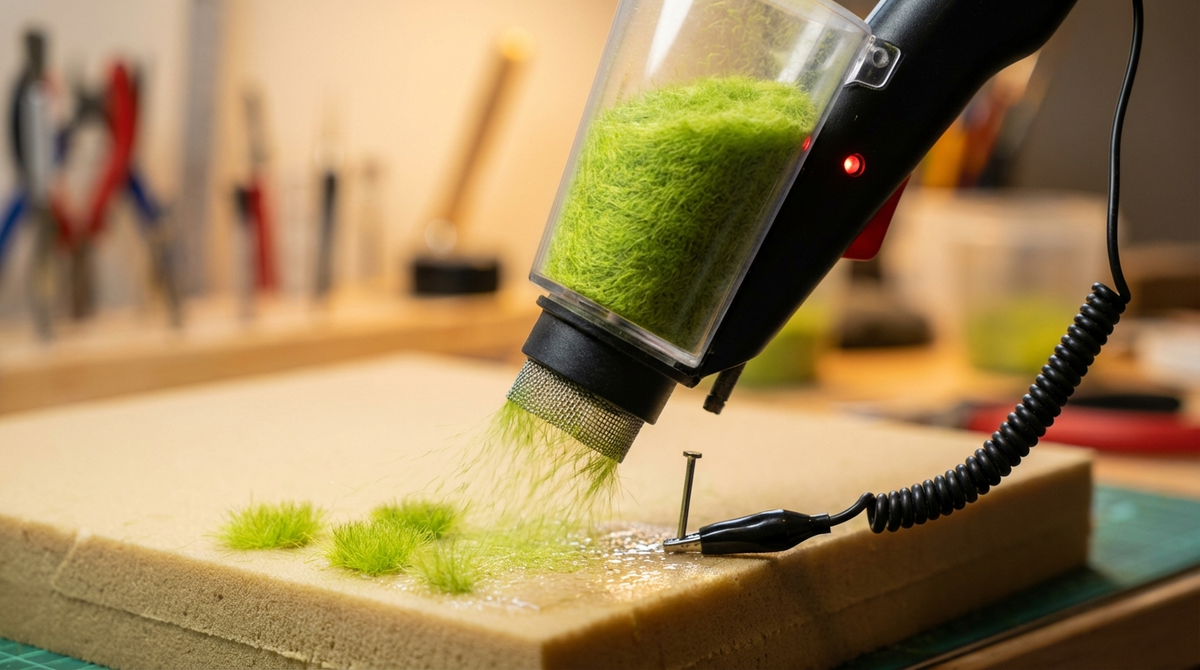
Nothing looks worse than grass lying flat like it got hit by a tornado. The whole point of static grass is that it stands upright, mimicking real vegetation. That requires an electrostatic charge and proper grounding.
The most common mistake is using a weak applicator or poor grounding technique. You need a high-voltage applicator of at least 12,000 volts. Drive a nail or pin directly into the wet glue and clip your applicator's ground wire to it. This creates a circuit that pulls the fibers upright.
For adhesive, use diluted matte medium or a dedicated static grass basing glue. Regular white PVA glue can dry shiny and cause grass to peel over time. Hold the applicator 1-2 inches from the surface and shake gently. After drying, vacuum up loose fibers with a stocking over the nozzle to save the excess.
You've got three tiers to choose from. A DIY fly swatter conversion runs $5-15 and works for testing the technique on a small area. Build quality is sketchy and there's some shock risk if you wire it wrong.
Mid-tier options like the Woodland Scenics Static King or WWS Pro Grass Detailer cost $70-135 and deliver consistent 12-16kV output. For most N scale work with short fibers, this is the sweet spot. Premium units like the RTS Greenkeeper push 55kV and handle longer fibers, but that's overkill for our scale.
Ballast is the crushed rock that holds real railroad ties in place. In N scale, using the right grain size isn't just about looks. Oversized ballast can foul turnout points and cause derailments.
Woodland Scenics Fine Ballast with particle sizes of 0.26-0.83mm works well for N scale. Arizona Rock & Mineral offers N scale-specific ballast made from real crushed rock that looks even more realistic and resists floating during gluing.
Spread dry ballast with a spoon, then use a small stiff brush to groom it below the tie tops and away from railheads. Pre-wet with "wet water" (water with a few drops of dish soap or 20% isopropyl alcohol) to break surface tension. Apply diluted adhesive with a pipette, letting it wick in through capillary action. Let it cure at least 24 hours before running trains.
The Arizona Rock tutorial covers this process in detail. A typical glue mix is 1 part white glue to 4 parts water, or a 1:3 matte medium to water ratio.
Turnouts need special attention. Never let ballast or glue enter the moving parts. Keep it clear of points, frogs, and throwbar mechanisms. After gluing, work the switch points back and forth every 10-15 minutes for the first hour to prevent them from freezing in place.
The "code" refers to rail height in thousandths of an inch. Code 80 is taller and less prototypical but runs everything. Code 55 looks more realistic but can cause problems with older equipment with deep "pizza-cutter" flanges.
Most equipment manufactured after 2000 runs fine on Code 55. But if you've got vintage stuff from the pre-1990s era with flanges deeper than 0.037", the wheels will bottom out on the ties.
Here's a trick: Peco Code 55 track embeds what's actually a Code 80 rail into the tie plates, leaving only Code 55 visible above. This design accepts most deep-flanged wheels while looking properly fine. It's the best compromise for mixed fleets.
Before you start adding scenery around your tracks, you need to know how much space trains need. The NMRA Recommended Practices for tangent track spell this out precisely.
For N scale on straight track, minimum track centers should be 0.60" (15mm). Total tunnel height needs to be at least 1.72" (44mm). These clearances increase on curves because car bodies swing outward.
The NMRA standards index has the complete documentation. The NMRA N Scale Standards Gauge is worth the few bucks to check your work as you build.
For curved track centers and curved obstacle clearances, the NMRA provides additional tables. The trackwork standards cover flangeway dimensions that affect turnout compatibility.
If you want to build scenery without getting bogged down in benchwork construction, the T-TRAK modular standard is your friend. A standard 308mm single module using Kato Unitrack can be ready for a powered test in under 2 hours.
Compare that to 8-10 hours for traditional benchwork and flex-track. T-TRAK lets you focus on what you actually want to practice: scenery techniques.
The standardized interface means your modules can connect with club layouts worldwide. The module specifications place the front track's edge 38mm from the module face, with 33mm center-to-center spacing to the second track. Wiring polarity is standardized as "blue-to-the-outside."
Kato Unitrack's UniJoiners handle both mechanical and electrical connections, so modules simply click together. Woodland Scenics even makes pre-formed T-TRAK modules if you don't want to build the boxes yourself.
NTRAK is the original N scale modular system with larger 2'x4' modules and three parallel mainlines. It allows longer train operations but requires more space and construction effort. NRail coordinates the various N scale modular groups.
Free-moN focuses on prototypical operations with single mainline, minimum 22" radius, and #6 minimum turnouts. Modules are built to a 50" viewing height and can be any shape between standardized endplates. It demands more skill but produces stunning results.
For detailed foreground rocks, casting beats carving every time. Commercial rubber molds from Woodland Scenics or Bragdon work with lightweight plaster materials.
Durham's Water Putty is an inexpensive gypsum product that sets hard, doesn't shrink, and can be carved while still soft about 20 minutes after mixing. The Idaho Gourd Society article covers its properties in detail.
For painting rocks, the Woodland Scenics "Leopard Spot" technique works beautifully. Dilute earth-toned acrylics and dab them randomly, then blend with a darker wash. The Earth Colors Kit instructions recommend a 1:16 pigment-to-water ratio for secondary colors.
For shallow streams under 1/8" deep, Woodland Scenics Realistic Water pours from the bottle and dries clear in 24 hours. Vallejo Still Water works similarly.
For deeper water over 1/8", Woodland Scenics Deep Pour Water handles single pours up to 1/2" and cures in 24 hours. The product instructions explain the mixing process.
Two-part epoxy resins like EnviroTex Lite give crystal-clear finishes but require thin layers no more than 1/8" at a time with 8-12 hours between pours. The manufacturer instructions are worth reading before your first pour.
Seal your base thoroughly with paint before any water product. Porosity releases air bubbles that ruin the effect. Pass a heat gun over fresh epoxy to pop surface bubbles. For waves, stipple acrylic gloss gel onto the cured surface with a stiff brush.
This is where I put on my CTA safety hat. Model scenery involves real hazards that too many hobbyists ignore. I've seen guys sanding plaster in their basements with no ventilation, breathing in dust that could cause serious long-term damage.
Sanding or mixing plaster and gypsum products like Durham's Water Putty releases fine dust containing respirable crystalline silica. OSHA's action level is 25 micrograms per cubic meter, and you can exceed that easily in an enclosed basement.
The CPSC Art and Craft Safety Guide covers hobby-related hazards. Wear a NIOSH-approved N95 or P100 respirator whenever you're generating dust. Wet-sand when possible to minimize airborne particles.
Two-part epoxy resins generate heat as they cure. According to West System's epoxy safety guide, a large mass in a confined container can reach temperatures hot enough to melt plastic or cause burns. Mix in shallow trays to dissipate heat, and never pour more than manufacturer recommendations at once.
Skin contact with uncured resin causes sensitization. Once you develop an allergy, you're allergic for life. Smooth-On's product information recommends nitrile gloves and eye protection. The West System user manual covers proper handling in detail.
Spray paints and solvents release volatile organic compounds (VOCs) that need ventilation. For airbrushing or regular solvent use, the 3M Respirator Selection Guide recommends organic vapor cartridges. A combination OV/P100 cartridge handles both vapors and particulates from spray paints.
One more thing: don't spray paint directly onto foam. The solvents in many spray paints will dissolve polystyrene. Use water-based latex or acrylic paints, or apply a barrier coat first. Check the product safety data sheets when in doubt.
High humidity slows plaster curing and can cause problems with epoxy. Moisture creates "amine blush," a waxy film on curing resin. The Epoxy King troubleshooting guide recommends working between 70-80°F with humidity below 60%.
In dry climates, static grass application can suffer from lack of ambient moisture to conduct the charge. Lightly misting the air helps. Water-based products cure faster in dry conditions, reducing your working time.
The best way to learn scenery techniques is on a small, low-stakes project. A 12" x 6" diorama lets you practice everything without risking an entire layout.
Total: around $68, leaving room for a rock mold or extra supplies.
The Woodland Scenics Scenic Ridge Kit covers 18 square feet for about $80 on sale, but for learning purposes, buying smaller individual items makes more sense. Bulk kits only become cost-effective when you're covering 6+ square feet.
Real dirt works as ground cover if you sift and sterilize it. Bake it at 250°F for an hour to kill any bugs or seeds, then sift through a fine mesh strainer.
For trees, natural twigs and sagebrush armatures beat expensive commercial kits. Dried Christmas tree branches make great evergreen foliage material.
A 50/50 mix of white glue and water with a drop of dish soap substitutes for specialty scenic cement. Most experienced modelers use this formula for ballasting with great results.
When things go wrong, and they will, you need to know the fixes before you panic and make things worse.
If water-based glue is the culprit, soak the area with 70-91% isopropyl alcohol for 10-15 minutes. The alcohol softens PVA and matte medium without damaging plastic. Use a dental pick to scrape away softened ballast while working the points back and forth. Clean glue from railheads with an alcohol-dampened cloth.
Glossy patches on matte scenery happen from using too much scenic cement or the wrong type. The quick fix is a light coat of Testors Dullcote or similar matte varnish. Prevention is better: use matte medium diluted 1:3 or 1:4 with water, and pre-wet with wet water so adhesive soaks in rather than pooling.
Flat grass means weak charge or bad grounding. Voltage matters. Check that your ground pin is in the wet glue, not just near it. Right after application, use a vacuum with a stocking to pull fibers upward. Once dry, a light mist of extra-hold hairspray can help seal things in place.
Visible seams between castings break the illusion. Butter fresh plaster on the back of new castings and press them so they overlap previous ones. Fill gaps with Sculptamold and press crumpled aluminum foil into it while wet to create matching texture.
Rail grime from scenery materials causes stalls and erratic running. Mask track with painter's tape before applying glue or paint. Clean with 91% isopropyl alcohol and a lint-free cloth after ballasting. For stubborn deposits, a track cleaning block works but use it sparingly to avoid scratching.
Before any grass goes down, you need a convincing earth base. The NMRA Beginners Guide to Scenery recommends earth-toned latex paint as the simplest starting point. This seals the plaster and provides natural-looking color if ground cover wears thin.
For better realism, NOCH and Woodland Scenics ground textures offer consistent scale-appropriate colors. WWScenics products work well too.
Ground goop combines texture, color, and adhesive in one paste. A typical recipe uses equal parts Sculptamold, fine vermiculite, and earth-colored latex paint with half-part white glue, thinned with water to oatmeal consistency. Spread it over your hard shell and apply fine turf or static grass directly into the wet surface.
Real ground cover builds up in layers. Start with fine dirt or earth-toned turf. Add patches of different colors for variation. Apply static grass last, using different colors and lengths in separate passes. The SLD NMRA clinic notes cover the complete layering process.
Putting down a ground cover layer first gives static grass something to bite into. Paint on diluted adhesive in stripes and apply different grass colors in each section for natural variation.
The NMRA Layout Planning Guide recommends a maximum 2% grade for reliable operations. That's a 1-inch rise over 100 inches of run. Grades steeper than 2.5% chop your train length dramatically.
Woodland Scenics makes foam inclines at 2%, 3%, and 4% grades that take the math out of it. Track grade issues are one of the most common beginner frustrations.
For minimum radius, 15 inches is the recommended mainline minimum for modern equipment. Tighter curves down to 11 inches work for industrial spurs but can cause coupler issues on long cars.
| Product Type | Density | Best Use | Cautions |
|---|---|---|---|
| EPS (White Beadboard) | 1.0-1.5 lb/ft³ | Budget fills, background hills | Messy, weak detail |
| XPS (Blue/Pink Board) | 1.3-2.2 lb/ft³ | Landforms, carving, roadbed | Use foam-safe adhesives |
| Owens Corning FOAMULAR | 1.3-3.0 lb/ft³ | Commercial projects | Various types for different loads |
The Owens Corning technical bulletin covers the full FOAMULAR line. Compressive strength varies from 15 to 100 psi depending on product.
| Adhesive | Foam Safe? | Cure Time | Notes |
|---|---|---|---|
| Loctite PL Premium | Yes | 24 hours | Strong polyurethane |
| PL Premium Fast Grab | Yes | 24 hours | Extended repositioning |
| DAP Alex Plus Caulk | Yes | 30-60 min | Easy to carve around |
| Liquid Nails Projects | Yes | 24 hours | Latex, water cleanup |
| Standard Hot Glue | No | - | Will melt foam |
The InsulFoam compatible adhesives bulletin lists tested products. Loctite's foam gluing guide has additional tips.
The NMRA Standard S-1.2 defines the 1:160 ratio for N scale. Rail transport modelling scales on Wikipedia covers all the variants. For British N at 1:148 or Japanese N at 1:150, the Model Rail Directory calculator handles conversions.
The NMRA Scales page explains the narrow gauge variations like Nn3. International standards from MOROP may differ slightly from NMRA specifications.
The NMRA Benchwork Guide covers traditional construction methods. But honestly? For your first N scale scenery project, skip the complicated stuff. Cut a piece of foam, skin it with plaster cloth, paint it earth tones, and start experimenting with ground cover.
You'll make mistakes. That's fine. Scenery is forgiving. If your static grass looks like a bad toupee, vacuum it up and try again. If your rocks look like painted potatoes, paint over them with darker washes. If your water feature turns cloudy, pour a fresh layer on top.
The goal isn't perfection. The goal is learning enough to make your next attempt better. After a few small dioramas, you'll develop an eye for what works and what doesn't. That's when you're ready for the big layout.
I've been in this hobby since my dad put that first Lionel set around our Christmas tree in Cicero. Fifty-some years later, I'm still learning. That's the best part. There's always another technique to try, another scene to build, another way to make things look a little more real. Get your hands dirty. Make some mistakes. Have fun with it.
✨ Complete Your Layout: Explore our wide selection of Photo Real buildings, diorama backdrops, detail parts, and accessories in every popular scale.
✨ Unmatched Realism: From chrome detailing products to neon lighting kits – every piece is designed to make your miniature world come alive.