
Model Train Layout Under Bed Design: A Practical Guide to Building in Forgotten Space
Posted by Carol Fitzgerald on 16th Feb 2026
Order by phone: 763-231-7847
Free Shipping On Orders Over $100!
If you are already registered, please log in.
Create your account and enjoy a new shopping experience.
Create A New AccountPosted by Carol Fitzgerald on 16th Feb 2026
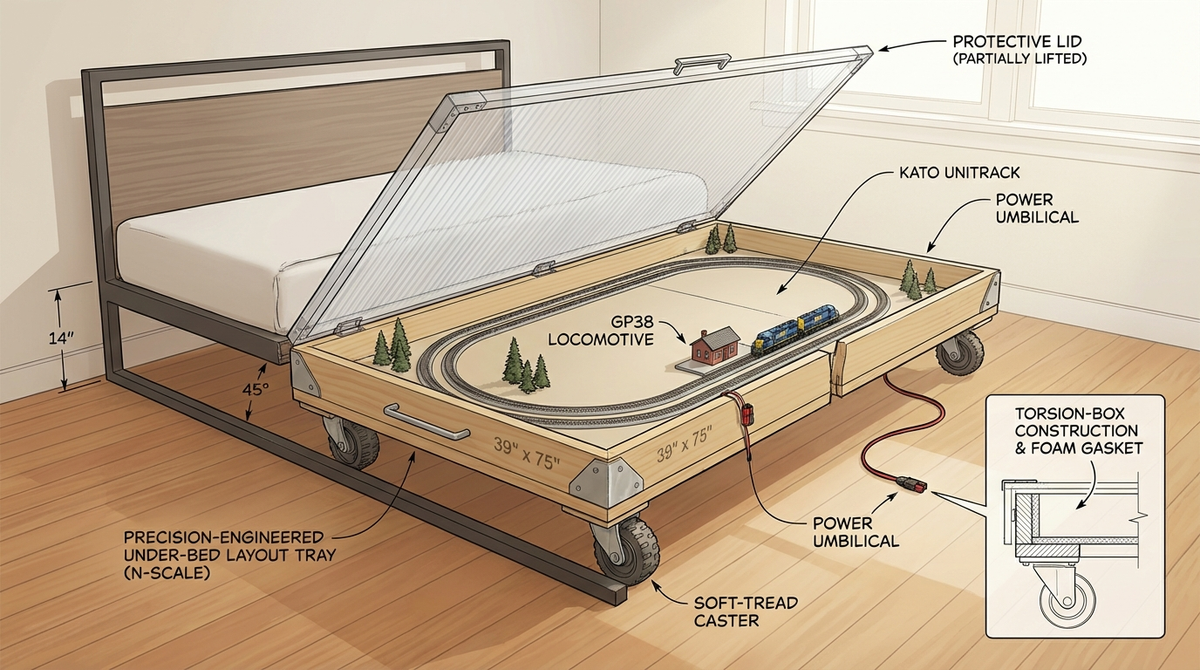
When my husband passed in 2008, I inherited not just his unfinished freight depot but also a problem I suspect many of you share: where on earth do you put a layout when your house wasn't built with one in mind? My workshop now occupies what used to be our dining room, and I've watched friends squeeze layouts into closets, attics, and yes, beneath their beds.
The space under a bed represents anywhere from 20 to 30 square feet of real estate most of us surrender to dust and forgotten shoe boxes. But reclaiming it for model railroading demands more than enthusiasm. You need engineering. I learned this the hard way watching a friend's HO switching layout warp because he treated it like a tabletop build instead of what it actually is: a precision instrument that moves.
Before you buy a single piece of track, grab a tape measure and get honest about your clearances. The advertised height of a bed frame rarely tells the whole story.
Standard metal platform beds typically offer around 13 to 14 inches of vertical clearance. That sounds generous until you realize your layout needs room to slide in and out without scraping. I recommend measuring from the floor to the lowest point of your frame, then subtracting a full inch for tolerance.
The Amazon Basics foldable platform advertises 13 inches of vertical clearance, which gives you workable room for N scale with scenery. But here's where things get tricky: if you have a trundle bed, you're dealing with a different animal entirely.
Pop-up steel trundle frames might lift to 17 inches when raised, but when lowered for storage, you're often looking at just 5 to 7 inches of internal space. That kills any hope of running HO and makes even N scale challenging.
Captain's beds with built-in drawers present an even bigger challenge. Those handsome Amish-built storage beds with their toe-kick bases leave you zero to three inches of clearance at best. If you own one, your under-bed layout dreams are dead on arrival unless you convert to a different frame.
Adjustable bed bases vary wildly. Some Tempur-Pedic models offer a minimum height of just 3.7 inches with their zero-clearance design, while maximum height can reach nearly 16 inches. Many adjustable beds for seniors come with removable legs, meaning you could potentially configure them to work, but you'll need to measure carefully with the bed in your preferred sleeping position.
Queen and King beds often have a center support bar running the length of the frame. This effectively bisects your available space into two narrower zones. For a continuous-run layout, you'll either need to work around this obstruction or choose a bed frame without center support, though that limits your options to smaller mattress sizes.
I've taught enough students over 34 years to know that ambition often outpaces geometry. The physics of curve radius will make or break your under-bed design.
For most under-bed builders, N scale (1:160) hits the geometric sweet spot. The minimum practical radius for N scale is around 9.75 inches. That means you can run a continuous oval on a Twin bed footprint (roughly 39 by 75 inches) with room to spare.
Kato publishes minimum turning radii for their locomotives and rolling stock. Four-axle diesels like the GP38 and 50-foot cars handle those 9.75-inch curves without complaint. Six-axle power and longer passenger equipment generally need 11-inch radius or more, so plan your fleet accordingly.
Can you build HO under a bed? Technically yes, but you're limited to switching operations. The minimum track radius for HO runs 18 to 22 inches for reliable operation. That's wider than most Twin beds and eats up enormous real estate on a Full.
If your heart is set on HO, think "shelf layout" rather than "oval." A point-to-point switching district with stub-end staging works beautifully in the long, narrow footprint under a bed. Just abandon any dreams of watching your train chase its tail around continuous loops.
For the truly space-constrained, Z scale (1:220) allows curves as tight as 195mm (about 7.7 inches). You can fit remarkable complexity into a shallow tray. The trade-off is cost, availability, and the reading glasses you'll need for detailing.
Here's where most under-bed projects fail. People build benchwork the same way they'd build a stationary tabletop layout, then wonder why their track kinks and their scenery cracks after a few months of sliding in and out.
A layout that moves must resist twisting. The solution is the torsion box, a structure that distributes stress across the entire panel rather than concentrating it at joints.
Model railroaders have adapted this technique from furniture making. The concept is straightforward: create a grid of internal supports sandwiched between two skins. The result can support substantial weight while remaining light enough to maneuver and, critically, flat enough to keep your track in gauge.
The Wood Whisperer explains the principle well: a torsion box is nothing more than a grid with a skin on both sides, creating a strong, light structure that resists warping and sagging.
The Spartanburg Subdivision project published in Trains Magazine established the "tray" design as the gold standard. Here's the approach I'd recommend based on that work:
The FOAMULAR product line includes several grades. For layout work, the 150 or 250 series provides adequate compressive strength without unnecessary weight.
Adhere the foam to the plywood using foam-compatible adhesive like Loctite PL300. Regular construction adhesive will eat through XPS, leaving you with a dissolved mess.
If you're not up for building a custom torsion tray, a hollow-core interior door provides similar stiffness with zero construction. The catch is fixed dimensions, typically 80 inches long, which may not match your bed frame. You'll also sacrifice the inverted-tray benefit of protected wiring underneath.
Your floor surface dictates your mobility strategy. Get this wrong and you'll either destroy your floors, ground out on carpet, or strain your back every time you want to run trains.
On smooth, hard surfaces, PTFE (Teflon) furniture sliders are the answer. They add roughly 0.24 inches (6mm) of height, which is negligible when you're counting every fraction of an inch.
PTFE has a coefficient of friction as low as 0.05, meaning a 25-pound layout requires just over a pound of force to move. I've used these on a friend's N scale layout in his hardwood-floored spare bedroom, and a child could slide it out.
Carpet changes everything. Rolling resistance increases dramatically on soft surfaces, and sliders will dig in rather than glide.
The solution is casters, but they come at a cost: even low-profile casters consume at least 2 inches of your vertical budget. Larger diameter wheels reduce rolling resistance (doubling diameter roughly halves the force required), so buy the biggest casters that still fit your clearance.
Häfele manufactures bed box casters specifically designed for under-bed applications. Their 35mm rigid caster is worth investigating if clearance is tight.
Ball transfer units allow movement in any direction, which sounds appealing until you realize they only work on perfectly clean, hard floors. One crumb jams the ball. Their rolling resistance runs 0.5 to 1.5% of the supported load, which is efficient, but the maintenance headache makes them impractical for most home applications.
A floor-level layout lives in the worst possible environment for cleanliness. Every footstep stirs particulates that settle on your track, gum up your locomotives, and dull your scenery. Dust control isn't optional; it's mandatory.
The goal is to create a sealed enclosure that keeps dust out while allowing the air inside to breathe enough to prevent condensation.
Start with a lightweight lid. Three-millimeter plywood or corrugated plastic (the stuff political yard signs are made from) works fine. The lid doesn't need to be structural; it just needs to seal.
For the seal itself, PORON microcellular urethane gaskets outperform ordinary foam tape. PORON has excellent compression set resistance (less than 2% at room temperature), meaning it bounces back after months of being compressed rather than taking a permanent set that breaks the seal.
Here's the counterintuitive part: you need ventilation. ePTFE (Gore-Tex) membrane vents allow air pressure to equalize while blocking particulates and liquid water. Without ventilation, temperature swings create condensation cycles that warp wood and rust rail.
Include silica gel packets inside your sealed enclosure. AGM's guide to silica gel desiccants explains the chemistry. Their desiccant unit calculator helps you determine how much you need based on your enclosure volume, roughly 1.2 units per cubic foot of air space.
Sectional track with integrated roadbed offers superior durability for mobile layouts. The roadbed protects rail joiners from lateral stress during extraction and hides feeder wires where they won't snag.
Kato Unitrack dominates mobile layout applications for good reason. The "Unijoiner" provides both mechanical and electrical connection in a single snap-fit piece. The wide roadbed profile protects wiring and point motors from damage.
For Z scale, Rokuhan track offers similar benefits. Their track system features stainless steel or nickel silver rail on a stable roadbed with integrated power feed points.
Peco Code 55 N scale flex track looks more realistic by burying the rail foot in the tie, but it requires careful installation and ballasting. Ballast can be brittle on a board that flexes during movement. If you use flex track on a mobile layout, bond it with flexible adhesive and expect to touch up loose ballast periodically.
Run a train across a hollow wooden box and you'll understand why soundproofing matters. The benchwork acts as a resonator, amplifying every wheel click into a rumble that defeats the realism you worked so hard to create.
Build your trackbed in layers:
Plastazote (cross-linked polyethylene foam) offers superior isolation if you can source it, though cork is more readily available at hobby shops.
PVA glue creates rigid sound bridges that transmit vibration directly into the baseboard. Use flexible latex adhesive instead. White glue is for structures; your track needs something with give.
Every time you slide that tray out, you stress every wire and connection. Standard wiring practices for fixed layouts will fail.
NMRA Technical Note 9 recommends 14 AWG stranded wire for main bus runs. Stranded wire resists breakage from repeated flexing far better than solid wire. The NMRA beginner's guide to adding power walks through the basics if you're new to layout wiring.
Anderson Powerpole connectors are the standard for modular and mobile layouts. They're rated for 10,000 cycles, feature a genderless design that simplifies assembly, and provide reliable connection even after years of use. The Free-mo standards document specifies Powerpoles for exactly these reasons.
Shelf Layouts for Model Railroads recommends consolidating all power and control connections into a single "umbilical" cable with proper strain relief. This prevents individual wires from snagging on bed legs or catching during extraction.
The cleanest solution is eliminating tethered throttles altogether. Digitrax's LNWI provides WiFi throttle capability, letting you control trains from your smartphone. DCC-EX running on an ESP32 microcontroller offers a more affordable open-source alternative with similar functionality.
When your ceiling is nine inches away, traditional scenery techniques need adaptation.
Scale Model Scenery's OO low-relief buildings run just one to two inches deep while providing full architectural detail on the visible facade. Scalescenes offers similar printable kits you can customize to fit your exact space requirements.
Metcalfe's low-relief timber-framed shop and similar card kits from Walthers Cornerstone give you building presence without consuming precious track-side real estate.
Trains Magazine's guide to forced perspective explains how placing smaller-scale structures in the background creates illusions of depth. Some modelers place N or Z scale buildings behind their primary-scale structures to suggest distant cityscapes or industrial districts.
Magnetic mounting for background buildings lets you remove scenic elements for storage or maintenance access. Velcro works too, though it's less elegant.
Your geometry dictates your fleet. Fight the curve radius and you'll spend more time rerailing cars than running trains.
The NMRA RP-7.1 clearance diagrams establish the standards. Standard S-8 covers track centers for reliable operation.
For N scale on 9.75-inch curves, stick to four-axle diesels and 50-foot cars. Six-axle power and 85-foot passenger cars want 11 inches or more.
NMRA RP-25 wheel contour specifies standards that improve tracking reliability. Metal wheelsets accumulate less gunk than plastic, which matters when your layout lives in a dusty environment despite your best sealing efforts.
If floor-level operation sounds miserable (and honestly, it is hard on aging knees), consider building modular segments stored under the bed but assembled on a table for operation.
T-TRAK standards for N scale specify modules just 70mm (2.75 inches) high. These fit easily in shallow trays, slide under any bed with reasonable clearance, and join together on a dining table when you want to run trains at a civilized height.
Dust management on stored layouts requires regular attention. A goat-hair brush and micro-vacuum handle most surface accumulation. For track cleaning, No-Ox-ID A-Special prevents oxidation while improving electrical contact.
The "Quarter Test" verifies your DCC wiring integrity. Short the rails with a coin; your circuit breaker should trip instantly. If it doesn't, you've got a wiring problem that needs attention before it becomes a fire hazard.
NEC code 400.12 prohibits running extension cords under rugs or furniture where they can overheat or suffer abrasion. Route your power connections where they won't be pinched or walked on.
NIOSH guidelines for lifting recommend at least 64mm of knuckle clearance for handles. If you're building handles into your tray, make sure you can actually grip them without scraping your fingers on the underside of the bed frame.
For a Twin-sized N scale tray (39 by 75 inches), here's what you're looking at:
| Component | Material | Estimated Cost | Weight |
|---|---|---|---|
| Frame | 1x4 Pine (Furniture Grade) | $40 | 8 lbs |
| Base | 1/4" Baltic Birch Plywood | $30 | 10 lbs |
| Core | 2" XPS Foam (FOAMULAR) | $35 | 2 lbs |
| Track | Kato Unitrack (Oval + Siding) | $150 | 3 lbs |
| Mobility | PTFE Sliders (Pack of 8) | $15 | Negligible |
| Total | ~$270 | ~23 lbs |
Twenty-three pounds is light enough for most people to lift onto a table if floor-level operation proves too uncomfortable. The foam core saves weight while the torsion-box construction maintains stiffness.
If you want automation, Arduino Nano boards fit within even the shallowest clearances and can drive servos, sensors, and lighting effects. The ESP32 DevKitC adds WiFi capability for wireless control integration.
NCE BD20 block detectors use current-sensing coils that require no direct track connection, saving space and simplifying wiring in tight quarters.
If you want to document your layout or create content, lighting becomes critical. Waveform Lighting's high-CRI LED strips provide studio-quality illumination. Their technical specifications detail the 95+ CRI rating that makes colors look accurate on camera.
Miniature action cameras mounted on flatcars allow immersive "cab ride" videos even when you can't fit your head into the scene.
The Spartanburg Subdivision proves the concept works. Built as a lightweight tray with proper torsion-box construction, it slides out smoothly, runs reliably, and tucks away when company comes.
On the other side, the Lionel O27 Twin-Bed attempt serves as a cautionary tale. The builder reported "never again" due to the excessive weight and physical strain of managing O-gauge equipment at floor level. O scale under a bed isn't impossible, but the weight and radius requirements make it impractical for most people.
Building under a bed isn't a compromise; it's a discipline. The constraints force you to think like an engineer rather than just a hobbyist. Every inch matters. Every ounce adds up. Every connection point is a potential failure when the layout moves.
But if you do it right, you've turned dead space into a working railroad. And there's something satisfying about that, about finding room for the hobby in a house that wasn't built with one in mind. My dining room became a workshop because I refused to let space limitations stop me from finishing my husband's freight depot. Your bedroom floor can become a mainline for the same reason.
Just measure twice. Build for movement. And remember: N scale is your friend when geometry turns hostile.
✨ Complete Your Layout: Explore our wide selection of Photo Real buildings, diorama backdrops, detail parts, and accessories in every popular scale.
✨ Unmatched Realism: From chrome detailing products to neon lighting kits – every piece is designed to make your miniature world come alive.